You can’t make this up:
Nasdaq’s price-to-BOOK ratio is now larger than Chinese stocks’ price-to-EARNINGS multiple.
AI will revolutionize the world, but it will unlikely alter the fact that the economy goes through business cycles and inflated valuations ultimately deflate.
H/t @dailychartbook
Early in my career, Stan Druckenmiller told me that the best way to understand an industry is to look at every company in it. I’ve found that this (mostly) works for people too. To understand people, read everything they’ve published, and listen to every talk they’ve given. It’s very much a bottoms-up approach to forming a top-down view.
This method can work for anyone—I’ve learnt about investing styles, asset classes, industries, and more using this method. Many of my friends expressed interest in doing the same, but the unfortunate reality is that most people don’t have the time or willingness to seek out and read this volume of material. So I started sharing individual memos and speeches with friends to help out. That evolved into the newsletter you are reading.
A Letter a Day is both a tasting menu and a launchpad. You can expect a letter from a different IFO each edition, which will help you learn more about individual IFOs, but also (I hope) serve as an inspiration to dig deeper into IFOs that resonate with you.
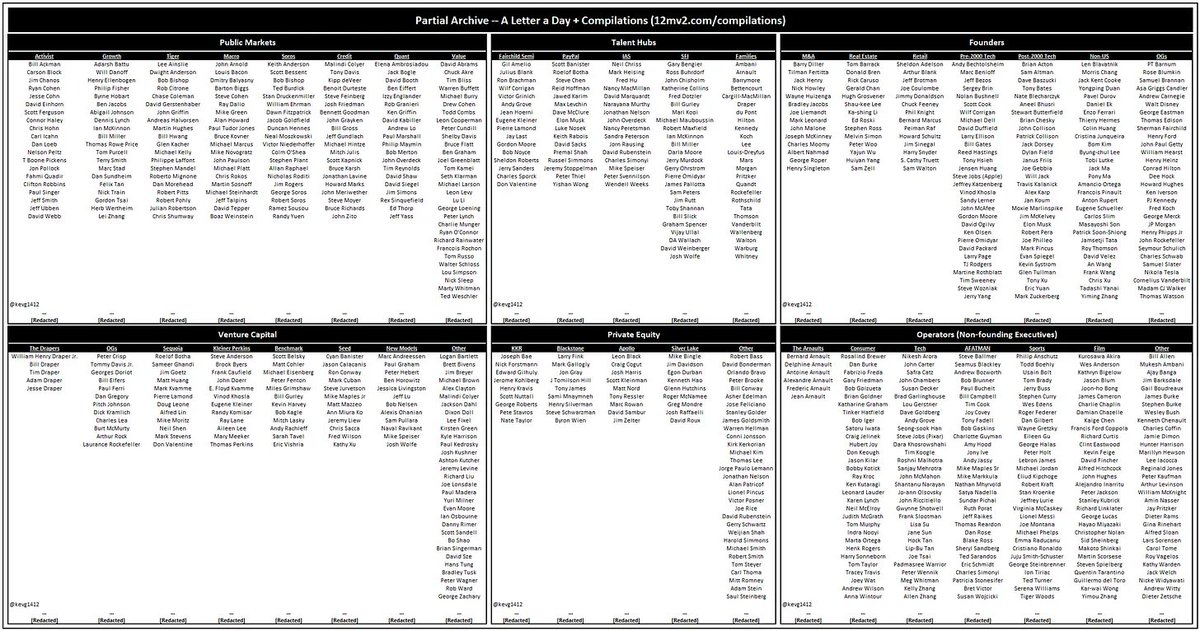
Without further ado, below is a partial archive (full thing is ~3x), roughly categorized, of some of the IFOs you can expect to hear from in this newsletter.
@JRogrow@HarrisOakmark Tax and transaction frictions must account for something. 7% dividend payer is definitely worse than a 7% compounder - difference over 10 years could be massive.
Here's what Buffett says about LTCM:
The whole Long Term Capital Management – I hope most of you are familiar with it – the whole story is really fascinating because if you take John Meriwether, Eric Rosenfeld, Larry Hillenbrand, Greg Hawkins, Victor Haghani, the two Nobel prize winners Merton Scholes… If you take the 16 of them, they probably have as high an average IQ as any 16 people working together in one business in the country, including Microsoft or where ever you want to name. So an incredible amount of intellect in that room. Now you combine that with the fact that those 16 had had extensive experience in the field they were operating in. These were not a bunch of guys who had made their money, you know, selling men’s clothing and all of a sudden went into the securities business. They had in aggregate, the 16, probably had 350 or 400 years of experience doing exactly what they were doing. And then you throw in the third factor that most of them had virtually all their very substantial net worths in the business. So they had their own money up. Hundreds and hundreds of millions of dollars of their own money up, super high intellect, working in a field they knew, and essentially they went broke. That to me is absolutely fascinating.
If I ever write a book it will be called “Why Smart People Do Dumb Things”. My partner says it should be autobiographical. But this might be an interesting illustration. These are perfectly decent guys. I respect them and they helped me out when I had problems at Salomon. They are not bad people at all.
But to make money they didn’t have and didn’t need, they risked what they did have and did need. That is foolish. That is just plain foolish. It doesn’t make any difference what your IQ is. If you risk something that is important to you for something that is unimportant to you it just does not make any sense. I don’t care whether the odds are 100 to 1 that you succeed or 1000 to 1 that you succeed. If you hand me a gun with a million chambers in it, and there’s one bullet in a chamber and you said, “Put it up to your temple. How much do want to be paid to pull it once,” I’m not going to pull it. You can name any sum you want, but it doesn’t do anything for me on the upside and I think the downside is fairly clear. So I’m not interested in that kind of a game. Yet people do it financially without thinking about it very much.
@TDM_Growth@Nasdaq Other benefits of ASX (for the short termist so perhaps less relevant):
- Capitalise software R&D on ASX
- Ability to sell significantly more equity on ASX upfront (up to 50-70%) vs US (10-20%)
Benefit of US for founder-led company with significant equity is dual class shares
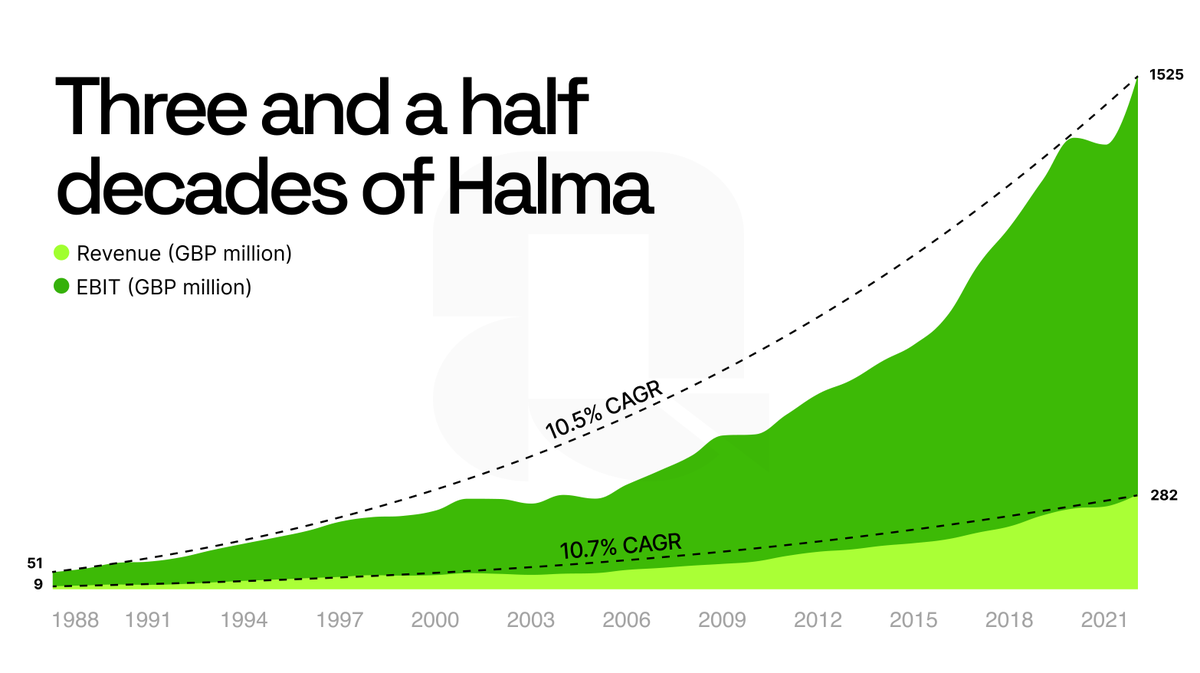
Are you familiar with $HLMA? This British serial acquirer has been an incredible long-term performer, returning 100,000%+ (excl. dividends) since 1988.
→ In 1997, David Barber, Halma's co-founder, long-term CEO and at that time Chairman, gave a speech describing the group's success recipe; the combination of a strategic long-term vision and a steady purpose.
"lt won't surprise you to learn that at Halma we choose the long term view, aiming from the start to build slowly and carefully"
Halma is run on those same principles to this day.
→ For almost 35 years, Halma has compounded its top and bottom line like clockwork at a steady 10-11% pace, keeping its EBIT margin consistently above 15% and closer to 20%.
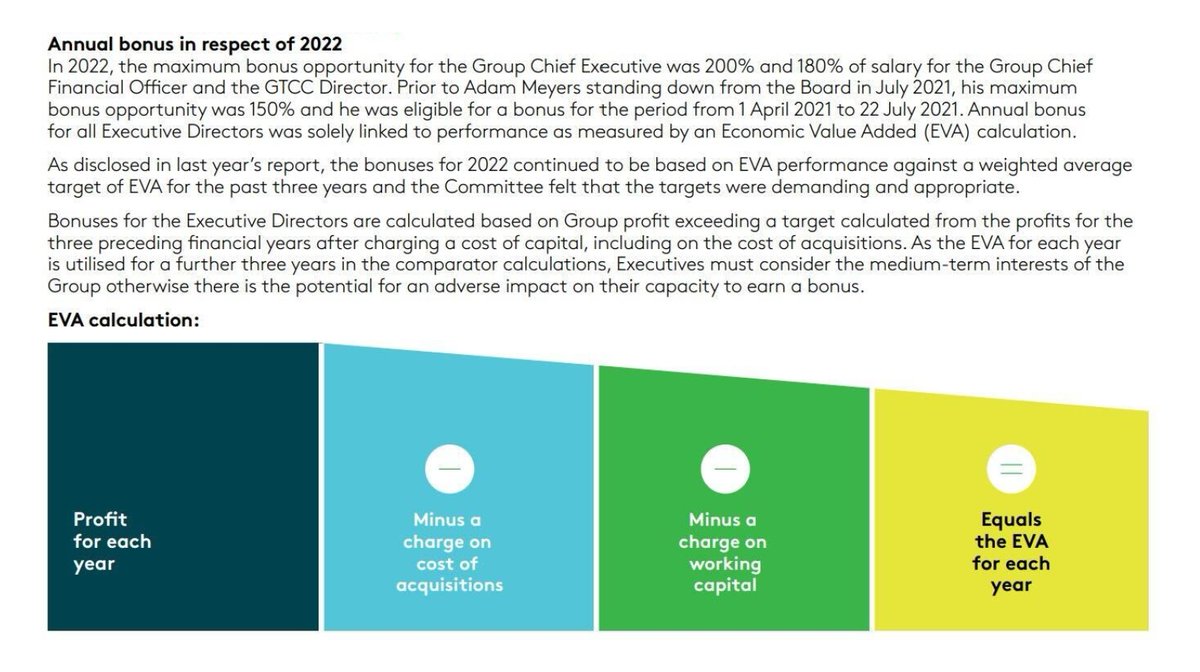
One thing that really stands out with Halma is their unique compensation framework (image #4), called "Economic Value Added". Kudos to @TMTMoats who recently shared it.