@tallsnail I took my daughter to see the Starship launch last week in TX. During the day we visited a sea turtle sanctuary and saw dolphins on a boat tour.
On the flight back home I asked what her favorite part was. She said it was the hotel pool.
We have a pool at home.
Sanctions hurt people, not dictators. Right? Wrong! This book by @miguelsantos12@JoseMoralesA and @zp2903 carefully looks at Venezuela and tells a much more interesting story: the sanctions forced the dictator to reduce their damaging command and control destructive measures. Read this 🧵!
Introducing USVC - a single basket of high-growth venture capital, for everyone.
No accreditation required, SEC-registered, and a very low $500 minimum.
Includes OpenAI, Anthropic, xAI, Sierra, Crusoe, Legora, and Vercel. As USVC adds more companies, investors will own a piece of that too.
Liquidity typically comes when companies exit, but we’re aiming to let investors redeem up to 5% of the fund every quarter. This isn’t guaranteed, but if we can make it work, you won’t be locked up like in a traditional venture fund.
It runs on AngelList, which already supports $125 billion of investor capital.
And I’ve joined USVC as the Chairman of its Investment Committee.
—
Go back to the 1500s, you set sail for the new world to find tons of gold - that was adventure capital.
Early-stage technology is the modern version. It says we are going to create something new, and it’s risky. It’s daring.
But ordinary people can’t invest until it’s old, until it’s no longer interesting, until everybody has access to it. By the time a stock IPOs, most of the alpha is gone. The adventure is gone. Public market investors are literally last in line.
This problem has become farcical in the last decade. Startups are reaching trillion dollar valuations in the private markets while ordinary investors have their noses up to the glass, wondering when they’ll be let in.
Investing in private markets isn’t easy. You need feet on the ground. You need judgment built over years. Most people don’t have the patience to wait ten or twenty years for an investment to come to fruition.
But there is no more productive, harder-working way to deploy a dollar than in true venture capital.
USVC enables you to invest in venture capital in a broad, accessible, professionally-managed way, through a single basket of innovation, focused on high-growth startups, at all stages.
It is how you bet on the future of tech: the smartest young people in the world, working insane hours, leveraged to the max, with code, hardware, capital, media, and community. Your dollar doesn’t work harder anywhere.
There is an old line - in the future, either you are telling a computer what to do, or a computer is telling you what to do. You don’t want to be on the wrong side of that transaction.
USVC lets you buy the future, but you buy it now. Then you wait, and if you are right, you get paid.
Get access here:
https://t.co/pAj1sqUsG0
Announcing my new thing:
I'm launching a new public venture fund
USVC is built by AngelList with @naval shaping our investment strategy in the technology companies building our future
And unlike traditional venture funds, everyone can invest along with just $500:
In 1993, the New York Times published an article criticising Federico Fellini and some other foreign language films for being "hard work". MARTIN SCORSESE sent this incredible letter in response.
Of course that's your contention. You're a first-time SaaS bear. You just got finished listening to some podcast, Dario on Dwarkesh, probably. Now you think it’s the end of white collar work and seat-based pricing is screwed. You're gonna be convinced of that til tomorrow when you get to “Something Big is Happening”. Then you’ll install ClawdBot on a Mac Mini, vibe code a dashboard on top of a postgres database and say we’re all just a couple ralph loops away from building a Salesforce competitor. That’s gonna last until next week when you discover context graphs, and then you're gonna be talking about how the systems of record will be disintermediated by an agentic layer and reposting OAI marketing graphics.
“Well, as a matter of fact, I won't, because ultimately the application layer is just ….”
The application layer is just business logic on top a CRUD database. You got that from Satya’s appearance on the BG2 pod, December 2024, right? Yeah, I saw that too. Were you gonna plagiarize the whole thing for us? Do you have any thoughts of your own on this matter? Or...is that your thing? You get into the replies of anyone posting a SaaS ticker. You watch some podcast and then pawn it off as your own idea just to impress some VCs and embarrass some anon who’s long SaaS? See the sad thing about a guy like you is in a couple years you're gonna start doing some thinking on your own and you're gonna come up with the fact that there are two certainties in life. One: don't do that. And two: you dropped thirty grand on Mac Minis and LLM API calls to come to the same conclusion you could’ve got for free by following a handful of VC accounts.
We are hiring an AI Lead at @svangel! It's an amazing opportunity for a builder passionate about AI and startups. Come build with us!
Apply here:
https://t.co/eAYG5jROfj
I spent last night with Andrew Strominger and Alex Lupsasca, two of the top physicists in the world
They just released a paper, co-authored with OpenAi, that seems to me like ASI
Andrew, who helped develop string theory, told me that a year ago, his view was that he didn’t know how helpful AI was going to be.
A year later, after some back and forth with GPT 5.2 pro, they submitted a final query to an internal model which solved AND proved a previously unsolved problem in quantum field theory…in 12 hours.
A model, doing something two of the smartest people in the world in their field couldn’t do. And, when I was with them, they were giddy with excitement for what might lay ahead.
Andy said “It is the first time I’ve seen AI solve a problem in my kind of theoretical physics that might not have been solvable by humans.”
They said, “two things changed: the model improved and we figured out how to talk to it.”
Andy also told me “I also now feel that with the recent advances, most physicists who want to keep up with the frontiers of progress will need to learn how to talk to it. That wasn’t true a year ago.”
ASI is here, just not evenly distributed.
As a Venezuelan, these last few days have been a rollercoaster of happiness, frustration, and sadness. On the day I thought would be the most important for my life and my country, I find myself struggling to make people understand that our reality isn’t an internet slogan.
It has left me completely broken to see that the fall of the criminal dictator who destroyed my family, my friends, and my country was not universally celebrated. What I found instead has left me with a profound sense of emptiness:
What I have seen confirms something I have felt for a long time. Nuanced thought has practically vanished. There is no longer a common ground where we can reason with any depth. We are so consumed by radical narratives that we have reduced complex, painful realities into simplified versions that feel comfortable to us.
Today, people react before they even try to understand. They take a stand based on their hatred of a figure or an ideology first, and only then do they look for a way to justify it. The question is no longer about what actually protects human life, but rather who is saying it and which side they belong to.
Moral analysis has been replaced by political identity.
Fewer and fewer people bother to learn from direct sources or real communities. Very few take the time to actually talk to those living the realities they criticize from afar. Instead, we consume fragments of information filtered by social media and algorithms designed to reinforce what we already believe, all seen through the lens of privilege.
We have reached a point where trying to understand nuance feels dangerous. Defending something objectively good is seen as a betrayal if the person doing it is on the "wrong side." Many people now reject actions that relieve human suffering simply because acknowledging them would mean agreeing with someone they have decided to hate.
Ideology has been placed above reality.
We are reducing entire countries and cultures to Instagram posts and slogans shared without context. People are taking to the streets to defend realities they have never experienced and pains they have never had to carry, convinced that a narrative learned online is enough to speak for others. We have never been so technologically connected while being so humanly disconnected.
Being right has become a priority over listening.
What disappoints me most is seeing how human rights fall below personal or political interests. People aren't thinking from a place of reason or shared humanity; they are completely rooted in extremes. I only ask for a little respect and compassion for those of us who have suffered through 30 years of dictatorship.
Please, listen to the voices that have been silenced for so long.
This image looks grim to us, but when Terence Cuneo painted it in 1947 it was a picture of progress. In fact it was commissioned by Ford, whose factory it portrays.
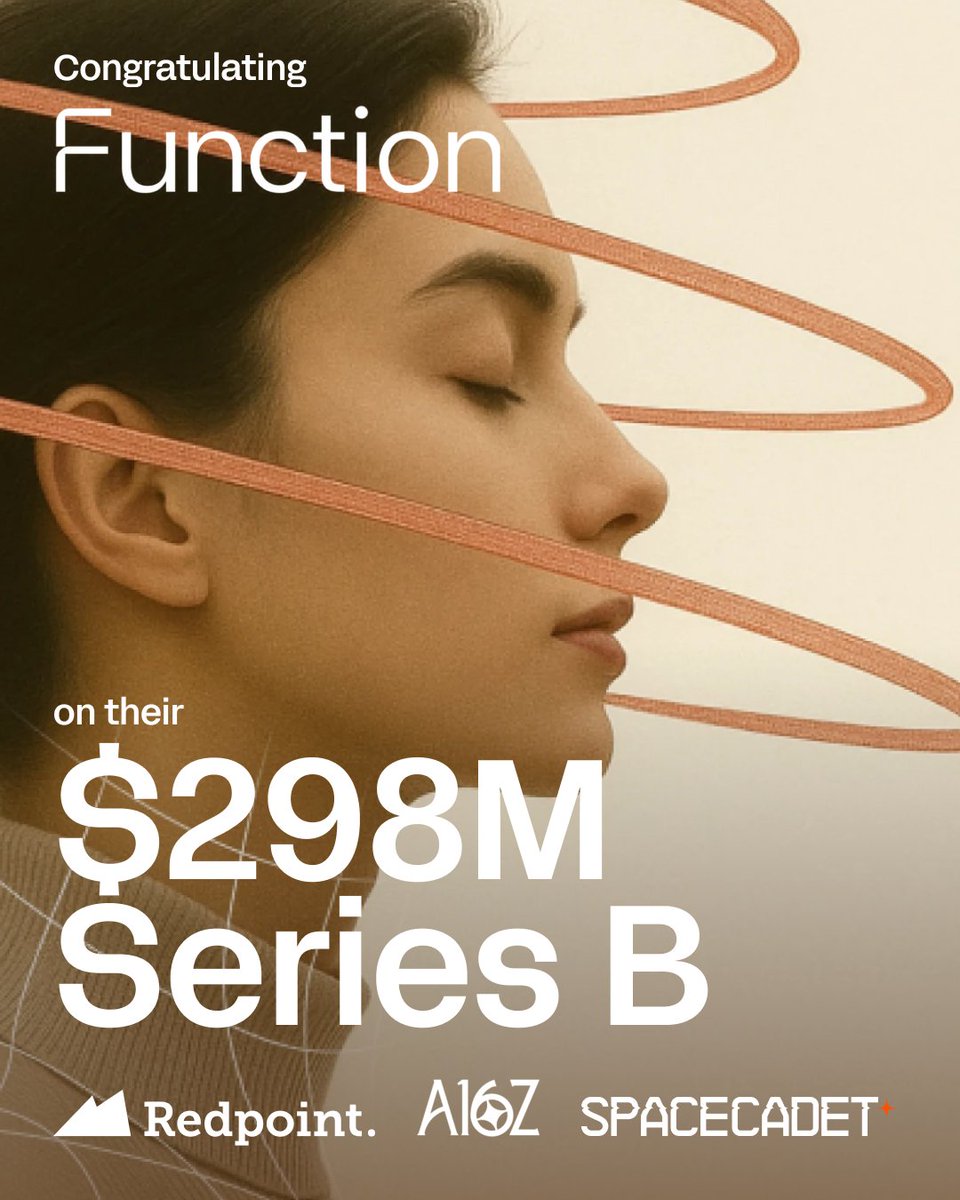
In case you missed it, @Function just announced a $298M Series B at a $2.5B valuation from Redpoint, a16z, Spacecadet, and many others. Huge congrats to @swerdlin, @drmarkhyman, @pranithapat, and the entire Function team for building what is quickly becoming the operating system for human health.
I couldn’t be more proud or more grateful to be one of the earliest investors. The most rewarding part is having a front row seat to the impact Function is having on hundreds of thousands of people in the US, and soon, millions around the world.
America spends ~2x more per capita on healthcare than Canada (my home country) and yet we have substantially worse outcomes and higher rates of disease. The biggest problem that plagues healthcare in America is that we’re far too reactive and not preventative enough. For most Americans, their first interaction with the healthcare system is a hospital visit, which is expensive and means the person waited far too long.
By pushing healthcare from reactive to truly preventative, Function has a chance to rewrite how we care for people around the world, and, if they succeed, to become one of the most valuable companies on the planet 👨🚀