What’s your organisation’s superpower? If your people and their commitment to #CX isn’t part of the answer, it’s time to rethink: https://t.co/eue2hLGkqE #innovation#4IR
Last week at Pioneer, Des Traynor spoke about what AI is doing to software, and how we shape our tools, and then our tools end up shaping us.
Software has always forced a choice: do you make the tool simple enough for anyone to start, or powerful enough to actually be worth using?
Now, with AI you just say what you want, like "fix my worst-performing CSAT queries", and it works out the rest. No menus, training, or learning where things live.
What changes after that is roles, then org charts, then entire companies.
Watch Des’s full keynote, and every session from Pioneer 2026 at the link below ↓
Fin 4 brings major upgrades to every part of the Fin system: a more capable Customer Agent, a more powerful Operator, and new ways for Fin to work with your team.
AI capability accelerated sharply in 2026, and we’re seeing three big changes in Agent capability. Agents are getting more autonomous, more proactive, and more directive.
The path to a fully agentic customer experience – 90-95% of customer communication without a human, at any size of business – is now clear. It’s a matter of when, not if, and the last barrier will be organizational rather than technological.
Read the full announcement via the link in the replies.
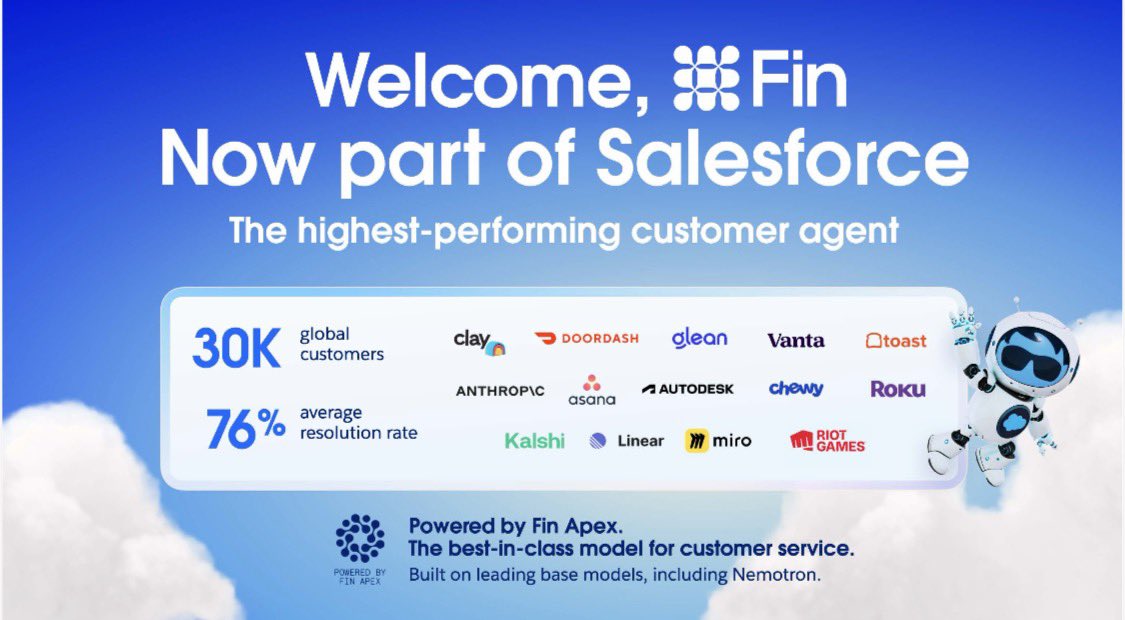
Today Fin officially joins @Salesforce.
It’s a huge moment for us. Fin was the very first AI Agent for CX and started an entirely new category. Today Fin is the highest performing Customer Agent on the market, running on our custom AI models trained specifically for CX, and resolving over 2 million customer issues every week.
Thank you to our customers, teammates, partners, and supporters who’ve been a huge part of our journey so far. Now with Salesforce, Fin will make perfect customer experiences possible for millions more people.
You can read the full press release here. https://t.co/Ff9FXiFhik
Slackbot just leveled up. 🤖 ✨
Amy Bauer, Senior Director of Product Management, shares Big Mode: a dedicated surface for scaling your workflows, deeper research, analysis, and automation.
Slackbot does the heavy lifting so you can focus on the work that only you can do.
@rwang0@united Yip. Happened twice over the last few weeks. Something is amiss for sure. Business travel seems to be booming for the airlines. Just have to have to take a breath.
Learn 99% of ChatGPT Work in 61 minutes:
GPT Work is like Codex in the cloud.
It works on phone, web, and desktop.
And I've been using it to run my business.
These are the 14 knowledge work capabilities.
00:00 Intro
03:18 #1 Presentations
09:16 #2 Plugins
17:36 #3 Blocks
23:34 #4 Websites & Apps & Hosting
30:09 #6 Branching Chats
31:51 #7 Desktop App (Cloud vs Local)
37:01 #8 Voice Mode
41:36 #9 Remote Voice Mode
45:52 #10 In-App Browser
48:50 #11 Skills
51:45 #12 Scheduled Automations
54:37 #13 Spreadsheets
56:58 #14 Multi-Agent Workspace
59:19 Final Review
For the last 40 years we used desktop productivity apps (yes, the spreadsheet is ~40 years old) on our PC's. I'm now calling this era, "Pre-Codex". Now in the Post-Codex world we teach the tools to serve us and not the other way round...long live the PC :)
Show Codex a workflow once. Reuse it as a skill.
Record & Replay lets you show Codex a recurring task, like filing an expense report or submitting a time-off request.
Codex turns that demo into an inspectable, editable skill.
You control when recording starts and stops.
Introducing GPT-Realtime-2 in the API: our most intelligent voice model yet, bringing GPT-5-class reasoning to voice agents.
Voice agents are now real-time collaborators that can listen, reason, and solve complex problems as conversations unfold.
Now available in the API alongside streaming models GPT-Realtime-Translate and GPT-Realtime-Whisper — a new set of audio capabilities for the next generation of voice interfaces.
It’s time to demystify Mythos.
Mythos is not magic. It’s not a doomsday device. It’s the first of many models that can automate cyber tasks (just like coding).
OpenAI’s GPT-5.5-cyber can now do the same. And all the frontier models (including those from China) will be there within approximately 6 months.
It’s important to recognize that these models do not create vulnerabilities; they discover them. The bugs are already in the code. Using AI to discover and patch them will actually harden these systems.
The leap from pre-AI cyber to post-AI cyber means that there will be a big upgrade cycle. After that, however, the market is likely to reach a new equilibrium between AI-powered cyber-offense and AI-powered cyber-defense.
Obviously it’s important that cyber defenders get access before cyber attackers. That process is already underway but needs to happen quickly (see point above about Chinese models).
Unlike Mythos, GPT-5.5-cyber appears not to be token constrained so it may be the first cyber model that defenders actually get to use.
we're starting rollout of GPT-5.5-Cyber, a frontier cybersecurity model, to critical cyber defenders in the next few days.
we will work with the entire ecosystem and the government to figure out trusted access for cyber; we want to rapidly help secure companies/infrastructure.
Had meetings and a dinner with 20+ enterprise AI and IT leaders today. Lots of interesting conversations around the state of AI in large enterprises, especially regulated businesses.
Here are some of general trends:
* Agents are clearly the big thing. Enterprises moving from talking about chatbots to agents, though we’re still very early. Coding is still the dominant agentic use-case being adopted thus far, with other categories of across knowledge work starting to emerge. Lots of agentic work moving from pilots and PoCs into production, and some enterprises had lots of active live use-cases.
* Agentic use-cases span every part of a business, from back office operations to client facing experiences from sales to customer onboarding workflows. General feeling is that agentic workflows will hit every part of an organization, often with biggest focus on delivering better for customers, getting better insights and intelligence from data and documents, speeding up high ROI workflows with agents, and so on. Very limited discussion on pure cost cutting.
* Data and AI governance still remain core challenges. Getting data and content into a spot that agents can securely and easily operate on remains a huge task for more organizations. Years of data management fragmentation that wasn’t a problem now is an issue for enterprises looking to adopt agents. And governing what agents can do with data in a workflow still a major topic.
* Identity emerging as a big topic. Can the agent have access to everything you have? In a world of dozens of agents working on behalf, potentially too much data exposure and scope for the agents. How do we manage agents with partitioned level of access to your information?
* Lots of emerging questions on how we will budget for tokens across use-cases and teams. Companies don’t want to constrain use-cases, but equally need to be mindful of ultimate token budgets. This is going to become a bigger part of OpEx over time, and probably won’t make sense to be considered an IT budget anymore. Likely needs to be factored into the rest of operating expenses.
* Interoperability is key. Every enterprise is deploying multiple AI systems right now, and it’s unlikely that there’s going to be a single platform to rule them all. Customers are getting savvier on how to handle agent interoperability, and this will be one of the biggest drivers of an AI stack going forward.
Lots more takeaways than just this, but needless to say the momentum is building but equally enterprises are acutely aware of the change management and work ahead. Lots of opportunity right now.