"This case is a litmus test for global justice. If the highest court in the world can be ignored with impunity, the entire post-WWII legal architecture collapses into irrelevance. South Africa is refusing to let that happen without a fight, leveraging its own historic legacy against institutionalized oppression to demand systemic fairness."
Nepal runs on 98% clean electricity.
It's #2 in the world for EV market share.
It produces less than 0.1% of global emissions.
It has also lost nearly a third of its ice in 30 years, and could lose 7% of its GDP by 2050.
Nepal did everything the world asked of it. It's being billed for what everyone else refused to do.
This isn't a plea for aid. It's an unpaid debt.
"The world has visited many terrible things on the Palestinian people, none more shameful than robbing them of their basic humanity" - Anthony Bourdain on the dehumanizing coverage of Palestinians 🇵🇸 in the media.
Il viendra un jour où les hommes connaîtront l'âme des animaux et tuer un animal sera considéré comme un crime, comme de tuer un être humain.
Ce jour-là, la civilisation aura avancé.
Léonard de Vinci
The beautiful people of Nepal consume fewer resources than almost anyone on Earth, are known for their extraordinary generosity, and do not deserve to die from a climate crisis driven by wealthy nations that refuse to end wars or rein in their relentless overconsumption.
There’s a Nepalese man on the news crying because he has lost his family in these terrible floods.
He says the floods were 10 times worse than even the worst floods they’ve ever seen.
I know people get irritated with people like me going on about climate change, but these are the stakes.
A lot of people are going to die, potentially millions, at worst billions.
I just can’t understand why the media and politicians cannot reflect what the scientists are telling us about the urgency of this moment.
L'Art nouveau est une véritable merveille quand on y pense.
Jetez un œil à ces portes conçues par Ernest Blerot.
Il était l'un des architectes Art nouveau les plus prolifiques de Bruxelles à son époque.
Do you feel it?
In late 19th-century Paris, while concert halls demanded massive orchestral sound and technical speed, Erik Satie took a radically different path. They made fun of him. They tried to ignore him.
Working as a pianist in the cabarets of Montmartre, he composed Gymnopédie No. 1 in 1888—a work that stripped Western classical music to its barest essentials.
The piece operates on a deliberate paradox. Though peaceful on the surface, Satie marked it lento e doloroso (slowly and painfully).
That underlying melancholy prevents the music from becoming purely decorative, giving every suspended chord weight and quiet gravity.
Watching it played, you see the thought and weight put into each simple note as it pulls on something inside you.
To many it is not to make you feel good but to feel. And in this is something shared. Perhaps a rainy-day memory.
In this 1966 broadcast, French pianist Jacques Février demonstrates the strict discipline Satie’s music requires. Chosen by Maurice Ravel and Francis Poulenc to premiere their works, he understood that performing Satie demands utter emotional restraint, letting the space between the notes carry the composition’s weight.
By removing resolving harmonies and traditional momentum, Satie laid the groundwork for modern minimalism and ambient music nearly a century before either genre had a name.
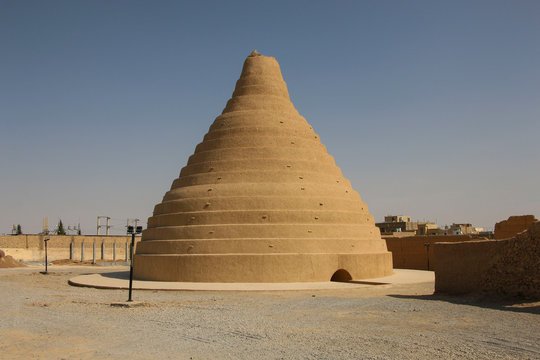
More than 2,400 years ago, Persian engineers solved a problem that wouldn't be solved again until the 19th century: how to make ice in the middle of the desert and keep it through a summer that regularly hits 40 degrees Celsius.
The structure they built is called a yakhchal. It translates, roughly, as "ice pit." The name undersells it.
From the outside, a yakhchal looks like a massive mud-brick dome, anywhere from 10 to 15 metres high, rising out of the flat desert floor. The geometry was deliberate. The dome's steep angle minimized the surface area exposed to direct sunlight. The thick walls, mixed with a waterproof mortar called sarooj, made from clay, sand, egg whites, goat hair, and ash, were nearly impermeable to heat. Engineers had worked out an effective insulating compound without knowing the word "insulation."
Below ground was the real machinery: a deep storage chamber, sometimes large enough to hold several tons of ice, carved into the earth where temperatures stayed stable even in the peak of summer.
But the yakhchal didn't just store ice. It also made it.
In winter, workers diverted water from nearby qanats, the underground irrigation channels that were themselves one of antiquity's great engineering achievements, into shallow pools beside the structure. The desert night sky, in an arid climate with little humidity, radiates heat into space with unusual efficiency. On cold clear nights, even when air temperatures barely dipped below freezing, the shallow water lost enough heat to the sky that it froze.
That ice was cut, carried into the underground chamber, and packed with insulating material.
Shading walls, often running east to west, protected the pools and the structure's north-facing entrance from direct sun throughout the day. The entire complex was oriented around shadow.
By the time summer arrived, the yakhchal held a reserve that could supply chilled drinks and chilled food to royal courts and urban markets for months. Faloodeh, a chilled dessert made with frozen rose water and starch, was served from yakhchal ice. So were chilled drinks offered to Persian nobles during audiences that would have been, without this system, simply intolerable.
Roughly 100 to 150 yakhchals survive in Iran today, mostly in the arid central and eastern regions around Yazd and Kerman. They are still standing. The sarooj mortar has outlasted most of what the modern world has built in the same interval.
The Achaemenid Empire, which commissioned many of these structures, fell to Alexander in 330 BCE. The yakhchals kept working anyway.
No electricity. No refrigerant. No moving parts.
Just geometry, the right mortar, and a precise understanding of how a desert sky loses heat on a winter night.
The sarooj mortar formula, clay, sand, egg whites, goat hair, ash, has survived long enough that modern materials scientists have studied it. Some of them came away genuinely impressed by the impermeability.
#drthehistories
A Scottish laird threw his sheep onto a beach in 1832 and left them to starve. They are still down there, still eating, and they have since evolved so far into the job that a green field would now poison them.
North Ronaldsay is the last island in Orkney before there is nothing. Three miles long, flat as a table, and windier than is strictly reasonable. The laird wanted the middle of it for cattle and crops, so out went the natives to the shore, which is a decision that reads perfectly well in an estate office and looks somewhat different when you are standing on shingle in February.
To keep them there, the islanders built a drystone dyke round the entire circumference of the island. Thirteen miles, six feet high, laid by hand, no mortar, still standing. It is a Grade A listed structure, so a wall put up to inconvenience sheep now enjoys the same legal protection as Edinburgh Castle.
Nobody expected the flock to make old bones.
They took up kelp.
There are two land mammals on this planet that live on seaweed. One is the marine iguana of the Galápagos, which has never been more than about nine feet from a film crew. The other is a small brown sheep in Orkney that nobody has heard of, working a beach in the dark.
And they did not just get by. They reorganised their entire lives around the tide. They sleep through high water and rise for the ebb, which is two hundred years of tide table written into an animal with no clock and no reason to care. Winter storms tear the kelp off the seabed and dump it up the shore, so while every other flock in Britain is going backwards on hay, the beach sheep are gaining condition in January on a crop nobody planted, watered, ploughed, sprayed or paid a penny for.
Seaweed carries almost no copper. So they evolved to hoover up every atom of it going, and that machinery has no off switch. Put one on ordinary pasture and it keeps taking copper on board at beach rates until the liver packs in. They are the most copper-sensitive mammals known to science, and a field of good Orkney grass is, to a North Ronaldsay, a slow poisoning with a lovely view.
Which leaves the arrangement completely inside out.
The wall was built to keep the sheep off the good ground.
The wall is the only thing keeping them alive.
About 2,500 of them, owned communally by a dozen or so islanders, descended from animals that were on that shore before the Vikings arrived and formed opinions about it. Every winter knocks a few more sections of dyke down. Every summer a handful of people put a few back up. Only one of those lines is heading the right way.
The kelp industry the wall was built to replace collapsed and is gone. The laird is gone. The crops are gone. Most of the islanders are gone.
The sheep he sentenced to death are out there tonight, waiting on the tide, farming the only ground in Britain that gets delivered twice a day by the sea.
“You do not have to be good.
You do not have to walk on your knees
for a hundred miles through the desert, repenting.
You only have to let the soft animal of your body
love what it loves.
Tell me about despair, yours, and I will tell you mine.
Meanwhile the world goes on.
Meanwhile the sun and the clear pebbles of the rain
are moving across the landscapes,
over the prairies and the deep trees,
the mountains and the rivers.
Meanwhile the wild geese, high in the clean blue air,
are heading home again.
Whoever you are, no matter how lonely,
the world offers itself to your imagination,
calls to you like the wild geese, harsh and exciting –
over and over announcing your place
in the family of things.”
― Mary Oliver
About 5000 years ago, a family sat beside a stone hearth in Orkney and arranged their belongings on a stone dresser. The dresser is still there. The hearth is still there. The stones they shaped with their hands are still fitted together, dry-laid without mortar, without cracking, after fifty centuries of Orkney winters. Skara Brae is the oldest surviving domestic settlement in northern Europe, and almost nothing about it has decayed. It is not ruins. It is a home.
The village was buried in a sandstorm around 2500 BCE and stayed buried until a violent storm in 1850 stripped the dunes back and revealed it to an astonished farmer. What the excavations uncovered over the following decades was almost impossible to credit: eight interconnected stone houses, linked by covered passages, each with its own hearth, storage alcoves, box beds defined by stone slabs, and a shelved dresser facing the entrance. Whoever lived here arranged their space with taste and care. They had privacy. They had community. They had, in the stone dresser placed where a modern family might put a television, something they wanted to see the moment they walked in the door.
No one knows exactly who built Skara Brae, what language they spoke, or where they went. We know they built their homes together, shared resources through the connecting passages, and lived here continuously for about 600 years. Older than the Egyptian pyramids. Older than Stonehenge. Built by people whose names we will never know on an island at the edge of the world. The oldest thing about Scotland is not a castle or a clan. It is a hearth, and it is waiting in Orkney.
#drthehistories