New paper draft: On Cheap Artificial Consciousness. When investigating AI consciousness, it's natural to look at what theories of consciousness tell us. Problem: you can build simple systems that meet their conditions. So, what should we say? A thread.
How did humans manage to control and create materials on nanometer scale and are now pushing beyond this, scales so far beyond what we can see with our own eyes?
In a nutshell it all started with lenses, and each time we managed to see something new, we developed a better understanding of the physics and managed to create an even more powerful "lens". From light microscopes we went to electron microscopes and eventually to particle accelerators. EUV lithography is basically a sophisticated spin-off of this.
It's been a virtuous cycle in which new scientific insights led to new technologies which led to new scientific insights.
But sometime around 30 years ago, this cycle broke. There haven't been any further scientific insights into the nature of physics at short scales. There haven't been any breakthrough technologies to push towards smaller scales. This is why, to make a long story short, particle accelerators are now just getting bigger and bigger.
Don't get me wrong, we can, and almost certainly will, minituarize electronics further, beyond nanometer scales. Yes, maybe high-T superconductors or wakefield acceleration can turn around things for particle colliders, at least for now.
But there's a bigger open question here, which is whether we've exceeded (or near exceeded) the scales for useful technologies, period.
This, ultimately, is the reason why the foundations of physics have been drifting off to lala-land. Because they're now almost decoupled from technological progress. There's nothing you can do with particles that decay in femtoseconds.
And this is why I've been saying that the next frontier in the foundations of physics isn't shorter distances but larger quantum systems. /end random thoughts
https://t.co/Txdu8MSLUe
5 Women in Philosophy of Science You Should Know
“Philosophy has not given some of these exceptional women the attention and admiration they deserve. It’s time to remedy that!” https://t.co/jgilCqlWZE
We're not living inside a simulation.
This one is now published -
https://t.co/nridGOQrme – a commentary on @davidchalmers42's book 'Reality+'.
Open access - you don't need even a simulated subscription.
I'll write a reply to Chalmers's response as well.
Latest papers: Philip Douglas Groth argues that the laws of appearance rule out views that identify perception with belief, and that consider propositions to be the contents of perception in this #openaccess article https://t.co/08pSbDWwK3
In this new preprint @smfleming and I present a theory of the functions and evolution of conscious vision. This is a big project: https://t.co/bAZ50DVNlE. We'd love to get your comments!
New paper in draft: The Copernican Argument for Alien Consciousness; the Mimicry Argument Against Robot Consciousness (with @JPober)
Abstract here and in thread below: https://t.co/UZqMXM5nn0
full paper here: https://t.co/FLR1JVqhF2
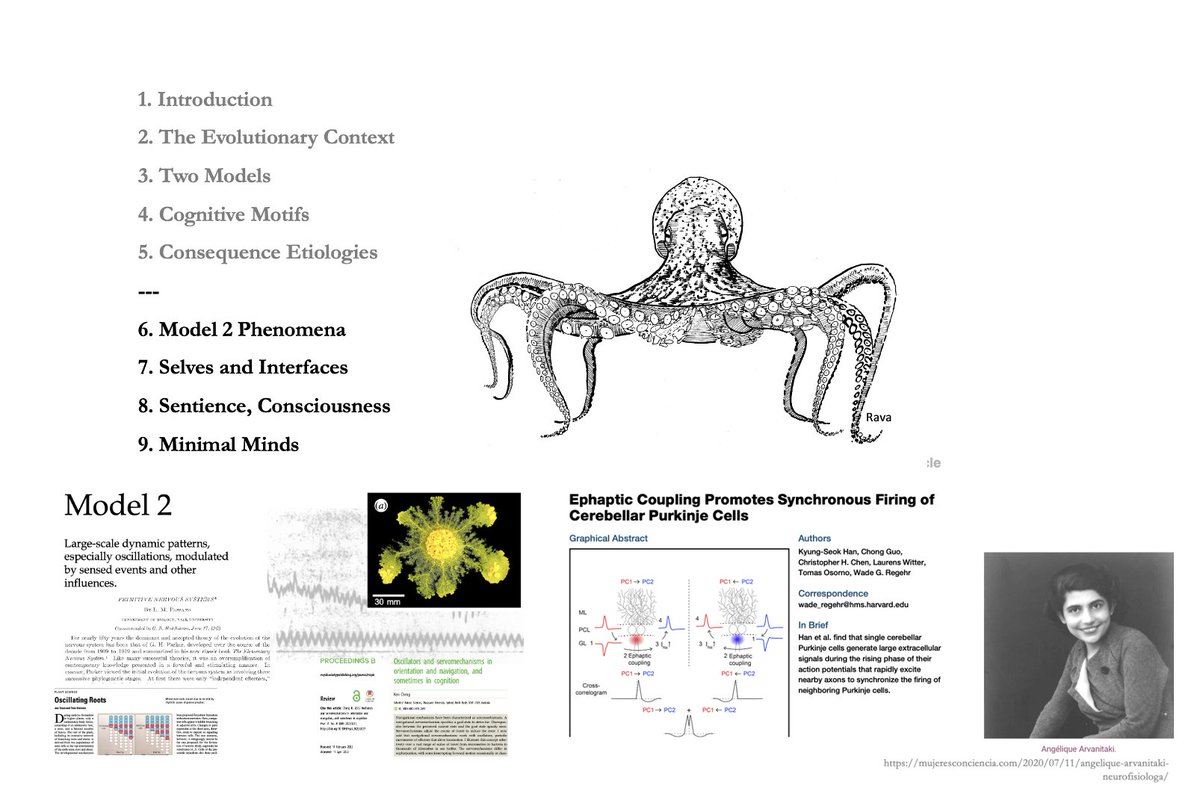
Two collages of slides from the second of my "Kant Lectures" at @Stanford today.
Minimal minds, physical peculiarities of nervous systems, their relations to other kinds of biological
control... 1/2
Dijkstra’s algorithm doesn’t just tell you the fastest route to one destination. Instead, it gives you an ordered list of travel times from your current location to every other point that you might want to visit — a solution to what researchers call the single-source shortest-paths problem.
https://t.co/5klGAQUmh8
Theories of consciousness like dualism and panpsychism often assume that conscious experiences involve acquaintance w/mental qualities, wholly internal to the mind. Yet, people who are untrained in analytic philos don’t find these qualities obvious at all https://t.co/rAF0eSt3ZM
We are very happy to announce that the winner of this year's Royal Society Trivedi Science Book Prize is 'A City on Mars: Can We Settle Space, and Have We Really Thought This Through?' by Kelly and Zach Weinersmith. Congratulations to Kelly and Zach! #SciBooks https://t.co/pnHXKU1khn
The European Union Parliament passed the EU AI Act in 2024, which is an important milestone towards the world's first comprehensive #AI law to formally take effect. Although this is a significant achievement, the real work begins with putting these rules into action, a journey filled with challenges and opportunities. Learn more about the recent interdisciplinary research aimed at facilitating the implementation of the prohibited AI practices outlined in the EU AI Act in this article and video by Huixin Zhong.
Watch the Video Abstract: https://t.co/JDuVOSkXh8
Read the Article: https://t.co/BiXz9WXsvx