Entropy is random. Its effects on aging are not.
Aging destabilizes the regulatory networks in blood stem cells🩸 But not every part breaks equally.
The hallmarks of blood stem cell aging trace to one thing: fragile TF programs collapse with age, while stable ones expand.
🧵1/8
The snake-oil industry of longevity supplements and aging clocks, claiming to either slowing aging, or being able to reliable measure aging excites biohackers that drank the kool-aid, but at the cost that the serious medical practitioners, investors and philanthropists think its all a scam.
DR is the oldest intervention to extend max lifespan, and still the strongest we have for mammals. Yet after a century of research, many key questions remain. In our latest @TheFangGroupUiO paper with 310+ refs in @NatureAging we try to answer this... 🧵🧵
https://t.co/ubybvmvyJ3
Excited to share our new study using engineered immune proteins to quench inflammation in aged brains!!
Congratulations to @Paloma_Negredo and team!
Fantastic collaboration with several labs - Chris Garcia's lab, @rsaxton_, @theRafLab, @wysscoray, and @VilledaLab!
AI is cool and all... but a new paper in @ScienceMagazine kind of figured out the origin of life?
The paper reports the discovery of a simple 45-nucleotide RNA molecule that can perfectly copy itself.
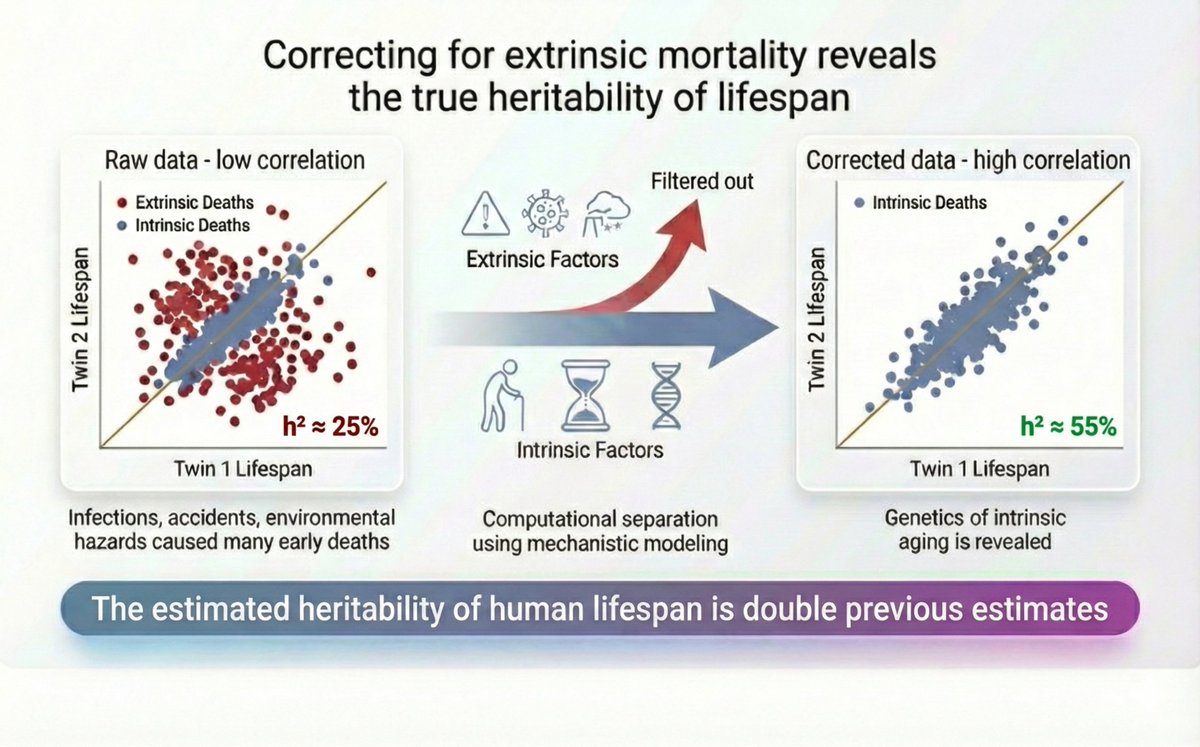
Our new paper on reassessing the heritability of human lifespan is out in @ScienceMagazine! 🧬
For decades, the consensus has been that genetics explains just 20–25% of lifespan differences. We found that after accounting for extrinsic mortality, that number jumps to ~50%.
A 🧵
New preprint! 🚨
Why has maximal human lifespan barely changed while median lifespan has doubled?
We used a mechanistic mathematical model of aging to find that fundamental aging rates are strikingly conserved across individuals and over time.
https://t.co/9jARhFWnP8
🧵1/n
@MicahZoltu@AlexanderMWolf7@LidskyPeter@ydeigin@johnhemming4mp@MarcosArrut@jpsenescence@MaxUnfried
I'm going to try to summarise where we are in the weeks-long thread discussing programmed aging, which has split into an unmanageable mumber of subthreads. I believe the situation can be described as follows:
0) The reason anyone cares about whether there is a pro-aging program (whatever one means by that - see below) is because its existence might provide an easier (though not easy!) way to postpone human aging than damage repair, which is the only option if no such program exists. I have put so much effort into this thread for only one reason, namely that at present an alarming number of experts are choosing their priorities based on the idea that such a program has a good chance of existing, whereas I claim that it has a vanishingly small chance of existing and that looking for it is therefore a waste of our valuable time.
1) There is disagreement as to the meaning of the term "programmed aging" (PA), which has held us back a lot. I have been using that term in the manner in which I am very sure that the most prominent proponents of the concept use it, whereas others have claimed that it has a broader definition. Specifically, when I discuss PA, I mean a process that
a) is genetically encoded
b) is present in most species
c) operates throughout adult life, rather than being triggered by circumstances
d) shortens (healthy and total) life
e) confers no benefit to most individuals most of the time
f) survives during evolution because of population-level (e.g. kin) selection
2) I presented in 2015, and have explained extensively here, what I consider the strongest argument that no such process can exist - namely, the cancelling-out argument (COA). I consider it extremely strong because it follows, by logical deduction, from three totally basic principles of evolution, via the concept of mutation-selection balance (MSB).
3) One category of phenomenon that does NOT come under the above definition is hyperfunction, which has sometimes been called "quasi-programmed aging". It differs from the definition in (1) in that (e) and (f) are different: the program survives because it also does good things early in life and because the bad things it does late in life are not bad enough to drive the evolution of a late-acting off-switch. Different examples of hyperfunction also vary in respect of how much they adhere to (b) and (c), but (e) and (f) are the defining distinction. I do not recall anyone here bringing up any concrete example of hyperfunction that they claim is relevant to human aging.
4) Another category of phenomenon that does NOT come under the above definition but which some people called "programmed aging" is semelparity. It differs from the definition in (1) in that (c) is different: the program survives because there is a particular circumstance (the proximity of a bunch of hungry individuals that share a lot of one's genes) that makes suicide evolutionarily positive. As with hyperfunction, I think there is agreement here that humans do not experience such circumstances and thus have no program to respond in such a way.
5) The main remaining phenomenon that does NOT come under the above definition but which others have suggested should also be called "programmed aging" is the response to abundant food; this shortens life, but it has a near-term selective value, namely that it accelerates growth and hastens reproductive maturity. The balance between age at reproductive maturity and age at death determines reproductive fitness, so there is selection for the ability to respond to variations in nutrient availability. This differs from the definition in (1) in that (c) and (f) are both different: the shortening of life occurs as a result of an event (the arrival of more food) rather than being what I've called "intrinsic", and it has selective value at the level of the individual. The issue that matters here is not whether this phenomenon should be called "PA" - it is that it is very weak in long-lived species, because long famines are too rare to have maintained a stronger program. Therefore, since a program can only do what it is built to do and no more (cannot be "turbo-charged), measures to activate it in humans (whether environmentally, pharmacologically or genetically), while not worthless, can be rejected as options for radical life extension.
6) While I have provided what I claim is an extremely solid argument that (1) cannot exist in humans - solid enough that significant effort to seek such a program is misguided - I entirely accept that (3), (4) and (5) all escape the COA and exist in some species, just that (for the respective reasons just outlined) they are not promising approaches to developing radical life extension in humans. So, what remains, other than biting the bullet of damage repair? It is theoretically possible that another example could exist that falls under the same heading as (5) but that, unlike the response to nutrient availability, alters human lifespan by a large factor. However, unlike the nutrient response, no such pathway has been identified in any species, nor even suggested to exist - including in this thread (for example, I don't think anyone has suggested that thymus preservation/restoration would double human lifespan). Therefore I view this, too, as vanishingly unlikely to get us anywhere in the direction of radical human life extension.
Going forward, I propose that we prioritise clarity concerning which part of the above we are addressing. I propose that everyone here should start by stating explicitly which of the above paragraphs they are disputing and which they agree with me on.
Online now! ✨To better reflect clinically meaningful risk, Fong, Koh and Gruber advocate reframing biological age as a more cleanly, objectively and empirically determined ‘risk-equivalent’ age https://t.co/h5puXWINsg https://t.co/QZr2FRcwxy
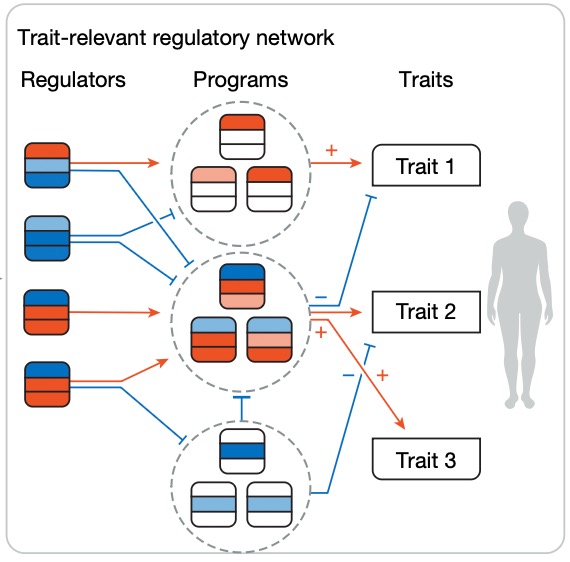
Modern GWAS can identify 1000s of significant hits but it can be hard to turn this into biological insight.
I'm excited to share our new work combining genetic associations and Perturb-seq to build interpretable causal graphs, out today in @Nature:
The problem is that we have a lot of data on aging, and this creates the illusion that we have enough data to assemble a drug. We say: “Look, this thing changes with aging — let’s fix it, and aging will slow down.”
But the truth is that everything in the body changes with aging, there are a million such things, and we have no idea how they are connected to one another.
We have no solid causal map of aging.
We cannot say what the root causes of aging are — or even whether such root causes exist.
What kind of “anti-aging drug” can we talk about if we don’t even have an answer to the question: “What is aging?”
We lack an evolutionary understanding of aging.
In gerontology circles, the absurd idea dominates that aging is simply “in the shadow of natural selection.”
Seriously? Evolution detects the tiniest detail in a living system, but somehow ignores the elephant in the room.
Whenever “evolution needs it,” it instantly increases lifespan.
Why do closely related species differ so dramatically in lifespan?
When we talk about aging, it’s not even clear what we’re talking about.
Is it the accumulation of errors?
And what about the factors that determine the rate of error accumulation?
Is aging a single process or many?
Are there switches of aging?
Which nodes in the network give leverage in animals and in humans?
How are cellular aging and organismal aging connected?
And how significant is that connection at all?
How do energy metabolism → epigenetics → inflammation → ECM → immunity → stem cells → neuroendocrine circuits interact within one system?
Or is this very framing leading us in the wrong direction?
What do we need to know about the origin of life and the phenomenon of consciousness in order to control aging?
Can we view the evolution of life as the evolution of intelligent systems — and aging as a loss of goals?
What do we know about the hidden capacities of the organism?
We pay minimal attention to replacement as a method of life extension.
What is the minimal amount of tissue and organs that must be replaced in order to slow aging?
What is the maximum number of replacements a mammalian organism can endure without losing viability?
Even if we take aging from the perspective of the Hallmarks, how can we even compare principled strategies for choosing combinations?
We don’t even have a retrospective analysis of how combination-selection methods were chosen.
There is no methodological discussion at all.
People propose testing essentially random combinations based on arbitrarily selected facts.
Where is the list of facts that cannot be ignored when developing anti-aging therapies?
This is only part of the problem.
Geroscience is not ready to create an anti-aging drug, and it is not ready to understand where it currently stands.
Fundamental aging research is shrinking — without ever truly beginning — while money is diverted to people who promise to deliver an anti-aging drug in five years.
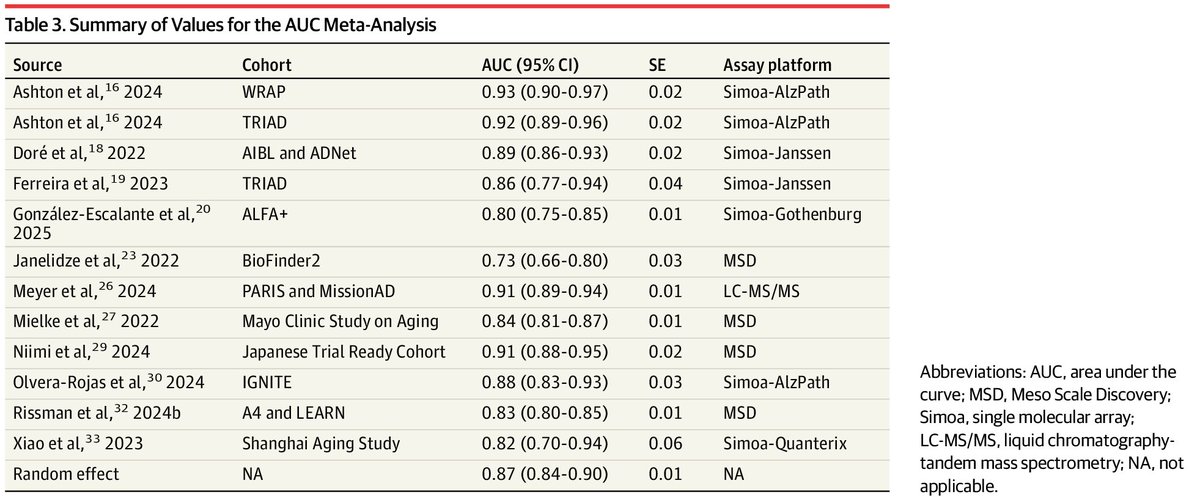
🚨 Blood test predicts Alzheimers before any memory impairment even begins
The blood test can literally “see” Alzheimers in the brain, years before any cognitive changes have taken hold.
What this blood test is, and why it matters for actually moving to a needle on Alzheimer’s therapeutics 🧵
What's more, a follow-up from the same group showed that a single circulating protein (GDF15) is more predictive of mortality than any epigenetic clock.
HR: GDF15 = 1.61 vs. GrimAgeV2 = 1.37
GDF15 is a stress-responsive mitokine (mitochondria-related cytokine) that rises sharply with age – a sensitive readout of accumulated cellular damage and declining homeostasis.
Delighted to share the latest paper from our team in Cell Metabolism (https://t.co/OcX5XWP8q7), which has been selected as the cover article for the upcoming December 2025 issue.
In this study, we demonstrate that GLP-1R agonism (using the drug exenatide) confers body-wide multi-omic age-counteraction that rivals rapamycin, the mTOR inhibitor and benchmark anti-aging drug, in aging/aged male mice. Interestingly, we found that this is largely mediated through the hypothalamus in the brain.
Our journey began eight years ago: Upon extensive literature review and in part inspired by the 2017 EXENATIDE-PD trial paper in Lancet, we first hypothesized that GLP-1RAs might have age-counteracting properties. We provided the first experimental evidence connecting aging and GLP-1 agonism in 2020 [https://t.co/m16JMiX6C7], showing that exenatide treatment can potently counteract mouse brain vascular aging. We then demonstrated that such an effect extends to most gliovascular cell types in a companion paper in 2021 [https://t.co/5UexRIVo6C].
Now, building on our prior works, we are delighted to offer the most direct experimental support to date for the growing discussion that this drug class holds significant anti-aging potential inferred from the expanding list of clinical pleiotropic effects—a topic that was recently raised again by Dr. Lotte Bjerre Knudsen at ARDD 2025 and featured in Nature Biotechnology [https://t.co/lJ4oh6HjR7].
Currently, our clinical team and collaborators are focused on leveraging the anti-aging and anti-neuroinflammatory mechanisms to test GLP-1RAs as treatments for cerebrovascular disorders (https://t.co/o4RfihUtO2: NCT05920889 [will be published very soon], NCT06788626 [getting close to the finish line], and NCT05356104 [will take another two years]).
A huge thank you to our entire team and collaborators, editor and reviewers, and to Dr. Jennifer Ma for the cover art that perfectly captures the spirit of our work [stay tuned!], paying tribute to the scientists who made two remarkable discoveries: namely, the isolation of the first GLP-1RA exenatide from Gila monster venom, and rapamycin from Easter Island soil bacteria. Who would have thought that these two natural substances would converge on age-counteraction, at least in the aging mouse!
I'm seeing lots of folks say that AI will solve aging. It won't and here's why.
The bottleneck in aging research is not in making predictions - which we have loads already - but in doing experiments and clinical trials, which no amount of money or intelligence can speed up.
Excited to share Nona: a unifying multimodal masking framework for functional genomics.
Models for DNA have evolved along separate paths: sequence-to-function (AlphaGenome), language models (Evo2), and generative models (DDSM).
Can these be unified under a single paradigm? 1/15
I'm delighted to share our curated list of 100 open problems in ageing science.
This represents a collective, systematic effort to map the key challenges and knowledge gaps across biogerontology.
1/3
https://t.co/6Kk1yhiFL8
It’s been 200 years since Benjamin Gompertz first described exponential mortality patterns in England.
Once you reach about age 30 your chances of dying double roughly every 8 years.
This is a true hallmark of aging as it’s consistent across populations and has not changed in 200 years - or as far as we know since the dawn of human history. If we could develop interventions to slow down this exponential increase in mortality, however, it would have massive health and longevity benefits.
In fact, if we could slow down aging by eight years that would mean cutting in half the incidence of every age-related disease at every age!







![shibadaddo's tweet photo. Delighted to share the latest paper from our team in Cell Metabolism (https://t.co/OcX5XWP8q7), which has been selected as the cover article for the upcoming December 2025 issue.
In this study, we demonstrate that GLP-1R agonism (using the drug exenatide) confers body-wide multi-omic age-counteraction that rivals rapamycin, the mTOR inhibitor and benchmark anti-aging drug, in aging/aged male mice. Interestingly, we found that this is largely mediated through the hypothalamus in the brain.
Our journey began eight years ago: Upon extensive literature review and in part inspired by the 2017 EXENATIDE-PD trial paper in Lancet, we first hypothesized that GLP-1RAs might have age-counteracting properties. We provided the first experimental evidence connecting aging and GLP-1 agonism in 2020 [https://t.co/m16JMiX6C7], showing that exenatide treatment can potently counteract mouse brain vascular aging. We then demonstrated that such an effect extends to most gliovascular cell types in a companion paper in 2021 [https://t.co/5UexRIVo6C].
Now, building on our prior works, we are delighted to offer the most direct experimental support to date for the growing discussion that this drug class holds significant anti-aging potential inferred from the expanding list of clinical pleiotropic effects—a topic that was recently raised again by Dr. Lotte Bjerre Knudsen at ARDD 2025 and featured in Nature Biotechnology [https://t.co/lJ4oh6HjR7].
Currently, our clinical team and collaborators are focused on leveraging the anti-aging and anti-neuroinflammatory mechanisms to test GLP-1RAs as treatments for cerebrovascular disorders (https://t.co/o4RfihUtO2: NCT05920889 [will be published very soon], NCT06788626 [getting close to the finish line], and NCT05356104 [will take another two years]).
A huge thank you to our entire team and collaborators, editor and reviewers, and to Dr. Jennifer Ma for the cover art that perfectly captures the spirit of our work [stay tuned!], paying tribute to the scientists who made two remarkable discoveries: namely, the isolation of the first GLP-1RA exenatide from Gila monster venom, and rapamycin from Easter Island soil bacteria. Who would have thought that these two natural substances would converge on age-counteraction, at least in the aging mouse!](https://pbs.twimg.com/media/G6IARRPaMAAQ0GM.jpg)


