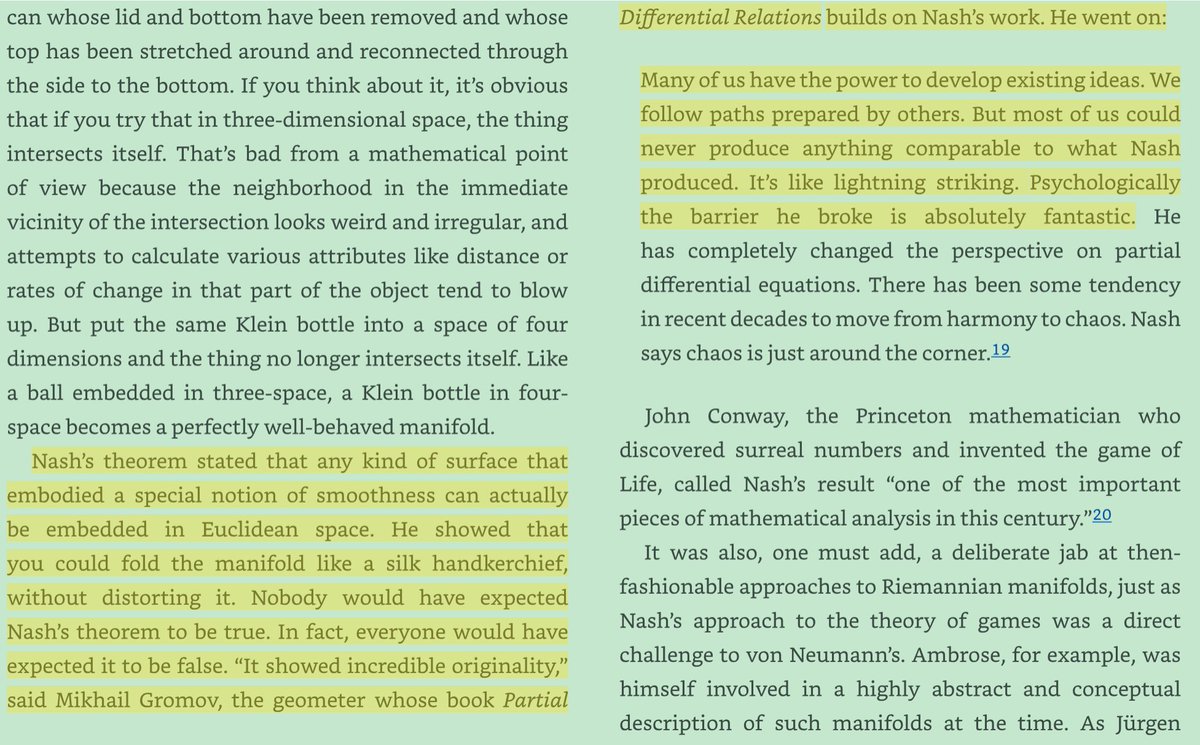
I was re-reading Sylvia Nasar's wonderful biography of John Nash, and I think Nash's solution of the embedding problem indicates some of the limitations of AI for math, at least for now.
The key thing was that it's not just that Nash's solution of the problem was brilliant and original, it's that even *formulating* the problem was considered pathbreaking and counterintuitive. In fact, as Nasar recounts, most mathematicians thought that even asking the question was crazy, and they believed that in fact the opposite of the theorem would be true. This not only took intuition but an incredible amount of courage and stubbornness on Nash's part.
This brings me back to two things: Firstly, even if AI can solve very tough problems, would it be able to formulate such original, counterintuitive problems? Secondly and more importantly, it underscores the fact that science and math are not about solving well-defined problems, they are about having the intuition and taste to define highly original problems in the first place; maybe AI can solve the Riemann hypothesis, but could it pose the Riemann hypothesis? I would submit that AI is not even close to demonstrating proficiency in that latter, most important task which is integral to the progress of science.
@chandnirao_here It cant be just cure the disease, thats marketing, companies shelve cure research for chronic treatment . Even in a pandemic the vax went to wealthy countries, shareholders before ethics. AI might monopolize science to the extreme, humans relegated to nod, not to understand.
String theory is what happens when an intelligent system is starved of sensory input and starts hallucinating. Intelligence needs grounding.
For this reason, intelligence is practically never the bottleneck to solving impactful problems. The bottleneck is iterated contact with reality.
Euronews replaced human narrators in their news clips with AI. Today, I felt like I was listening to a dead person speaking.
I think the backlash that we observe against AI among normal people all over the world isn't about what AI can do (normal people are mostly unaware), but about this uncanny valley that they now feel everywhere they go: from funny cat videos to their favorite news outlets to their coworkers' emails.
@HughHansen@curiouswavefn Would you rather have a dishwasher that might harm you since its designed by an unpredictable black box? Heck it might kill you, not for being evil, its a bug of the many it has but you cant know until they occur.
Probably the stupidest category error argument, backed by people so easily fooled as @Briankeating. It is highly doubtful this @AndrewCurran_ has any understanding of math, or maybe even science.
Maths is not an applied field like engineering or medicine which look for real world solutions. And where understanding may arrive after solutions are found. Hydraulics was known long before the quantum chemistry of water was understood.
Engineering or medicine often rely on accidental discoveries.
The purpose of maths is not just discovery but concomitant understanding. That's why the subject has unproven conjectures in the first place. Because if discoveries without understanding mattered we would take many accidental discoveries as actual discoveries. We would assume Euler's conjecture about 4th powers worked because no one has found a case where it didn't. Yet in the late 1980s Noam Elkies found the counter example.
The point about Stage 4 cancer is an utterly pointless contrived point. Tao is perfectly understandable in context. Furthermore, the point of mathematics is understanding. Anyone who thinks it's results without understanding has no understanding at all.
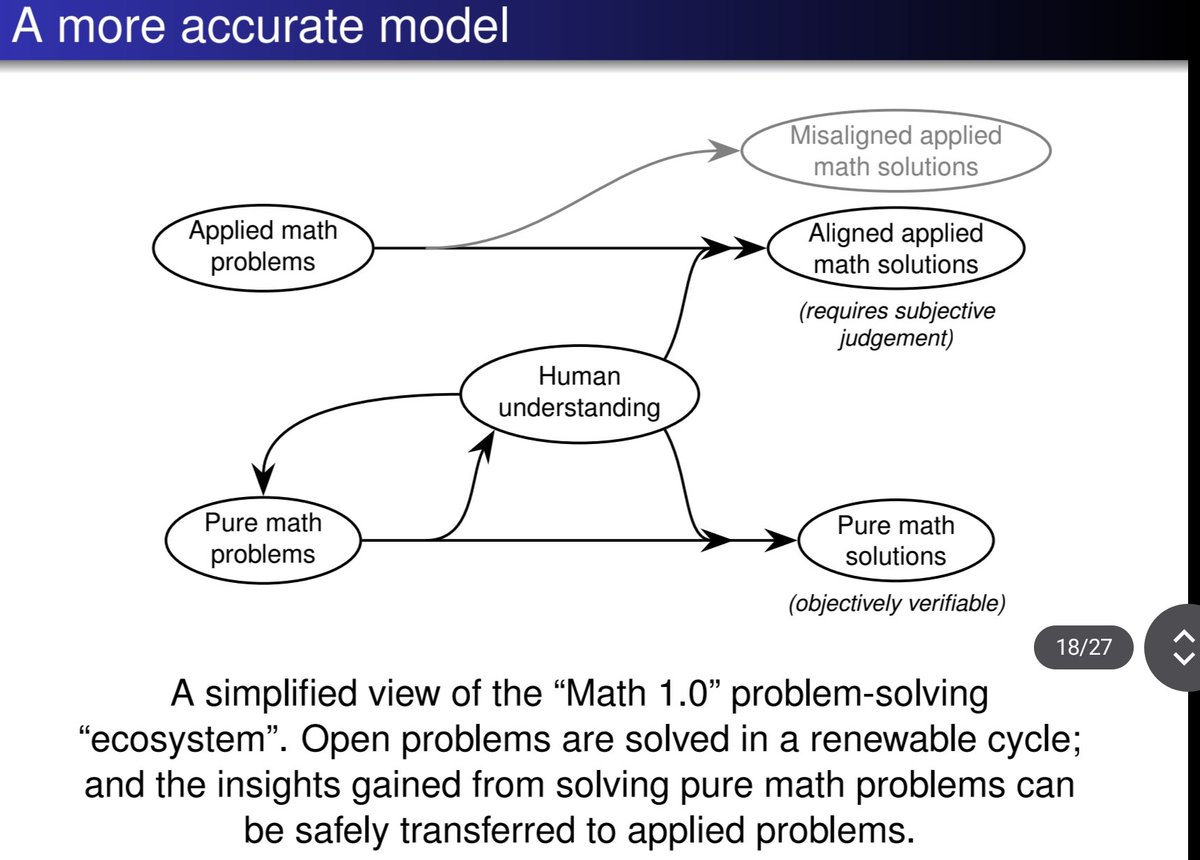
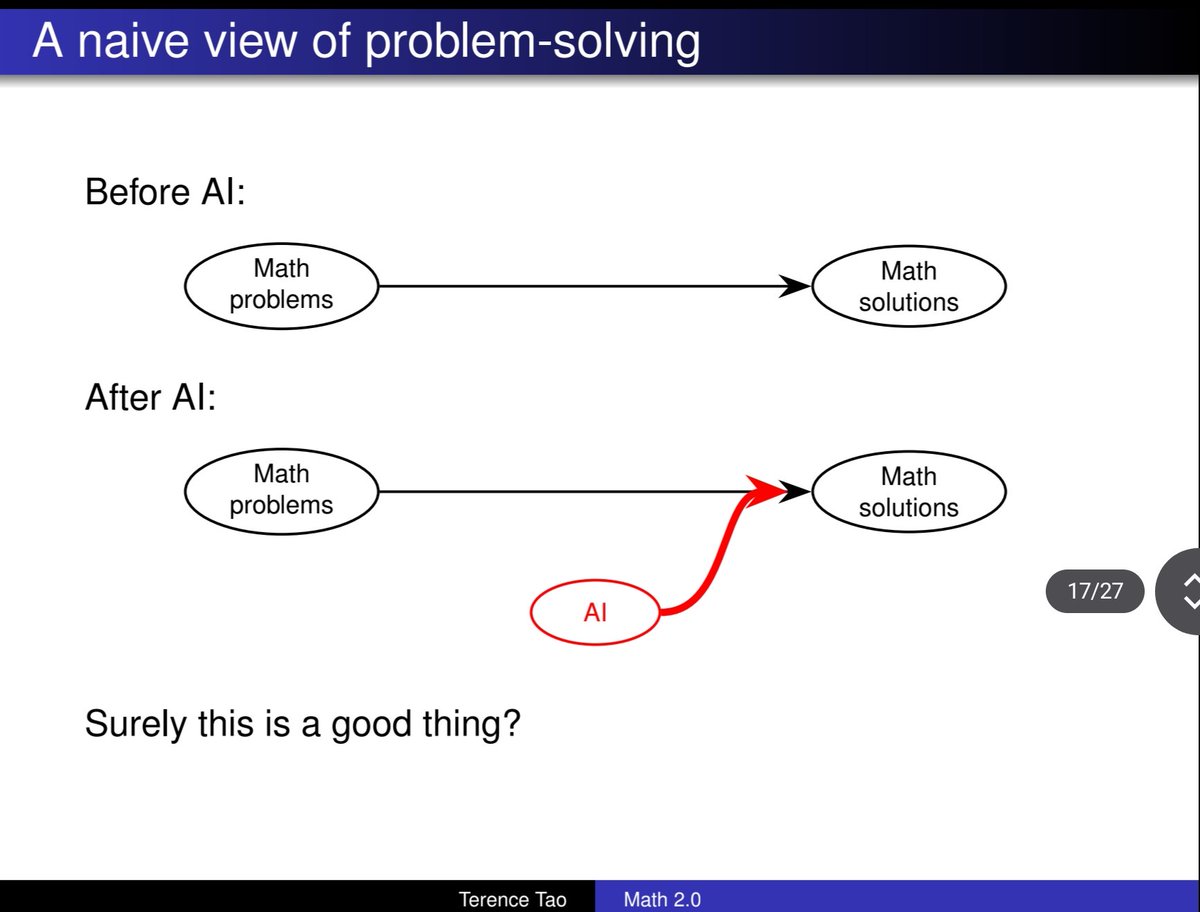
Tao's lecture is the cleanest exposition of how math works, how AI bypassing it without understanding will lead to issues, and how the math community and AI can work together in the future.
If these guys had basic understanding, they would have been able to follow the argument laid out as simply as anyone could.
Tao's crystal clear exposition is in these 4 slides that I wrote about yesterday on Substack. Interesting that these people didn't, or maybe couldn't, comment.
These 4 slides should be printed out and put on every desk doing math - whether in academia or in tech.