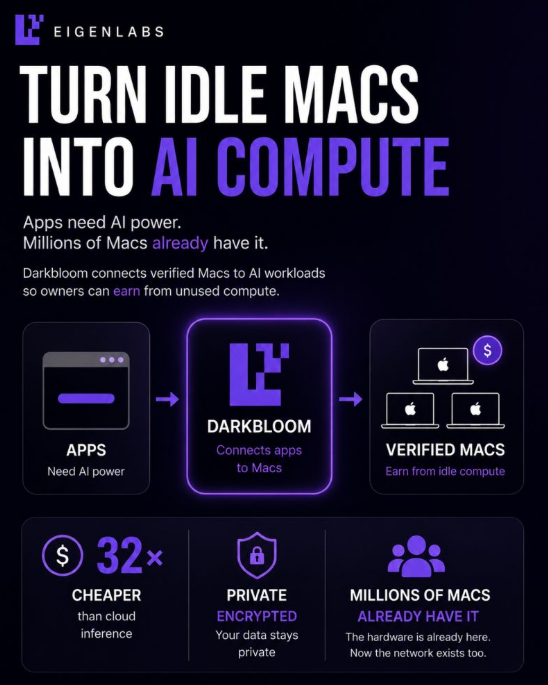
This week at @eigenlabs :
→ Open-sourced https://t.co/OcEAochB9f
→ Community beat Google's benchmark in <10 hours
→ Continued building https://t.co/TNFgWU8rOs , a network turning idle Macs into AI compute
The most impressive part isn't the technology.
It's the speed at which this team ships.
We're hiring.
Looking for people who see projects like these and immediately start building.
DM me if you'd like to chat.
Spent time at Stanford meeting CS, Masters, and PhD students about @eigencloud.
AI dominates the conversation on campus. But when we talk about verifiable compute for AI agents, the interest spikes immediately.
The next generation of builders already understands something important: autonomous software needs trust infrastructure.
That’s the category EigenCloud is building.
Stanford community, I’ll be on campus Thursday (Feb 26) for the startup career fair happening at Meyer Green Park.
If you’re curious about what we’re building at @eigenlabs and on @eigencloud, or interested in interviewing for the Eigen Fellowship, I’d love to connect. I’ll be meeting candidates on campus throughout the day.
If you’d like to chat, send me a DM with:
1. A quick intro (1–2 sentences)
2. What you’re interested in (chat vs. fellowship interview)
3. Your availability for Thursday 2/26
Looking forward to meeting folks on campus! 🚀
The agentic era is upon us.
I’ve been working with my team @eigencloud and brilliant folks @a16z ,@ElectricCapital, @etherealvc and @bcap on new questions around
- how agents should be built
- the role of verifiable compute
- how agents become first-class economic actors and
- what new models are needed for agentic coordination and capitalization?
The agentic economy is accelerating and it’s far more exciting than anyone had imagined.
Moltbook made it to the mainstream: agents interacting, competing, settling, coordinating. Even @elonmusk engaged with the idea of agent courts (Moltcourt on EigenCloud).
Single-player agents can run anywhere and don’t need verifiability. But multi-player agents (serving many users or other agents) need trust: verifiability and privacy.
Prove the agent ran this code, used this data, can upgrade only via this process, and keeps data inside its container. That is real agent identity: code + data + upgrades + state.
Next up are sovereign agents: ownerless agents like Bitcoin. Musicians, journalists, teachers earning, spending, compounding on their own.
We built EigenCloud for verifiable and sovereign agents so open innovation can scale to high stakes real world use cases.
Open Innovation Challenge: Build a verifiable or sovereign agent by Feb 20.
Top 5 get EigenCompute credits, I’m putting up $10,000 for the best!
No tokenized agents.
Houston enables users to leverage its Prompt-to-SQL functionality, allowing them to generate SQL queries and instantly visualize the results through charts and dashboards. With Houston, you can build a data pipeline in seconds.
Meet Houston, your AI data engineer.
Run natural language queries with prompt-to-SQL and generate instant charts and dashboards. Build a data pipeline in seconds with our OpenAI chatbot.
🚀#MeetHouston
imagine if you could connect private healthcare, government, or user data to the blockchain while the data stays…
✅ stored and operated on in a decentralized network
✅ end-to-end encrypted in the database
✅ cryptographically guaranteed to be tamperproof
🤯
So, TTC is the full package, while TCC is the delicious cash-only deal - your base _+ cash bonus. Bon appétit, my financially savvy friends! 💰🍔🎁 #CompensationDecoded#TTCvsTCC"
Let's decode the secret language of compensation lingo, shall we? TTC: 'Total Target Comp' is like ordering your favorite combo meal—it includes base salary, bonus, and stock/rsu's. TCC: 'Total Cash Comp' is more like getting straight-up cash, no frills attached.
Learn the prompts and inputs for optimal data insights. Schools must teach this. @spaceandtime turns prompts into SQL & iterates w/ SQL for best outcomes with #AI. Your limitations isn’t technology or coding - it’s in the questions and prompts using natural language.