Payments are becoming programmable with @oobit.
On the Arbitrum Platform, businesses can build payment systems with instant settlement, predictable costs and customizable infrastructure built around how their products already operate.
Now Oobit users can spend directly from onchain balances at 150M+ Visa merchants worldwide.
Endlich konnte ich FSD in Deutschland testen. Wir sind fast eine Stunde durch Dörfer, über Landstraßen und Autobahnen gefahren. Alles lief perfekt. @PSchnieder, wann retten wir Leben in Deutschland?🇩🇪
The next serious stablecoin @USDKG_Official pitch is not “look how fast we are.”
It is:
look at the reserve structure,
look at the audit trail,
look at the redemption framework,
look at where it can actually be used.
New podcast, new format. Three founders join us.
Waste Tokens, Save Time
00:00 Three Frontier Founders
01:27 AI Software Factories
04:15 Waste Tokens, Save Time
05:47 Models Instructing Humans
09:30 Is Pure Software Dead?
12:04 You Don't Get Stuck Anymore
With @rauchg, @maxhodak_, and @bscholl.
Have you ever wondered just how decentralized @Rocket_Pool is?
What ~1500 worldwide node operators supporting rETH looks like??
Look no further, Steely from our community built this beautiful tracker to see attestations in real time all over the world!
Ethereum in motion.
LATEST: 📊 Prediction markets pushed deeper into private finance this week as Polymarket opened IPO and startup-valuation markets, while the SEC paused event contract ETFs for more review.
CoinMarketCap has the full breakdown on private-company bets, delayed ETFs, and the Minnesota legal fight. 👇
Devcon 8 is coming to Mumbai.
This November, the Ethereum community gathers around the values shaping what comes next: open source, privacy, security, and censorship resistance.
Tickets open today - spots are limited.
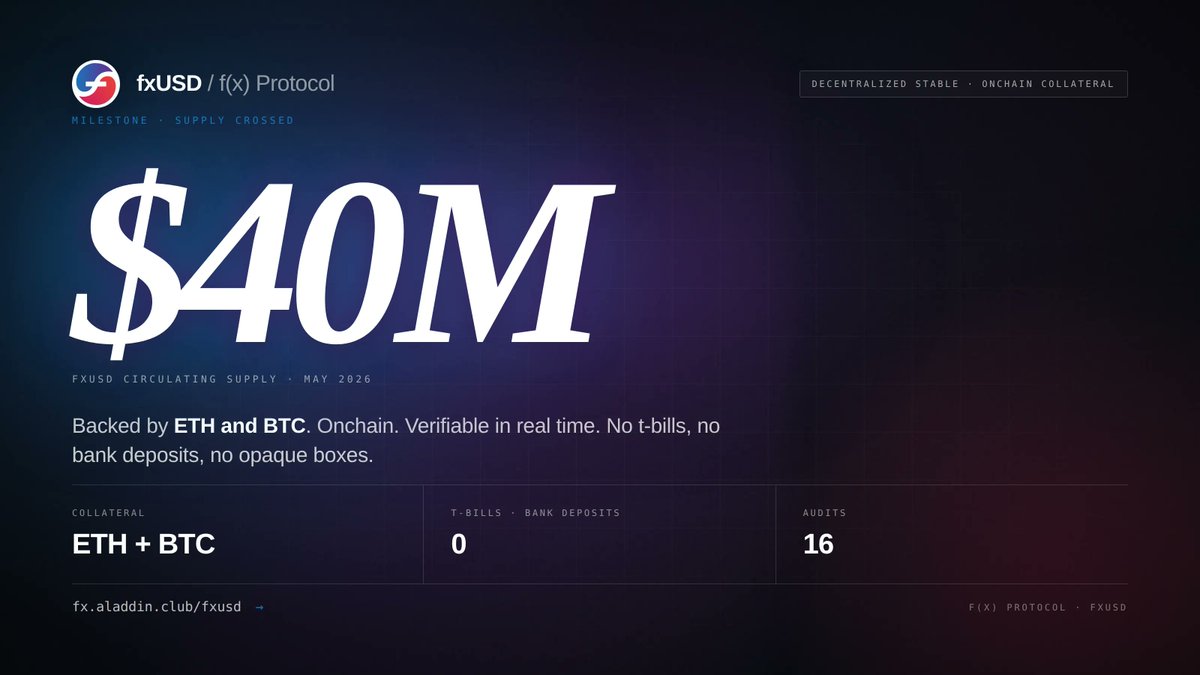
fxUSD supply just crossed $40M.
No t-bills. No bank deposits. No opaque boxes. Nothing to trust.
Just ETH and BTC, onchain, backing every dollar.
This is what decentralized stables look like.
Fundrise VCX is exactly why USVC needs to exist.
Retail wants access to OpenAI, Anthropic, SpaceX, xAI, etc. That demand is not going away.
VCX turned that demand into a liquid public wrapper that still trades around 4-5x NAV.
At today’s ~$90 price vs. recent NAV references around ~$19, buyers may be paying roughly $4-5 for every $1 of actual private tech exposure.
Access at the wrong price is not access. It’s just scarcity monetized.
Yes, venture has fees. It always has. You pay for access, selection, and portfolio construction.
But paying venture fees is very different from paying 4-5x NAV for the wrapper before the venture return even happens.
The companies inside VCX can be great and retail can still get wrecked if the premium collapses.
USVC is the cleaner answer: diversified private tech exposure, SEC-registered, available to unaccredited investors, and bought around NAV instead of through a hyped public wrapper trading miles above its assets.
The real test for me is simple: my mom wants to invest in startups/private tech.
I would rather she do USVC 100x over VCX, because at least with USVC I can understand the structure, explain the tradeoffs, and know she is not just paying a massive public-market hype premium for the wrapper.
In venture, access matters.
But the wrapper can still ruin the investment. And right now, some products are monetizing retail demand for private AI/startup exposure more than they are solving it.
USVC is at least aimed at the right problem.