Marco van Dijk has seen Livepeer from almost every angle.
✅ Core infrastructure contributor
✅ Independent GPU node orchestrator
✅ Founder of FrameWorks, sovereign video infra built on the open compute network
His story is a rare look at what happens when someone builds from inside the stack.
NEW RELEASE Scope v0.2.5 from @DaydreamLiveAI
Current image-to-agent avatars land as flat talking faces. Scope v0.2.5 sharpens conversational avatar workflows by skipping CPU offload on high-VRAM GPUs, boosting generation speed.
The expansion of @Livepeer from a transcoding network to a realtime AI video infrastructure is well underway. Here are some of the highlights, and some of the upcoming challenges for the ecosystem:
Highlights:
* AI fees represent over 60% of the share of the network.
* Quarterly fee capture at an all time high.
* Diverse AI job types from generative realtime AI video and world models, to embodied agents, to LLM inference for OpenClaw, to audio and media generation.
* Inflation rate decreasing daily for 6 months+ and continuing to fall.
* Agent-based network access through MCPs and skill files.
Challenges ahead:
* AI apps built on the network moving from development and beta into scaled production use with product market fit.
* Eliminate or reduce circular fees (Gateways using only their own hardware and not falling over to broader network for scale.)
* Better DevX for using the Network as a Product.
See @MessariCrypto Q1 2026 report on Livepeer below.
Kicking off a new push on delegator UX, starting with transparency, thanks @b3nnn21 for driving this.
You can now check orchestrator reward & fee cut history and easily subscribe to updates. Shoutout to @0xVires for the Telegram bot and @RaidGuild for maintaining the Explorer and reviewing.
More on the way, including native notifications and better visibility into delegator earnings, keep an eye on the Explorer over the next month.
"The AI buildout so far has been about making models smarter. The next phase is about building the infrastructure to run them for billions of users." @a16z
We see this on the cutting edge of media AI. Everyone is playing with and tuning models. Soon it'll be time to build apps.
Without an open internet, all that’s left is censorship.
The internet should be what it was always meant to be, an open, accessible ecosystem.
The path forward is building open-access products built on the Livepeer network.
🎤: @ericxtang, @petkanics, @honestly_rich, @hthillman
The Livepeer Mission: To Represent Open Video Infrastructure.
Our co-founder @petkanics shares how "Google Cloud and AWS are great platforms to build upon, but they also own YouTube and Twitch, the big platforms that many companies are trying to compete with."
Why is Livepeer special to you? Let us know in the comments 👇
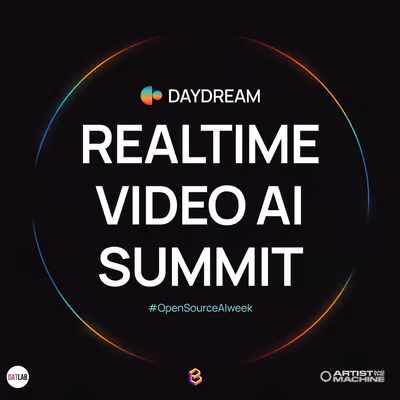
Next Monday's Realtime AI Video Summit during open source AI week in SF is going to be looked back upon in a couple years as a seminal event early in the maturity of what will be a huge video world model market. The authors of StreamDiffusion, StreamV2V, and Self-Forcing amongst others all in one place to share insights, learnings, and the latest tools and tutorials. https://t.co/ptqp0DRSRd
Great couple of days in Portugal with the @Livepeer crew and all the community! It was great to meet people that I hadn't met before and finally to see real people behind the avatars!
I gave a talk at this week's @Livepeer summit highlighting the history of innovations that the project has spurred in the decentralized tech space over the last decade, all while powering millions of minutes of video processing per week for global streaming and AI applications:
2017: Whitepaper including architecture for verified deterministic compute in a decentralized work protocol via financial security.
2018: Merklemine - an open access and fair token distribution mechanism to seed a stake-based network with 2,500,000+ token holders in lieu of a speculative crowdsale or ICO.
2019-2020: Active participation incentives, rewarding those providing useful compute on the network with increased network ownership over time. Cited as the inspiration for yield farming when DeFi summer arrived.
2021: First compute protocol to successfully migrate all state to @arbitrum following their launch, alleviating the high costs of protocol participation by 100x+, without a full network restart.
2022-2023: Launched the Web3 Index (thanks @AdamSoffer) along with projects like @Filecoin@akashnet@helium that became a major sector in the space that came to be known as DePIN.
2024: Became one of the first protocols to introduce a community governed, onchain treasury mid-flight, that populated bottom up from protocol emissions over time. Progressive sustainability via community governance, without any new mint or withheld genesis allocation.
2025: Job type expansion from purely video transcoding to AI video inference, dramatically expanding fees on the network and setting Livepeer up for the next decade of growth via being the backbone for realtime video AI and world models.
This community has always put its head down and done the work, and it's reflected by the deep technical innovations it's pioneered to keep the project and decentralized tech space moving forward. It was inspiring to spend time with this whole group this week, and I'm really looking forward to all that's ahead.
✅ The LiveInfra SPE proposal passed in July!
It enhances the Community Arbitrum Node, giving Livepeer builders free, reliable RPC access with improved uptime, redundancy, and performance.
A win for public goods and developer experience.
Find out more:
https://t.co/z6l7cw6p2i
This week, we’re proud to share that the official @BMwebcast has launched Playa Daydream, allowing viewers of the cast to remix the Playa in realtime using AI. Try it out and vote every 60 seconds on the next remix.
https://t.co/LjFUtYPvCF