As of this year, about 50% of Tamil Nadu school students study in government schools. This percentage has dropped considerably because the government schools have gotten worse. Often even poor rural parents borrow money to send their children to private schools when they can, because of the deterioration in government schools.
One key problem is the corruption in government school recruitment, which has been a long standing open secret and the going rate I am told is about one year of salary paid in advance.
I studied in free schools funded by the government (aided school) so I want to make the system stronger.
We are happy to run our free private schools, and we will expand them further, but we need to make our government schools much stronger.
We still have many dedicated teachers in government schools. We have to strengthen them. A good place to start is to end the corruption in school teacher recruitment.
The infrastructure of government schools is good in some places, not so good in others. But fixing that comes next, only after fixing recruitment.
Our poorest communities need strong free schools. Thank you 🙏 @CMOTamilnadu
Dr Muzaffar Ahmad. Paediatrician. Popular among parents, kind to children. Yesterday, NIA chargesheeted him as one of the prime architects of the Red Fort terror attack that killed 11. He was secretly manufacturing, testing and safekeeping TATP-based IEDs.
You can't do anything.
The foundational motto of Charvaka is:
Yāvaj jīvet sukham jīvet, ṛṇaṃ kṛtvā ghṛtaṃ pibet.
(As long as you live, live happily; even if you have to take debt, drink ghee!)
Charvaka is hyper-individualistic hedonism & pragmatism; Communism is hyper-collectivist state submission. They are philosophically incompatible.
Anyone who says that the Bible is the fount of morality has not read it in its entirety. It is clearly an R rated book. Before introducing it in schools, many parts have to be snipped such as :
1. Cain kills his brother Abel out of jealousy in the Bible (Genesis 4).
2. Abraham poses off his wife Sarah as his sister and puts her in the harem of the Pharaoh while he is in Egypt (Genesis 12).
3. Lot offers his virgin daughters to a mob in Sodom for gang rape to protect male guests (Genesis 19).
4. After Sodom's destruction, the two daughters of Lot get their father drunk in a cave and have sex with their father on consecutive nights (without his knowledge) to conceive children. Both become pregnant, birthing Moab and Ben-Ammi (the ancestors of Moabites and Ammonites) (Genesis 19).
5. Abraham is ready to sacrifice his own son because God asks him to (Genesis 22).
6. Dinah is raped by Shechem, after which her brothers massacre the city in revenge (Genesis 34).
7. Reuben sleeps with his father Jacob’s concubine Bilhah (Genesis 35).
8. Judah has sex with daughter-in-law Tamar (who deceives him by posing as a prostitute) (Genesis 38).
9. The Bible says : "For the slave is his money/property," (Exodus 21:20-21).
10. Israelite soldiers can take beautiful war captives, force them to mourn, then have sex with and marry them (Deuteronomy 21:10-14).
11. A rebellious son can be stoned to death by his parents (Deuteronomy 21:18-21).
12. Phineas spears an Israelite man and Midianite woman during intercourse to stop a plague (Numbers 25).
13. God in the Bible commands for total destruction of Canaanite nations: Kill everything that breathes—men, women, children, infants (Deuteronomy 20:16-17).
14. The judge Jephthah vows to sacrifice whatever first comes from his house after victory; his only daughter greets him. He fulfills the vow and sacrifices his own daughter (Judges 11).
15. A Levite's concubine is gang-raped all night by a mob in Gibeah until she dies; her husband then dismembers her body (Judges 19).
16. The High Priest Eli's sons rape women serving at the tabernacle that serves as a portable temple (1 Samuel 2:22).
17. David commits adultery with a woman named Bathsheba and arranges for her husband to be murdered when he finds out that she is pregnant (2 Samuel 11).
18. The prophet Elisha curses and kills small children who mock his baldness (2 Kings 2:23-24).
The uncomfortable reality is that much of this problematic material is not presented as the actions of “bad people” that we should condemn. In many cases it is either commanded by God, carried out by revered biblical figures (sometimes even without any rebuke), or treated as part of God’s plan.
I was fourteen, walking home from school in Paris with my French-American friend. Summer was around the corner and the heat was relentless.
‘You must be used to this heat,’ she said.
‘Not really,’ I replied. ‘We lived in the hills in India before we came to Paris.’
‘Hills? I didn’t know India had hills.’
‘We have the Himalayas,” I had replied. ‘The highest mountains in the world.’
She stopped dead.
‘You’ve got to be kidding! The highest mountains are in America.’
That expression of absolute certainty is etched into my memory even today.
Twenty years later, when I met her again in New York, I reminded her of that conversation. We couldn’t stop ourselves from laughing.
So anyway that afternoon we went home, and I opened my Philips Atlas and showed her the Himalayas.
‘You know,’ she said thoughtfully, ‘ I’d always wondered about that weird name. I just assumed it was some Native American name.’
A few weeks later, in geography class, while studying the Alps, our teacher announced they were the highest mountains in the world.
My newly enlightened friend proudly corrected her.
‘Actually, the Himalayas are.’
The teacher shot me a look that instantly identified the culprit behind this inconvenient fact.
Then, without missing a beat, she recovered.
‘Yes… but the Himalayas are the newest highest mountains. The Alps were the oldest highest mountains.’
Case closed.
At fourteen, I learnt one of life’s great lessons: The West doesn’t just write history, geography, science. It often decides it.
If something is ancient, extraordinary or foundational, somehow it must have originated in Europe or at the very least be explained through a European lens.
The Rig Veda became “Aryan.” A Middle Eastern Jew named Jesus acquired blond hair and blue eyes.
Even Panini, at one point, seemed to belong to everyone except India.
Now, apparently, Panini is Pakistani.
Progress, I suppose.
From ‘ that’s impossible’ to ‘it was ours all along.’
The script changes. The narrator doesn’t.
#SundayMusings
నెల్లూరు స్వర్ణాల చెరువులో వేల సంవత్సరాల చరిత్ర కలిగిన శివలింగం..! వేసవిలో నీటి మట్టం తగ్గినప్పుడు దర్శనమిస్తుంది. కాకతీయులు నిర్మించిన పవిత్ర శివాలయం..
రొట్టెల పండుగ పేరుతో ఇస్లామిక్ స్థలంగా మార్చేశారు సెక్యులర్లు. నిజాలు బయటపడాలి!
వాస్తవ చరిత్ర:
• 11వ శతాబ్దం: కాకతీయ గణపతి దేవుడు స్వర్ణాల చెరువు తవ్వించి, మధ్యలో శివలింగం ప్రతిష్టించారు.
• 1751: మక్కా-సౌదీ నుంచి వచ్చిన 12 మంది ఇస్లాం వ్యాప్తికి వచ్చి అకృత్యాలు చేశారు. గండవరం వద్ద అరుంధతీయ సోదరులు ధైర్యంగా పోరాడి వారి తలలు తెగేశారు.
• హెచ్చరికగా మొండాలను గుర్రాలపై ప్రదర్శించారు. ఆ శవాలు చెరువు వద్ద పడ్డాయి. నవాబుల కాలంలో వాటిని “బారా షహీద్”గా మార్చి చరిత్రను మరుగుపరిచారు.
1905 బ్రిటీష్ గెజిట్, చెన్నై సెంట్రల్ లైబ్రరీ రికార్డులు, ఆర్కియాలజీ ఆధారాలు — అన్నీ ఆ స్థలంలో హిందూ-జైన దేవాలయాలు ఉన్నట్టు చెబుతున్నాయి.
ఇటీవల కొటంరెడ్డి శ్రీనివాసులు రెడ్డి శివలింగాన్ని రక్షించి ఆలయం నిర్మాణం చేస్తామని చెప్పినా వ్యతిరేకత వచ్చింది.
నెల్లూరు హిందువులు మత సామరస్యం కోరుకుంటూ కూడా తమ ధర్మ రక్షణ కోసం న్యాయం కోరుతున్నారు.
సత్యం జయించాలి!
ధర్మం రక్షించబడాలి!
జై శ్రీ రామ్ 🙏🚩
I have an atheist friend a communist who thinks Charvak philosophy is same as communism. He keeps saying he is a Charvak and hence has authority to criticize everything Hindu dharma.
Critics love to say, "Hindus destroyed all the Charvaka texts because they hated atheism." This is a massive historical half-truth.
It is true that independent, primary Charvaka sutras like the Barhaspatya Sutras did not survive the ravages of time, climate & foreign invasions, their entire philosophy survived precisely because Orthodox Hindu scholars meticulously preserved it.
In the unique tradition of Indian debate (Shastrartha), there is a foundational law called Purva Paksha (the opponent’s view). Before a Vedantin/a Nyaya scholar could present their own philosophy, they were strictly required by academic law to state their opponent’s view with absolute honesty, depth & perfection w/o twisting it.
The most common mistake critics make is assuming "Charvaka" was a singular, outcast rebel. The etymology tells a completely different story.
In Sanskrit, the name is derived from 2 roots:
- चारु (Cāru): Sweet/pleasant/elegant.
- वाक (Vāka): Speech/words.
In the Ramayana (Ayodhya Kanda), when Jabali uses materialist arguments to convince Rama to abandon his exile, he is speaking as a royal advisor using elite statecraft logic. The Charvakas were deeply embedded in the royal courts as ministers because their materialist, hyper-logical focus made them incredible economists & political strategists.
The most detailed, comprehensive layout of the Charvaka system exists in the Sarva-Darshana-Samgraha, written by Madhava Acharya, the 14th-century head of the Sringeri Sharada Peetham & orthodox champion of Vedic thought.
If Hinduism was a dogmatic, insecure faith, its highest religious leader would not have dedicated the opening chapter of his magnum opus to archiving the exact arguments against the soul, rituals & God. He preserved his enemy's armor so he could sharpen his own sword against it.
The biggest source of pleasure for those trying to target Sanatan Dharma is shouting, "See! Charvaka proves Hinduism contains its own contradiction!" This assumes Hinduism functions like Western, dogmatic religions.
In the Western framework, religion is a closed box of Belief vs. Heresy. If you do not believe the book, you are an infidel.
In the Indic framework, it is Darshana. The civilization categorizes systems based on Astika (accepting Vedic authority) & Nastika (rejecting Vedic authority).
Sanatan Dharma is the civilizational canopy that contains both the Astika & Nastika schools. Charvaka is an internal product of the Indian mind, utilizing Sanskrit, interacting within the same cultural context & participating in the same intellectual ecosystem.
Name 1 other ancient civilization on Earth that took its absolute materialist, anti-theist, anti-scriptural critics, cataloged their ideas with academic perfection, gave their founders the title of "Rishi" (Sage Brihaspati is traditionally credited with its origins) & preserved their arguments within its own sacred encyclopedias.
You will not find 1.
Charvaka does not expose a flaw in Sanatan Dharma; it exposes its ultimate, unparalleled intellectual freedom.
There was no such "room" on the Boeing 747 that served as the erstwhile Air India One. Makeshift arrangements were made during those briefings. The seating area used by media served this purpose.
Been there both as a DD News officer and a PMO press officer. @PMOIndia
This is great news. Thought Micromax is gone. Rahul Sharma is turning out to be visionary business leader, moved away from commodity smart phone business to deeptech
A few might be thinking: What is Micromax up to? While the average consumer assumes they vanished after the smartphone wars, Micromax has quietly pulled off 1 of the most brilliant strategic pivots in Indian tech history.
Instead of fighting losing battles in the retail smartphone market, they pivoted deep into hardware infrastructure through a stealthy JV with Phison Electronics (the Taiwanese global titan of NAND flash controllers) called MiPhi Semiconductors, established in Dec 2024.
Historically, Indian tech brands were just "re-badgers", importing finished white-label products from China, slapping a local logo on them & selling them. MiPhi completely breaks that cycle.
Micromax holds a 55% controlling stake, while Phison holds 45%. Micromax provides the local manufacturing footprint (via their factories in Noida/Greater Noida), domestic supply chain logistics & sales infra. Phison brings the actual core IP, 2100+ global storage patents & elite NAND controller architecture.
In mid-2025, MiPhi became the 1st brand to locally design & manufacture enterprise-grade SSDs in India. Now, they are ramping up production capacity 10x, moving from a baseline of 30K units/month to 300K enterprise SSD units/month.
Co-founder Rahul Sharma announced that after hitting around ₹100 crore in the fiscal year ending March, the company is targeting a ₹1000 cr revenue run-rate by the end of this year, funded primarily through internal accruals.
The best part, when Phison & Micromax announced this venture, they highlighted a major goal: slashing the cost of AI training by 90% using their proprietary storage architecture.
Instead of buying hyper-expensive, heavily sanctioned enterprise GPUs (like NVIDIA's H100s) to run massive LLMs, MiPhi has been rolling out solutions (like Phison's aiDAPTIV+ technology) that offload heavy AI model weights directly onto ultra-fast, high-end local SSDs. In late 2025, they even partnered with Intel and SUSE to demonstrate AI training setups that bypass expensive GPUs entirely for small-to-medium enterprise models.
Micromax is very much alive & rocking also :))
Who gave Madurai Central MLA Mustafa permission to enter the Madurai Meenakshi Amman Temple while displaying his religious identity?
He said 'We will eradicate Sanatana Dharma'—what business do he have in our temple?
And more disgusting is those priests & all Hindus surrounding & honouring him, instead of restricting him from entering the temple !!
Who gave Madurai Central MLA Mustafa permission to enter the Madurai Meenakshi Amman Temple while displaying his religious identity?
He said 'We will eradicate Sanatana Dharma'—what business do he have in our temple?
And more disgusting is those priests & all Hindus surrounding & honouring him, instead of restricting him from entering the temple !!
If Sikh symbols are so sacred, why has not a single Sikh religious body even highlighted the issue of Christian converts wearing turbans?
How do we know that those holding key positions in Sikh religious bodies are not Christians?
The global chemical giants were smug. The multi-billion-dollar conglomerates of Europe & America looked at a newly independent India and saw a permanent, captive market. The narrative was unyielding: Developing nations can harvest crops, but they do not have the brains to manufacture the complex molecules required to protect them. India was forced to import vital agrochemicals & dyes at astronomical, monopolistic rates, draining the nation's wealth.
They did not account for a fiercely stubborn, eccentric Parsi man who possessed a manic obsession with chemical formulas & zero respect for Western monopolies.
This is the story of Dr. Keki Hormusji Gharda: the "Father of the Indian Agrochemical Industry." A man who used nothing but a rented shed, a wooden drum & raw intellectual defiance to orchestrate a molecular revolution that broke Western chemical empires forever.
In the 1960s, Western conglomerates like Sandoz, Bayer & Hoechst ruled the global chemical landscape. They guarded their patented chemical processes like nuclear launch codes. If an Indian farmer needed a specific pesticide to save his crop from devastation/a local textile mill needed high-quality dyes, they had to pay whatever extortionate price the Western giants demanded.
Keki Gharda was an anomaly. He had finished his PhD in the US on multiple prestigious scholarships & American university labs were practically begging him to stay. But in 1964, he returned to a struggling India. He did not have millions in venture capital. He did not have a grand lab.
With just ₹2 lakhs pooled together by his mother & sisters, Keki rented a small, primitive shed in Dombivli, near Bombay. The setup was so barren & crude that he literally used an empty wooden drum as his office table & a heavy chemical carboy as his chair.
The Strategy was reverse-engineer the world's most complex, patented molecules, bypass their expensive processes & manufacture them using cheap, indigenous "jugaad" chemistry.
Gharda directly took on the global monopoly of "German Blue" (Phthalocyanine) pigments & high-end pesticides. The European giants claimed their synthesis processes required rare, expensive catalysts & highly specialized infrastructure that India simply did not possess.
Keki locked himself in his sweltering, fumes-choked shed, working up to 16 hrs a day. Neighbors would literally ask his wife, Abaan, if Keki had a mistress because he never came home before midnight.
Her legendary reply? "Yes - Chemical Technology."
Through sheer genius, Gharda shattered the Western molecular blueprints. He invented entirely new, unpatented pathways to create the exact same high-performance molecules. In fact, he made them purer, cleaner & at a jaw-dropping fraction of the global cost.
When Gharda Chemicals unleashed its indigenously manufactured agrochemicals into the market, the global giants were pushed into absolute panic. MNCs that had ruthlessly controlled prices for decades were forced to slash their rates by 50% to 70% just to survive the "Gharda Effect."
He single-handedly democratized the Green Revolution for the Indian farmer.
The Western powers were so flummoxed by this 1 man demolition crew that in 2004, the American Institute of Chemists did something unprecedented: they awarded Keki Gharda the prestigious"Chemical Pioneer Award", making him the 1st Indian & the 1st Asian, to ever receive it. Global behemoths like DuPont eventually came knocking on his door, offering a staggering ₹1200+ crore to buy him out.
Keki looked at the mountain of Western money & walked away.
Why? Because his life was not about the ARR/personal luxury. Keki lived economically & wore simple clothes. When he passed away in late 2024, he did not leave his massive empire to corporate sharks.
He transferred 99% of his personal holdings & wealth into a philanthropic research trust dedicated to upgrading rural India, transforming his life's work into a permanent engine for public good.
Keki Gharda proved that true sovereignty is not just about drawing lines on a map; it is about owning the molecules that feed & protect your people. He showed the world that a brilliant mind sitting on an empty chemical carboy in a rented Indian shed could out-innovate the greatest labs of the Western world.
𝗧𝗵𝗲 𝗥𝗲𝗴𝗶𝘀𝘁𝗿𝗮𝘁𝗶𝗼𝗻 𝗠𝘆𝘀𝘁𝗲𝗿𝘆: 𝗛𝗼𝘄 𝗮𝗻 𝗜𝗹𝗹𝗲𝗴𝗮𝗹 𝗚𝗶𝗿𝗹𝘀 𝗛𝗼𝗺𝗲 𝗕𝗲𝗰𝗮𝗺𝗲 𝗮 𝗚𝗼𝘃𝗲𝗿𝗻𝗺𝗲𝗻𝘁-𝗥𝗲𝗴𝗶𝘀𝘁𝗲𝗿𝗲𝗱 𝗜𝗻𝘀𝘁𝗶𝘁𝘂𝘁𝗶𝗼𝗻
Sometimes, the most disturbing stories do not begin with a crime. They begin with a question.
For Legal Rights Protection Forum, that question arose while examining an RTI reply received from the Office of the District Woman and Child Welfare Department, Palnadu District, Andhra Pradesh
Among the list of registered Child Care Institutions was an entry that immediately caught our attention.
Gipsy Girls Home, Janapadu. Registered on 6 August 2021.
We could hardly believe what we were reading.
At first glance, it appeared to be just another registered Child Care Institution.
But for us, it was anything but ordinary.
Because this was the very same Girls Home against which we had lodged a complaint nearly two years earlier.
The inspection report documented several serious violations. It recorded that the Home was functioning illegally, referred to the penal provisions under Section 42(2) of the Act, noted non-compliance with the prescribed minimum standards, found male staff residing inside a Girls Home, highlighted safety deficiencies, and pointed out the absence of proper statutory records.
Yet, the records presently available do not indicate that any criminal prosecution was initiated or that the institution was immediately prohibited from functioning.
Even more concerning, the inspection report says very little about the children themselves. It does not disclose who they were, whether they were lawfully admitted through the Child Welfare Committee, whether mandatory records existed, or what happened to them after authorities discovered they were residing in an unregistered institution.
Then came the biggest surprise.
The RTI records revealed that the same institution was granted registration on 6 August 2021.
What changed?
Were all the deficiencies rectified?
Were follow-up inspections conducted?
Why was no prosecution initiated despite the official finding that the Home was operating illegally?
Most importantly, were the rights, safety and welfare of the girl children ever properly safeguarded?
These are the questions that prompted LRPF to once again approach the Women Development & Child Welfare Department, seeking a comprehensive enquiry into the entire sequence of events: From the illegal functioning of the Home to the circumstances under which it ultimately received government registration.
The quote, 'Never wrestle with a pig, you both get dirty & the pig likes it,' is universally slapped onto SM whenever the Right wants to back out of an ugly narrative fight. We constantly tell ourselves: 'We will not stoop to the level of the Left. We will remain civil.' But let us actually decipher George Bernard Shaw.
George Bernard Shaw was 1 of the most prominent, early members of the Fabian Society: the cradle of modern Western democratic socialism & Left-liberalism. The Fabians did not believe in sudden bloody revolutions; they believed in subversion through infiltration.
Their strategy was to slowly capture academic institutions, media & state bureaucracies to dismantle traditional societies from within. In fact, when people like Nehru came to the UK, they were deeply indoctrinated by this exact Fabian Socialist circle.
When we look closely at this strategy, the 'pig' quote takes on a dark, tactical reality. The Left is perfectly happy to be called a pig. They have absolutely no issue playing in the mud/gaslighting/using personal & professional annihilation against us. Because they know the Right values personal honor & ritual Pavitrata. By creating a filthy battlefield, they guarantee that the Right will look down, say 'I am too dignified for this,' & walk away.
That is exactly how the Left wins the argument. They win by walkover. They capture the institution while the Right celebrates a hollow 'moral victory' on the sidelines.
When Shishupala stood in the open royal assembly hurling the vilest insults, Krishna did not walk away saying, 'I will not wrestle with this creature.' He silently counted the offenses. He let the enemy expose their absolute corruption completely & the exact moment the 100th boundary was crossed, the Sudarshana Chakra was unleashed to execute absolute justice in full public view.
All this is fine as advice on what is best for USA. But your focus should be on what’s best for India given the other countries are the way they are whether that is right or wrong. Indian diplomacy should not be about morality or advice to others, but pragmatic policies for India’s self interest. @KanwalSibal
Trust voluminous gasbag Ruchika to scale new height of ignorance everyday.
The Rig Veda shows NO evidence of racial discrimination on the basis of skin color. One of the most famous Rig Vedic patron of Rishis himself was named Divodāsa - was he a slave according to Ruchika?
Several other Vedic Rishis like Kaņva, Dīrghatamas, etc. themselves had dark complexions. Rishi Kaņva even refers to himself as Krśna (the dark one) in RV 8.85.3-4
If the Rig Veda categorized dark skin as evil then how come the greatest Rishis who composed parts of the Rig Vedas themselves were dark? Any claim that the Hindu Varna system originated from some kind of color based racism against dark skin in the Rig Veda - is demonstrably false.
Moreover Mlechha always referred to foreigners or outsiders whose speech or customs were outside the Vedic norms. It’s exactly the same as the Greek barbaros ("those whose speech sounds like 'bar-bar'"), or Old Chinese labels for surrounding peoples, and Roman usage of "barbarian"
Such malevolent propagandists have never read original Hindu sources but conveniently like to distort Hindu history & demonize it as “casteist”
For the last 15 years, I've always had one dream and desire which was to make Indian history interesting for everyone.
In that time period, I have tried writing blogs, long-form posts, stories and threads, to do exactly that.
Some worked, most didn't. But with every post, I always had this nagging question.
Why is Indian history always taught with a tunnel vision. Why is it so fragmented?
Why do we always learn things from the perspective of one empire, kingdom, king or invader.
Why do we never see an all India view of history?
I mean most of us struggle if we are ever are asked this question
1. What was the true extent of the Mughal Empire at its peak?
2. Who were the Cholas' contemporaries in North India?
3. While Muhammad Ghori was fighting the Second Battle of Tarain, who ruled Thanjavur?
4. While Harsha ruled Kannauj, who ruled Assam?
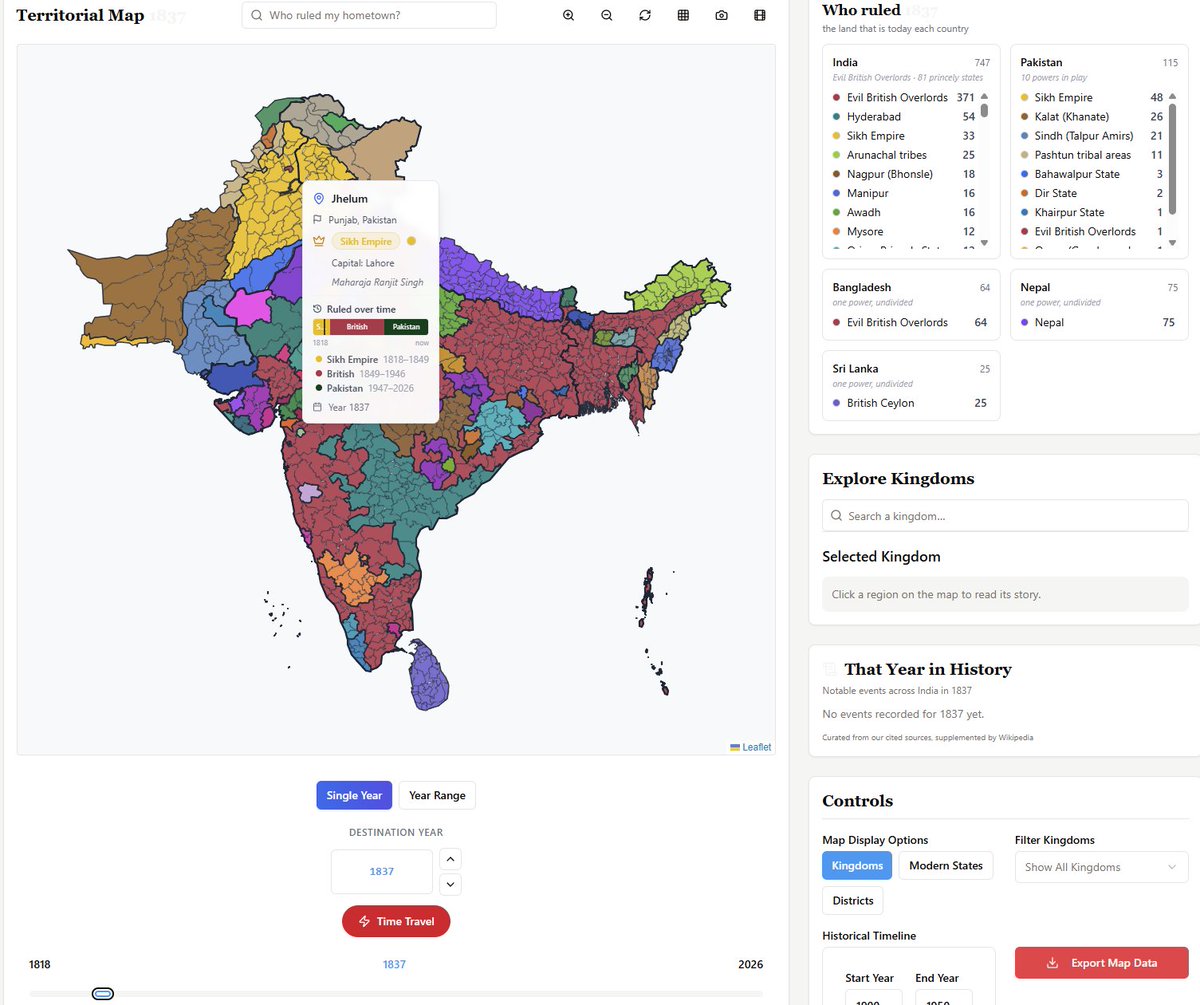
I have always wished there was a simple way to see the political map of India for any year in Indian history.
I have always wished there be a place where
1. One Could Select any year and instantly see who ruled every part of the Indian subcontinent.
2. One could Discover the important events that happened in that year
3. One could select a time period, say 1700 - 1947, and see how the Indian subcontinent evolved in that period.
4. How did one tiny red dot in West Bengal, from a tiny red dot in Europe, somehow came to rule an entire subcontinent of 400 million people,
For years, that idea remained just an idea and a dream because
1. I didn't know how to build a website.
2. I couldn't afford to hire someone who could.
Then Claude Came along.
Thanks to generous support and heavy lifting by Claude, over the last few months, that 15-year-old idea is slowly transforming into a reality.
And today, it has reached a position, where I'm excited to share with all of you, the first sneak peek of https://t.co/6ph2s9Zzl9
It is my attempt to create an interactive historical atlas of India that lets you travel through time and explore the political history of the subcontinent, one year at a time.
This is my attempt to make history interactive and fun.
I'd love to hear what you think.