A few random notes from claude coding quite a bit last few weeks.
Coding workflow. Given the latest lift in LLM coding capability, like many others I rapidly went from about 80% manual+autocomplete coding and 20% agents in November to 80% agent coding and 20% edits+touchups in December. i.e. I really am mostly programming in English now, a bit sheepishly telling the LLM what code to write... in words. It hurts the ego a bit but the power to operate over software in large "code actions" is just too net useful, especially once you adapt to it, configure it, learn to use it, and wrap your head around what it can and cannot do. This is easily the biggest change to my basic coding workflow in ~2 decades of programming and it happened over the course of a few weeks. I'd expect something similar to be happening to well into double digit percent of engineers out there, while the awareness of it in the general population feels well into low single digit percent.
IDEs/agent swarms/fallability. Both the "no need for IDE anymore" hype and the "agent swarm" hype is imo too much for right now. The models definitely still make mistakes and if you have any code you actually care about I would watch them like a hawk, in a nice large IDE on the side. The mistakes have changed a lot - they are not simple syntax errors anymore, they are subtle conceptual errors that a slightly sloppy, hasty junior dev might do. The most common category is that the models make wrong assumptions on your behalf and just run along with them without checking. They also don't manage their confusion, they don't seek clarifications, they don't surface inconsistencies, they don't present tradeoffs, they don't push back when they should, and they are still a little too sycophantic. Things get better in plan mode, but there is some need for a lightweight inline plan mode. They also really like to overcomplicate code and APIs, they bloat abstractions, they don't clean up dead code after themselves, etc. They will implement an inefficient, bloated, brittle construction over 1000 lines of code and it's up to you to be like "umm couldn't you just do this instead?" and they will be like "of course!" and immediately cut it down to 100 lines. They still sometimes change/remove comments and code they don't like or don't sufficiently understand as side effects, even if it is orthogonal to the task at hand. All of this happens despite a few simple attempts to fix it via instructions in CLAUDE . md. Despite all these issues, it is still a net huge improvement and it's very difficult to imagine going back to manual coding. TLDR everyone has their developing flow, my current is a small few CC sessions on the left in ghostty windows/tabs and an IDE on the right for viewing the code + manual edits.
Tenacity. It's so interesting to watch an agent relentlessly work at something. They never get tired, they never get demoralized, they just keep going and trying things where a person would have given up long ago to fight another day. It's a "feel the AGI" moment to watch it struggle with something for a long time just to come out victorious 30 minutes later. You realize that stamina is a core bottleneck to work and that with LLMs in hand it has been dramatically increased.
Speedups. It's not clear how to measure the "speedup" of LLM assistance. Certainly I feel net way faster at what I was going to do, but the main effect is that I do a lot more than I was going to do because 1) I can code up all kinds of things that just wouldn't have been worth coding before and 2) I can approach code that I couldn't work on before because of knowledge/skill issue. So certainly it's speedup, but it's possibly a lot more an expansion.
Leverage. LLMs are exceptionally good at looping until they meet specific goals and this is where most of the "feel the AGI" magic is to be found. Don't tell it what to do, give it success criteria and watch it go. Get it to write tests first and then pass them. Put it in the loop with a browser MCP. Write the naive algorithm that is very likely correct first, then ask it to optimize it while preserving correctness. Change your approach from imperative to declarative to get the agents looping longer and gain leverage.
Fun. I didn't anticipate that with agents programming feels *more* fun because a lot of the fill in the blanks drudgery is removed and what remains is the creative part. I also feel less blocked/stuck (which is not fun) and I experience a lot more courage because there's almost always a way to work hand in hand with it to make some positive progress. I have seen the opposite sentiment from other people too; LLM coding will split up engineers based on those who primarily liked coding and those who primarily liked building.
Atrophy. I've already noticed that I am slowly starting to atrophy my ability to write code manually. Generation (writing code) and discrimination (reading code) are different capabilities in the brain. Largely due to all the little mostly syntactic details involved in programming, you can review code just fine even if you struggle to write it.
Slopacolypse. I am bracing for 2026 as the year of the slopacolypse across all of github, substack, arxiv, X/instagram, and generally all digital media. We're also going to see a lot more AI hype productivity theater (is that even possible?), on the side of actual, real improvements.
Questions. A few of the questions on my mind:
- What happens to the "10X engineer" - the ratio of productivity between the mean and the max engineer? It's quite possible that this grows *a lot*.
- Armed with LLMs, do generalists increasingly outperform specialists? LLMs are a lot better at fill in the blanks (the micro) than grand strategy (the macro).
- What does LLM coding feel like in the future? Is it like playing StarCraft? Playing Factorio? Playing music?
- How much of society is bottlenecked by digital knowledge work?
TLDR Where does this leave us? LLM agent capabilities (Claude & Codex especially) have crossed some kind of threshold of coherence around December 2025 and caused a phase shift in software engineering and closely related. The intelligence part suddenly feels quite a bit ahead of all the rest of it - integrations (tools, knowledge), the necessity for new organizational workflows, processes, diffusion more generally. 2026 is going to be a high energy year as the industry metabolizes the new capability.
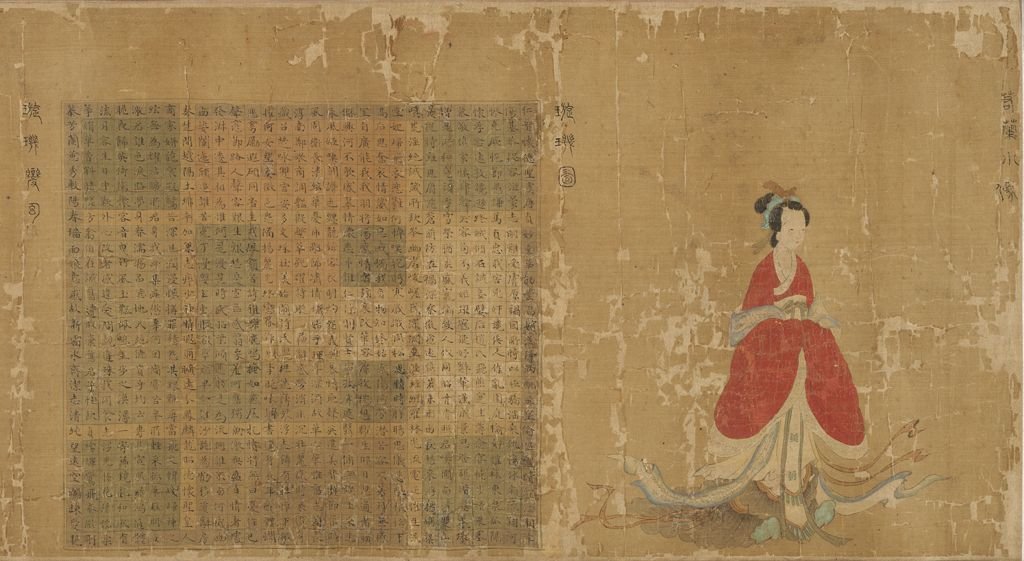
This strange square 👇 is undoubtedly the most extraordinary work of literature in human history. Yet, unfortunately, barely anyone in the West has ever heard of it.
There was this woman poet in 4th century China called Su Hui (蘇蕙), a child genius who had reportedly mastered Chinese characters by age 3.
At 21 years old, heartbroken by her husband who left her for another woman, she decided to encode her feelings in a structure so intricate, so beautiful, so intellectually staggering that it still baffles scholars to this day.
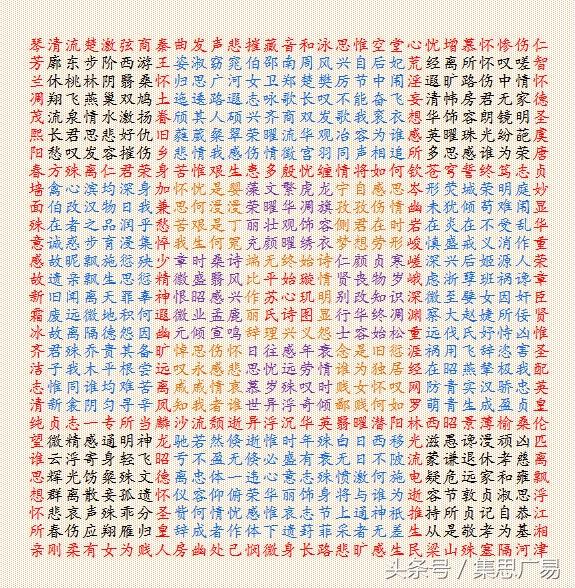
Came to be known as the Xuanji Tu (璇璣圖) - the "Star Gauge" or "Map of the Armillary Sphere" - it's a 29 by 29 grid of 841 characters that can produce over 4,000 different poems.
Read it forward. Read it backward. Read it horizontally, vertically, diagonally. Read it spiraling outward from the center. Read it in circles around the outer edge. Each path through the grid produces a different poem - all of them coherent, all of them beautiful, all of them rhyming, all of them expressing variations on the same themes of longing, betrayal, regret, and undying love.
The outer ring of 112 characters forms a single circular poem - believed to be both the first and longest of its kind ever written. The interior grid produces 2,848 different four-line poems of seven characters each. In addition, there are hundreds of other smaller and longer poems, depending on the reading method.
At the center a single character she left implied but unwritten: 心 (xin) - "heart." Later copyists would add it explicitly, but in Su Hui's original the meaning was even more beautiful: 4,000 poems, all orbiting the space where her heart used to be.
Take for instance the outer red grid of the Star Gauge. Starting from the top right corner and reading down, you get this seven-character quatrain:
仁智懷德聖虞唐,
貞志篤終誓穹蒼,
欽所感想妄淫荒,
心憂增慕懷慘傷。
In pinyin, it is:
Rén zhì huái dé shèng yú táng,
zhēnzhì dǔ zhōng shì qióng cāng,
qīn suǒ gǎnxiǎng wàng yín huāng,
xīn yōu zēng mù huái cǎn shāng.
Notice how it rhymes? táng / cāng / huāng / shāng
The rough translation in English is: "The benevolent and wise cherish virtue, like the sage-kings Yao and Shun, With steadfast will I swear to the heavens above, What I revere and feel - how could it be wanton or dissolute? My heart's sorrow grows, longing brings only grief."
Now read it from the bottom to the top and you get this entirely different seven-character quatrain:
傷慘懷慕增憂心,
荒淫妄想感所欽,
蒼穹誓終篤志貞,
唐虞聖德懷智仁。
The pinyin:
Shāng cǎn huái mù zēng yōu xīn,
huāngyín wàngxiǎng gǎn suǒ qīn,
cāngqióng shì zhōng dǔzhì zhēn,
táng yúshèngdé huái zhì rén.
It rhymes too: xīn and qīn, zhēn and rén
And the meaning is just as beautiful and coherent: "Grief and sorrow, longing fills my worried heart, Wanton and dissolute fantasies - is that what you revere? I swear to the heavens my constancy is true, May we embody the sage-kings' virtue, wisdom, and benevolence."
That's just 2 poems out of the over 4,000 you can construct from the Xuanji Tu!
At the very center of the grid, the 8 red characters wrapped around the central heart, she "signed" her poem with a hidden message:
詩圖璇玑,始平蘇氏。 "The poem-picture of the Armillary Sphere, by Su of Shiping."
Or reversed:
蘇氏詩圖,璇玑始平。 "Su's poem-picture - the Armillary Sphere begins in peace."
Many scholars, and even emperors, throughout Chinese history have been completely obsessed by Su Hui's puzzle.
For instance, in the Ming dynasty, a scholar named Kang Wanmin (康萬民) devoted his entire life to the poems (https://t.co/4exP9zpqbc), ending up documenting twelve different reading methods - forward, backward, diagonal, radiating, corner-to-corner, spiraling - and extracting 4,206 poems. His book on the subject ("Reading Methods for the Xuanji Tu Poems", 璇璣圖詩讀法) runs to hundreds of pages.
Empress Wu Zetian herself, the legendary woman emperor of the Tang dynasty, wrote a preface to the Xuanji Tu around 692 CE (https://t.co/yW7aR73MPc).
Incredibly, there's even far more complexity to the Xuanji Tu than just the poems:
- The name 璇玑 (Xuanji) - Armillary Sphere - is astronomical in meaning and the way the poems can be read mirrors the way celestial bodies orbit around a fixed center. It's a model of the heavens.
- Her original work, with the characters woven on silk brocade, was in five colors (red, black, blue/green, purple, and yellow) which correspond to the Five Elements (五行) - the foundational Chinese philosophical system that explains how the universe operates. So it's also a model of the entire cosmic order according to ancient Chinese philosophy.
- It's also of course deeply mathematical with this 29 x 29 perfect square grid, with sub-squares, lines and rectangles, and a structure which allows for symmetrical reading patterns in all directions
- Last but not least, the content of the poems themselves contain multiple registers. On top of expressing her personal grief and longing for her husband, it's also filled with accusations against the concubine (Zhao Yangtai) he left her for, reflections on politics (with many references to sage-kings) and philosophical reflections.
So the Star Gauge is simultaneously:
- A love letter (expressing personal longing)
- A legal brief (arguing her case against her rival)
- A cosmological model (structured like the heavens)
- A Five Element diagram (encoding the fundamental structure of the world according to ancient Chinese philosophy)
- A mathematical construction with perfect symmetry and precision
And yet, for all this complexity, we should not forget this was all ultimately in service of the simplest human message imaginable: a 21-year-old woman asking the love of her life "come back to me".
Her husband did, eventually. According to what empress Wu Zetian herself wrote in her preface to the Xuanji Tu, when he received Su's brocade he was so "moved by its supreme beauty" that he sent away his concubine and returned to his wife. As the story goes, they lived together until old age.
The heart at the center was filled after all.
Inferencing NT-Java-1.1B on Desktop!
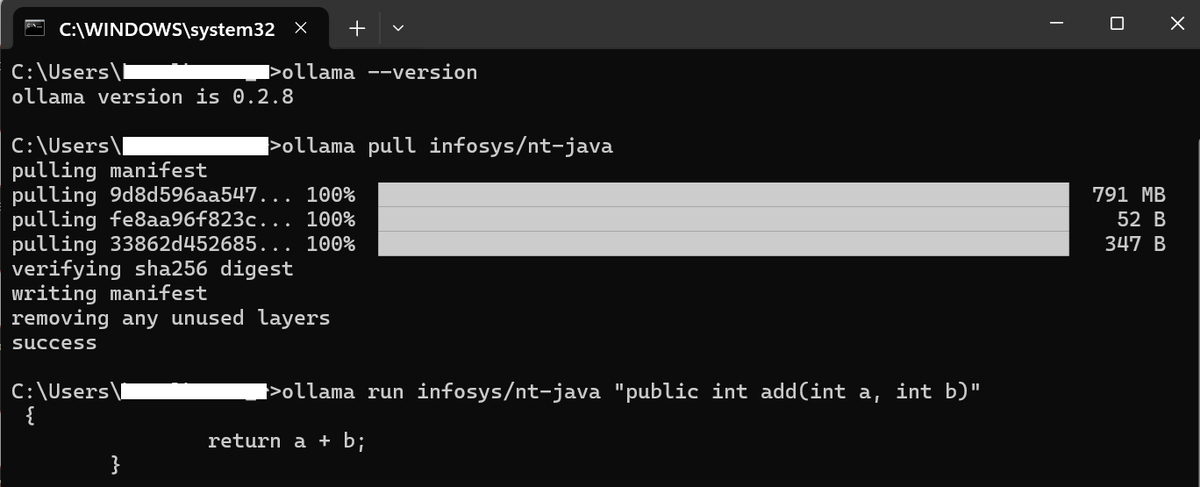
NT-Java-1.1B is now available in @ollama framework. Download & install ollama from https://t.co/QQ6lDX8aIP. Steps for inferencing:
Thrilled to introduce NT-Java-1.1B! We at @Infosys further trained StarCoderBase-1.1B from @BigCodeProject with a Java dataset from The Stack v1, focusing solely on @Java. NT-Java-1.1B achieved a pass@1 score in Java that outperforms both its base model and the 3B variant!
Paper: "Narrow Transformer: StarCoder-based Java-LM for Desktop" (https://t.co/X4bGxQNaSC)
Model: https://t.co/yFUlmAL6zu, https://t.co/cNOYsiIpE0
Code: https://t.co/SSZDCxlIRJ
As we begin a new age of technology, Global Systems Integrators (GSI's) sit at the intersection of the Al and software economies. This presents a generational opportunity to accelerate digital transformation and GDP growth across every region.
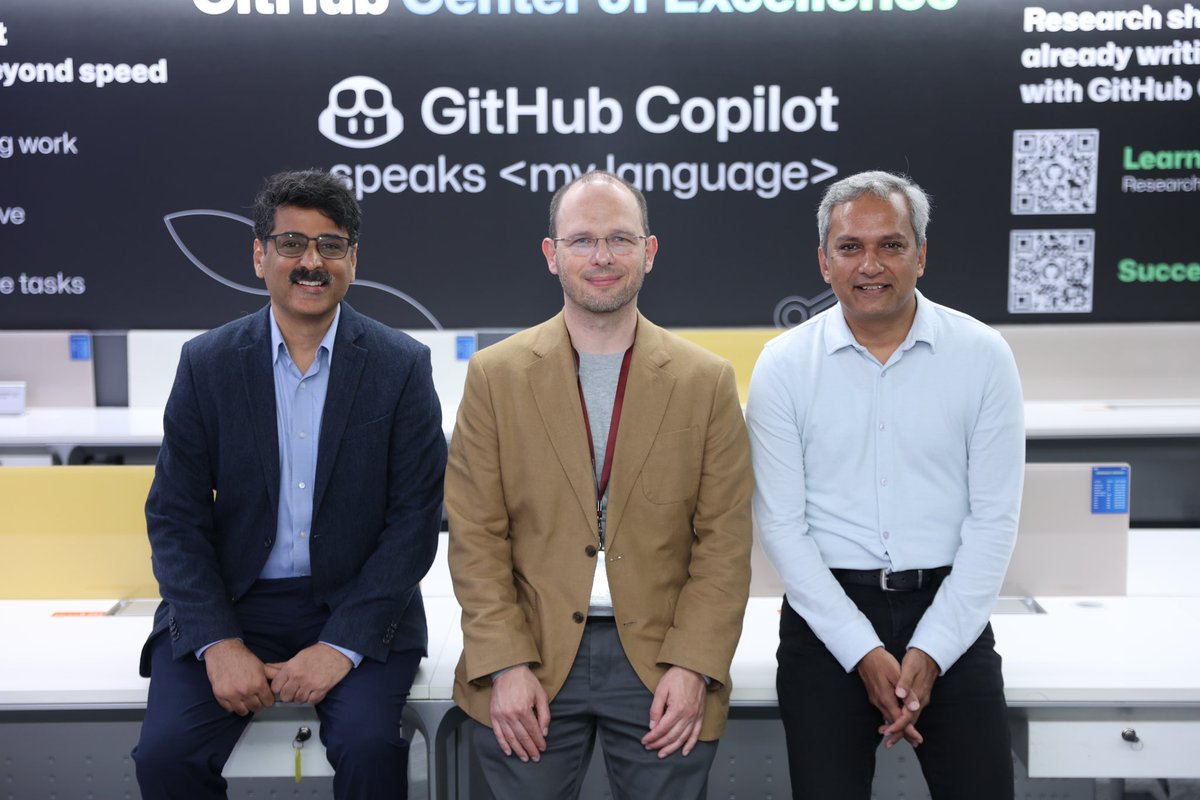
By enabling their developers with GitHub Copilot organization-wide, and extending the capabilities to their customers, GSI's can generate a globalized step change in the speed of software production. Together with @Infosys, we will achieve just this-delivering a new wave of business value for software in the global economy.
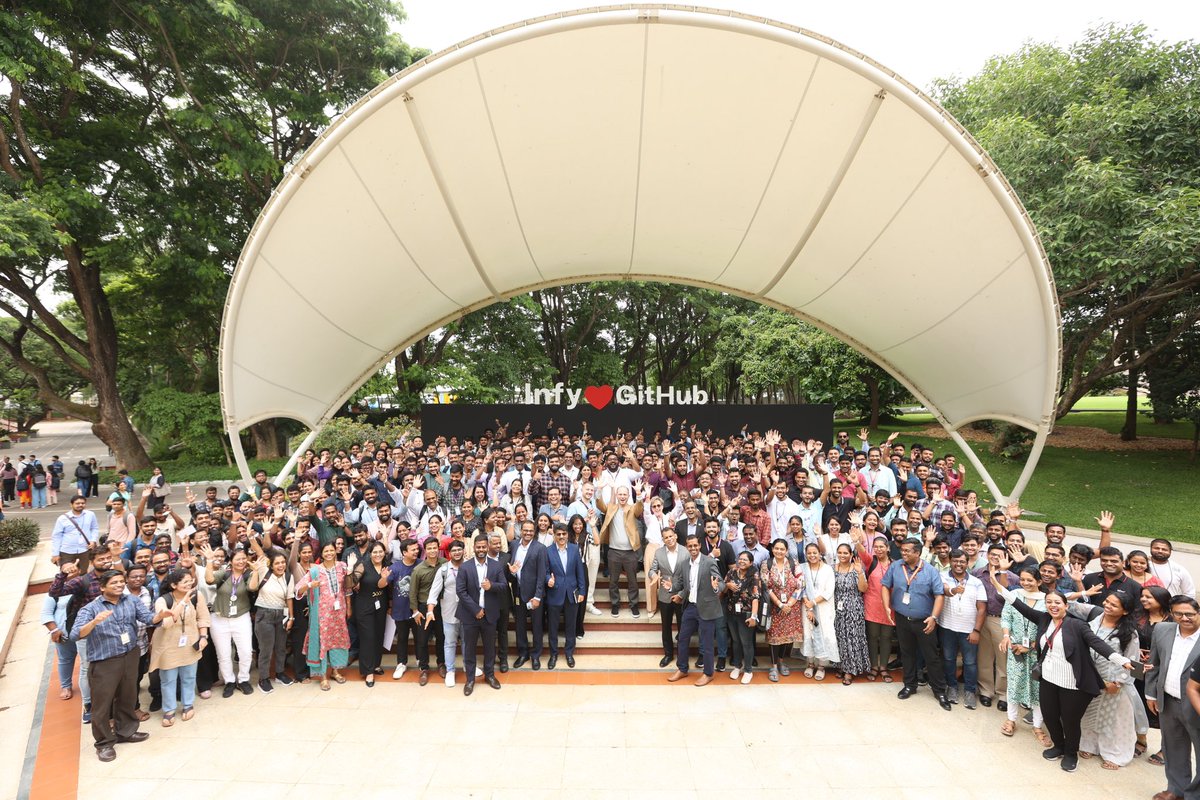
Thank you for having me today Rafee, Bali (Balakrishna), and all the team at Infosys, as we opened the first @github Center of Excellence. The energy was incredible!
A new day has begun for the world's GSl's. The Age of Copilot is here.
The fact that most individual neurons are uninterpretable presents a serious roadblock to a mechanistic understanding of language models. We demonstrate a method for decomposing groups of neurons into interpretable features with the potential to move past that roadblock.
The Adam optimizer is at the heart of modern AI. Researchers have been trying to dethrone Adam for years.
How about we ask a machine to do a better job? @GoogleAI uses evolution to discover a simpler & efficient algorithm with remarkable features.
It’s just 8 lines of code: 🧵
13. Why do LLMs appear much better at generating code than generating general text?
Because, unlike the real world, the universe that a program manipulates (the state of the variables) is limited, discrete, deterministic, and fully observable.
The real world is none of that.
Children should evolve from parent-loving, God-fearing, curious minds to human-loving, parent-caring, science-embracing agnostic or atheists. This is true evolution of the mind. Nothing less. Question dogmas. Break traditions. Keep learning, think out of the box, grow stronger.
11 ways ChatGPT saves me hours of work every day, and why you'll never outcompete those who use AI effectively.
A list for those who write code:
1 of 16
This study is remarkable. No,I did not rename seated calf raises “soleus push-ups”, and no it’s not the same as walking a lot… nor is it just fidgeting. Soleus push-ups may indeed be a powerful tool for improving metabolism. Yes, we still need exercise. https://t.co/xKhhmpwbsK
Having a computer do artistic explorations in the background while i'm doing chores... that's unexpected. i was hoping the future would be the other way around.
Based on recent papers (Gpt3, Palm, dalle2, Gato, Metaformer) I am forming the opinion that maybe 'Scale is all you need', possibly even for general intelligence (?!). Just convert everything to tokens and predict the next token. (1/n)
"Prioritising learning first is like a money slingshot. You are taking a few steps back to 10x your future direction" - salary trap via @george__mack.
People brush off this advice time and again and use the wrong scoreboards. An opportunity to learn & create is priceless.
Thanks for having me on the show #FYI, @Sonal_MK and @ndtv. #hybrid#work is something we believe in and work on shaping with clients and leaders. Great chat and many interesting points by all the panelists.