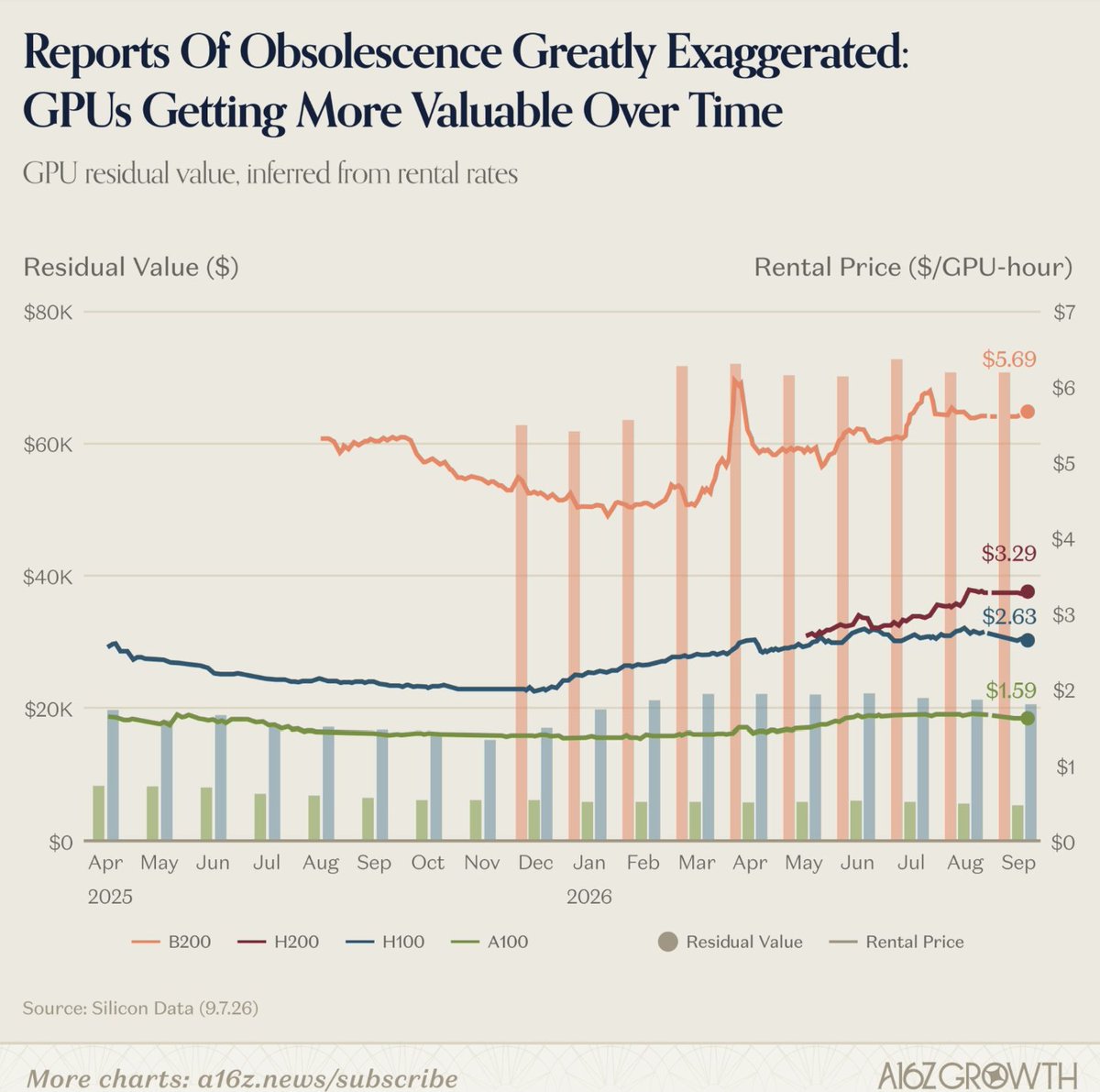
The more I look at the economics of AI infrastructure, the more convinced I become that one of the most popular bear arguments against the AI capex cycle is beginning to weaken, because the market has spent the last two years assuming that GPUs are effectively brutally depreciating assets with extremely short economic lives, where every new NVIDIA generation supposedly renders the previous one obsolete and leaves hyperscalers and neoclouds holding stranded hardware, yet the data in these charts suggest something much more interesting is happening, with older GPUs maintaining or even improving rental economics, inferred residual values remaining surprisingly resilient, and this occurring at exactly the same time that the end-user cost of AI, measured through token prices, is falling sharply.
That combination matters enormously because if the bear case were correct and every new generation of GPUs immediately destroyed the value of the previous generation, then we should already be seeing H100, A100 and H200 rental rates collapse as customers migrate toward newer hardware, secondary-market values deteriorate and utilization falls, yet the opposite appears to be happening, with H100 residual values recovering toward roughly US$30,000, H200 values around US$38,000, A100 values still holding near US$18,000, while B200 rental rates remain extremely strong around US$5.69 per GPU-hour, H200 around US$3.29, H100 around US$2.63 and A100 around US$1.59, which is not what an oversupplied or rapidly obsolescing market is supposed to look like.
What makes the second chart even more interesting is the overlay with the token price index, which has fallen dramatically from above US$2 per million tokens toward roughly US$1, meaning that the cost of consuming intelligence is declining at the same time that the productive value of the hardware producing that intelligence remains resilient, and I think this is the point that many investors are still missing because falling token prices are often interpreted as evidence that AI economics are deteriorating, when in reality they may instead be evidence that AI is becoming dramatically more efficient while usage grows even faster.
This is the same pattern we have seen repeatedly throughout the history of technology, where storage became cheaper and the world responded by storing exponentially more data, bandwidth became cheaper and people responded by streaming more video, compute became cheaper and companies responded by building more software, and now intelligence itself is becoming cheaper, which means the natural outcome may not be that the world spends less on AI but rather that the world consumes far more intelligence because the number of economically viable applications expands every time the cost of inference falls.
That is why I think investors need to be careful when they look at AI hardware through the lens of traditional server depreciation, because older GPUs do not necessarily become useless when a new generation arrives, particularly when the underlying demand for compute is expanding much faster than new supply can be installed, which means the market can evolve into a hierarchy where the newest GPUs are allocated to frontier training and the most compute-intensive reasoning workloads, the previous generation migrates into mainstream inference and fine-tuning, and older generations continue serving enterprise workloads, batch processing, smaller models and latency-insensitive tasks.
The best analogy may actually be aviation rather than smartphones, because a new Boeing 787 does not suddenly make every 777 worthless, and while the newer aircraft may be more fuel efficient and better suited to certain routes, the older aircraft can still generate attractive returns if demand for air travel remains strong enough, which is increasingly how AI compute appears to be behaving, with Blackwell not necessarily killing Hopper, Hopper not necessarily killing Ampere, and each new generation instead creating a new upper tier while the older hardware cascades downward into other economically useful workloads.
That is not instant obsolescence. It is segmentation. And segmentation matters because it expands the total market by allowing different classes of hardware to serve different levels of workload intensity, which means that if aggregate AI demand continues to grow faster than aggregate compute supply, then every layer of that hierarchy can remain valuable even as the frontier keeps moving forward.
This is exactly why the rental-rate data are so important, because H100 pricing stopped declining and began recovering, A100 pricing stabilized, H200 economics strengthened and B200 pricing remained strong, all of which suggest that the market is not experiencing widespread compute oversupply but rather continued absorption across generations, and if that interpretation is correct, then one of the key arguments behind the AI capex bear case, namely that hyperscalers and neoclouds are overbuying GPUs that will become economically obsolete before earning back their capital cost, begins to look much less persuasive.
The useful economic life of these assets may simply be longer than the pessimists assume, and even more importantly, the payback period may be materially shorter than the depreciation period, which is the combination that actually matters for capital returns because if a GPU costs US$30,000 but can generate thousands of dollars of monthly rental revenue at high utilization, the owner can recover a substantial portion of the original investment long before the hardware becomes economically irrelevant, meaning that whatever residual value remains after payback becomes optionality rather than a prerequisite for achieving an acceptable return.
That is a fundamentally different economic setup from buying an asset that loses most of its value before it has generated sufficient cash flow, and this distinction becomes particularly important when evaluating the hyperscalers, because Microsoft $MSFT, Amazon $AMZN, Alphabet $GOOG and Meta $META are all spending extraordinary amounts on AI infrastructure while investors continue to ask whether this capex eventually becomes stranded, yet if older GPUs retain economic usefulness while newer hardware commands premium workloads, then the effective return on invested capital could turn out to be much better than simplistic depreciation assumptions suggest.
This is also why I think investors should stop treating falling token prices as automatically bearish for AI infrastructure, because the relationship between price and revenue is not linear, and a 50% decline in token price does not mean AI revenue necessarily falls 50% if the lower price causes usage to increase fivefold, particularly as AI usage moves away from simple chatbot interactions toward agentic workflows that can consume orders of magnitude more compute because they reason across multiple steps, search, call tools, retry, verify outputs, coordinate with other agents and maintain memory.
A simple chatbot interaction may require only a few thousand tokens, while an autonomous agent performing a complicated workflow could eventually consume hundreds of thousands or millions of tokens as it iterates through a task, which means the move from chatbots to agents can massively increase aggregate token consumption even while the cost per token continues falling, and this is why I think the right metric to watch is not price per token but total useful intelligence consumed.
That is the more important economic variable because enterprises do not ultimately care about tokens in isolation, they care about whether the output creates more value than it costs, and if an AI agent can perform a task for US$2 that previously required US$50 of human labor, then the economics are still extraordinary even if token prices fall by another 50%, while that lower cost actually unlocks new workflows that would previously have been too expensive to automate and expands the addressable market further.
This is why deflation at the unit level can coexist perfectly well with a massive boom at the aggregate level, because semiconductor cost per unit of compute fell for decades while semiconductor demand exploded, storage cost per gigabyte collapsed while global data generation became enormous, telecommunications cost per bit fell while internet traffic multiplied, and AI could follow the same path except that what is becoming cheaper is not simply storage or bandwidth but intelligence itself, which could make this one of the most economically important cost curves of our generation.
The GPU residual-value data are also important from a financing perspective because if lenders, infrastructure investors and private-credit providers become more confident that GPUs retain meaningful residual value rather than becoming near-worthless after a short period, then the cost of capital for AI infrastructure can decline, since a bank financing a GPU cluster cares enormously about what the underlying hardware is worth in a downside scenario, and there is a huge difference between assuming that a US$30,000 GPU will be worth US$5,000 after two years and assuming that it can still be rented profitably or sold for US$15,000.
The second scenario produces a much stronger collateral profile, which can support lower financing spreads, higher advance rates and larger pools of capital, which in turn supports more infrastructure buildout, more model development, more inference capacity and ultimately more AI applications, creating a reinforcing flywheel where stronger residual values make the financing of compute easier while greater availability of compute helps expand the market for intelligence.
This is particularly relevant for neoclouds and GPU infrastructure providers, where much of the bearish thesis depends on the idea that they are funding short-lived assets with long-duration liabilities, because if the assets retain economic value for longer than expected, the asset-liability mismatch becomes less severe, even though utilization, customer concentration, financing costs and power availability still remain critical risks.
The same dynamic strengthens NVIDIA’s strategic position because if customers believe its GPUs retain stronger residual values, then the effective total cost of ownership falls, which means the willingness to pay for new generations can actually remain high even as NVIDIA continues releasing better hardware, and this is where the annual product cadence can become bullish rather than cannibalistic, because the conventional bear argument says a new architecture every year accelerates obsolescence while the alternative view is that the newest architecture takes the highest-value frontier workloads, the previous generation migrates into mainstream inference and older hardware finds lower-cost applications where it still generates cash.
Again, that is not obsolescence. It is a cascading compute stack. And if demand is expanding fast enough, the stack can keep growing even while every individual generation becomes less cutting-edge over time.
That said, I would not take the charts at face value without caveats because the residual values here are inferred from rental rates rather than actual realized secondary-market transactions across a deep and liquid resale market, while rental rates themselves can be influenced by temporary shortages, regional constraints, specific configurations, cluster topology, power costs, networking quality and utilization, which means a GPU sitting idle in the wrong data center is not economically equivalent to the same GPU operating inside a highly utilized, well-networked cluster.
Compute is not merely the chip. It is the chip plus networking, power, cooling, orchestration, software and customers.
That is why utilization remains the key risk, because if AI demand were to disappoint materially and large portions of the installed base became underutilized, rental rates and residual values could fall very quickly, which means the bullish interpretation depends fundamentally on continued growth in economically useful workloads rather than on the hardware itself possessing some magical immunity to depreciation.
But that is also why the current trend matters so much, because if we were already in a severe AI infrastructure bubble with widespread overcapacity, I would expect the oldest hardware to be collapsing first, yet instead H100, H200 and even A100 economics remain resilient while token prices continue declining, which suggests the industry is becoming more efficient without simultaneously destroying demand for compute.
That is an unusually bullish combination because it means cheaper intelligence is not translating into weaker hardware economics but into broader adoption, higher utilization and stronger aggregate consumption, which is exactly what you would expect to see if the demand curve were shifting outward faster than the cost curve were moving downward.
Cheaper intelligence. More applications. More agents. More inference. Higher utilization. Resilient rental rates. Stable or rising residual values. New generations commanding premium pricing. Older generations remaining economically useful. That is not what the end of a capex cycle looks like. It looks much more like an industry moving down the cost curve while the market for its output expands even faster.
This is why I remain bullish on AI stocks, because I do not believe every company associated with AI will win, I do not believe every data center project will earn attractive returns, I do not believe every neocloud will survive, and I certainly do not think valuation can be ignored, but I increasingly think the core infrastructure thesis remains intact because the market continues to underestimate how much compute the next generation of agents, reasoning systems and autonomous workflows could consume.
The bear case assumes rapid technological obsolescence, while the data increasingly point toward persistent economic usefulness.
The bear case assumes falling token prices destroy AI economics, while I think falling token prices expand the market.
The bear case assumes hyperscalers are overbuilding capacity, while I see older GPUs retaining value even as newer hardware is being installed at record speed.
The bear case assumes saturation is approaching, while I think we are moving from a world where humans occasionally chat with models toward one where billions of software agents consume intelligence continuously in the background.
That is a completely different demand curve.
So my takeaway from these charts is relatively simple: AI compute is getting cheaper at the unit level while becoming more valuable at the system level, and that is not a contradiction but exactly what happens when a technology becomes economically transformative, because lower costs unlock more use cases, more use cases create more consumption, more consumption supports higher infrastructure utilization and higher utilization preserves the value of the hardware.
If intelligence follows the same path as bandwidth, storage and compute before it, where unit costs collapse while aggregate consumption explodes, then the biggest risk for investors may not be that the world has already built too much AI infrastructure.
It may be that we are still underestimating how much intelligence the world will eventually consume.
Long AI.
@immad@jacksondahl Immad ... really enjoyed listening to you on the dialectic. What resonated the most with me is the approach of a product org vs. sales orgs which most banks are. The truth in that + impact of that is super underappreciated.
my favorite quote in the US Passport.
"For this is what America is all about. It is the uncrossed desert and the unclimbed ridge. It is the star that is not reached and the harvest that is sleeping in the unplowed ground.
Is our world gone? We say farewell.
Is a new world coming? We welcome it, and we will bend it to the hopes of man."
- LBJ’s 1965 inaugural
Then --was the dawn of the space Age. In the address he mentioned Mars twice. Mariner 4 was on a mission to photograph the red planet for the first time.
Now -- With Starship taking flight and the dawn of the AI revolution...hits as hard as ever.
America welcomes the new world b/c we will shape it.
Congrats @fervoenergy on an amazing IPO. I was curious about returns for investors - so @claudeai did the math!
$36 open, 5 investors with ~$3.6B of gains, ~8x MOIC
@DevonEnergy: 10.4x
Capricorn: 5.6x
@DCVC : 7.2x
@Breakthrough: 10.3x
Centaurus (@johnarnold) : 11.5x
@fortworthchris@jamesbeshara@magicmind Wow! Reminds of the Gita. Arjuna stood on the battlefield, saw his own family on the other side, and wanted to walk away. Too painful. Krishna's response: Your duty doesn't bend to your discomfort. The battle is yours to fight, not because it's easy, but because it's yours.
@bgurley@patrick_oshag@bgurley - compared to Uber/ Lyft, this situation has high fixed but low marginal costs and competition from open source models. How does that affect the long term pricing power and industry economics?
@buccocapital@DavidGeorge83 If that 40%+ operating margin is defensible in the long term, such companies are super undervalued today. I think that's harder to evidence in the short term vs. the AI revenue acceleration which is easily measurable.
@DavidGeorge83 Great read, thank you. On the acceleration path, how do you advise companies evaluate acquisitions? When is that a good path vs not? What's the price to pay? How should the company operate post acquisition?
@qasar ... Loved listening to you on @lennysan's pod, especially on the topic of reading books and developing taste. A book that I think you will enjoy is Zen and the art of motorcycle maintenance. The discussion on "Quality" and relationship to technology is incredible.
@BobCasey Bob - Love this. You were one of my favorite clients - both Tegus as an organization and you as an individual.
I can attest to the passion, the quality, and overall excellence of your team.
Rooting for you from afar. Thank you for sharing your lessons so openly!
@somehotelguy Indeed, hats off for getting this spot on. What do you think of models like blueground which compete in the longer term (3-9 months) space? Those models may be better suited from a competition, occupancy, operating costs perspective?