On the first Thiel Fellowship application, one of the questions was: “Tell us one thing about the world that you strongly believe is true, but that most people think is not true. If this belief shapes the way you live, tell us how.”
Attached is how future fellow @zoink of @figma answered.
Our latest essay explores the defining moments that shaped the fellowship: https://t.co/gR2vdS05M8
Jensen Huang recognized that five of his biggest customers were trillion dollar hyperscalers that were each building their internal alternative to NVIDIA GPUs
In response, he financed and provided backstops to build up an entire ecosystem of neo cloud companies, the poster child being Coreweave
Coreweave buys GPUs from NVIDIA and then rents that compute back to other companies, including the hyperscalers themselves
In essence, Jensen helped build an intermediary between himself and the hyperscaler customers, with the goal of diversifying his revenue base
Marc Andreessen on why cities ended up with $3 million homes, public housing, and no middle class
"There's a French geographer who has the best analysis on this, a great book called Twilight of the Elites. If you replant the commanding heights of your economy on knowledge work, you're going to slam basically all economic growth into the cities"
"The cities become a magnet for two kinds of people. The highly educated elite who can afford $3 million houses, and then public housing. Who's squeezed out is the entire middle class. If you're a cop or a firefighter and you work in Palo Alto, you can be commuting 3 hours both ways just to have a house and afford a family"
"You look at the cities and there's lots of dogs, very few kids. You can't buy a house, you can't have a family. You've ejected the middle out of the cities into the countryside, but you've deindustrialized, so there's no new economic activity happening in the countryside"
INSTEAD OF WATCHING NETFLIX TONIGHT. Spend 2 hour with this. Claude AI FULL COURSE that teaches you how to BUILD and AUTOMATE anything. The people who watch this tonight will wake up tomorrow with a new skill. Watch it and bookmark it now.
A billionaire sat in a room for 42 minutes and listed every psychological trick that makes people lose money. for free. the finance industry has spent thirty years pretending this recording does not exist.
he didn't sell a course. he didn't write a newsletter. he sat in a chair at 96 years old and explained why brilliant people do the dumbest things with their money. then he explained why they will keep doing it.
MBA programs charge $200,000 to teach behavioral finance. he covered 25 biases in one sitting. some of them are still not in any curriculum. he gave the entire framework away on camera.
the part nobody talks about: he called crypto antisocial. he said index funds will crush most managers. he said private equity is full of wretched excess. he said all of this in a room full of people who manage money for a living. nobody argued.
a hedge fund analyst at a top firm told me this is the first thing they send to anyone who joins the desk. not a book. not a model. a 42-minute video of a 96-year-old man explaining why you will be wrong and how to recognize it before it costs you everything.
40 million people have heard his name. almost none of them have watched him explain the 25 ways their own brain is working against them.
the lecture is free. he died the following year. it is in the video.
Mark Zuckerberg was 22 when Yahoo offered $1 billion for Facebook, and his own team wanted him to take it. He went to Steve Jobs instead.
Jobs told him to go to India.
In the video below, Zuckerberg tells India's Prime Minister Narendra Modi what happened next.
"This is a story that I haven't told publicly and very few people know."
Facebook was 2 years old, with about 10 million users. Zuckerberg said no to Yahoo.
It was a tough patch, he says. A lot of people wanted to buy Facebook and thought he should sell.
So he went to one of his mentors, Steve Jobs.
Jobs told him to visit the temple in India he had gone to while figuring out what Apple should be.
Zuckerberg traveled for almost a month. It "reinforced for me the importance of what we were doing."
For early employees with stock, a $1 billion sale is a life-changing payout. Saying no means years of waiting, maybe for nothing.
Within a year of saying no to Yahoo, his entire management team had quit.
He never sold. Today Meta is worth over $1.4 trillion.
Yahoo offered $1 billion.
Steve Jobs offered a temple.
Would you have taken $1 billion at 22, or the ticket to India?
Save the video, and follow for more money stories from behind the world's biggest names.
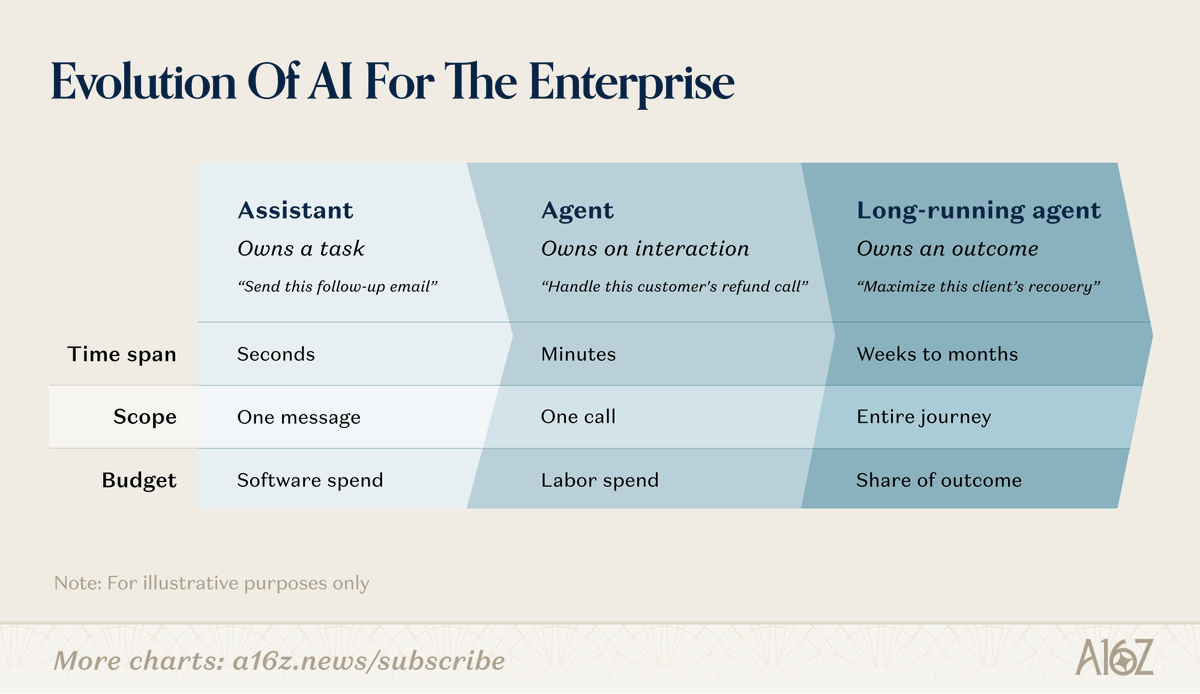
How AI for the enterprise is evolving, from owning a task to owning an outcome:
1. Assistant: handles one task in seconds, like sending a follow-up email. Companies pay for it out of their software budget.
2. Agent: handles one interaction in minutes, like a customer's refund call. It takes on work people used to do, so it gets paid for out of the labor budget.
3. Long-running agent: works toward a goal for weeks or months, like getting an injured client the biggest settlement possible. Because it owns the result, the company selling it can price on the outcome it delivers.
Full piece from a16z's @dhaber on long-running agents in high-value customer journeys: https://t.co/aHaatcizcd
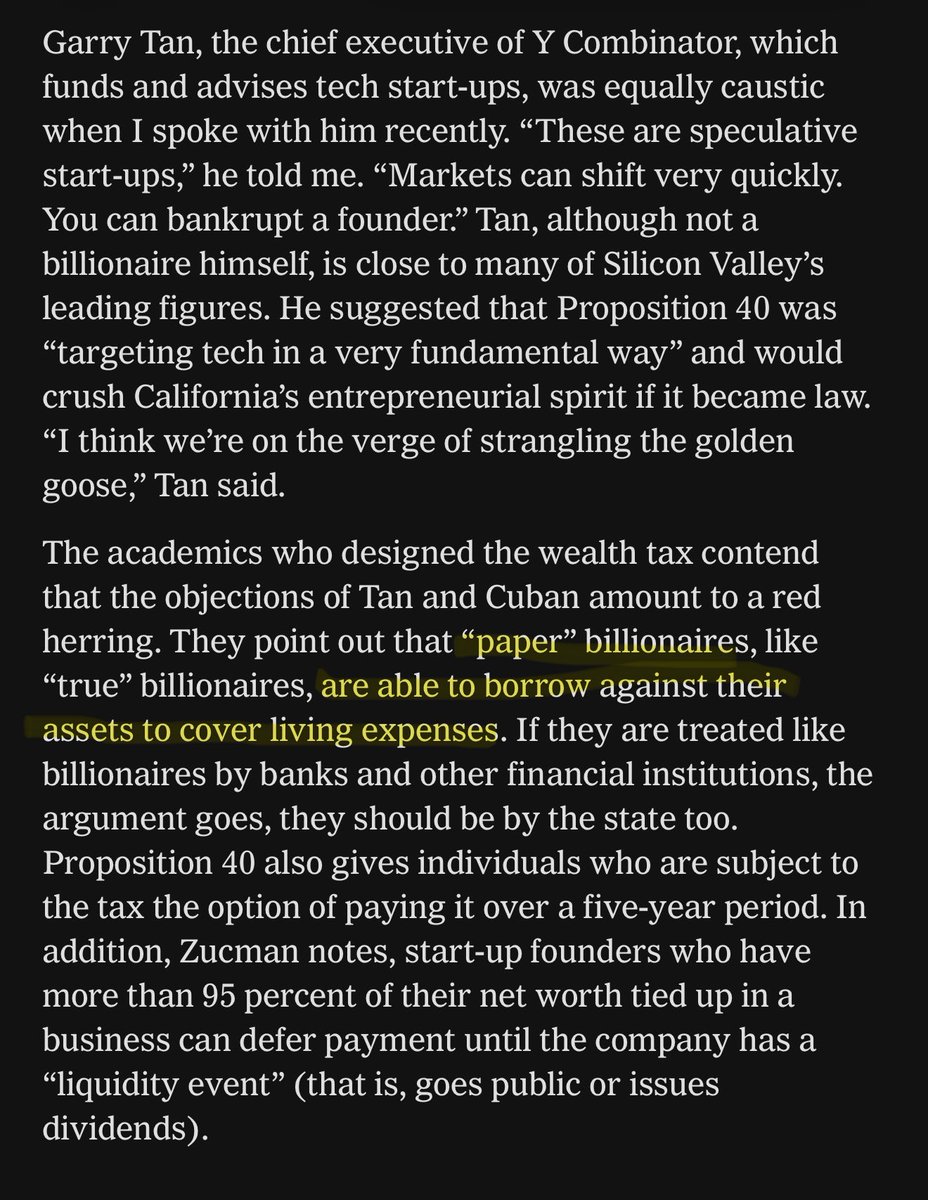
The academics think the founder who raised at $2B valuation can pay but they can’t
You are a founder who owns 50% of your company and you have 20x voting rights. You owe 5% on $10B in the asset seizure tax. You owe $500M of your paper $1B. Find me a way to get a loan for half your illiquid net worth. You cant.
The asset seizure proponents are dishonest and also it’s not a 5% tax on startups. It’s a 50% tax in this simple case.
The U.S. will experience an economic recession if a moratorium against data centers is established, BlackRock CEO Larry Fink opined. He argued the buildout of the controversial facilities is “not the problem” as Americans have grown more negative about data centers and their impacts.
Read more: https://t.co/5MoQ5r7C1u
📸: Paul Morigi via Getty Images
We’re bringing Jensen Huang to Startup School for a fireside chat with @garrytan!
From co-founding @nvidia in 1993 to building the backbone of the AI era, Jensen helped turn GPUs into the engine of modern computing.
Apply to attend: https://t.co/c1ISr8O64k
This is exciting; I expect we are going to see a lot more things like this and it will be one of the most important impacts of AI. Congrats to the Future House team.
https://t.co/Cxeh8UlWdk
Very excited to share @theworldlabs ‘s latest research work RTFM!! It’s a real-time, persistent, and 3D consistent generative World Model running on *a single* H100 GPU! Blog and live demo are available below! 🤩