Moritz spends a lot of time talking about the imprint parents leave on their children, and how it shapes them for the rest of their lives.
Ravi Gupta (@GuptaRK22) tells a story about Michael interviewing him for Instacart, spending an hour and a half asking about his parents and where his motivation comes from.
"The only thing that endures is the intrinsic motivation, and I think understanding the source of that is critical. Why does it matter if you succeed? What is the thing that keeps you going?"
Michael Moritz on Steve Jobs in 2009:
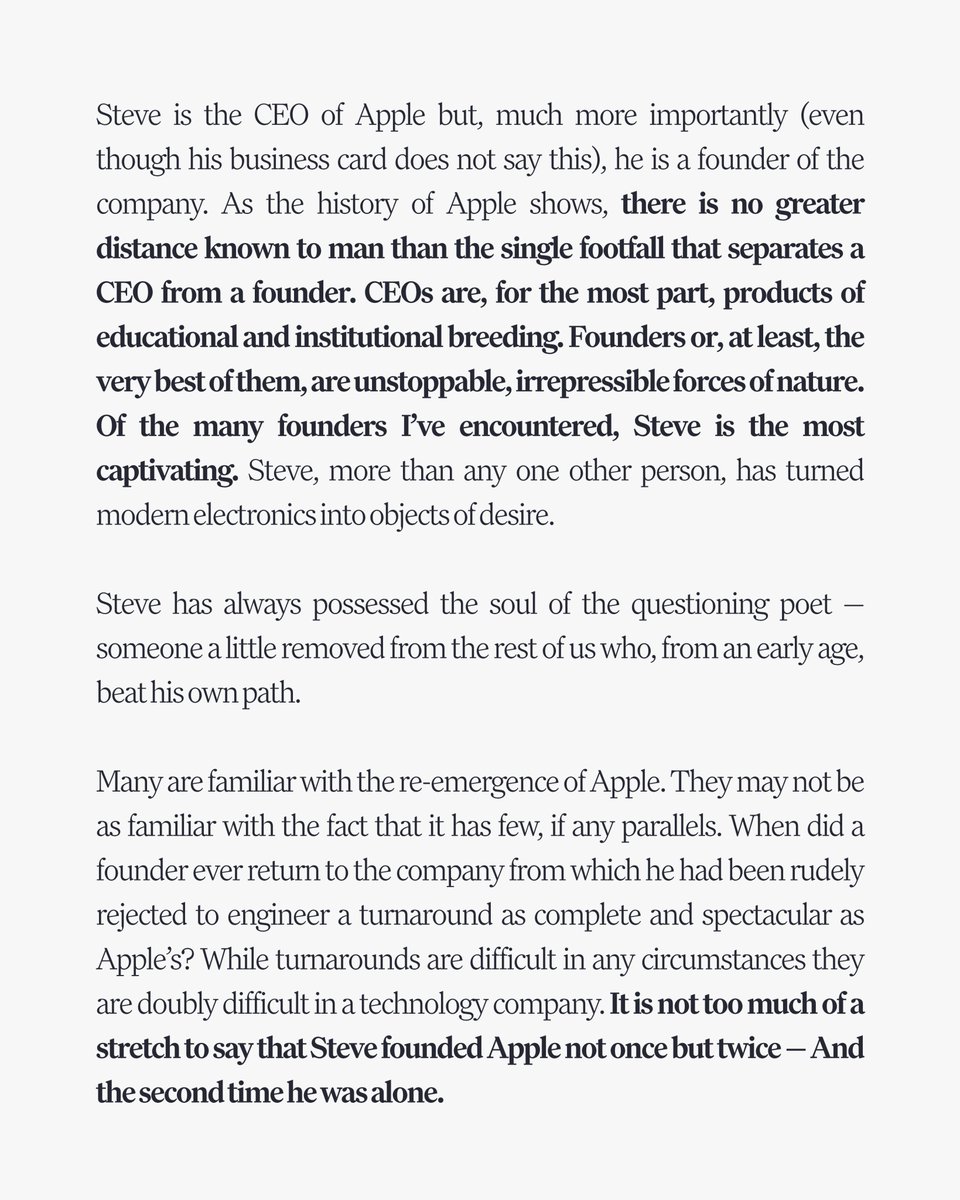
"There is no greater distance known to man than the single footfall that separates a CEO from a founder.
CEOs are, for the most part, products of educational and institutional breeding.
Founders or, at least, the very best of them, are unstoppable, irrepressible forces of nature.
Of the many founders I’ve encountered, Steve is the most captivating.
It is not too much of a stretch to say that Steve founded Apple not once but twice — and the second time he was alone."
Michael Moritz on the Time profile that ended his relationship with Steve Jobs, and whether he was ever in awe of him.
"Steve was convinced that he was going to be named Man of the Year, even though nobody had told him that.
But worst of all, the profile, which he hated for very good reason, and I was appalled by for different reasons, severed my relationship with Steve.
Back then at Time, these things went through an editorial combine harvester.
So what came out in the bale at the end probably didn't resemble very much of the straw that got fed in. And so the whole tone of the piece was malicious and nasty and underhanded.
Sadly, as a result of that, really never repaired the relationship with Steve.
Were you in awe of him?
No.
I respected him. I admired him tremendously. But I knew some of the darker shades of him, which made it difficult to hold him up as an object of unalloyed admiration. But he's a heroic figure, obviously."
In 1982 Steve Jobs gave Michael Moritz unfettered access to Apple, then cut him off completely after the Time profile.
Michael on Steve in 2009:
"There is no greater distance known to man than the single footfall that separates a CEO from a founder.
CEOs are, for the most part, products of educational and institutional breeding.
Founders or, at least, the very best of them, are unstoppable, irrepressible forces of nature.
Of the many founders I’ve encountered, Steve is the most captivating.
It is not too much of a stretch to say that Steve founded Apple not once but twice — and the second time he was alone."
Michael Moritz's investment memo for Stripe was under 4 pages.
"The shorter the memo, the better. If you can express yourself clearly and have a strong opinion, you don't need a lot of paper."
"Being able to distill things to their essence and keep it very short has stood me in good stead over the years."
Naval Ravikant: "You're going to die. It's all going to zero. What's there to stress about?"
"Stress is when your mind has two conflicting desires at once. You want to be liked, but you want to do something selfish. You don't want to go to work, but you want to make money. You have two conflicting desires, and that's stress."
Most people use stress and anxiety interchangeably. Naval says they're different things:
"Anxiety is this pervasive, unidentifiable stress where you're stressed out all the time and you're not even sure why. The reason is you have so many unresolved problems that have piled up in your life, you can no longer identify what the problems are. There's this mountain of garbage in your mind. A little bit is poking out the top like an iceberg; that's anxiety. But underneath, there's a lot of unresolved things."
His fix for it is thinking about death:
"One big anxiety resolver for me is just ruminating on death. You're going to die. It's all going to zero. You cannot take anything with you. If you can keep that idea in front of you at all times, what's there to stress about?"
Which raises a question. If nothing matters, isn't all time wasted?
"What is wasted time? Everything is wasted time in a sense because nothing matters in the ultimate. But in each moment, it's the only thing that matters. So if you're doing something you want to do and you're fully there for it it's not wasted time. If your mind is running away, wishing you were somewhere else, anticipating the future, regretting the past, that's wasted time. That's time you're not present for."
And the part most people miss:
"People get worried about dying and no longer being here. But they don't realize that so much of their life is spent not being here in any case."
“I cannot teach anybody anything; I can only make them think.” —Socrates
A teacher asked his students to take the orange out without spilling any water.
Do not use your energy to worry. Life is too short to worry about stupid things.
Have fun. Fall in love. Regret nothing and do not let people bring you down.
Study, think, create and grow. Teach yourself and teach others.
—Professor Richard Feynman
An Indian passenger train cruising over the fields near Western Ghats, India.
Indian Railways, which is 99.6% electrified in broad guage (next only to Switzerland word-wide), can take you to all these picturesque places in India. Do visit.
Video Credits: @Indianrailgram
Jim Simons got married at 21, took his wedding cash to Merrill Lynch, bought two stocks, got bored in a month, and asked his broker for something more exciting. The broker said soybeans.
He bought two contracts of soybean futures. They went up. They went down. He panicked, sold both, bought one back.
Started driving from Berkeley to San Francisco at 8 AM to watch the market. A graduate student, skipping sleep to stare at soybeans.
Then he made the smartest decision of his life. He said: I'm either going to write a thesis or trade soybeans. You can't do both.
He closed the position with a tiny profit and didn't trade again for years.
That man went on to build Renaissance Technologies. Right on trades 50.75% of the time. Over $100 billion in profit. The greatest money-making machine in history.
Five equations sit underneath every honest decision he ever made. Compound growth. Present value. The geometric mean. The Rule of 72. Real return. All older than any bank on earth. All fit on a napkin.
A fund advertising "20% average return" is quoting the arithmetic mean. Ask for the geometric and the number gets quieter every time. The industry does not hide this. It just hopes you never ask.
Simons didn't beat the equations. He just never argued with them. The napkin is free. The discipline is the fortune.
Harvard needs 8% return every year just to keep the lights on. 5% spending plus 3% inflation. Miss that number and buildings stop, professors leave, research dies.
40% of the operating budget comes from one portfolio. Not tuition. Not grants. One fund.
Jake Xia manages that fund's public markets. He also teaches the math behind it at MIT for free. One of the top five most-watched courses on OpenCourseWare. Millions of views. Almost nobody changed how they invest.
Every year he hands students a blank page. Build a portfolio. No rules. Someone writes 100% Apple. Someone writes rare coins. Confident picks. Same blind spot, every time.
Not one student asks the only question that matters: how much goes in each position. They all pick what to buy. Nobody sizes it.
Sizing is the entire job. The answer won the Nobel Prize. It's called the efficient frontier. Xia draws it on the board in under a minute.
Five equations sit underneath it. Compound growth. Present value. The geometric mean. The Rule of 72. Real return. All older than any bank on earth. All fit on a napkin. None behind a paywall.
A "guaranteed 5% bond" during 4% inflation is a 1% return. The industry doesn't hide this. It just hopes you never run the equation yourself.
The lecture is free. The napkin is free. The only thing that costs anything is not knowing.
HARVARD FILMED THE FIRST LECTURE OF THEIR MOST POPULAR STATISTICS COURSE - TAUGHT BY A PROFESSOR WHOSE STUDENTS CALL HIM THE BEST TEACHER THEY HAVE EVER HAD - AND IT PROVES WHY EVEN ISAAC NEWTON GOT PROBABILITY WRONG
This is Joe Blitzstein, Harvard, Statistics 110, lecture 1. He has won Harvard's Excellence in Teaching award multiple times, his textbook Introduction to Probability is used in over 200 universities worldwide, and his online course has been taken by over 2 million people across 190 countries. He opens by saying that after a few weeks of this course you will easily solve calculations that 300 years ago required consulting Isaac Newton - and Newton's intuition was still wrong.
He traces probability to Fermat and Pascal writing letters back and forth in the 1650s analyzing gambling games. No one had mathematically derived the rules before. They invented the subject by betting on dice in correspondence. Then he shows why the naive definition - probability equals favorable outcomes divided by total outcomes - breaks immediately. Ask what the probability of life on Neptune is. Either there is or there isn't. By the naive definition the answer is 1/2. So is the probability of intelligent life on Neptune. Something is severely wrong.
Then the multiplication rule. Two types of ice cream cone and three flavors gives 6 combinations - not because you memorized it but because you can draw a tree and count branches. Every counting problem in the course is just a bigger version of that tree. Then binomial coefficients - n choose k counts the number of ways to select k objects from n when order doesn't matter. The full house in poker falls out in 4 lines of multiplication once you understand the tree.
Watch the moment he fills in the sampling table - with or without replacement, order matters or doesn't. Three of the four boxes are immediate from the multiplication rule. The fourth requires a proof he saves for next lecture. That one box is harder than the other three combined.
A data scientist I know rewatched this lecture before switching careers into statistics. Said it was the first time probability felt like a system with rules rather than a collection of tricks.
Free on YouTube, Harvard, over 2 million views.
bookmark this and watch later - after this lecture you will never again confuse equally likely with obviously true
Ancient Roman couples had one rule before every difficult conversation.
Modern psychology has no equivalent. Divorce rates were below 5%.
Then the rule disappeared. And everything changed...
The founder of Citadel went to China after DeepSeek dropped. What he saw should worry America
- "Not one author on DeepSeek was educated in America. It was a point of national pride."
Ken Griffin on losing the talent war, China quietly wiring Africa's power, airports and networks, and why US tariffs only speed the retreat
bookmark & watch - the clearest warning that America is losing ground to China