Science basics: dipeptide, oligopeptide, polypeptide.
Peptides are named by length. Two residues make a dipeptide, three a tripeptide. Short chains are oligopeptides, longer ones polypeptides.
Proteins are long polypeptide chains folded into a 3D shape.
#PeptideResearch
@ScienceMagazine Non-targeted workflows lean heavily on good chromatographic separation before the MS stage. Annotation confidence is still the hard part.
Science basics: dipeptide, oligopeptide, polypeptide.
Peptides are named by length. Two residues make a dipeptide, three a tripeptide. Short chains are oligopeptides, longer ones polypeptides.
Proteins are long polypeptide chains folded into a 3D shape.
#PeptideResearch
For the lab: where do you draw the line between a peptide and a protein in your work, chain length (around 50 residues) or folded structure? #PeptideResearch
Science basics: dipeptide, oligopeptide, polypeptide.
Peptides are named by length. Two residues make a dipeptide, three a tripeptide. Short chains are oligopeptides, longer ones polypeptides.
Proteins are long polypeptide chains folded into a 3D shape.
#PeptideResearch
@tangming2005 Good point. Fragmentation coverage is often the limiting factor for confident proteoform assignment. Which dissociation method has worked best for you?
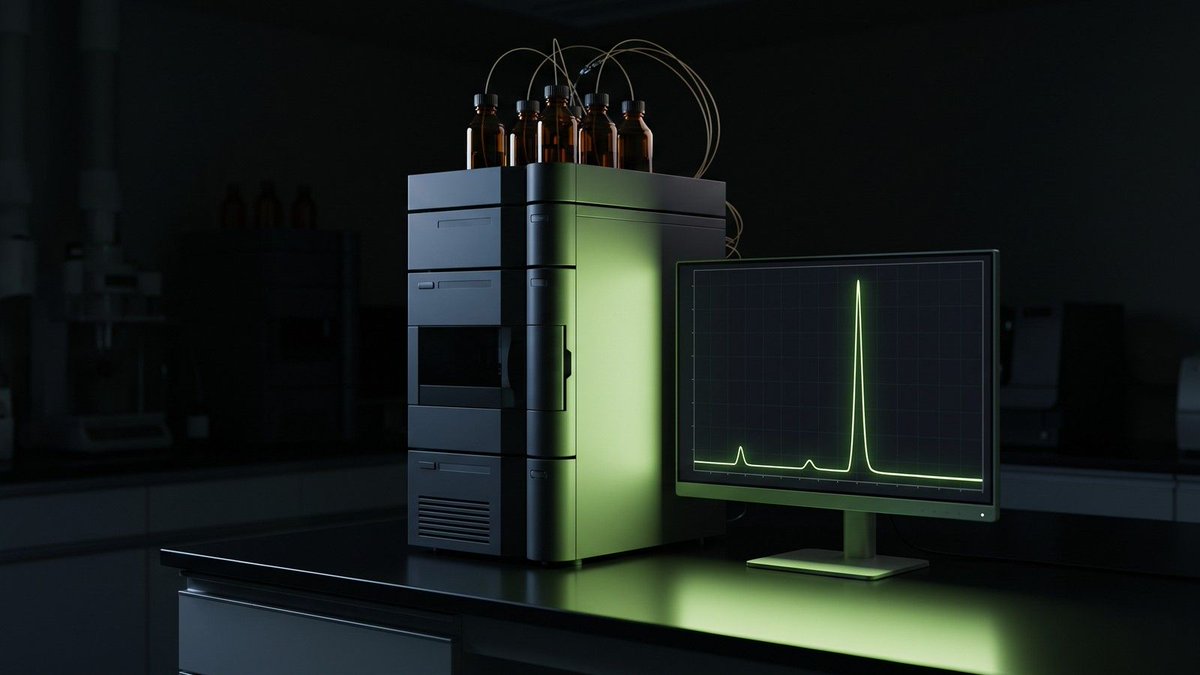
Science basics: what does HPLC purity % measure?
On a chromatogram, each compound shows up as a peak. Purity is the main peak's area as a share of the total area of all detected peaks.
98% purity means 98% of the detected signal is the target peptide.
#HPLC#LabResearch
Science basics: what does HPLC purity % measure?
On a chromatogram, each compound shows up as a peak. Purity is the main peak's area as a share of the total area of all detected peaks.
98% purity means 98% of the detected signal is the target peptide.
#HPLC#LabResearch
Science basics: amino acid vs residue.
When an amino acid joins a chain through a peptide bond, a water molecule is released. What stays in the chain is called a residue.
A 10-residue peptide is built from 10 amino acids.
https://t.co/oqqeIpVJkA
#PeptideResearch
Science basics: amino acid vs residue.
When an amino acid joins a chain through a peptide bond, a water molecule is released. What stays in the chain is called a residue.
A 10-residue peptide is built from 10 amino acids.
https://t.co/oqqeIpVJkA
#PeptideResearch
@rierinkcom Thanks, that's really helpful 🙌 Shallow gradients make a lot of sense for picking out close-eluting truncations and deletions. Good shout on the 0.1% TFA too.
Science basics: what is retention time?
In HPLC, each compound moves through the column at its own pace. Retention time is how long it takes to reach the detector.
The main peak's share of total peak area gives the purity figure.
#HPLC#PeptideResearch
Science basics: how to read a peptide sequence.
Sequences run N-terminus to C-terminus, left to right, in one-letter amino acid codes: G glycine, A alanine, K lysine, W tryptophan.
So GAK reads glycine, alanine, lysine, joined by peptide bonds.
Science basics: how to read a peptide sequence.
Sequences run N-terminus to C-terminus, left to right, in one-letter amino acid codes: G glycine, A alanine, K lysine, W tryptophan.
So GAK reads glycine, alanine, lysine, joined by peptide bonds.