If you’re still unsure what to film for your @ycombinator video, here’s ours!
We’re @polygres , and we turn your entire database into a context window.
We uprooted our entire lives to come to SF, because we believe this is the best place to build a startup.
- @daleverett@daltonmeon@damienhe
Super super short summary, trying to be as objective as possible:
- Malaysia does not allow Israelis to enter the country, by law. Last year, an Israeli content creator with two passports entered on his other passport and recorded a video promoting Network School.
- A social media account then alleged that Network School was enabling Israeli citizens to gain access to the country illegally.
- This resulted in a police raid, where Johor police checked the passports of all Network School residents/attendees. In that investigation, they did not find anyone who's broken Malaysian immigration laws.
- Balaji recorded a 25min+ video summarizing the incident and requesting an "audience with the Prime Minister" to sign a formal MOU between Malaysia and Network School to ensure this never occurs again.
- Many Malaysians on social media were angered by the tone of the video and, having not heard about Network School before, were alarmed by clips and portions of his Network State book which they inferred meant NS would take over part of Malaysian land and eventually try to separate from the country/violate the sovereignty of the country. Balaji did say at the end of his video reply that he respects the laws of Malaysia, but only about 22ish minutes into the video itself; he also offered to take his investment elsewhere if he didn't get an audience with the PM, which many Malaysians found offensive.
- Given it's an election year and public opinion on this is sharply negative (in part due to the video's tone)... IMO it never seemed likely he'd get a kind conversation with the Malaysian gov after recording that video. And he did not.
- Johor police/gov eventually demanded NS shut down (pulled its business license) due to filing for a license for office space, when they were also offering an educational program and calling themselves a "school". This requires them to cease operations immediately.
- Balaji announces a partnership with the Kazakhstan government to open Network School there instead.
I won't wade into this matter too much (also I'm not Malaysian) but my two cents:
1) I think if you write a book claiming that you eventually want to form a new breakaway country and can't articulate to the country that's hosting you why you won't subvert their sovereignty, citizens will assume you will, and you will earn many enemies (unless *from the start* you clearly announce that's what you want to do and get explicit permission). NS did not do this.
2) Malaysia is a democratic country, and the opinion of its citizens matters highly. If you're going to set up shop in a country where your operation (of any kind) depends on that country's resources, it should be quite obvious that managing political relationships and public opinion (and perhaps not calling your project "near Singapore" on every ad) is one of your most important responsibilities.
3) Personally I always saw the brand of "new country" as not a literal thing; it was a community, rather than a country. More accurately, it was a hotel + adjacent apartment block on the Forest City campus which was still in operation, leased to house NS occupants. But by using that brand and calling himself a "tech Zionist" on podcasts/in writing, it seems fair to me that Malaysians would take him literally, and there wasn't really a strong response either to people's concerns (just "take it or leave it").
4) Bluntly, if you're going to move to a place and invite others to move to a place, I think you ought to first respect the culture, rules, and people of that place (or simply not opt to move there).
Having been to NS and seen founders incubate really interesting projects there (again I always saw it as a live-in startup incubator), I hope for their residents' sake that they go off and thrive in Kazakhstan and build something awesome there, if that's what they want to do (not to interfere with the sovereignty of any country). Given that JB could in theory effectively serve as a hub for deep tech and global founders across Malaysia + Singapore, I wish this would have worked out positively for both sides, but it certainly didn't.
@kenisalim Serious answer: read widely. @balajis authored The Network State, and is a technocratic libertarian ideal of what a nation should look like. It's NOT about zionism. You'll get the most value out of life by honestly framing the other's view, whether you agree w it or not
This is going to hurt Malaysia's reputation as a tech investment hub in a very, very big way. I can't stress enough that politicians need to stop fanning extremist rhetoric and allow toxic fear mongering to spread without wisdom and discipline.
You reap what you sow.
What @ns is doing is genuinely good and impressive. It could be a real opportunity for Malaysia’s long-term ambition to become more advanced, build world-class talent, and attract more investor and tech companies around the world into the country.
But progress cannot mean ignoring principles. The concern around Isra*li dual citizenship is valid, especially when Malaysia has no formal diplomatic relations with them and our passports clearly state that they are valid for all countries except Israel.
Malaysia needs a sensible middle ground: stay open to global talent and progress, while remaining firm on the values and foreign policy principles that matter to us.
@wolfipali@ns Well said @wolfipali ! Let's hope our legislators workout a fair middle ground for both parties. We have alot to gain as a nation having NS on on shores.
Why do we still buy stadium tickets without ever seeing what the view from the seat actually looks like? ☠️
So I prototyped an idea.
A 3D seat view experience for a football stadium built with Fable 5 + @threejs, where you can preview exactly what you'll see from your seat before buying.
The entire 3D experience was working after the first prompt, and the whole prototype came together in just five prompts.
This is the kind of 3D experience I'd love to see more of, tbh. Feels so good.
Right now, buying a ticket gives you almost no sense of what the experience will actually feel like. We're still relying on static seat maps, charts, and boring UI layouts, when interactive 3D experiences could make that decision so much easier.
If you think, 3D development has the potential to create genuinely useful experiences. This feels like the direction we should be heading. 3D is the future.
I can already imagine this for cinemas, cricket stadiums, Wimbledon, concerts, and so many other venues.
I'm planning to take this further. What should I build next? More stadium features, or should I try another venue? Let me know :D
Code: https://t.co/6siJHap4fb
Live: https://t.co/n5eZfpf7Jw
AI finally has an unlimited context window.
Today, we’re launching Polygres: turn your entire database into an extended context window for AI.
Sign up @polygres (it's 100% free for a limited time). Links Below.
See it in action ↓
This 1-hour Stanford lecture on Markov Decision Processes will teach you more about the math behind systematic trading than a 3-month internship at Jane Street or JPMorgan.
Bookmark & give it an hour today, no matter what.
@electra_frost@ns Hoping for the best. NS has the ability to open so many doors to Malaysians and our friends in the region, especially in the realm of startups and technoprenuership.
Should the global tech community continue investing in Malaysia?
Given recent events, I raise this question respectfully for the consideration of Prime Minister Yang Amat Berhormat Dato’ Seri Anwar bin Ibrahim (@anwaribrahim), for the people of Malaysia, and for our friends in the Malaysian tech community. The answer will be of interest to anyone in global tech that’s considering building, investing, or expanding in Malaysia, including executives at Google, Amazon, Apple, and Microsoft, founders of tech unicorns like Coinbase and Solana, and investors at the world’s largest venture capital funds like a16z and Polychain.
As context, I am the former CTO of Coinbase and former General Partner at a16z. In October 2024, I opened a startup society called Network School in Malaysia, because I felt I’d been invited in by the government’s pro-tech policies.
Specifically, the KL20 initiative set out Malaysia’s ambition of becoming a top 20 global tech hub. Their MDEC digital nomad visas and MM2H investor visas were created to facilitate an influx of global talent and capital. And the Johor-Singapore Special Economic Zone was announced to facilitate the flow of capital and talent between Malaysia and Singapore, where I live. When taken in combination with Malaysia’s datacenter buildout and its policy of welcoming visa-free visits for 98% of the world, it seemed like Malaysia might be a great place to build a global tech hub that was simultaneously inexpensive and easy to visit (especially for non-Westerners).
And that’s what we did, by creating Network School. It’s an international tech community with its first node in Forest City, Malaysia. We picked Forest City because it had millions of square feet of empty space, because it was one hour from Singapore’s capital markets, and because it was within the Johor-Singapore Special Economic Zone. Then, within 18 months, without a single penny of government money, we built Network School into a global attraction that brought thousands of engineers, investors, and builders from 70+ countries to learn technology, burn calories, earn online, and have fun, integrating with the local Malaysian economy along the way.
Indeed, in terms of quantifiable contribution to the Malaysian economy, we’ve already invested 100M+ MYR in our campus to make it startup-friendly. For perspective, that’s about 4% of the budget of Johor, the Malaysian state where Forest City is located. We employ dozens of Malaysians directly and indirectly at every level from executive to staff. We’ve backed Malaysian tech startups like Collektr, hosted events for local teams like Superteam Malaysia, and are major customers of many local businesses like barbers, laundromats, and restaurants. We’ve also revitalized the multibillion-dollar Forest City project, causing millions of MYR in real estate appreciation. And, as the video below describes, we were on the cusp of a 500M+ MYR expansion to grow our community, as well as a global merit scholarship with my friend Amjad Masad of Replit.
However, that emerging multi-billion dollar success story — which should rightfully have been hailed as a huge victory for the pro-tech policies of the Malaysian government — is at risk of being derailed by a fake story spread by an anonymous account named MP4P.
In short: on the day before the July 11 Johor elections, MP4P posted an Instagram post falsely accusing Network School of harboring illegal aliens. The sensational accusations caused a tizzy in Malaysia, until Malaysian authorities came to our campus on July 14 to investigate. (I should note that the officers were very polite and professional.) After checking hundreds of physical passports from 40 countries, including dual passport holders, the authorities confirmed to the press on July 15 that all travel documents were in order. During the process, we cooperated fully; in the thread below you can see a photo of the men, women, and children of Network School smiling and holding up their passports in the bright daylight. Our faces are shown and our names are known; we have nothing to hide.
With that said, the process is the punishment. What MP4P did is very similar to the American crime of “swatting”, because MP4P created a hoax report of a serious threat, thereby forcing the Malaysian police to take time away from protecting the Malaysian people towards investigating a nonexistent issue. Moreover, this anonymous MP4P account has also called for Malaysia to boycott Apple, Google, Amazon, and Microsoft…a move that would cost ordinary Malaysians thousands of jobs…even while MP4P’s own Instagram collaborators promote their Apple and Google apps! I mean, we aren’t talking about a credible accuser, but just someone screaming inconsistently at the top of their lungs on social media for traffic, an all-too-common phenomenon these days.
Anyway, at this point, all further investment we were planning to make in Malaysia is on hold until we get sufficient assurance that such issues won’t recur. So are the investment plans of many of our friends, including the execs and investors at global tech firms that we brought to Forest City. Because to put it very plainly: we have invested 100M+ MYR in Malaysia, while creating jobs for dozens of Malaysians, and our faces and names are known. Our Malaysian executives and employees deserve the benefit of the doubt over anonymous internet trolls.
There are two paths forward. In the first case, if Malaysia still wants continued global tech investment, if it wants to be a top 20 tech hub, if it wants us to revitalize Forest City, then we request an audience with the Prime Minister’s office to discuss the terms of a memorandum of understanding between Network School and the Malaysian government, similar to the document recently signed between the Solana Foundation and the Kazakhstan government.
Specifics can of course be discussed, but we would publicly commit to abiding by all Malaysian laws (we already do) and respecting Malaysia’s sovereignty (never in question). In return, they’d get to know our friendly community, and realize that we actually chose Malaysia because we thought it was a great place to build a tech hub where engineers from the global South, investors from the West, and builders from Malaysia itself could meet new people, build cool things, and perhaps create millions of dollars in economic growth in the fullness of time.
That vision of peace and trade, internationalism and entrepreneurialism, is still on the table. We aren’t asking for any money — just a meeting, to help restore confidence in Malaysia as an investable jurisdiction. Alternatively, if you don’t want our investment, or those of our colleagues at billion dollar funds and trillion dollar companies, we will of course respect your wishes, and reallocate our capital to other countries instead.
Either way, we will remain friends and abide by your decision. Please let us know.
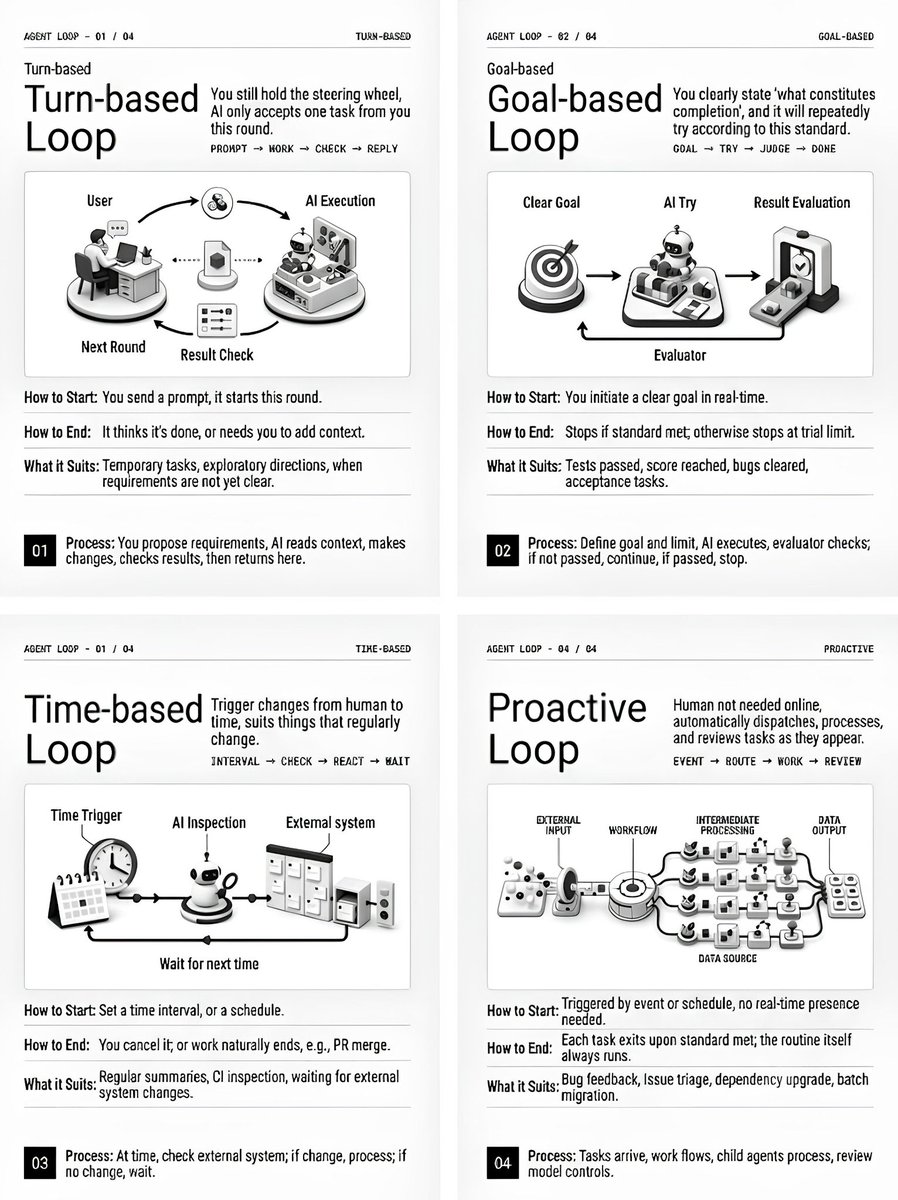
Claude Code just dropped "Getting Started with Loops"
This is their first official document about Loop Engineering.
Spoiler: prompt engineering didn't survive.
Here's the full guide in one post:
1. Turn-based
Every prompt you send already runs as a loop: Claude gathers context, takes action, checks its own work, and repeats until it decides the task is done or realizes it needs your input.
2. Goal-based
You define what "done" looks like with /goal, and Claude keeps iterating toward it. Every time it tries to stop, a separate evaluator model checks your condition - if it's not met, Claude gets sent back to work until the goal is reached or the turn limit hits.
3. Time-based
This is the /loop command: нou set an interval and a prompt fires on schedule. For example, every 5 minutes Claude checks your PR, addresses review comments, and fixes failing CI.
4. Proactive
Here you set up an event once, and the loop triggers itself whenever that event happens - with zero human input.
Anthropic also shared optimization advice - and this part matters most:
- Loop quality depends on system quality.
- Tokens are the real cost
None of this is magic. It's the same familiar parts - /goal, /loop, Skills, Hooks - composed into systems that run without you.
I built exactly that kind of system in my article:
Loop that wakes up at 6 AM, finds work on its own, reviews itself, and leaves ready PRs for you. Step by step, from SKILL(.)md to cron trigger: