Another reminder that the hand on the switch of commercial satellite services belongs to the company (or the government that can influence it), not the military user. Sovereign (and secure) communication capability is not a luxury, it is an operational necessity. #AtmanirbharBharat
@NarenNp@KRANTII01@quant_guru
Another reminder that the hand on the switch of commercial satellite services belongs to the company (or the government that can influence it), not the military user. Sovereign (and secure) communication capability is not a luxury, it is an operational necessity. #AtmanirbharBharat
@NarenNp@KRANTII01@quant_guru
Troubling if true. The information may (or may not) be worthless but the larger question is why aren’t we securing our data. Indigenous solutions exist. Need to realise the gravity and start implementing. #PQC@KRANTII01@quant_guru@cdf_23@CaptDKS
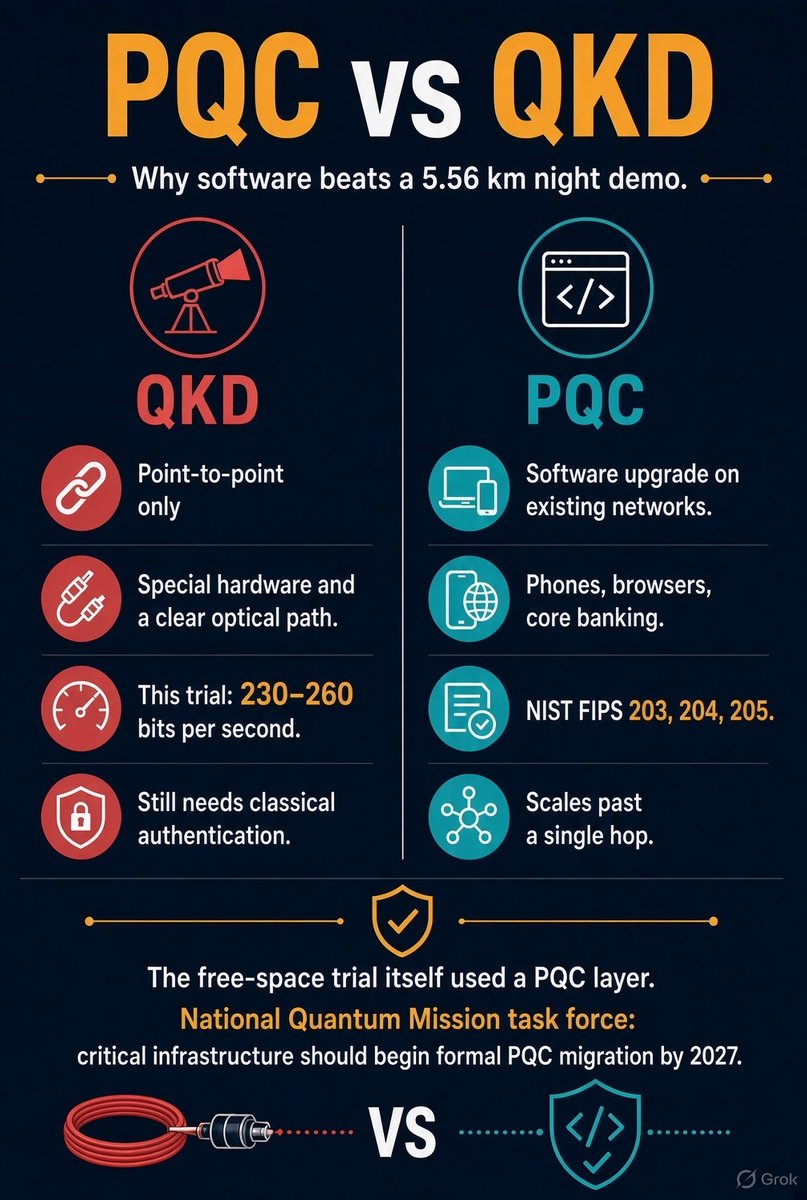
In my reply to @upadhyaya_kriti’s post detailing the recent QKD (Quantum Key Distribution) trial, I bring out the advantages of PQC (Post Quantum Cryptography) over QKD. She correctly states that the US has prioritised PQC over QKD. So has our National Quantum Mission Task Force. There is a good reason.
Happy to debate.
@adgpi@indiannavy@IAF_MCC
A suggestion @svembu, we could consider integrating and offering Post Quantum Cryptography (PQC) as an add-on paid service especially targeting strategic users or even civilian use-cases where security is critical. @ScytaleAlpha (an @India_iDEX winner) could collaborate with you to roll out this feature quickly
Why can driven wheels spin at different speeds without shredding tires?
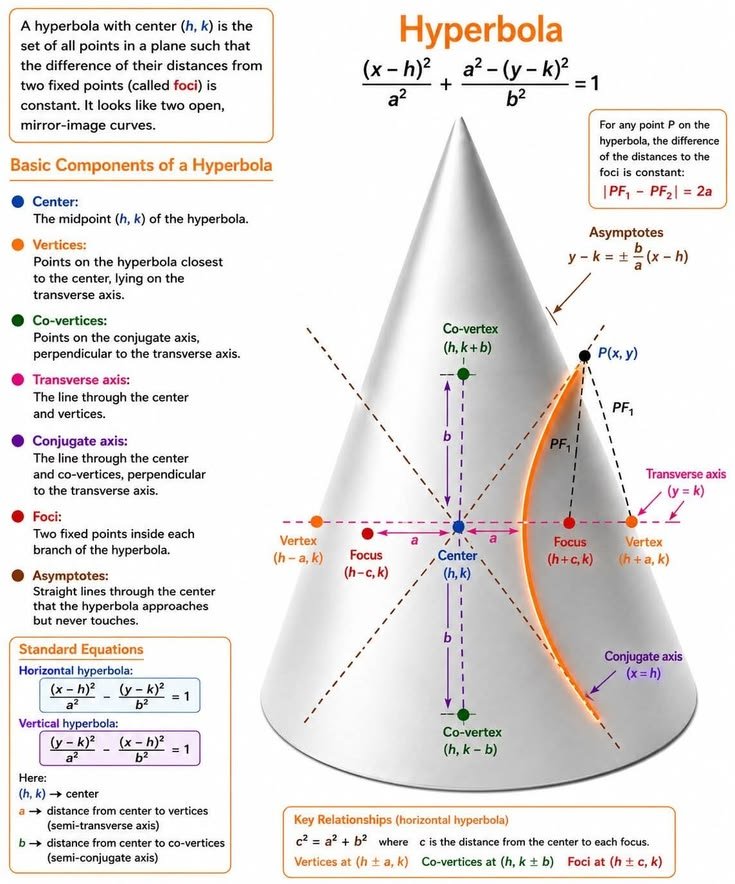
Bevel satellites mesh side gears at 90°. Tooth count is
Zₛₐₜ = 2Rₑ / (mₑ √(Uₛₐₜ² + 1))
so pitch cones share one apex. That constraint lets a car turn without fighting its own drivetrain.
The same cone packing appears in robot joints and EV e-axles.
A short equation often decides whether two shafts may disagree.
Where else have you seen geometry, not torque, split motion?
No matter how the curve snakes from (p, r) to (q, s), the blue region plus the green region is locked at qs − pr.
That single geometric fact forces
∫r^s u dv + ∫_p^q v du = uv |{(p,r)}^{(q,s)}
Parametrize by x with u = f(x), v = g(x).
The identity becomes the product rule run backwards:
∫_a^b f g' dx = [f g]_a^b − ∫_a^b g f' dx
Finite-element codes for elastic solids rely on exactly this shift: derivatives move onto the known shape functions so the stiffness matrix is assembled from boundary integrals alone.
Which other classical identity gains the most from being drawn as pure area?
The internet was busy debating jantar Mantar & a quiet facility in India witnessed something straight out of science fiction. An engine fired up. But it did not hum & it did not roar like a normal jet.
It detonated. Continuous supersonic shockwaves raced around a circular chamber 1000s of times/sec, harnessing controlled explosions to generate thrust.
The startup D-Propulse just gave the world a sneak peek of their air-breathing Rotating Detonation Engine (RDE) with an integrated aerospike nozzle.
Every jet engine on a commercial airliner, every fighter jet & every rocket we have ever seen operates on deflagration. We mix fuel with air/oxygen, ignite it & it burns relatively slowly at subsonic speeds. It is effective, but humanity has pushed this tech to its absolute physical limits.
RDEs throw that century-old playbook into the fire. Instead of burning fuel smoothly, an RDE explodes it intentionally. A continuous detonation wave sweeps around an annular (ring-shaped) channel at supersonic speeds, reaching over 2000 m/s. This is called Pressure-Gain Combustion.
It extracts 15-25% more thermal efficiency out of the exact same amount of fuel. In the world of high-speed flight, a 25% jump in efficiency is a completely different league.
Why this Matters for India?
For decades, the narrative surrounding Indian engineering was tied to catching up on legacy systems, spending billions trying to replicate 1970s turbofan engine metallurgy/importing critical defense tech.
D-Propulse is proving that India does not need to play catch-up anymore.
By leapfrogging straight to Pressure-Gain Combustion, an Indian deep-tech startup, guided by veteran scientists & built by young engineers is standing on the frontlines alongside research labs in the US, Japan & China.
Imagine hypersonic cruise missiles, ultra-long-range combat drones & spaceplanes that do not need heavy, complex moving turbopumps to break speed records. That is the realm this technology unlocks.
The future does not belong to those who build better versions of old machines. It belongs to those who rewrite the physics of how machines work.
Bir foton yıldızların içinden çıkıp 4 milyon yıl boyunca güneşin çekirdeğinden yüzeyine yolculuk ediyor sonra 8 dakika daha sana ulaşıyor ve sen o ışığa bakıp geçmişini görüyorsun diye düşünüyorsun ama kuantum fiziğinde ertelenmiş seçim deneyi diye bir şey var ve bu hikayeyi paramparça ediyor
Deney şöyle çalışıyor bir foton iki yarıktan geçiriliyor ve hangi yarıktan geçtiği ölçülmediğinde dalga gibi davranıyor her iki yarıktan aynı anda geçiyor ve girişim deseni oluşuyor ama ölçüm cihazını sonradan açtığında foton sanki baştan beri tek bir yoldan gelmiş gibi davranıyor geçmişi gözlemlendiği ana göre yeniden yazılıyor
Şimdi bunu büyüt milyonlarca yıl önce bir y��ldızın içinde üretilen bir foton uzayda sana doğru geliyor ve sen tam şu an o fotonu ölçmeye karar verene kadar o fotonun hangi yoldan gittiği belirsiz kalıyor yani o parçacığın milyonlarca yıllık geçmişi senin bir kararınla bu saniye kesinleşiyor ya da tamamen siliniyor evren gözlemlenene kadar arkasını açık bırakıyor
Ve sarsıcı kısım şu eğer şu anki bir eylemin milyonlarca yıl önceki bir parçacığın geçmişini belirleyebiliyorsa zaman çizgisi düşündüğün gibi doğrusal bir çizgi değil şimdiki bilincine göre yeniden yazılan esnek bir kurgu olabilir bu durumda geçmiş dediğin şey seni belirleyen sabit bir gerçek değil şu anki gözlemin üzerine çöken bir gölge
Insanın kendi geçmişine duyduğu o sarsılmaz inanç belki de kuantum silgisinin yarattığı bir algı illüzyonu belleğin sana anlattığı hikaye evrenin sana sunduğu tutarlı bir render ve sen o renderin içinde sadece izleyici değilsin aynı zamanda yazarsın gerçekten bir geçmişe sahip olduğunu ve o geçmişin seni belirlediğini iddia edebilir misin yoksa her sabah uyandığında evren seninle birlikte mi başlıyor
Ve belki de bu değil şu gözlemci olmadan gerçeklik var mı yoksa sen baktığın için mi var
Stress distribution is the way internal forces are spread throughout a material when an external load is applied.
A uniform distribution keeps a structure stable, while concentrated stress can lead to deformation or failure. Understanding stress distribution is essential for designing safe and durable engineering structures.









![mathemetica's tweet photo. No matter how the curve snakes from (p, r) to (q, s), the blue region plus the green region is locked at qs − pr.
That single geometric fact forces
∫r^s u dv + ∫_p^q v du = uv |{(p,r)}^{(q,s)}
Parametrize by x with u = f(x), v = g(x).
The identity becomes the product rule run backwards:
∫_a^b f g' dx = [f g]_a^b − ∫_a^b g f' dx
Finite-element codes for elastic solids rely on exactly this shift: derivatives move onto the known shape functions so the stiffness matrix is assembled from boundary integrals alone.
Which other classical identity gains the most from being drawn as pure area?](https://pbs.twimg.com/media/HPDlOhdaUAEcsty.jpg)