A world map of the proof of the Riemann hypothesis!Introducing a fully interactive map of the semantic embeddings of all the Lean declarations and proofs in the formalization of the Riemann hypothesis.
You can explore the whole proof visually, see where the declarations live and how they connect and interact, search the map, and follow links to the original source code. The map will be updated with each iteration of the proof.
If you want to focus on one aspect of this monumental proof, you can now locate semantically related fragments. I hope this will help structure the code and broaden our understanding of its high- and low-level structure.
soon .... 🇵🇱
kilka słów - open silniki i modele
- silniki 3.0 i 3.1 - gotowe i przetestowane będą wprowadzane kolejno (za dużo na raz funkcjonalności) - absolutnie zoptymalizowane pod Gemma4
- omni-2.0 - trening trwa - początek grudnia cała rodzina
typhoon - specjalizowany silnik (ultra wydajny), pod uszytą nową architekturę decyzyjną (pierwsze testy - moc porównywalna do ultra, szybkość mini), production ready - prezentacja mocy - szacuję końcówka listopada. Prawdopodobnie będą dwie wersje - typhoon 1.0 (omni-ultra a szybkość mini) oraz typhoon 1.0-ultra (moc powyżej ultra 2.0).
te kilka słów byście wiedzieli nad czym obecnie trwają prace w drodze do silnego modelu decyzyjnego
“Thinking with Looped Flows”
Looped models can spend more compute by recurrently updating hidden states, but truncated backprop makes it hard for early steps to learn computations that stay useful later.
This paper trains recurrence through progressively easier denoising objectives with decreasing noise, turning reasoning into a flow from noise to solution while carrying a recurrent state across steps.
This able to obtain more stable test-time scaling and 58.8% on ARC-AGI-1 and 12.2% on ARC-AGI-2, outperforming prior looped models overall.
https://t.co/cQ5rxpXJPS
Introducing TimesFM-3, a state-of-the-art time series foundation model that enables accurate multivariate time series forecasting in a single forward pass, significantly outperforming other forecasting models across major benchmarks.
More on the blog →https://t.co/uSlnIdUJ4Q
We can finally talk about it:
We found a way to extract hidden reasoning of frontier models using a vulnerability in the APIs of every frontier AI company.
We verified that our reasoning token count matches billed API thinking tokens 1:1 for most of the prompts we queried.
Use Case 3: One-Shot Blindfold Chess
Can an AI hold an entire game state in memory without drifting?
To test Fugu Ultra’s persona stability and sustained memory, we had it play 4 back-to-back games of blindfold chess. Every model played the same way: no board shown, requiring them to hold the full game state entirely in memory.
We matched Fugu Ultra against 3 leading frontier models and a 2100-Elo Stockfish engine.
The Results: Fugu Ultra outplayed all 4 opponents. Where the other models eventually drifted or lost track of the board state, Fugu remained accurate, ending every single game in checkmate.
Watch the full sequence below to see Fugu capitalize the moment the other models slip.
Today we’re introducing Gemma 4 12B — our latest open model that brings advanced agentic reasoning, vision and audio directly to your laptop.
It delivers performance nearing our larger Gemma models with a much smaller total memory footprint, while being small enough to run locally with just 16GB of VRAM. It’s open and accessible for everyone to use under a permissive Apache 2.0 license.
This is all made possible by our new, unified architecture that removes separate multimodal encoders. Here’s how we did it 🧵
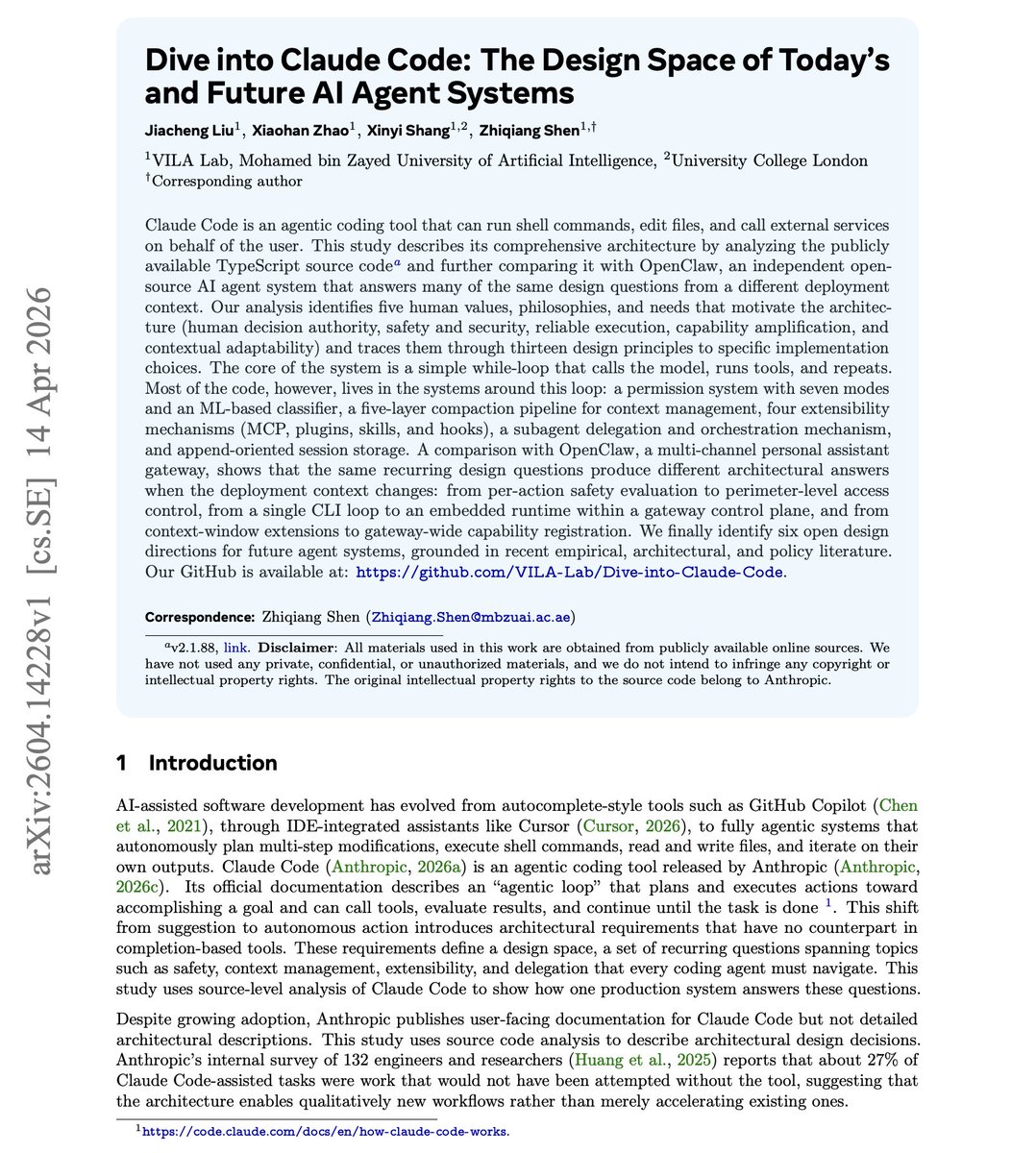
Fascinating and very deep article about DeepSeek AI (@deepseek_ai). You would have never guessed what their strategy is, it's really interesting:
They're not chasing quick money from coding plans or multimodal models. Instead, their radical architecture innovations (MoE, MLA, Engram, mHC, etc.) slash KV cache and compute needs so dramatically that they can build an entire 10T Chinese AI hardware ecosystem (NAND, LPDDR, ASICs) and position themselves for a 1T valuation in the process. Long game, masterfully played.
Language is discrete. Language models don’t have to be.
🧚Introducing ELF🧚♀️: Embedded Language Flows—a class of diffusion models in continuous embedding space based on continuous-time Flow Matching 🧵
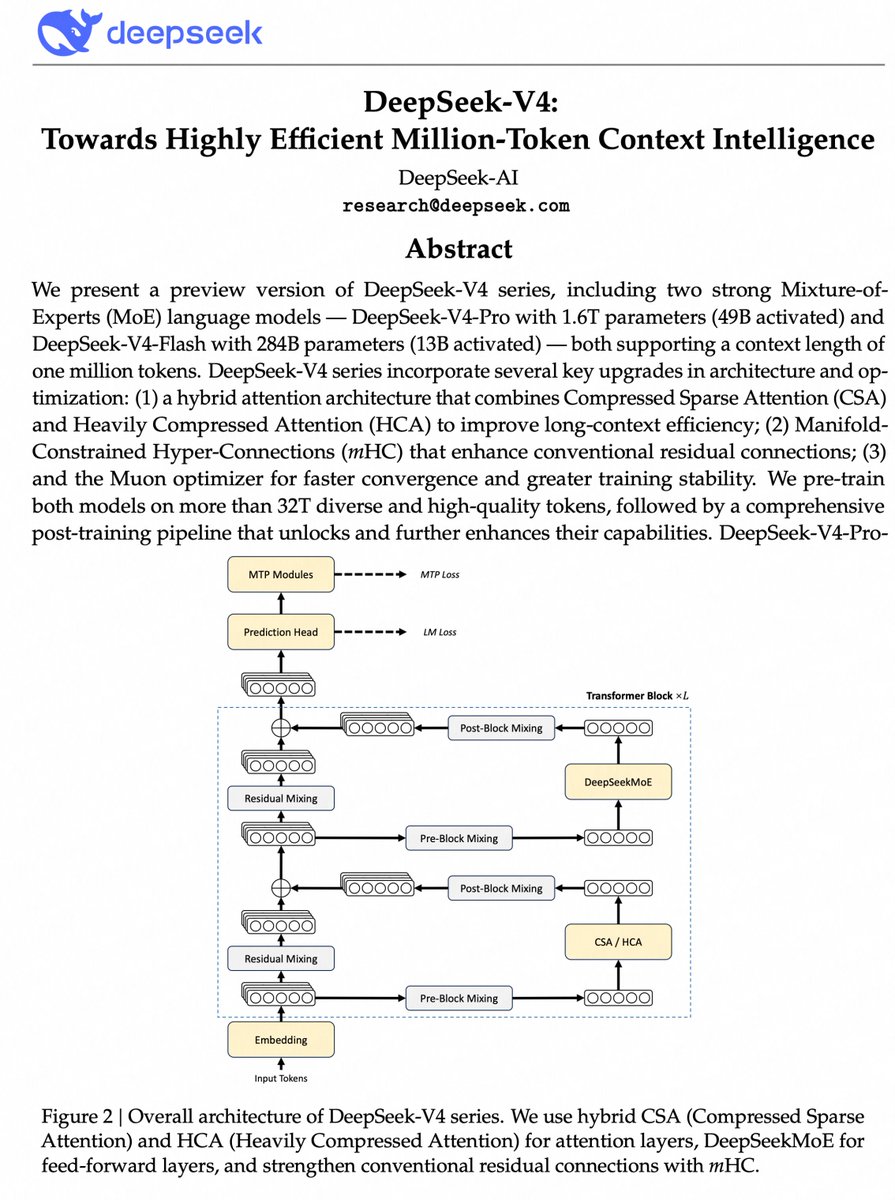
Deepseek V4 Pro is the biggest open model ever with 1.6T total 49B active, trained on 33T tokens, 1M context, with 2 new attention mechanisms, Muon, mHC, open source kernels, FP4 QAT, MIT license and with one of the best tech repot of the year
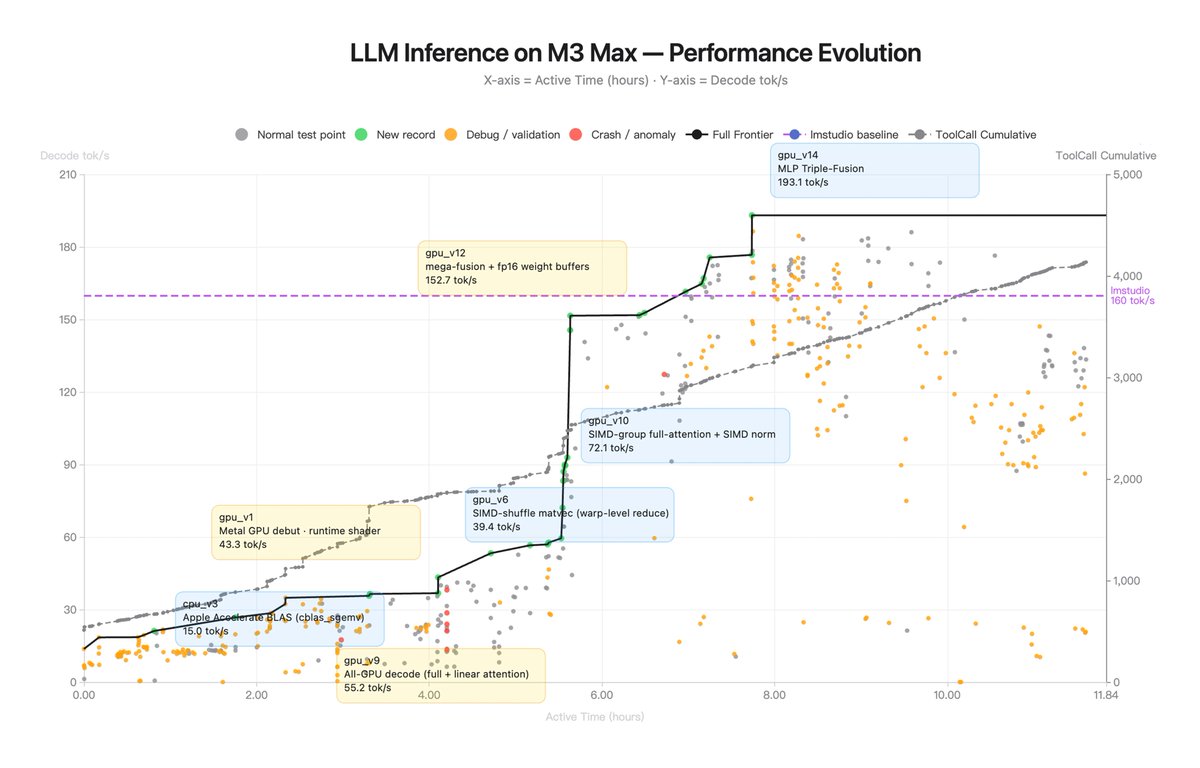
Kimi K2.6 demonstrates strong long-horizon coding in complex engineering tasks:
Kimi K2.6 successfully downloaded and deployed the Qwen3.5-0.8B model locally on a Mac. By implementing and optimizing model inference in Zig—a highly niche programming language—it demonstrated exceptional out-of-distribution generalization.
Across 4,000+ tool calls, over 12 hours of continuous execution, and 14 iterations, Kimi K2.6 dramatically improved throughput from ~15 to ~193 tokens/sec, ultimately achieving speeds ~20% faster than LM Studio.
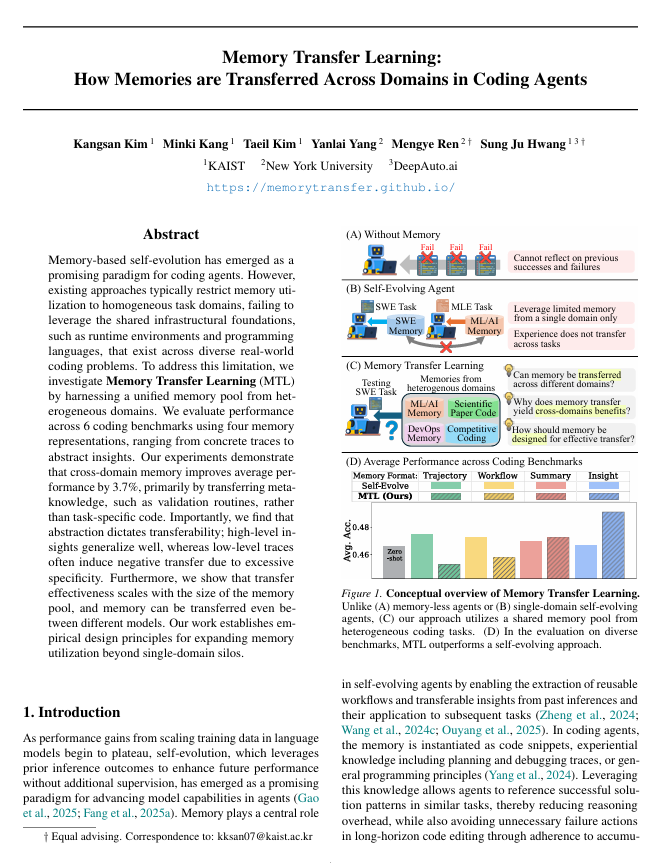
.@KAIST_AI and @nyuniversity proposed a cross-domain shared memory for coding agents
This idea is called Memory Transfer Learning (MTL)
Build one big memory pool from many different kinds of coding tasks
and let the agent reuse that memory across domains
→ This memory can become a shared resource and a general experience library for many agents and models.
The improvement (+3.7% on average) comes from meta-knowledge:
- how to validate a solution
- how to structure debugging
- what checks to run
- how to detect failure patterns
And all of this should be at the right level of abstraction, because memories that are too specific to the task hurt performance.
So debugging memory, code generation memory, testing memory → all go into the same pool. The more memory you have, the better the transfer works.
MTL is the way for the coding agent to reuse general reasoning and checking rather than just exact solution traces.
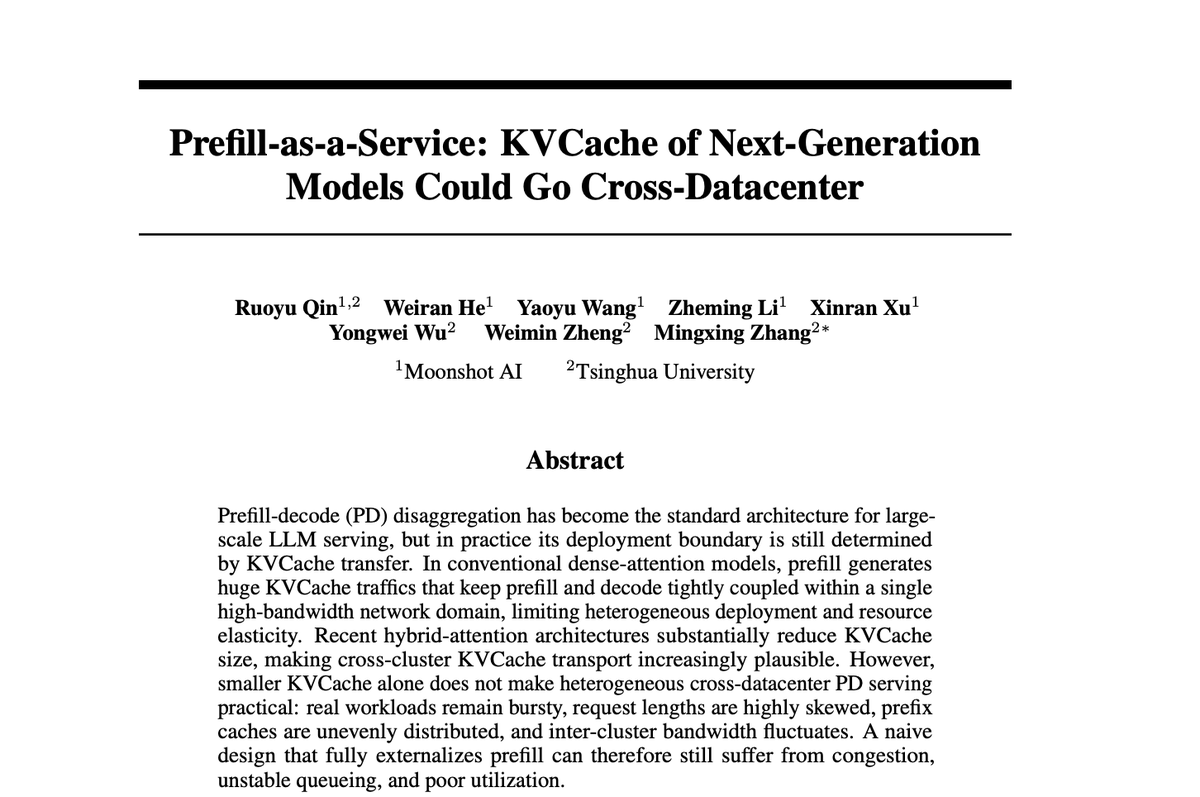
We push Prefill/Decode disaggregation beyond a single cluster: cross-datacenter + heterogeneous hardware, unlocking the potential for significantly lower cost per token.
This was previously blocked by KV cache transfer overhead. The key enabler is our hybrid model (Kimi Linear), which reduces KV cache size and makes cross-DC PD practical.
Validated on a 20x scaled-up Kimi Linear model:
✅ 1.54× throughput
✅ 64% ↓ P90 TTFT
→ Directly translating into lower token cost.
More in Prefill-as-a-Service: https://t.co/If8fA3t9Og
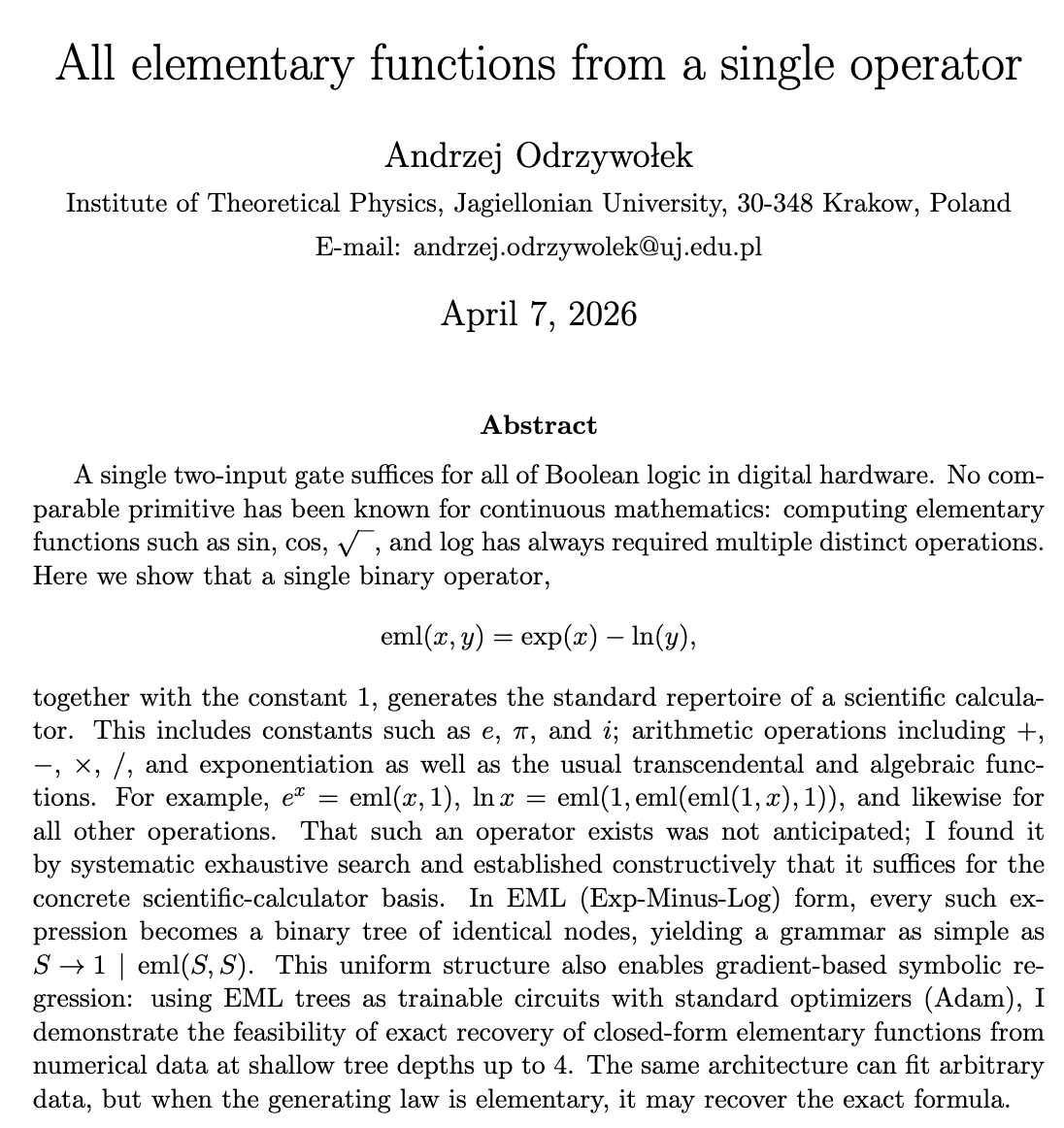
The Polish theoretical physicist who proved that you can recreate all mathematical functions from just this one operation is Andrzej Odrzywołek from Jagiellonian University @JagiellonskiUni. Truly a remarkable piece of work! Congrats @AndrzOdrz
https://t.co/vnWJB4JCmf
Linux kernel 7.0 is now available, featuring stable Rust support and updates to filesystems, networking, virtualization, and security.
https://t.co/cj0Zfhv9QN
#Linux#Kernel#OpenSource