🚨 Cristiano Ronaldo: "Is the ketchup bottle open?
I know that whoever works, God helps him. It was a tough week, a dark one, it started as if I had retired from football.
But I held on as I always hold on because I believe in work more than football.
It was tough, I have to admit that, but we came back.”
🚨🇵🇹 Cristiano: “I know that whoever works hard, God helps him. It was a tough week, a dark one, it started as if I had retired from football”.
But I held on as I always hold on because I believe in work more than football. It was tough, I have to admit, but we came back”.
@drake0DTE Please could you let me DM you, I have a brand sponsor ship deal for you and your channel. I would love to see if you are interested!
Thank you
@DaveShapi Hey, I hope you are well
Please can I dm you, I have a brand deal that I would like to pitch you, the brand is looking for Content creators like yourself
Thank you!
Guys please donate to my brothers son, stabbed in the heart in a vicious assault a few days back in Pimlico, London.
We need all the prayers possible to see him pull through and sadaqah in his name. Let’s try get as many blessings as possible. Times like this only God can help, it’s critical and he’s a young uni student.
May Allah bless him and his family & overcome this trial. Ameen.
Every donation counts.
Thank you
https://t.co/ZMOimQ0eNI
سيدنا إبراهيم توقع أن يموت عقيماً وكان رد زوجته متعجبة وقالت عجوز عقيم لكنه أصبح أباً لكثيرين ونسله كنجوم السماء سيدنا يوسف توقع أن يكمل حياته مسجوناً لكنه أصبح الرجل الثاني بعد عزيز مصر ، سیدنا داوود توقع أن يموت على يد جالوت لكن مات جالوت وملك داوود متحطش سيناريوهات من خيالك
How mental distancing improves willpower and self-control:
"Self-control fails when we are not able to move in distance. When it's far away, it's easy. When it's close, it's really difficult."
"Referring to yourself in the third person creates psychological distance that gives you just enough to think of it as far as opposed to close."
"When you ask yourself 'What would Batman do?' you literally have to think like Batman. In other words, literally turning me and my cognitive system into somebody else."
Dr. Kentaro Fujita on @hubermanlab
◾️Kadı Şüreyh der ki:
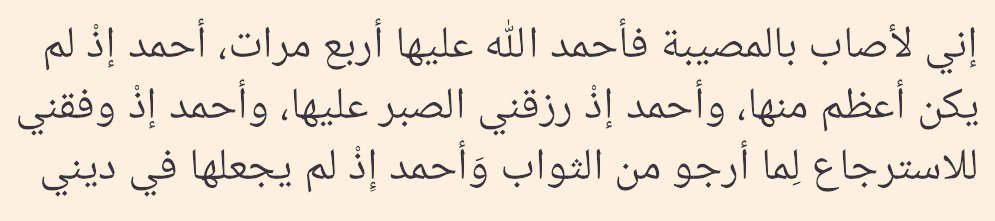
📍Başıma bir musibet geldiğinde, Allah'a dört defa hamd ederim:
1. Hamd ederim ki, o musibetten daha büyüğü olmadı.
2. Hamd ederim ki, o musibete karşı sabır göstermemi nasip etti.
3. Hamd ederim ki, o musibeti: "İnnâ lillâhi ve innâ ileyhi râciûn / Biz Allah’a aidiz ve şüphesiz O’na döneceğiz.” diyerek karşılamamda beni muvaffak kıldı, ki bu sözü söylemekten dolayı sevap umarım.
4. Hamd ederim ki, o musibeti dinim hakkında kılmadı.
Why Are You Still Waiting for a Miracle?
People tend to imagine that certainty must come through something dramatic. They try to find it in things like rare events or visible miracles that overwhelm the senses and leave no room for hesitation. It’s as if the ordinary texture of life is too familiar to carry that level of conviction, and certainty must therefore arrive from outside through some exceptional event.
The Qur'an navigates this human thirst for spectacle with exquisite psychological precision. Even when it brings an extraordinary event before you, it does not let your mind come to rest there. It takes your gaze somewhere deeper. It redirects you from the unusual "miracle" to a more fundamental sign that has been with you all along, so near to you and so constant that you've almost stopped seeing it.
When Zakariyya (as) calls upon his Lord in weakness and hope, he stands at a point where, by every human measure, the doors of possibility already seem closed. He's old and his wife is barren, and yet the response comes with glad tidings of a son named Yahya. He responds in wonder at how such a thing could be. He knows full well that nothing is beyond Allah’s power, but what he’s looking at are the apparent obstacles that would normally make such a thing seem out of reach.
Then comes the divine answer: "It is easy for Me. And I brought you into being before, when you had not been anything at all."
There’s more than just comfort and reassurance in that answer. There’s a recalibration of the very scale by which human beings measure wonder. It's as though the verse is saying: why does this strike you as the greater marvel when your own existence is the greater marvel? Why should the birth of a child in old age seem so astonishing, while your own coming into being after not existing at all has become, in your eyes, something ordinary?
This speaks to that recurring human habit. We become captivated by the exceptional because we've grown numb to what is more fundamental. We imagine that certainty can only be found in witnessing something rare, when in reality the deepest signs are often those that are nearest to us, most constant around us, and most woven into the very fabric of our being.
But our persistent demand for spectacle is actually a mask for something else. It reflects a deeper resistance to the truth more than a sincere search for evidence. When the Qur’an addresses people who ask for miracles on their own terms, it hardly ever makes the miracle itself the center of attention. Again and again, it shows that even when striking signs are given, disbelief can remain exactly where it is. It reminds us that a lack of evidence was never really the issue, and that entire civilizations in the past were granted the very spectacles later sought by others, only to turn away in arrogance. It brings the human being back to what should already be impossible to miss: “And in the earth are signs for those of sure faith, and in your own selves; do you not then see?” It turns our attention to the shifting winds, the rise and fall of nations, the intricate balance of the cosmos, and the breath moving through you this very moment. Because a heart that‘s grown blind to the signs already present all around it is rarely awakened by one more extraordinary event.
It’s as if the Qur’an is training the human heart not to become dependent on spectacle. It teaches it how to look again at what it has learned to take for granted. It teaches it that the familiar is not insignificant simply because it is familiar. There are signs whose constancy makes them easier to ignore, even though they can be far greater than the unusual things people imagine would finally settle their doubts.
He says "I brought you into being before, when you had not been anything at all" not to remind you of some hidden or uncertain event, but of the most obvious and undeniable fact about your existence: that you came to be after once not being there at all. He's reminding you that everything you now take for granted about your inner life, your awareness, your thoughts, and your very capacity to reach out to him Him was brought forth from nothing by His power.
Once that settles into the heart, many of the signs people keep chasing begin to look strangely small by comparison. A person can live as though certainty is still being withheld from him, while all the while he‘s alive, conscious, reasoning, desiring, and speaking. He can continue waiting for some further spectacle, even as he stands within a reality more astonishing than many of the things he says would finally convince him. In that sense, the one demanding a miracle is often already using a miracle to demand another miracle.
The same pattern appears in the way Allah deals with human weakness and need. When a person is overwhelmed by what he needs and what he's desperately asking Allah for, when he sees it as too difficult or too unlikely, the Qur’an doesn’t answer the request in isolation. It reconnects the heart to something Allah has already done for you that you've become far too familiar with. It strengthens hope by reminding the human being of prior blessings, prior care, prior mercy, and a history of divine favor that was already there before the present difficulty appeared.
When Musa (as) is given the immense task of confronting Pharaoh, he asks for what he needs in order to carry it: expansion of the chest, ease in the task, clarity in speech, and the support of his brother Harun (as). He‘s granted what he asks, but the response doesn't just end there. Allah immediately reminds him of the care and favor that had already surrounded him from much earlier in his life. He reminds him how He inspired his mother to save him from Pharaoh, and that He protected him as an infant, returned him to her, and carried him through one stage after another until this moment. He reminds him that the One helping you now is the same One who‘s already been taking care of you long before this moment. What He‘s granting you today is not something detached from everything that came before it. It stands within a larger pattern of mercy and care through which He has already been carrying you all along.
In Surat al-Duha, the Prophet (pbuh) is similarly comforted through a reminder of what preceded the present pain:
”By the morning brightness, and by the night when it grows still, your Lord has neither forsaken you nor turned away from you. And surely, the life to come is better for you than this one. And your Lord will surely give you until you are pleased. Did He not find you an orphan and give you shelter? And find you lost, then guide you? And find you in need, then enrich you?”
The comfort comes through remembrance. The heart is brought back to earlier blessings so that it can understand the present moment properly. What feels heavy in isolation begins to look different when seen within a longer history of divine care.
What all of this teaches the human being is not to isolate what he hopes for from the broader reality of what Allah has already shown him and already given him. We often take one desired outcome, one apparently closed door or unlikely blessing, and we let it grow so large in our sight that it begins to overshadow everything else Allah has already shown us. The Qur’an brings that need or request back into a wider picture and reminds the human being of the signs already surrounding him, the blessings already behind him, and the astonishing reality of the very existence through which he is making the request in the first place.
Once that wider picture is restored, the scale changes. What seemed immense begins to look small before the One who brought you into being when you were nothing. What seemed remote begins to look closer before the One whose care has already accompanied you through stages you barely remember. What seemed too extraordinary to hope for begins to lose some of its strangeness before the One in whose power your life, consciousness, and very existence already stand as a constant sign.
إخواني الكرام :
والدتي الكريمة ترقد في المستشفى وحالتها حرجة ، فأرجو ألا تنسوها من صالح دعائكم ، لعل دعوة صادقة من أحدكم توافق ساعة استجابة ، فيمنّ الله عليها بالعافية والشفاء …
اللهم اشفها شفاءً لا يغادر سقمًا ، وألبسها ثوب الصحة والعافية ، وتولّها برحمتك وفضلك …
Hairline Retention Guide: https://t.co/RcPg1DtBBU
Detailed guide on how to retain your hairline & reverse male pattern baldness
- Why DHT isn’t actually the ‘villain’ in the hair loss mechanism
- The Peaty framework for understanding why your hormonal optimisation matters more than your genetics
- The exact way to slow it down, stop it, or reverse it without castrating yourself
You’re welcome 🫡