It’s clear to me that @OpenAI has one of the most compelling advertising opportunities ahead of it. The scale, use engagement and combination of search and behavioral data are incomparable. With folks like Vijaye Raji and Benji Shomair at the helm, I’d be surprised if OAI ad revenue is not at least $10b annualized by 2030, and likely much bigger ($25-50b+).
The scale of ChatGPT is a big differentiator for OpenAI, and I hope they don’t abandon or deprioritize it in the rat race to focus on enterprise and developers.
Let's take a look at how Seattle's DoorDash law actually turned out.
In 2024, Seattle implemented "PayUp" — a minimum wage law for food delivery drivers, setting the rate at $26.40/hour. The intent was to protect workers. Here's what actually happened:
DoorDash added a $5 fee to every order. Customers stopped ordering. Within two weeks, 30,000 fewer orders. UberEats volume dropped 30%. Drivers — the people the law was supposed to help — saw their available deliveries cut in half and earnings per hour fall 25%.
A new National Bureau of Economic Research study confirmed what the numbers already showed: higher per-delivery pay was completely offset by fewer deliveries and lower tips. Active drivers saw zero net gain in monthly earnings.
KUOW reported this week that two years in, the results are undeniable — Seattle is now the most expensive delivery market in the country. Denver, Portland, and San Francisco, cities without these laws, saw delivery revenue grow 20-40%. Seattle stagnated.
The parallel to what's happening with WA tax proposals is obvious. SB 6346 would impose a 9.9% income tax on high earners. The QSBS add-back bills would strip federal tax exclusions from founders. The argument is always "just a small tax on those who can afford it." But capital moves. Founders move. Companies incorporate elsewhere.
The DoorDash data gives us a controlled experiment: same company, same product, same time period, different policy environments. The city with the heaviest regulation saw the worst outcomes — including for the workers it tried to protect.
Incentives matter. Every time.
https://t.co/0rusleqBbk
#StartupLaw #WashingtonState #PolicyMatters #QSBS #Founders #waleg
The convergence of sequence modeling and recommendation systems has opened new frontiers in artificial intelligence.
🚀 Our new multi-layer sequence learning architecture demonstrates LLM-like scaling law, while delivering performance in latency-sensitive ads ranking models.
This new architecture is deployed for user representation within Meta’s ads recommendation as a resource efficient, multi-stage system that boasts high upstream-to-online transfer ratios.
👉 Read our research paper to learn more: https://t.co/WA41I4zlAF
The Adolescence of Technology: an essay on the risks posed by powerful AI to national security, economies and democracy—and how we can defend against them: https://t.co/0phIiJjrmz
The first symptom of a poorly managed team is good players looking really poor. Liverpool have that in abundance. Slot should have gone last week. It isn’t going to improve.
In India, doctor bashing is a political sport because doctors are considered "rich looters" since the public feel that increasing general consultation fees by 100 rupees is catastrophic...
...when this so-called health minister arrived in a ₹10000000 Range Rover along with the media to fire the CMO of a public hospital...
...all because the senior doctor who I was told is a gentleman and highly efficient, asked a patient to get a vitamin B12 injection from the outpatient day care service and not emergency services because a vitamin B12 injection was never an emergency.
If there is a species that can be considered scum of the universe, it's politicians of India who dehumanise doctors in front of the public for optics. And the joke is on us because we elect these buffoons to serve us.
"To fund his golfing ambitions, McIlroy's parents took on extra jobs. Gerry worked 100 hours a week; he cleaned toilets and showers at a local sports club in the mornings, served as a bartender at Holywood Golf Club from 12 to 6 pm, then returned to the sports club to work behind the bar in the evenings. Rosie looked after Rory during the day, and worked night shifts packaging rolls of tape at a 3M factory in Bangor, County Down. Due to their conflicting schedules, McIlroy's parents rarely saw each other during this period. Gerry later said: "I had no idea what else to do. I’m a working-class man. We wanted to give our only child a chance."
After finding success as a professional golfer, McIlroy bought his parents a house in 2009, and stated: "I’ll never be able to repay Mum and Dad for what they did, but at least they know they’ll never have to work another day. I’ll do whatever it takes to look after them."
LOLOL
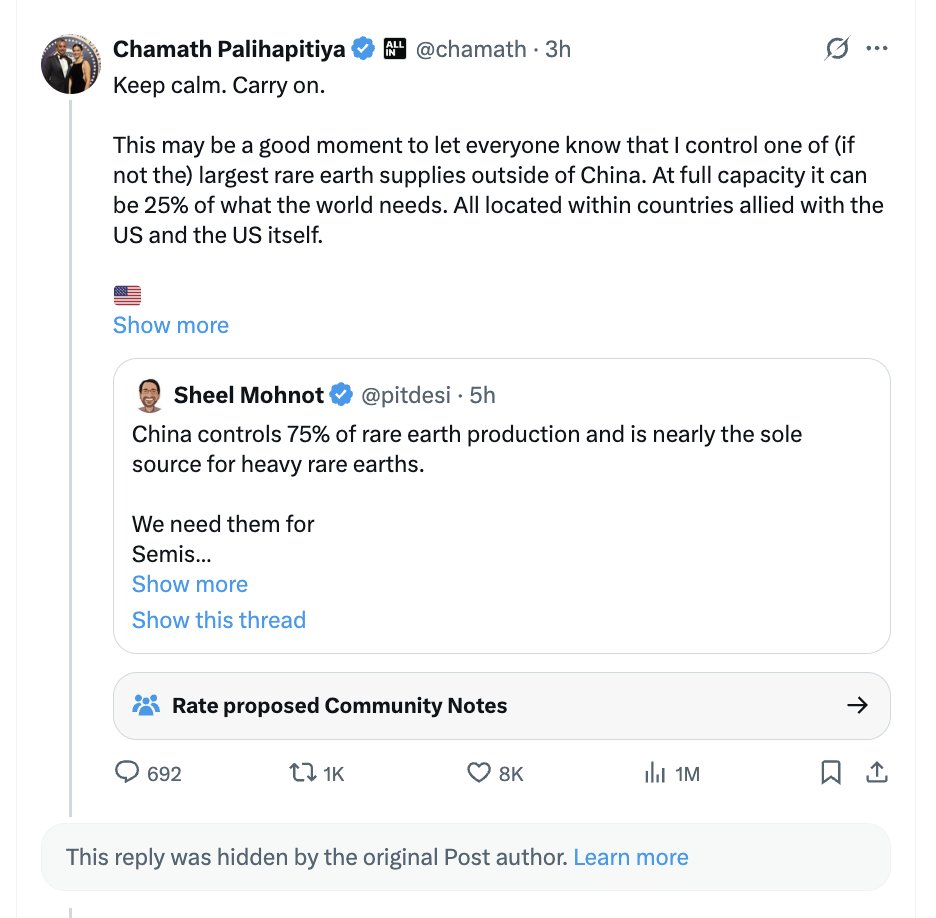
Chamath claims to "control" one of the largest rare earth mineral supplies outside of China.
I comment with proof that CCP owns more of the company than he does (proof below).
Chamath HIDES my comment.
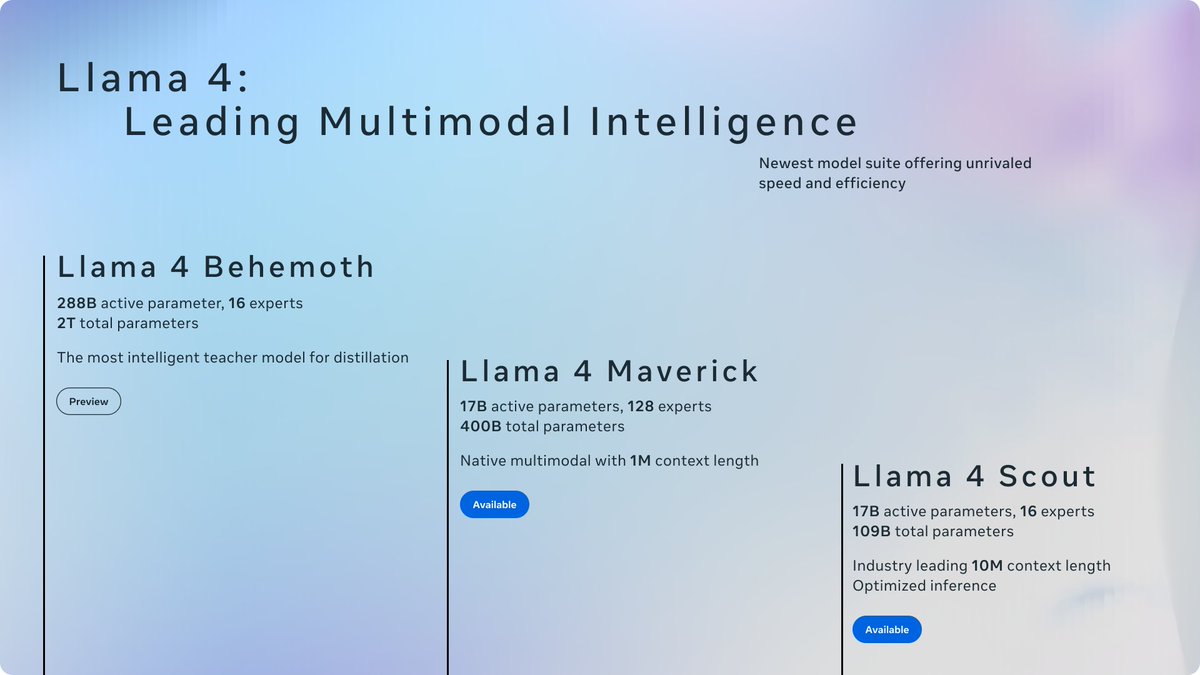
Today is the start of a new era of natively multimodal AI innovation.
Today, we’re introducing the first Llama 4 models: Llama 4 Scout and Llama 4 Maverick — our most advanced models yet and the best in their class for multimodality.
Llama 4 Scout
• 17B-active-parameter model with 16 experts.
• Industry-leading context window of 10M tokens.
• Outperforms Gemma 3, Gemini 2.0 Flash-Lite and Mistral 3.1 across a broad range of widely accepted benchmarks.
Llama 4 Maverick
• 17B-active-parameter model with 128 experts.
• Best-in-class image grounding with the ability to align user prompts with relevant visual concepts and anchor model responses to regions in the image.
• Outperforms GPT-4o and Gemini 2.0 Flash across a broad range of widely accepted benchmarks.
• Achieves comparable results to DeepSeek v3 on reasoning and coding — at half the active parameters.
• Unparalleled performance-to-cost ratio with a chat version scoring ELO of 1417 on LMArena.
These models are our best yet thanks to distillation from Llama 4 Behemoth, our most powerful model yet. Llama 4 Behemoth is still in training and is currently seeing results that outperform GPT-4.5, Claude Sonnet 3.7, and Gemini 2.0 Pro on STEM-focused benchmarks. We’re excited to share more details about it even while it’s still in flight.
Read more about the first Llama 4 models, including training and benchmarks ➡️ https://t.co/9G3QgVdCkB
Download Llama 4 ➡️ https://t.co/eVomRvEr0w
The H-1B was designed to be 6 years. In 2000, employers were struggling because the H-1Bs they had sponsored for green cards were facing a backlog due to the green card caps on each country and their H-1B would expire before they got their green card.
Rather than abolishing the caps on each country and expanding the number of green cards to meet the age of the internet economy, Congress modified the H-1B so that workers in the green card backlog could renew their visa in perpetuity as they wait.
H-1B is now used as an endless waiting room for employees in the green card backlog. Not having a green card after working here for many years causes a multitude of problems. Not only do they have a lot more bureaucratic hurdles and restrictions when it comes to switching jobs, the children they brought with them age out of their dependent visa status when they turn 21, causing them to get kicked out of the green card line and potentially the country. Even the dependents with high paying job offers can be rejected by the visa lottery, or the Department of Labor can take too long to approve their employer's green card petition and they're forced to leave anyway.
They also can't freely travel back home without stopping at a consular office abroad to renew their authorization every 3 years. The renewal process is unpredictable, and people might be stuck in another country for months as the State Department processes their visa renewals.
Why are people still getting in the green card line if the backlogs are so long? Because the government is terrible at projecting how long it takes to get a green card. One year, they say an applicant could get it in 5 years. The next year it could be 20 years. That lack of transparency makes people believe they can wait it out, but it also gives people false hope as their estimated wait rapidly fluctuates.
These people have already bought houses, built families, and have become well seasoned professionals in our broader economy, defense industrial base, and health care workforce.
But rather than worrying about these very real issues, the discourse is centered around imaginary instances of H-1B baristas and cooks making $30,000. Hint: if most RNs aren't considered educated and specialized enough for an H-1B, then a barista certainly is not eligible.
High skilled immigration has been central to America leading the world in tech.
The biggest misunderstand about high skill immigration stems from people thinking that the market opportunities in tech, and tech-adjacent fields, are zero sum. This essentially imagines innovation is finite and we’re all fighting over the same job or opportunity pool.
This may be true of a few very legacy, slow growth industries, but it’s categorically not true for any important industry in the past 50 years or the next 100. Biotech, AI, advanced manufacturing, software, EVs, new energy sources, and dozens of other fields of the future are our high growth industries. And there’s no inherently fixed volume of companies or talent that the market needs.
Tesla being started or not started in America is the difference between 100,000’s of jobs here - and leading in EVs globally - and not. Apple being started here is the difference between potentially millions of jobs being here - and leading consumer electronics globally - and not. You could go through this list all day long.
Tech is not zero sum. More startups, pursuing more ideas, ultimately create more innovation and ultimately more jobs and prosperity. And that means you need the right talent to both work at these companies, and start the next ones. High skilled immigration has directly made America dominant technically and thus economically, and create far more jobs in America for others than are supposedly displaced.
Even briefly imagining the alternative scenario, it’s obvious how disastrous this would be. The demand from tech companies for this top talent will remain, yet America won’t benefit directly from their hiring. That talent will go to another company that competes with the US and makes our dominance harder to maintain. You’re just increasing the odds you have more competition in the future.
And even in the “best case” scenario (for our competitiveness) where a larger company like Google hires the same people internationally that would have otherwise moved here, when that person leaves Google to start their next company, it will be in their country of origin, not America.
This is how you lose the tech war within one or two generations. There’s simply no good game theory in anything that reduces our talent access.
Yes, we absolutely have and need to continue to educate and train incredible talent that grows up in the US, but equally having access to the world’s smartest talent has always been a huge advantage for America.
this christmas, i am humbly asking for your help to support dr. hankinson's research.
if not with $, i would be just as grateful for a repost or a like on this thread.
100% of your donation goes directly to funding the research efforts of Hankinson Lab: https://t.co/z8DcECGXGS
Lot of talk re: layoffs but not as much written about how much of the recent $META success is driven by getting better at helping advertisers find customers
TL;DR: CACs are better than they’ve been in years. Consumer investing has been out of vogue but the math has changed & it'll be back in style.
Observations:
-IG reels is really good now, the algorithm is as good as TikTok imo. Insanely good at showcasing me relevant ads. Reels was terrible at launch (& for too long), the incremental changes have been great. 75% of Meta advertisers are using it now!
-Meta rolled out a bunch of tools/improvements (CAPI, AEM, Advantage+) for better signal measurement, segmenting, targeting, campaign management etc. (Some of this is AI-driven). It's working!
-our consumer businesses have had lower cac than projections for a couple of quarters, cost per ad went up (8% across Meta) but ROAS also went up, simultaneously good for advertisers, Meta, and consumers. Also - auction models work & produce efficiency for advertisers.
-Meta has taken many steps over the years to undo the damages from Apple's privacy initiatives that made consumer CAC’s too high, ROAS is probably back to pre-ATT levels.
-All of these privacy-centric changes/regulations (GDPR/ATT etc) have the effect of creating more power in the hands of a small handful of platforms, perhaps the opposite of intentions.
-One worry is that the Chinese apps (Temu, TikTok etc) have been pushing a ton of ads that are temporary/unsustainable. Meta revenue grew 25% YoY, 500 bps of that is from Chinese apps! Seems like that revenue could contract.
Thoughts?
Recently re-read this. So good.
I'm that middle class kid. I had my one throw, but now trying to afford more tickets for more throws, through things like freelancing.
All the while just hoping I'll never have to go back to working at the carnival.