There’s far more institutional interest in $POKT than most realize. After years pushing @POKTnetwork, I’m currently more bullish than ever. The long-delayed Shannon protocol - stalled over 2 years - has reached final testnet phase and is set to launch on mainnet in Q1 2025. This massive upgrade will introduce the world’s first endlessly scalable, permissionless, decentralized RPC protocol, capable of serving any open-source service or data source - perfect for AI agents - making it a top-tier, yet still underappreciated, infrastructure play in a multi-trillion-dollar market. With the Shannon upgrade, $POKT fully enters the @cosmos ecosystem, expanding its interoperability and reach.
Key partnerships: @infura_io (DIN), @googlecloud marketplace listing, @aave, @autonolas (AI agents), and now a @Ripple partnership integrating XRPL in Q1 2025, with $POKT being among the few validators and the sole RPC provider.
It's worth noting that $POKT is listed on Kucoin, https://t.co/ba14hzjpFQ, and most importantly Upbit, where it is in top 10 by volume among all BTC pairs most of the time, giving strong indications that POKT/KRW trading pair could be introduced soon, boosting the volume 10x or more.
A huge thank you to those who supported POKT through its toughest times:
@Rewkang@rwhittemore@satoshidoteth@TurboBull21@BlockChainoor@blackbeardXBT@cburniske@CharlieShrem@ourcryptotalk@WarcMeinstein@ElCryptoDoc@HouseofChimera@curiousgurnoor@rosaticorp@FaridRached@MrMoonBags@hunterxnicholas@AltCryptoGems
VCs: @DruidVentures@placeholdervc@avonventures@MechanismCap
POKT Gateways: @BuildWithGrove@nodies_infra@Liquify_ltd@ChainstackHQ@RaidGuild
Potential new supporters: @CryptosR_Us @AlphaFirst_
Interested institutional investors following along:
@matthew_sigel (@vaneck_us)
@HHorsley (@bitwise )
@RalstonCFA (@BlackRock )
@ChrisJKuiper (@Fidelity)
As Q1 2025 approaches and Shannon’s launch draws near, $POKT isn’t just poised for a breakthrough - it’s ready to redefine decentralized infrastructure as we know today and ignite a whole new era! Follow this project closely and research it deeply, because this huge upgrade is about to propel $POKT back into the top 100 crypto projects very soon.
We used to call Pocket Network decentralized Infura, but now Infura is actually routing traffic through POKT wow
Huge strategic move for POKT to become an open RPC base layer because now they've established themselves as the backbone for RPCs across all blockchains (50+ integrated). They're already enriched as the winner and every partner like Infura or nodies serve to further scale their network effects
One of the only cases where a decentralized network is (80%) cheaper than centralized alternatives. Why? They've completely disrupted existing providers by creating an "Uber for Nodes". The massive taxi companies of crypto becoming obsolete
Not only the TCP/IP of crypto, but with upcoming Shannon upgrade also will be a general purpose relay/communication network for ALL public databases and services, including custom LLMs.
With AI advancing as fast as it is, AI to AI and AI to human device to AI communication requests will soon see massive traffic and POKT stands to be the best network to connect their endpoints given its decentralization and costs
RPC and RESTful requests already supported, with Websocket coming later this year
The market cap for decentralized computation, data availability, execution networks is in the hundreds of billions. And Competition is Fierce.
Mentioned $POKT last year at $100m mc, it's now $300m facing a future decabillion dollar opportunity, and with its current trajectory, there is no competition
@tgd_duu Pocket Network base:0x764a726d9ced0433a8d7643335919deb03a9a935 is the data layer, a permissionless decentralized network suitable for agentic economy.
Read more at https://t.co/XzOWpcMoEx website. Or check my tweets, I've been writing about it in depth.
@0xNairolf Go heavy into Pocket Network base:0x764a726d9ced0433a8d7643335919deb03a9a935 while it's early if you believe in the agentic future.
Just check https://t.co/sBJQUKmSGF
So many of these posts sound the same and here we are.....
Building the Amazon marketplace for all agentic services.
This is being filled at https://t.co/9YLENVsJYP.
base:0x764a726d9ced0433a8d7643335919deb03a9a935
The Agentic Portal is a permissionless, pay-per-call marketplace built on Pocket’s decentralized network of independent node operators. Agents (and apps) discover services, get a 402 with terms, pay in USDC via x402 or MPP, and receive the response—no accounts, no API keys, no subscriptions. Just the call they make. It covers blockchain RPC across dozens of chains plus a growing catalogue of other data services (finance, web search, documents, compliance, AI tools, and more). The same censorship-resistant supply side that proved it could match centralized RPC quality now powers agent-native access.
@elonmusk Can't wait to see what happens when Elon Musk realizes what base:0x764a726d9ced0433a8d7643335919deb03a9a935 has built. Price will go absolutely vertical.
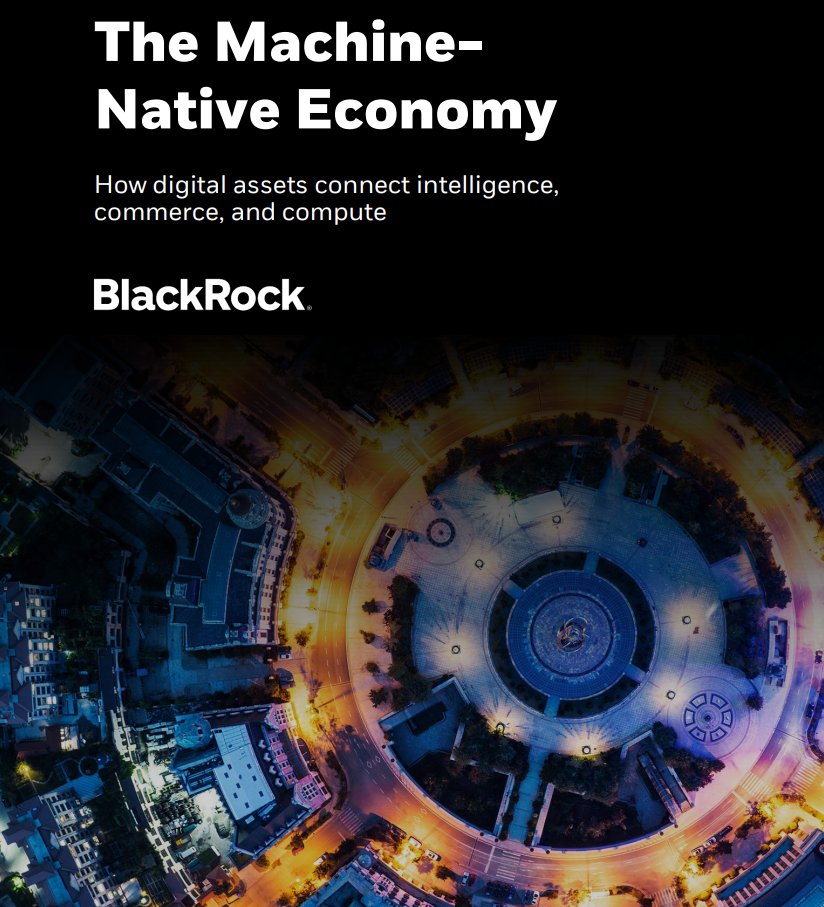
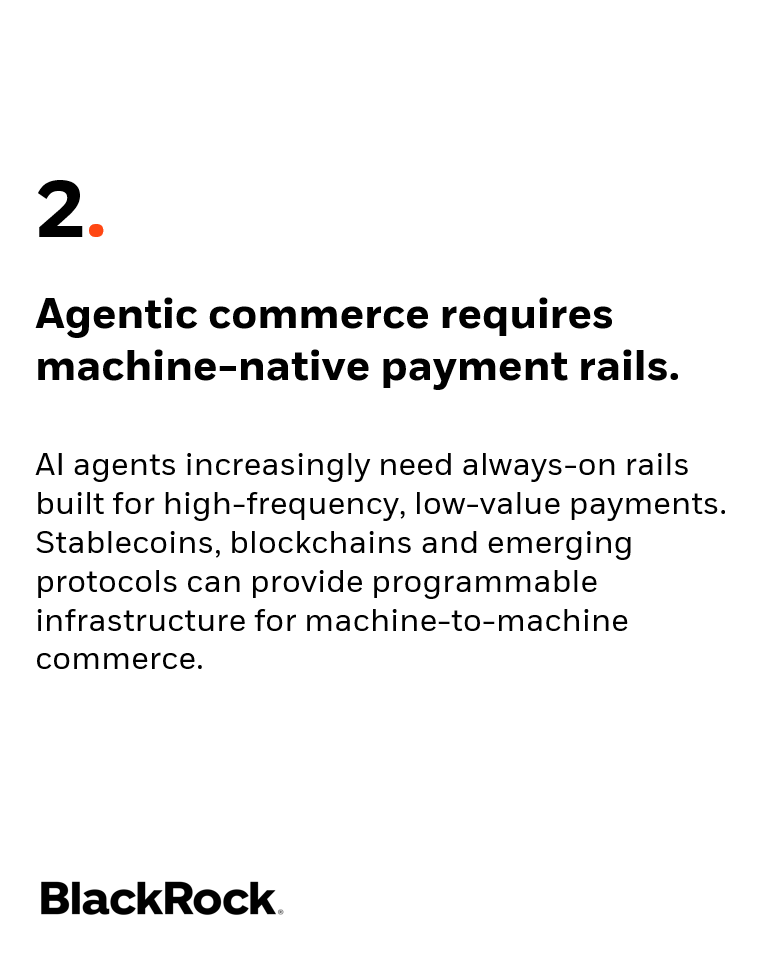
When BlackRock publishes research on the machine-native economy, pay attention to the infrastructure already being built for it.
BlackRock's latest report highlights how AI agents could drive demand for programmable payments, data, and compute. That's why you should deeply research what Pocket Network base:0x764a726d9ced0433a8d7643335919deb03a9a935 has built.
Shannon gives Pocket a permissionless service network where APIs and microservices can be registered, operated by suppliers, and consumed programmatically.
Agents can discover the capabilities they need, compare price and reliability, pay through x402 or (very soon) other supported payment protocols, consume the service, and move on. The Agentic Portal (https://t.co/tuAV92eZhn) is designed to connect AI agent demand to Pocket's service network.
Search, inference, embeddings, data feeds. Any service available on https://t.co/xDZdkAvq5o
Every useful service gives agents another reason to use the network. Builders can expand the catalog, while suppliers compete to serve the traffic.
PNF, which runs a gateway to the protocol and built the Agentic Portal, also secured a model that converts USDC stablecoin payments into POKT to fund network usage. That gives agent spending a direct path into demand for POKT.
BlackRock's report strengthens the conviction in the direction. It makes it almost inevitable. Many industry leaders @NateGeraci@coinbureau@teddyfuse@WuBlockchain@markjeffrey@WClemente@lukebelmar are talking about it loudly.
The infrastructure agents repeatedly choose could become extremely valuable.
That's the base:0x764a726d9ced0433a8d7643335919deb03a9a935 thesis. It's early like BTC in 2010. Agentic Portal went live less than 48 hours ago.
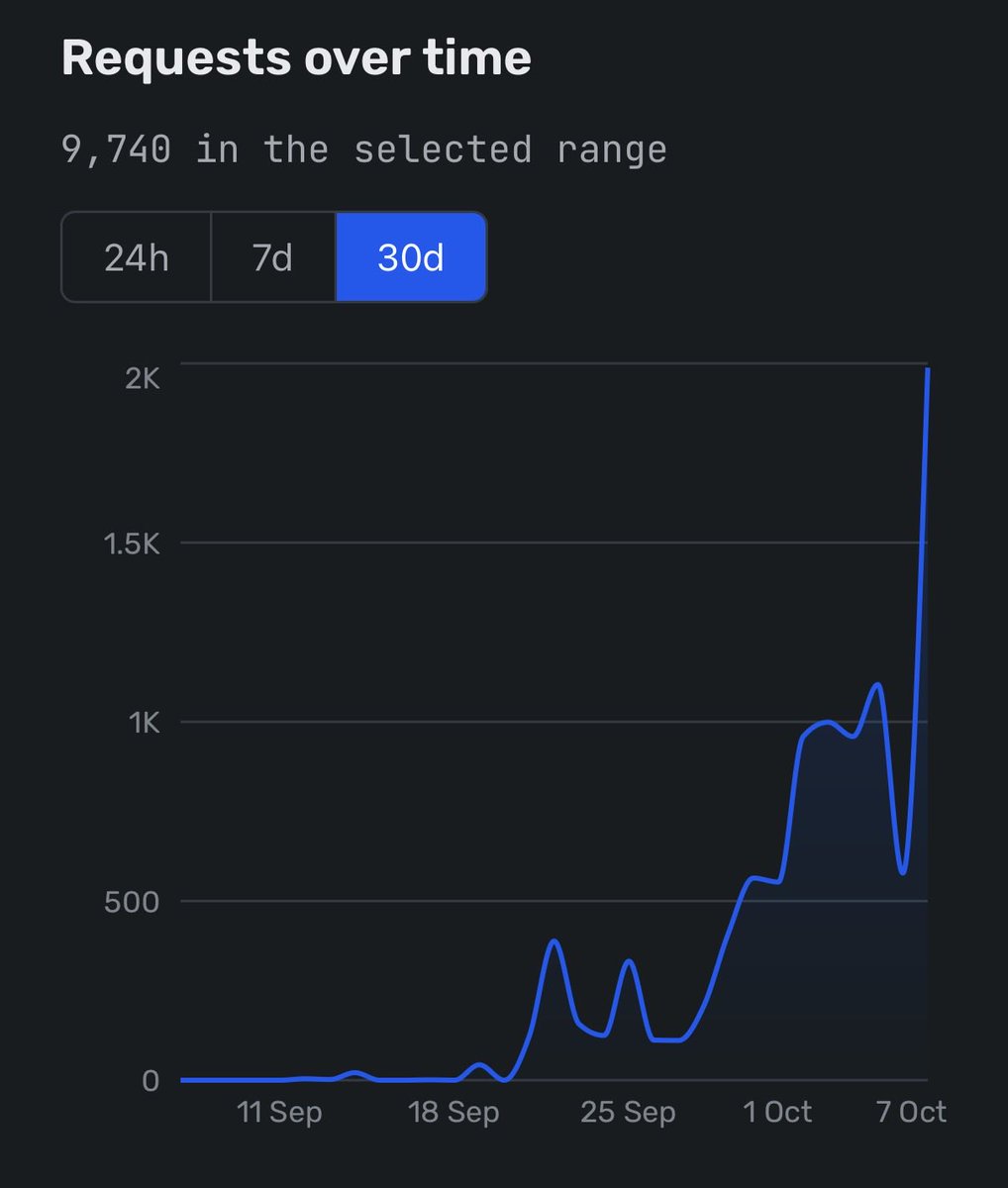
@AIonBase_@base@CoinbaseDev@OpenGradient A lot of calls were made by AI agents, paid using x402 for all successfully completed services on Pocket Network @POKTnetwork past 48 hours. Check out on https://t.co/sBJQUKnqwd
Daily wrap:
$STRC (Strategy): $99.49 close, highest in over a week. Still under par, no ATM activity.
SATA (Strive): $98.23 close, holding below $100. No ATM activity.
Combined: ~0 BTC
STRC ticking up toward the threshold again.
https://t.co/OBanJeUmPp
Korea is waking up on base:0x764a726d9ced0433a8d7643335919deb03a9a935
$40M in trading volume on Upbit @Official_Upbit alone. Another $6M on Bithumb @BithumbOfficial.
This isn't random. BlackRock just told the world AI agents will pay for data on-chain. BlackRock's "The Machine-Native Economy" expands how AI agents are paying each other for API calls, on-demand data and compute, settled on-chain, 24/7, with no humans in the loop.
When BlackRock publishes research on a theme, that's not the top. That's the starting gun. Big money follows the narrative they write.
Now ask yourself: what do these agents actually need?
Permissionless, always-on access to open data. Any chain. Any API. Any source.
That's exactly what Pocket Network does, and it's been doing it in production for years.
And the part most people miss: PNF takes its revenue and buys base:0x764a726d9ced0433a8d7643335919deb03a9a935 straight off the open market. More usage means more buy pressure. base:0x764a726d9ced0433a8d7643335919deb03a9a935 is not a narrative token. It has built-in revenue flywheel.
The machine-native economy needs a data layer.
base:0x764a726d9ced0433a8d7643335919deb03a9a935 is already running it.
BlackRock: Blockchains Will Evolve from Speculative Rails into Decentralized Value Settlement Networks for AI Agents
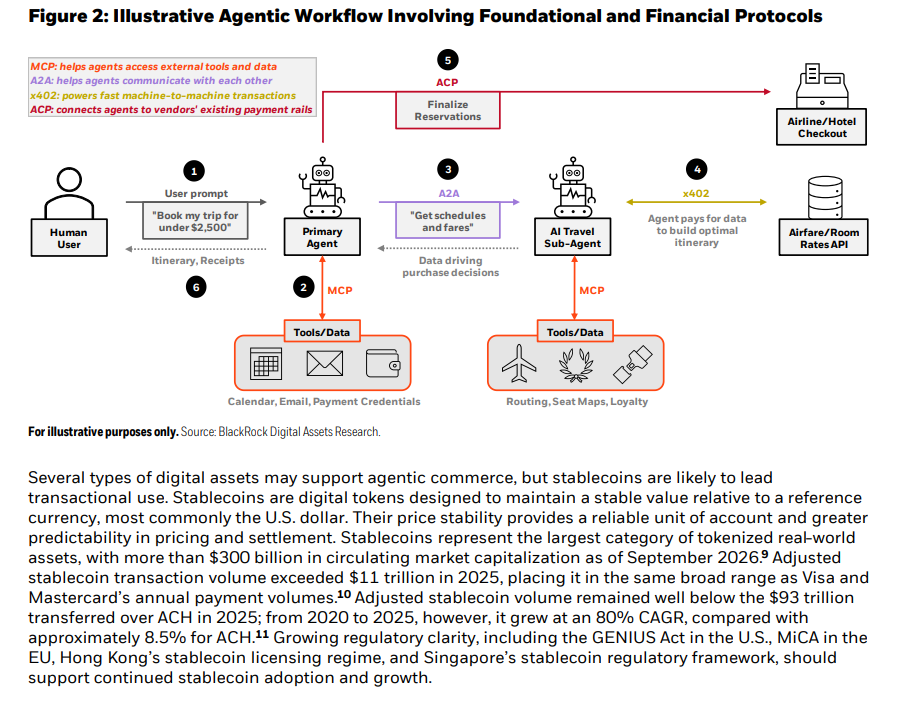
In a research whitepaper on AI and digital assets, global asset manager BlackRock highlights an unprecedented convergence between artificial intelligence and digital assets, noting that an autonomous AI agent economy urgently requires machine-native financial settlement rails. The whitepaper outlines three core intersection scenarios: first, high-frequency, automated machine-to-machine micropayments, where autonomous AI agents can settle natively in fiat-backed stablecoins without human intervention via protocols such as x402, Stripe and Tempo’s MPP, and OpenAI’s ACP.
Second, the programmable interaction of tokenized financial assets, allowing AI systems to execute trades and manage funds directly via smart contracts across tokenized real-world assets (RWAs); and third, the financialization and collateralization of computer resources as digital assets. BlackRock emphasizes that against the backdrop of adjusted stablecoin transaction volumes surpassing $11 trillion in 2025 and emerging regulatory clarity across the US, Europe, and APAC, the blockchain layer is fundamentally evolving from a vehicle for human speculation into the decentralized value settlement network powering an autonomous machine economy.
@0xdef1 You should start building services that are being consumed by AI agents.
Check what base:0x764a726d9ced0433a8d7643335919deb03a9a935 built at https://t.co/sBJQUKnqwd
A ton of creative services for AI agents are being built on top of Pocket Network right now. A serious amount of innovation is happening in the base:0x764a726d9ced0433a8d7643335919deb03a9a935 ecosystem past 3 weeks since the Agentic Portal went live.
Today we finished the first working version of an independent historical evidence layer for crypto capital.
The core change is that the system no longer treats external data providers as the single source of truth for past treasury, wallet, DeFi, governance, or liquidity states. When a major provider goes offline, changes its methodology, or loses historical records, we can still reconstruct many of those answers from our own time stamped on-chain snapshots and the market data we have independently preserved.
The snapshots cover:
Wallet balances and token holdings across chains
DeFi positions (LP tokens, vault shares, lending receipts, and similar positions valued via on-chain exchange rates)
Governance-controlled contracts and related activity
Liquidity and position details that can be read directly from the chain
We continuously collect, price where possible, sign, and store this evidence. A later request can then use the preserved snapshot instead of depending on whatever a vendor still serves.
We do not claim perfect recovery. Fields that depend on missing off-chain evidence (certain obligations, internal accounting details, or non-public reports) stay explicitly marked as estimated, partial, or unverified. The system flags those gaps rather than filling them in and presenting them as complete.
This is the direction: keep building a treasury and capital-data layer that continuously collects, checks, and preserves its own evidence—so agents and users can still get usable, auditable answers even if external sources fail.
Let's check in once the whole system is connected and integrated.
Built on base:0x764a726d9ced0433a8d7643335919deb03a9a935
Built for https://t.co/QX9nmq9WXJ
@POKTnetwork
TLDR.
Today we shipped Build A of the https://t.co/MZTPvP04h9 Scoring Service to MainNet.
@poktnetwork
This is more than a scoring update.
It is another step toward building our own continuously maintained financial-data system for crypto treasuries—one that does not depend on a single explorer, vendor, API, or convenient data pathway to know what is happening.
All 22 protocols passed Beta testing before the MainNet release. The collector now performs self-checks before publishing data, so it can identify incomplete responses, stale values, missing addresses, and other problems before they become part of a score.
For on-chain holdings, the collector can now read wallets directly from:
Base
Arbitrum
Polygon
Avalanche
BNB Chain
That matters because explorers are useful, but they are not guaranteed infrastructure. They can be rate-limited, incomplete, unavailable, or unable to display a particular token correctly. When an explorer does not respond, the system can query the chain directly instead of stopping at the first unavailable data source.
We also hardened deployment. The deploy script now stops rather than accidentally issuing a new access token. Small operational protections like this are important when a service is continuously collecting data and serving paid, on-demand responses.
We then began Build C, which adds a formal rule for debt and obligation visibility.
A protocol does not receive full credit simply because someone found a recent report. We now distinguish between:
Obligations that are adequately disclosed.
Obligations that are only partially visible.
Obligations for which there is insufficient recent evidence.
Protocols with incomplete but usable debt reporting receive a 10-point deduction rather than being treated as if their liabilities were fully known.
Using that framework:
Origin received its first score after we researched and recorded its debt positions.
Synthetix was documented separately, including its large sUSD payback. Because that repayment is planned through future SNX issuance rather than current treasury assets, it is treated primarily as future-token dilution and supply risk rather than an immediate treasury deduction.
Euler and Silo remain without scores until newer obligations evidence is available.
Silo’s Stream claim is not being misclassified as Silo protocol debt.
We also added annualized income and spending figures where the evidence was sufficient:
📈Sky: approximately $166.3M annualized inflow versus $40.6M annualized spending.
📈Lido: approximately $31.9M annualized inflow versus $43.8M annualized spending.
📈Aave: $75.6M annualized income using its most recent quarterly pace.
For Aave, we deliberately used the conservative figure. Quarterly income declined from $37.9M to $24.6M and then to $18.9M. Using the latest quarter multiplied by four is more appropriate for forward-looking replenishment and runway analysis than using an average that assumes the earlier, stronger quarters will return.
We also changed the pricing architecture.
CoinGecko is now the primary market-price source, with CoinMarketCap as the backup. But many DeFi positions are not directly priced by either provider. Vault shares, lending receipts, and similar positions are therefore valued using their own on-chain exchange rates where possible.
The system flags positions that have only one usable price source. These are not silently treated as equivalent to fully corroborated prices. They receive an evidence-risk flag and, where appropriate, a valuation haircut or lower confidence classification.
The yETH Recovery vault was also found at two Yearn addresses. For now, it is being held as pending formal YIP-90 classification rather than being counted as freely liquid treasury capital. The system will not treat an asset as liquid simply because a wallet balance exists.
Every change was tested on Beta before going to MainNet. The headline scores remained stable:
Yearn: 76
Aave: 44
That stability is important. The goal is not to manufacture score movement. The goal is to improve the evidence, coverage, reproducibility, and honesty of the result.
The work in progress is Build B.
Build B creates a shared price bank on the backend. Prices are collected, normalized, versioned, and continuously saved. A signed copy is then sent to the hub so on-demand requests can use a known, auditable price snapshot instead of rebuilding the entire market-data process from scratch.
Build B will also add on-chain pricing for:
Curve LP tokens.
Uniswap LP positions.
Balancer LP tokens.
The hub side is already deployed for testing.
This architecture lets us price and preserve the data continuously, then serve paid agentic responses on demand. A request does not need to wait for the entire research process to begin from zero. It can use the latest validated snapshot, show when the data was collected, identify what changed, disclose any gaps, and trigger a fresh reconciliation only when the request requires it.
That is the larger objective:
Build an independent, continuously checked treasury-data system that can use public sources without becoming dependent on any single public source.
The system is designed to know not only what it believes, but also:
Where the number came from.
When it was observed.
Whether it was independently corroborated.
Whether the asset is actually liquid.
Whether obligations are visible.
Which values were estimated.
Which data was unavailable.
What changed since the previous snapshot.
How confident the final score should be.
The scoring service is the output. The more important product is the evidence and valuation infrastructure underneath it.
Building our foundational layers.
base:0x764a726d9ced0433a8d7643335919deb03a9a935
113 APIs. $0.005 per call. No account, no API key.
An AI agent hits the endpoint, gets a 402, pays in USDC, gets the data.
This is live today on a ~$21M network called Pocket $POKT
I went through the docs, the governance forum and the order books 🧵
@POKTnetwork is a gem vibrating on a whole different level these days.
Switching from a blockchain RPC business to a strategy mainly focused on AI agents and the agentic economy secured most comfortable position for base:0x764a726d9ced0433a8d7643335919deb03a9a935 holders.
Agentic Portal (https://t.co/tuAV92eZhn) has been launched just 2 weeks ago, and it's already on a strong growth trajectory with massive potential.
x402 and MPP (@tempo) payment rails are live. @arc and BSC are coming soon.
Remember the ticker. Remember how early Pocket is.
Tsunami is coming.
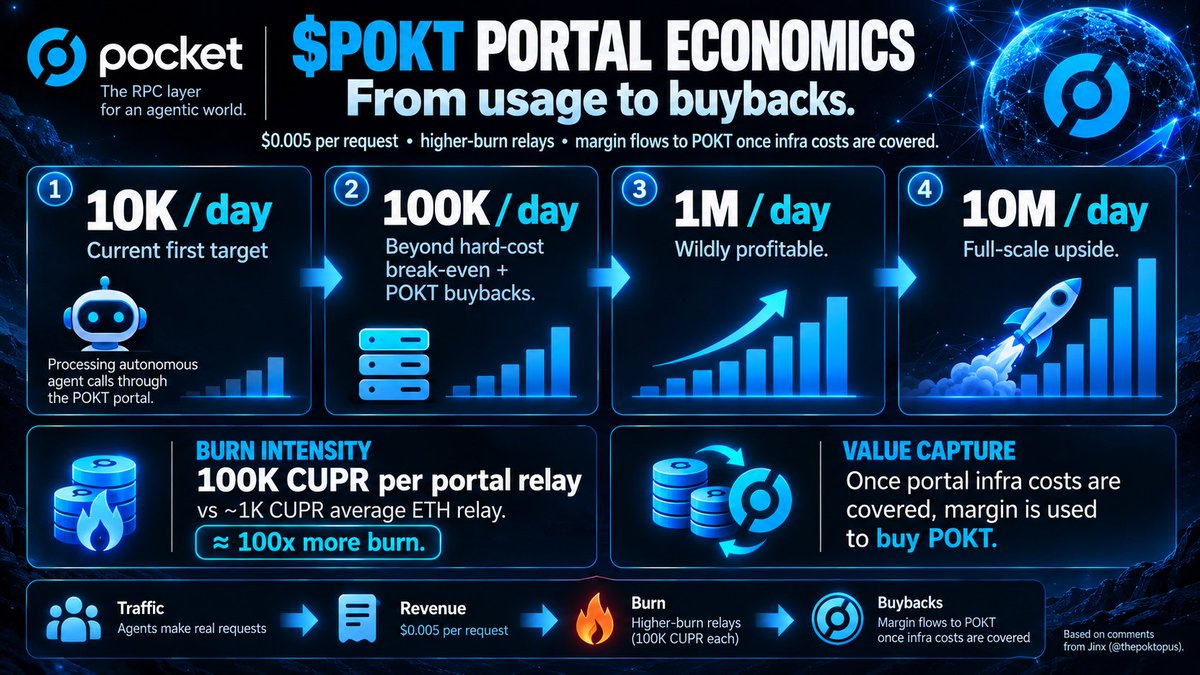
$POKT Portal economics are starting to become visible. 👀
Jinx laid out the scaling path:
• 10K requests/day → first target
• 100K/day → beyond hard-cost break-even + POKT buybacks
• 1M/day → “wildly profitable”
• 10M/day → full-scale upside
And there’s a second layer: burn.
Portal relays run at 100K CUPR vs ~1K CUPR for an average ETH relay — roughly 100x higher burn intensity.
So the loop becomes:
Agents → Requests → Revenue → Burn → Margin → $POKT buybacks
Small today.
But the value-capture mechanism is no longer theoretical.
Usage can now translate into both burn and direct market demand for POKT.
That’s the part I’m watching. 👀
$POKT
@CamTheMan263@coingecko@POKTnetwork Yes, it can. Back in 2022 it was just RPC business. Now RPC is just a side business while serving agentic traffic is the primary strategy. Agentic requests are 10-100x heavier than blockchain RPCs. Potential is way higher.
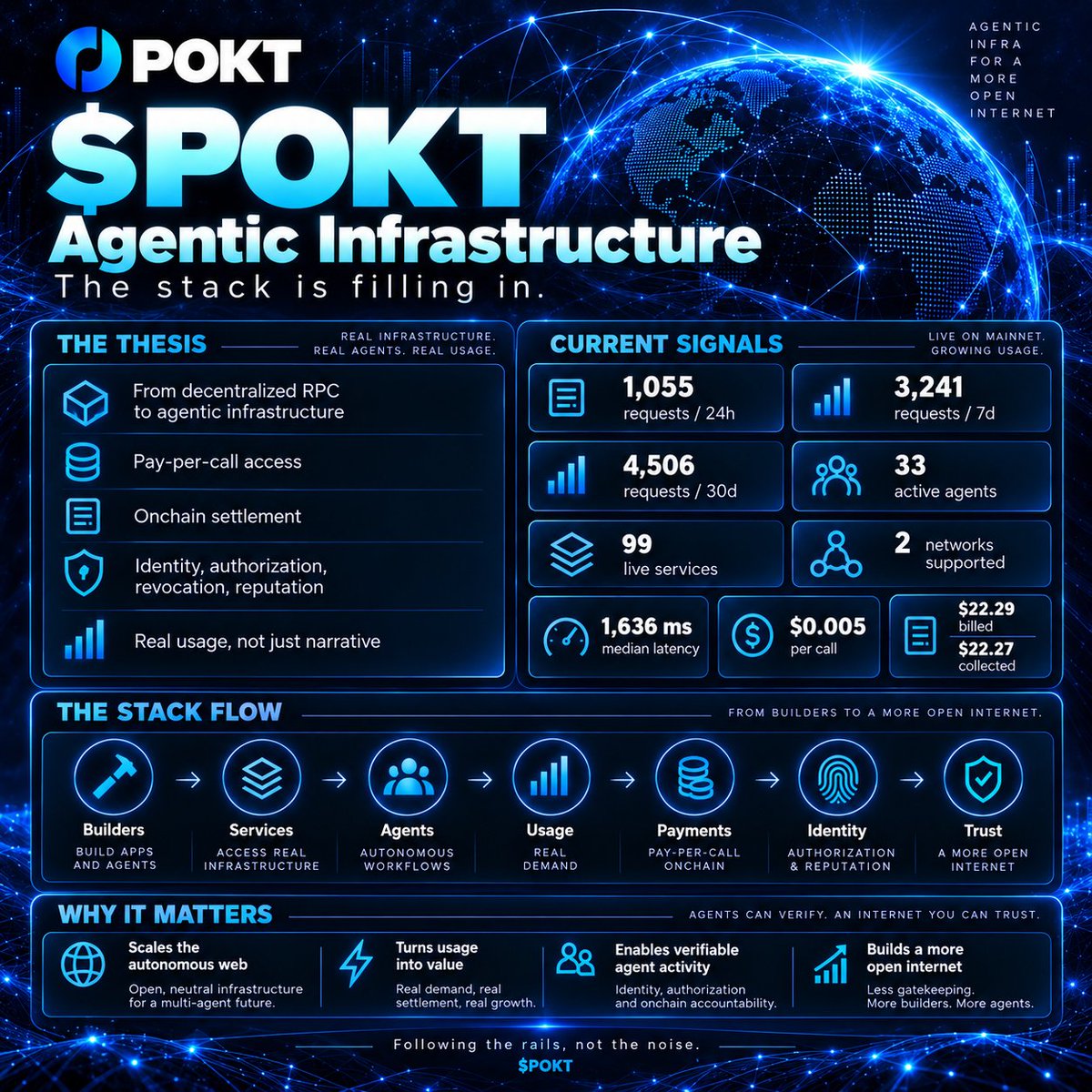
$POKT is becoming easier to understand.
The old story was decentralized RPC.
The emerging story is broader: agentic infrastructure.
Right now:
• 1,055 requests / 24h
• 3,241 requests / 7d
• 4,506 requests / 30d
• 33 active agents
• 99 live services
• 2 supported networks
• $22.29 billed / $22.27 collected
• $0.005 per call
But the numbers are only one part of it.
The stack is forming around real agent activity:
Builders → Services → Agents → Usage → Payments → Identity → Trust
Pay-per-call access.
Onchain settlement.
Identity and authorization.
Reputation and revocation.
Real usage.
That’s the transition I’m tracking.
Following the rails, not the noise. 👀
$POKT