Come join our livestream tomorrow where we'll preview some exciting updates to the Codex and the OpenAI platform.
Tuesday 6/2 at 8:30am PT / 11:30am ET / 4:30pm BST
https://t.co/CpbYn8Z4Xl
jason from the codex team here,
heres a draft on codex maxxing and the primatives i use on a daily basis
https://t.co/DR4N6xtAwe
would love any feedback
at openai we are obsessed with making reasoning more efficient and 5.5 is a step up in this direction.
lower token usage means lower costs + lower latency despite the increased intelligence. i keep hearing 5.5 feels different and this is a big reason why.
> Codex now features the best computer use feature I have ever tested in any LLM or desktop agent — @viticci
The team (and their Codex agents) cooked!
https://t.co/suFkX0BjIS
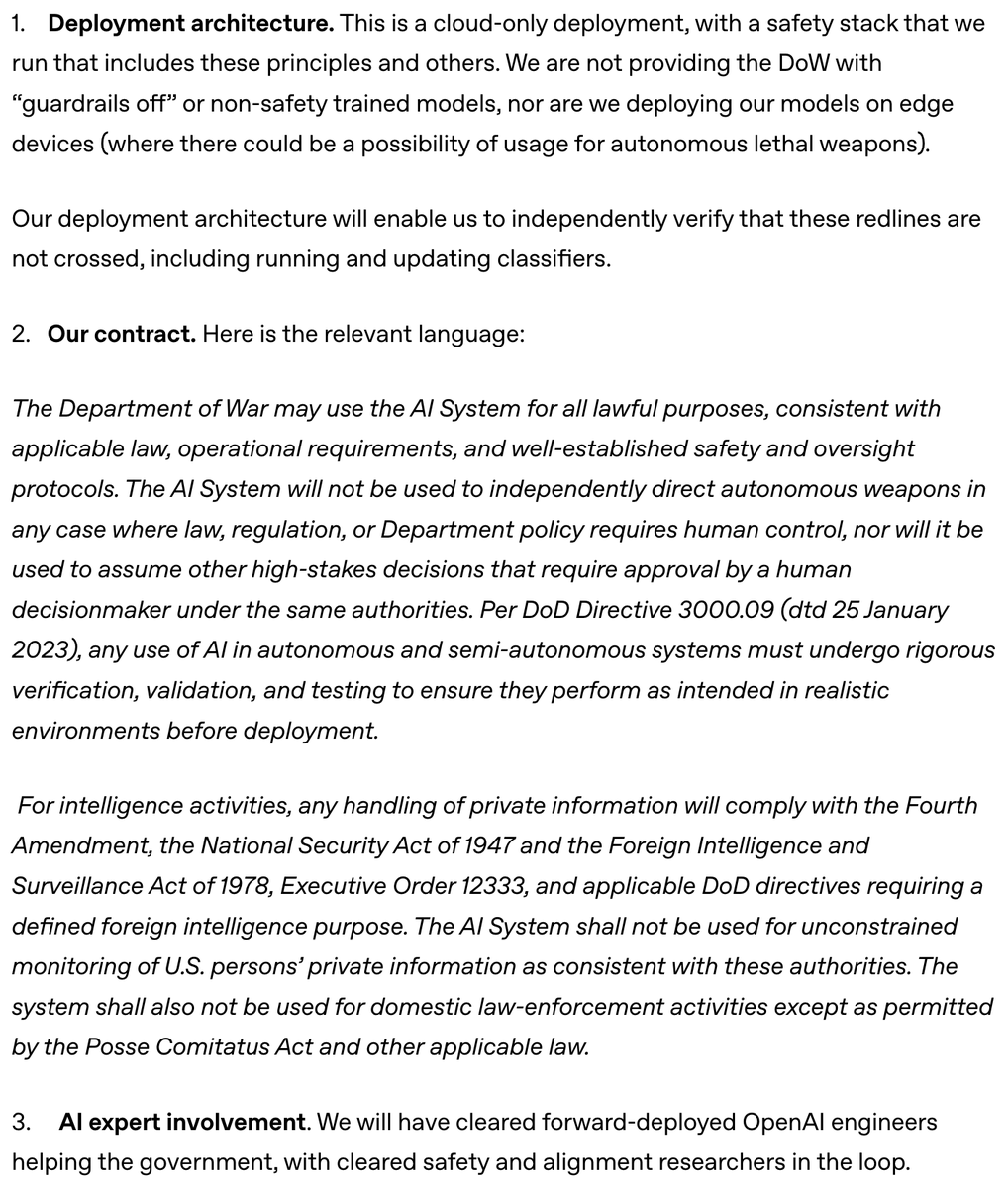
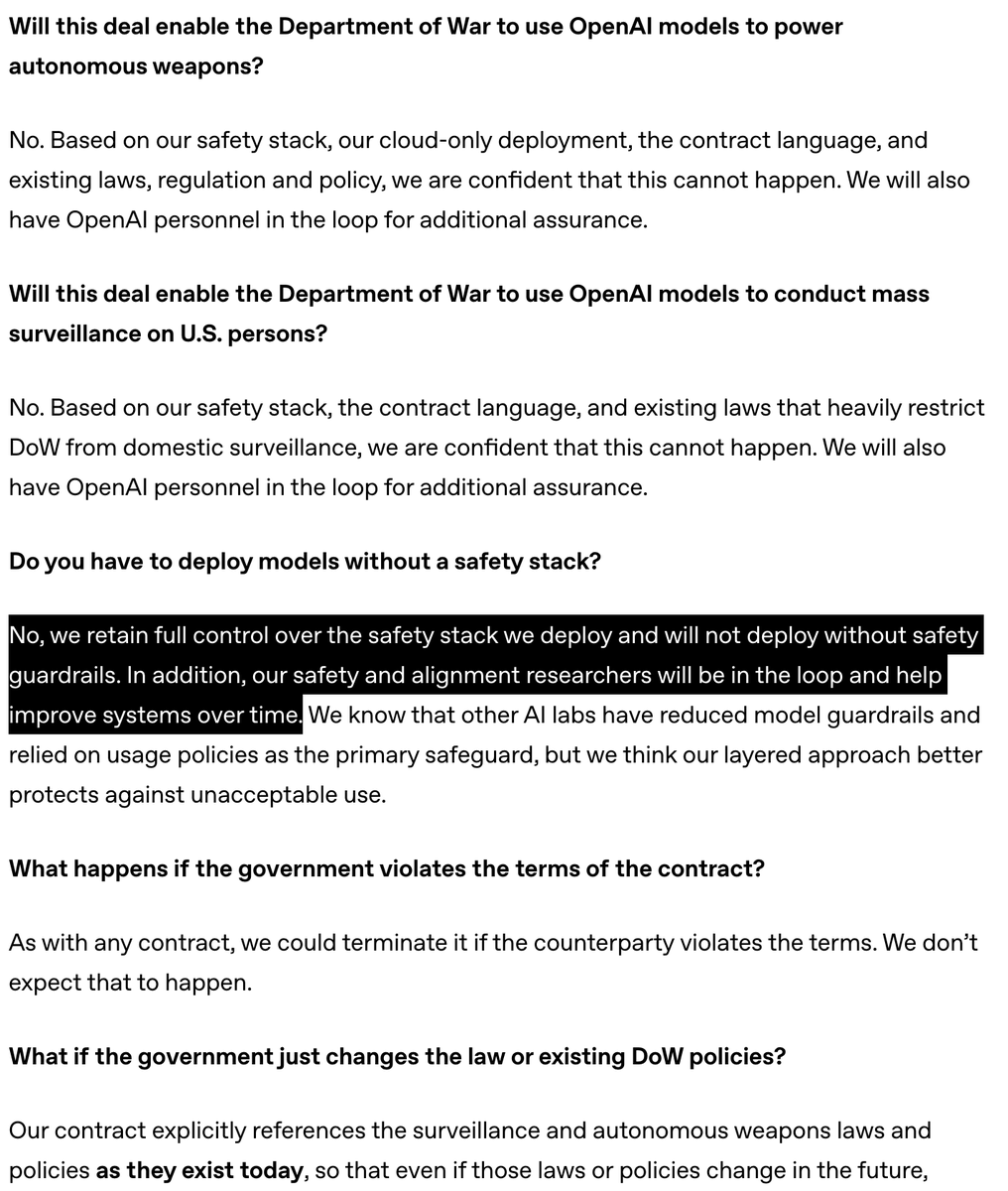
Yesterday we reached an agreement with the Department of War for deploying advanced AI systems in classified environments, which we requested they make available to all AI companies.
We think our deployment has more guardrails than any previous agreement for classified AI deployments, including Anthropic's. Here's why: https://t.co/k1Ge2MqqPr
I know this is pretty well established at this point, but Codex 5.3 is a much more effective model than Opus 4.6. I went back and forth on both for a bit, but haven’t touched Opus at all now for a full week. First model to get me off of Opus… ever. Good job Codex team.
I'm joining @OpenAI to bring agents to everyone. @OpenClaw is becoming a foundation: open, independent, and just getting started.🦞
https://t.co/XOc7X4jOxq
Peter Steinberger is joining OpenAI to drive the next generation of personal agents. He is a genius with a lot of amazing ideas about the future of very smart agents interacting with each other to do very useful things for people. We expect this will quickly become core to our product offerings.
OpenClaw will live in a foundation as an open source project that OpenAI will continue to support. The future is going to be extremely multi-agent and it's important to us to support open source as part of that.
Excited to work with Peter Steinberger to build the future of agents for everyone and to continue to improve Codex in leaps and bounds.
We are committed to OSS, continuing to make OpenClaw flourish and bringing agents to life in a way that is fun, safe and highly productive. Can’t wait to see what we ship together!
the primary criticism of AI you hear has nothing to do with water use or existential risk whatsoever: most people just think it’s fake and doesn’t work and is a tremendous bubble eating intellectual property while emitting useless slop along the way. when GPT-5 came out and perhaps didn’t live up to what people were expecting for a full version bump, the timeline reaction was not mild, it was a full-scale meltdown. there are many intelligent (and unintelligent) people who latched onto this moment to declare AI scaling over, thousands of viral tweets, still a prevailing view in many circles. The financial-cultural phenomenon of machine intelligence is one of the most powerful in decades, and there are a lot of people who would like for its position to be weakened, many outright celebrating its losses and setback. Michael burry of ‘Big Short’ fame, unfortunately the type of guy to predict 12 of the last 3 recessions, has bet himself into insolvency on the AI bubble’s collapse
one of the stranger things about this time is that there are very few secrets, and very little reason to be so misinformed. model labs have very little space in between creating new capabilities and launching them to the public. The view among the well informed public and not just “lab insiders” is that machine intelligence is absurdly joyfully smart at so many new things every month. It’s actively contributing on the cutting edge of programming and math and science. Sebastian Bubeck and co’s recent paper reports that GPT5-pro is capable of producing results on the frontier of theoretical physics research, Terry Tao wrote a blog about “vibe-proving” Erdos problems with the auto-formalization AI Aristotle. You can read that these scientists are using it to actively contribute to black hole physics, tighten mathematical bounds in optimization theory, churning morasses of biomedical data into real insight. Google Deepmind, from the way they are signalling, seems to be slowly closing a dragnet around the Navier-Stokes smoothness millennium problem (though of course, I don’t know). Several companies stocked top to bottom with brilliant scientists are racing to build pipelines to solve novel physics and chemistry and biology
You can read online about the new kinds of organizations being born around machine intelligence as a first class factor of production. For the first time, the new factor actually gives you ideas for improving the processes themselves. It’s designing whole assembly lines where some of the workers on the assembly line are also AIs, and the line itself is morphing and self-optimizing. Tiny teams are producing amounts of work that seemed impossible to organizations of a few years ago. It’s hard not to feel excited by the productivity growth happening in these admittedly narrow software sectors. Every time I use codex to solve some issue late at night or GPT helps me figure out a difficult strategic problem I feel: what a relief. There are so few minds on Earth that are both intelligent and persistent enough about some intellectual pursuit to generate new insights and keep the torch of scientific civilization alive. Now you have potentially infinite minds to throw at infinite potential problems. Your computer friend that never takes the day off, never gets bored, never checks out and stops trying. You can feel the unburdening of Atlas, the takeoff. It feels more prosaic and less poetic than it did in 2023, even though the results speak for themselves more loudly
Really enjoyed demoing how @OpenAI’s FDE team turns messy multi-team enterprise processes into end-to-end AI systems.
The model coordinates across fragmented systems with only a thin logic layer. This is the hardest part most companies never solve.
It also runs structured simulations with verifiable outputs. This is key for business stakeholders to trust it, and is core to our ethos of using the right tool for every job, whether it’s an LLM or not.
Watch my conversation with @apoorv03 on @AltimeterCap's podcast where we dig into all things FDE, including my lessons learned from founding the team.
https://t.co/4NLcUAtjaM
We just open-sourced a Sora API sample app. It’s a fast, lightweight playground for experimenting with the Sora API – generate and remix cinematic videos from simple text and image prompts!