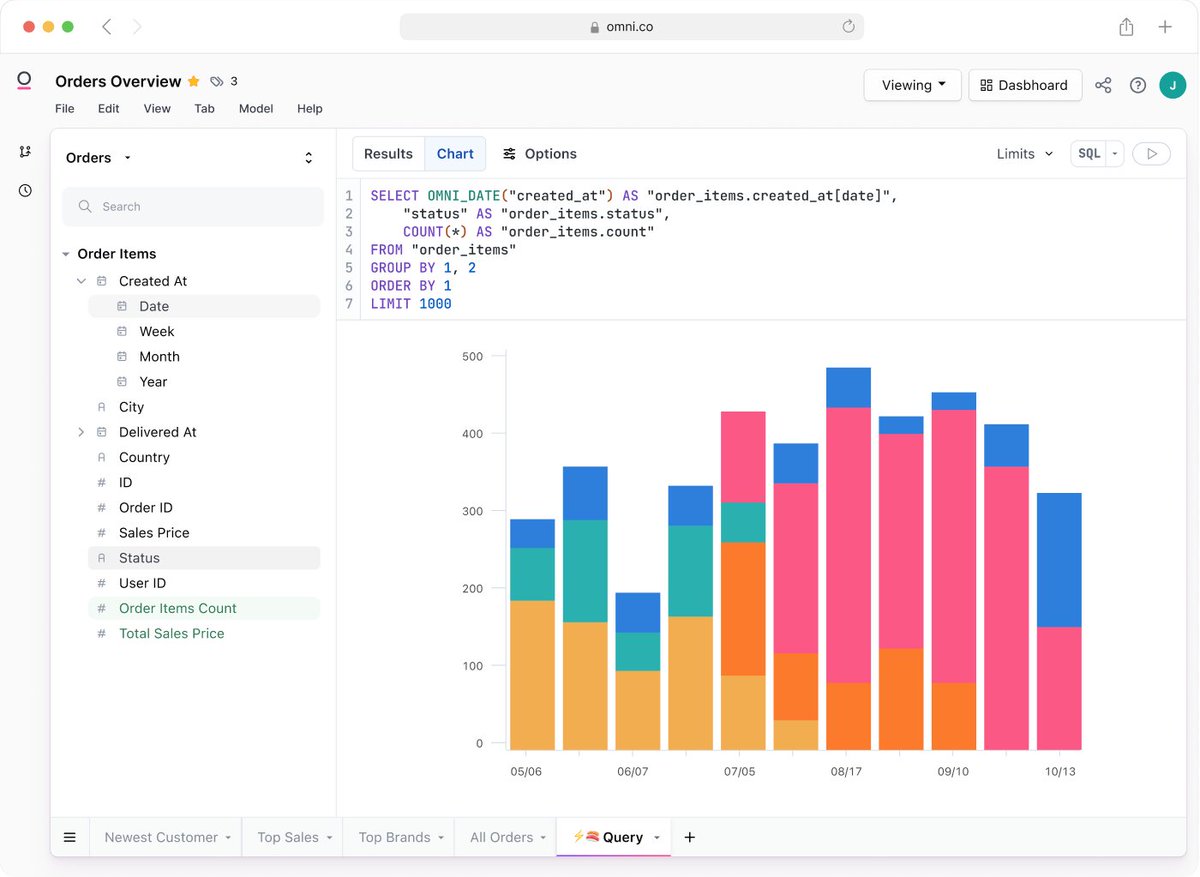
Use the Data Plugin in @ChatGPT Work to connect directly to @omni's semantic layer to build and interact with governed reports and dashboards.
With the Omni CLI, you can go further to branch the model, add a measure, verify the output, and open it for review.
The bar for AI is rising. As models become part of everyday workflows, speed alone isn't always enough. Companies need answers and decisions to reflect how the business actually works, grounded in trusted business logic.
@drinkzima, @jamiedavidson, and Chris Merrick saw that coming. We believe @omni is the infrastructure that makes it possible, and we're proud to lead their Series C and double down on our partnership with them and the team.
Read more: https://t.co/MQ2uonoFCW
Disclaimer: https://t.co/fdP8ALDhEm
Today, we're announcing a $120M Series C at a $1.5B valuation, led by @ICONIQCapital with participation from @Theoryvc, @firstround, @Redpoint, and GV.
Read the full note from our CEO, Colin Zima 👉 https://t.co/DzcckVHfm9
💥@databricks Ventures has invested in @Omni—its first-ever investment in business intelligence💥
Together, we bring reliable AI-driven insights within reach of every user. To learn why customers like @bamboohr choose us, read @jamiedavidson’s post: https://t.co/YTm7GjqyQ4
Thrilled to lead @omni's Series B and partner with @drinkzima + team as they strive to redefine the future of business intelligence!
🚀 Omni bridges the BI gap—combining governance, flexibility & self-service to empower all users with trusted insights. https://t.co/cQ4A0pCiw9
Thanks to our amazing customers & team, our third birthday is another big one 🥳
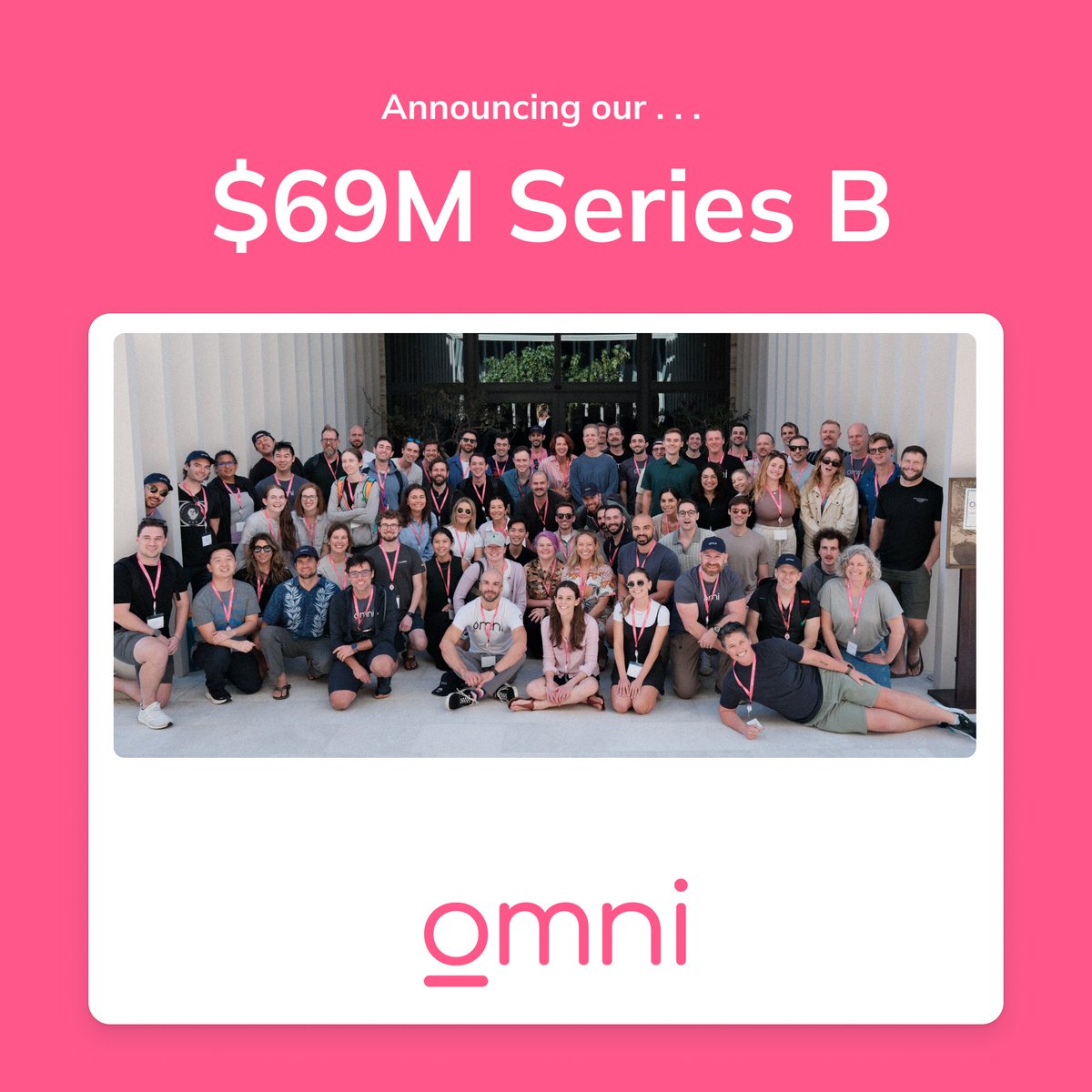
Today we’re excited to announce $69 million in Series B funding.
Check out our blog by @drinkzima to learn more 🔗 https://t.co/awO0WWRvFC
I'm excited to share that @SnowflakeDB Ventures has invested in @omni
We built Omni to close the gap between trusted, governed BI experiences and fast, flexible data exploration — to finally make self-service a reality for all decision-makers.
https://t.co/g3R5VysRL3
> independently discover a Zeno's paradox at age 3
> MIT at 17, grad level math in 1st year
> graduate in 3 years
> drive motor scooters from Boston to Bogotá with the boys
> start a company in Colombia
> start code breaking with the IDA for money
> solve minimal varieties in riemannian manifolds
> speak out against Vietnam War, get fired from IDA
> take over math dept. at Stonybrook, make it a top-ranked program globally
> develop Churn-Simons theory, accidentally contribute more to physics than most physicists
> get bored with math, start modeling financial markets
> return 60% for 4 decades straight
> establish one of the most effective philanthropic organizations of all time
> chain smoke cigarettes the entire time
RIP Jim 🫡
Big news: Announcing our series F and tender offer led by @coatuemgmt, with @foundersfund, @greenoaksfund, and others participating.
With this funding, we’ll keep investing heavily in R&D 🥽 & build even more robust products 🧱
Read the full story:
https://t.co/3TBqZwvZtr
The dbt <> BI workflow is broken.
Switch to #dbt → build/test/document your model → check it into version control → build → deploy. Doing this for every data set doesn’t scale. There's a better way.
Join our LinkedIn Live w/ @cmerrick to learn more: https://t.co/iYEz9NX4er
Introducing @omni ‘98 — which works the same, but is somehow better
Check out this post by Richard Czechowski to learn why 95% of prospects from a made-up survey intend to switch 🚀
📎 https://t.co/lDUu4ARPM7
Within data teams, a tension exists. Centralize the data analysis to ensure accuracy or enable end-users to analyze their own data directly which is faster & more direct.
The pendulum between these two states started with centralization during the 2000s with BI products from Microstrategy, Cognos, BusinessObjects, & Hyperion. In 2004, Tableau emerged from the Stanford campus to deliver their application to the users.
Cloud databases ushered in an opportunity to centralize that data analysis again. Looker’s modeling language, LookML, provided a way to define metrics across an organization.
There’s a pendulum that swings in the world of business intelligence between control & freedom. In our Office Hours last week, Colin Zima CEO at Omni talked about this oscillation. BI in the future won’t oscillate between these two, but serve both purposes.
How will this happen?
Users work with their own metrics definitions. When they create a metric, the BI system can enable it to be promoted from the person, to the team, to the department, & potentially across the company - mediated by the data team.
Metric promotion provides a unique form of collaboration that balances central control & end-user speed.
This was a special Office Hours for two reasons. First, Omni celebrated their 2 year birthday as a company. Second, because we announced Theory’s $20m investment in the business.
For more than a decade, we’ve been working with the Omni team at Looker. We share their vision for the future of business intelligence & are thrilled to continue to support them as they re-invent BI again.
If you’d like to try the product, click here : https://t.co/o2bW04TfP7.
We covered much more in the Office Hours including other technical advances like hybrid execution, the future of the semantic layer, permissioning, & the paradoxical increase in data teams & users with AI. The video is here : https://t.co/ALrRefM1fZ & the podcast version here : https://t.co/cZOxOn05g2.
Thanks to our amazing customers and team, year two was a big one for us 😎
Today we’re excited to announce an additional $20M in funding from @Theoryvc and the addition of former Looker CRO, Lambert Billet to our board!
A note from @drinkzima in the thread 👇
Introducing embedded analytics👋
Whether you want to launch your first customer-facing dashboard or create a multi-tier user experience, we can help you use data to build more ways for customers to engage with your product.
@drinkzima's post for more👇
https://t.co/s5KrTj6rD8
1/ The way you’re doing a startup job search is wrong.
You join Ramp instead of taking guaranteed cash from FAANG because you believe the equity will be worth more in the future.
This is a VC decision and you need VC tools to make it.