Excited to share a review with Clay Holroyd. We discuss RL approaches to foraging behavior (and what the ACC might do), and we propose that a hierarchal RL mechanism implemented by ACC can give lights into the neural computations supporting foraging.
https://t.co/wfJbiP8VL4
🇵🇪 The Deep Learning class that I teach at @UTECuniversidad ends with #TheFuture 🏎 : An autonomous driving race that's open algorithm. Top groups are using VLM, occupancy map, path planning and LIDAR integration. They're all undergrads! 🤯! Arriba Peru!! 🇵🇪
True of science generally! I recall my first preprint. I gave it to my mentor David Hubel who covered it in annotations, all about the grammar. I said “but you didn’t comment on the science!!”. He said “I can’t. It’s not written clearly. I have no idea what the science is”.
Excited to share our updated preprint on the neural basis of foraging decisions! This work was co-led by Michael Bukwich (twitterless, now at UCL) and me, with major contributions from co-authors, and the incredible animation is by @KJHerr23. (1/12)
https://t.co/GopGdBoVly
A new study shows how flexibly new chunks are formed in long-term memory, and how this process is linked to the way information is grouped in working memory during encoding
📢New from: @PhilippMusfeld, @JoschaDutlli, Klaus Oberauer, & @lea_bartsch
https://t.co/YRUOzwVWk5
Our meta-analyses, using computational models to investigate shifts in learning strategies across learning environments is now finally out in Psychological Review (https://t.co/JsyQjVAnWp)
Dynamic changes in task preparation in a multi-task environment: The task transformation paradigm
📢New from: Mengqiao Chai, Clay B. Holroyd, Marcel Brass, & Senne Braem
https://t.co/xgaXP7l5kR
New preprint! @tafazolisina shows the brain builds complex tasks by compositionally combining simpler sub-task representations. By dynamically reusing neural subspaces for sensory inputs and motor actions, the brain can flexibly perform multiple tasks. 🧵 https://t.co/PpMhFiO5YP
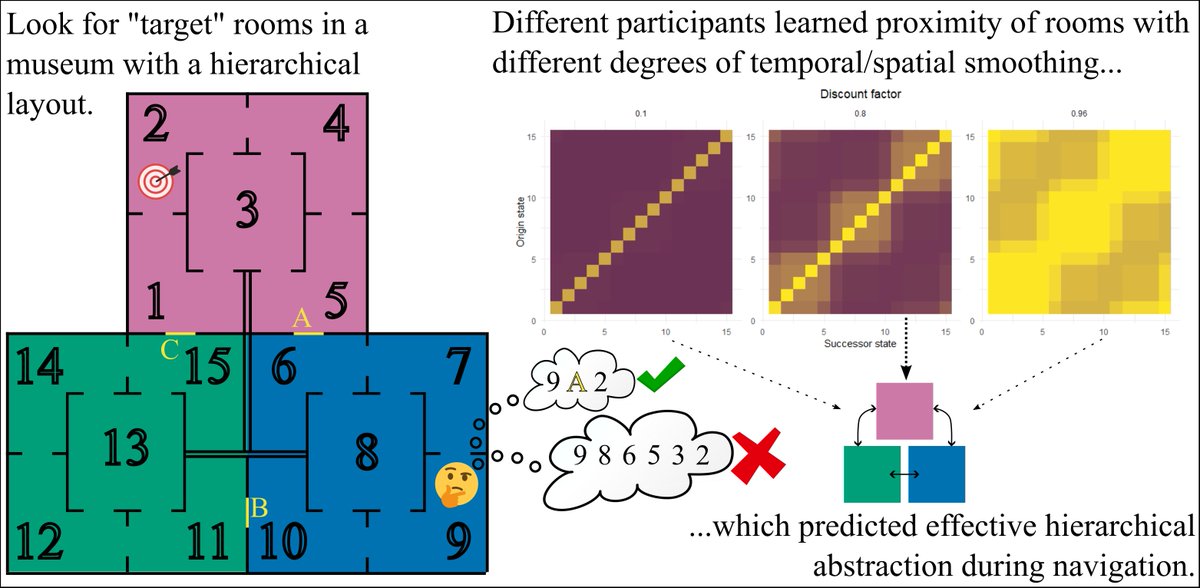
Excited to announce our new work finding that individual differences in predictive learning (e.g. Successor Representations) show a strong relationship with hierarchical abstraction during decision making, now out in @PLOSCompBiol! Read on👇or visit https://t.co/eBw4fcomtN
Our first preprint on combined non-invasive deep brain stimulation (temporal interference) and fMRI. TI opens so many possibilities for causal inference and clinical treatments https://t.co/LG6FJWRM2M with @ModakPriyamvada@JustFineNeuro@Peter_Finn_911@SoterixMedical
New theoretical article by Clay Holroyd on the neural origin of cognitive effort: The controllosphere: an energy-inefficient region of neural state space associated with high control, which surrounds the better known, energy-efficient “intrinsic manifold” https://t.co/Zij3kPHBfp
Brief summary of (1) the recent n=20000 study showing depression and thermoregulation are related, and (2) related press coverage.
TLDR:
- cool results
- problematic conclusions
- the temperature treatment angle is quite silly
https://t.co/PDpKd6WUON
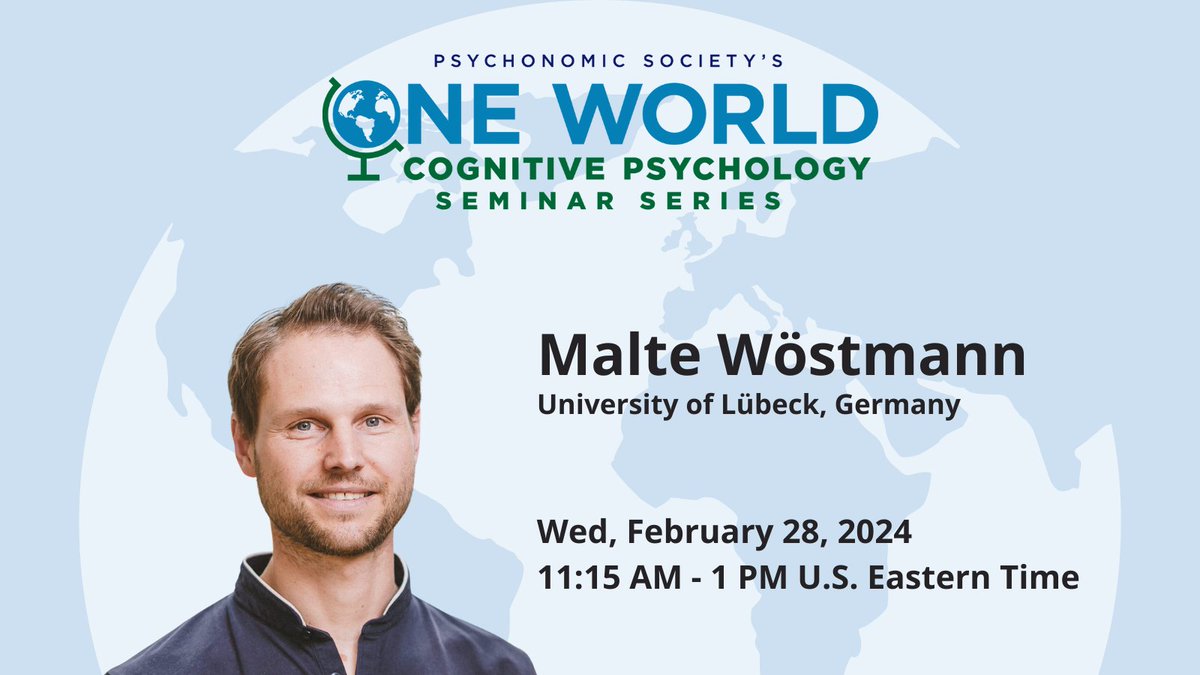
Get ready for the upcoming One World Seminar “Attention, please! Behavioral and neural dynamics of distraction” presented by Malte Wöstmann from the University of Lübeck, Germany. Reserve your complimentary ticket today! https://t.co/VM2sFAQ4NC
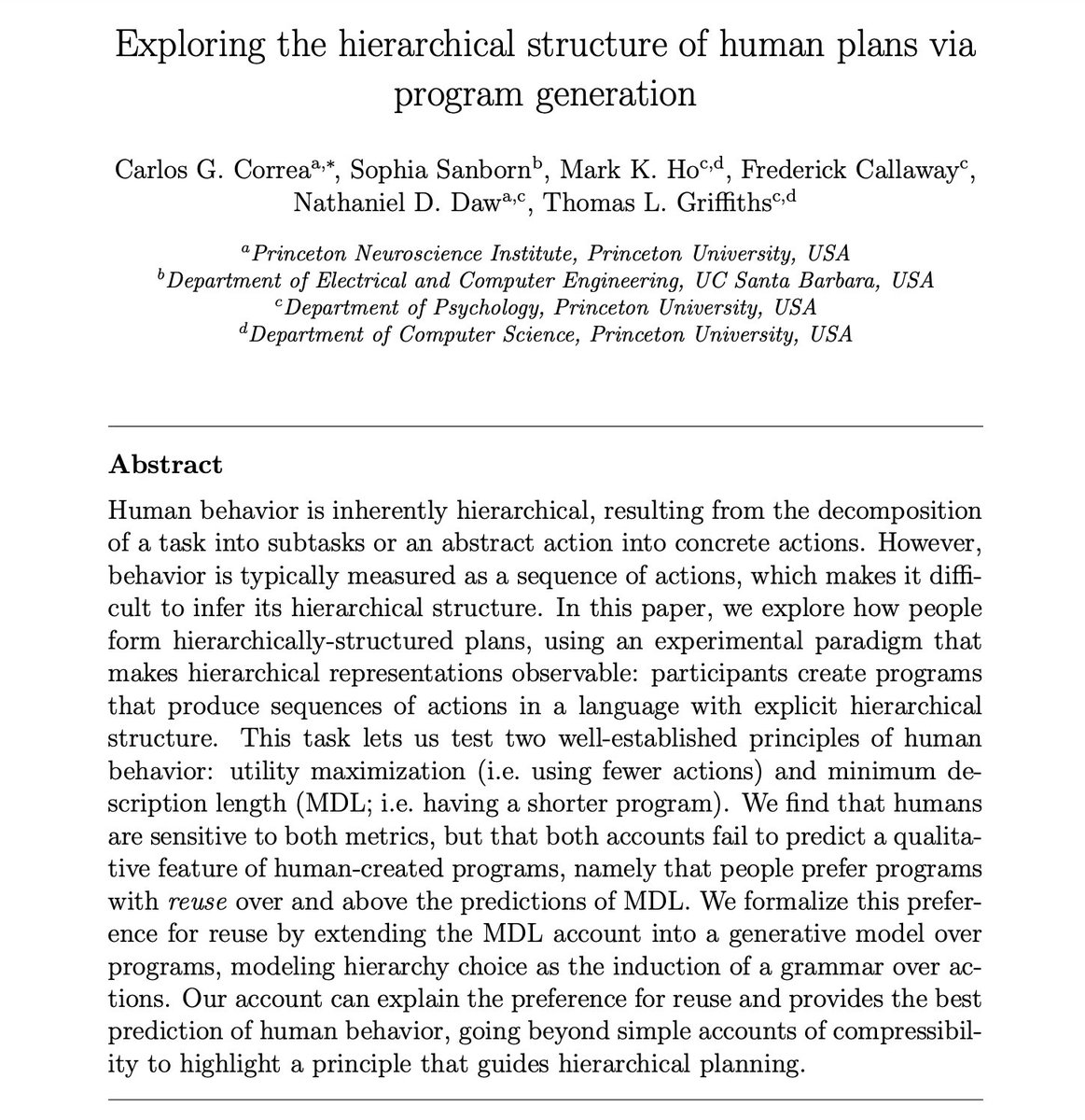
Human behavior is hierarchically structured. But what determines *which* hierarchies people use? In a preprint, we run an experiment where people create programs that correspond to hierarchies, finding that people prefer structures with more reuse.
https://t.co/5a9YdhK04U
1/7
How do we maintain multiple, potential action plans in WM? Our work shows that task demands flexibly prioritize S-R mappings according to their relevance, leading to non-orthogonal (i.e., interference-prone) active and latent functional states.
https://t.co/xsnunSenBl