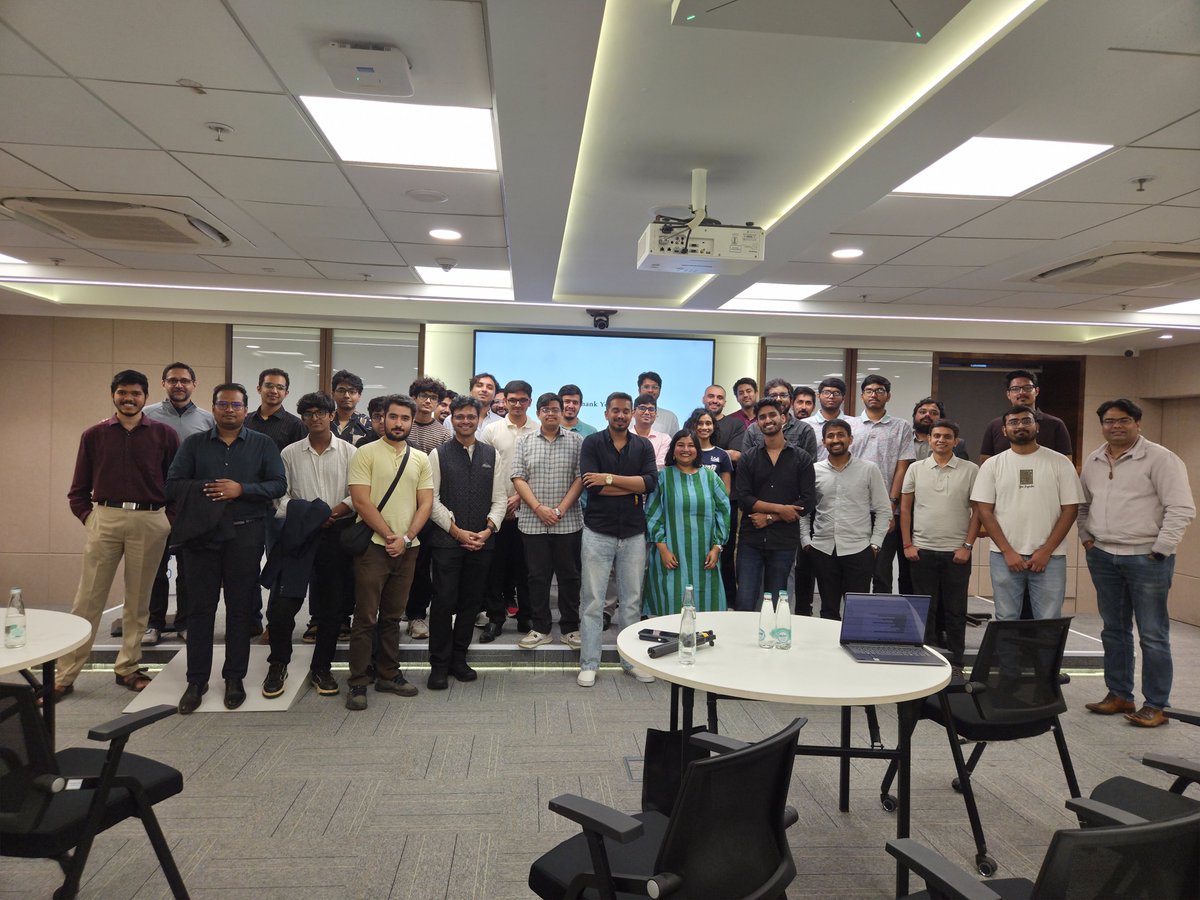
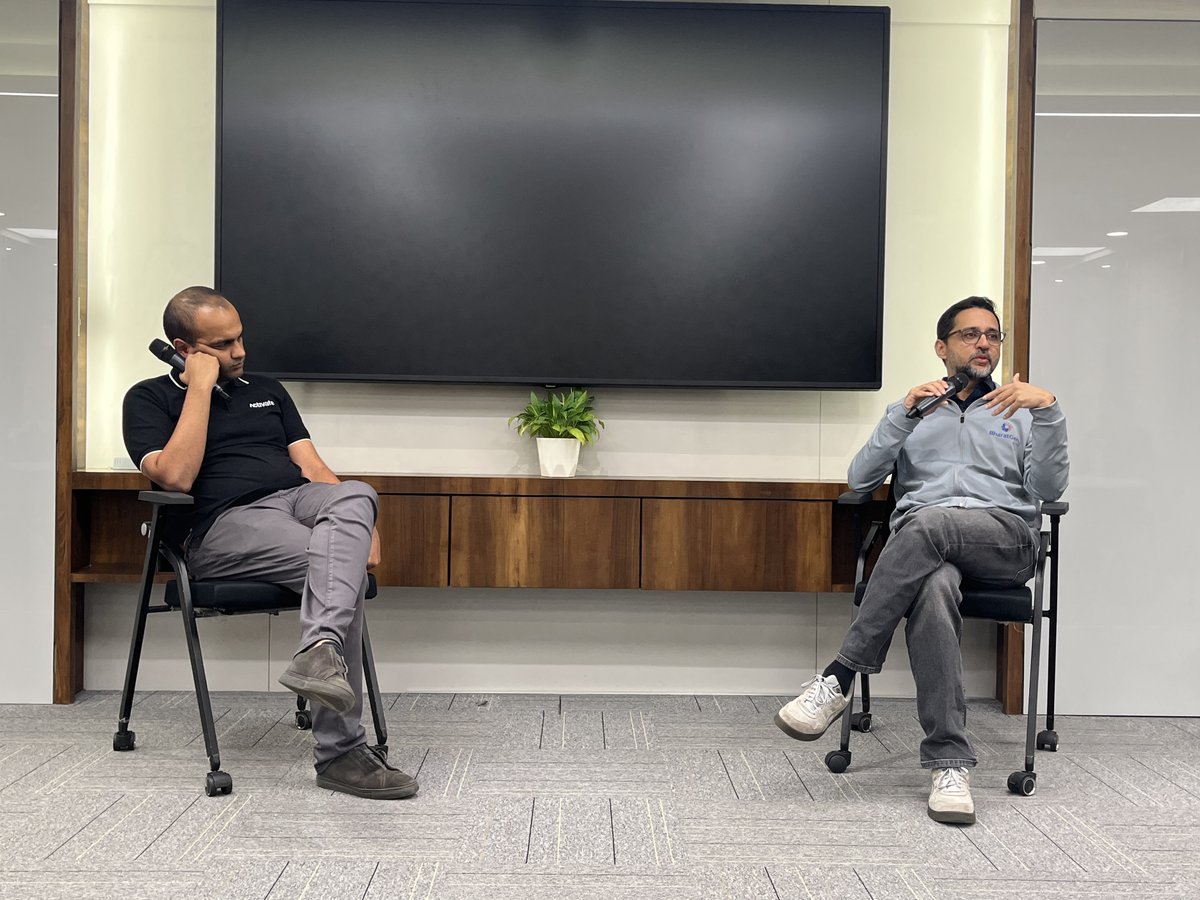
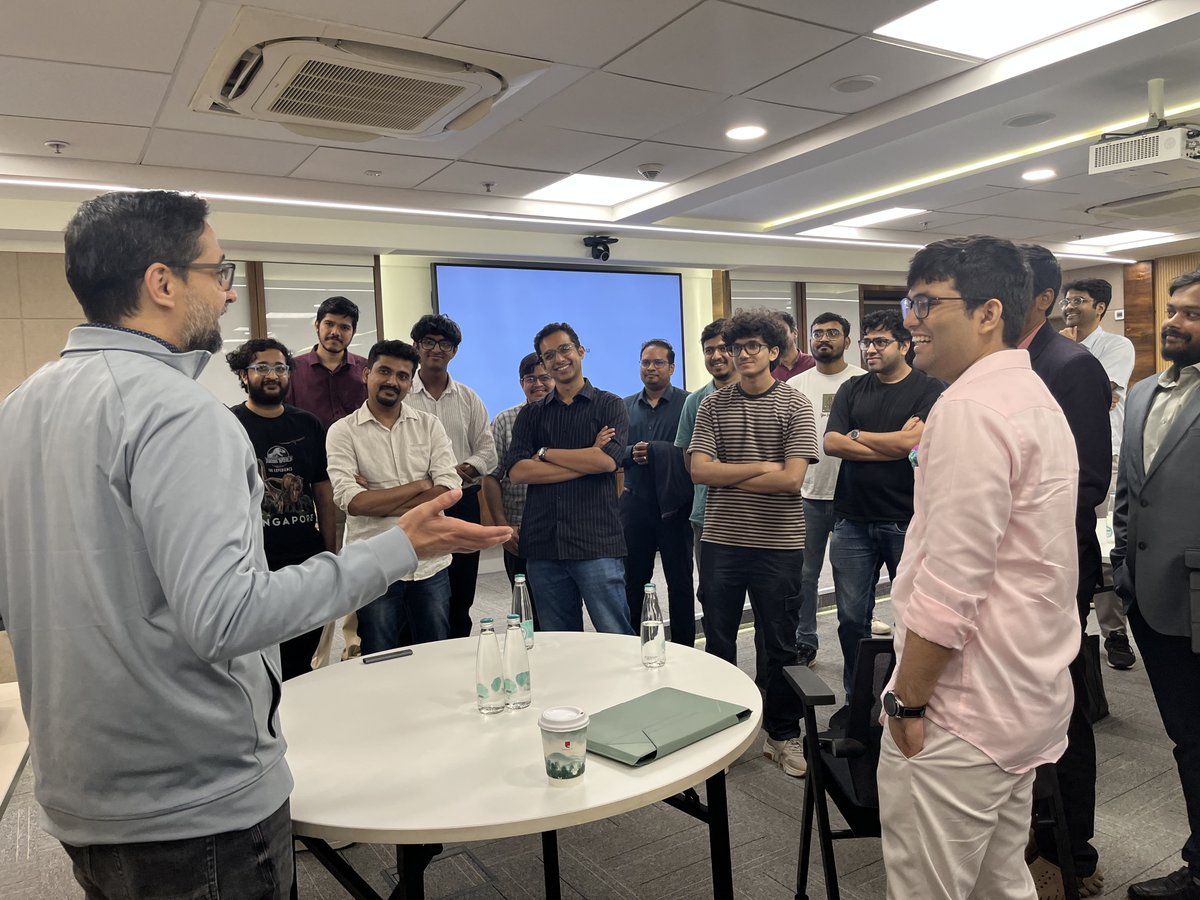
We partnered with Activate to host 'Mixture of Experts' in Mumbai, bringing together people building across models, infrastructure, research and applications.
Thank you to everyone who joined us in Mumbai.
@aakrit@rishibal
The frontier still matters. But for a shrinking share of enterprise work.
Most enterprise AI is not writing sonnets. It is reading invoices. By my estimate, 90% of enterprise AI volume will not need a frontier model. Classifying documents, summarising internal files, pulling fields from forms, answering the same routine questions for the hundredth time. What this work needs is inference that is fast, reliable and cheap while preserving data and control.
Enterprises have noticed, and open-weight models have been the biggest winners so far.
What interests me more is how the conversation has changed. The teams that come to us have usually tried both open and commercial models by now. The model is rarely the only place where they need help. They are stuck on everything around it as well.
That is where the real change is happening. The single model is giving way to a composite system that the enterprise owns.
Broadly, it has six parts:
- Deterministic engines: business rules, constraint solvers and schema validation, for the parts that must be consistent every time.
- Information retrieval: across internal documents, databases and knowledge graphs, so that answers rest on the enterprise’s own data rather than the model’s memory.
- Non-deterministic models: LLMs working alongside specialised models for speech, vision and classification, each matched to its task.
- Context management: deciding what each model gets to see, with memory running from the task at hand up to long-term organisational knowledge.
- The harness: handling routing and orchestration: which model takes which task, with which tools, and what happens when something breaks.
- Trust and security: monitoring, human engagement, PII handling, access controls, guardrail classifiers and audit logs.
Put together, this is intelligence being unbundled: model, rules, context and controls become separate parts the enterprise chooses and combines.
Custom models make the system work. A generalist model raises the floor across many tasks; a custom model raises the ceiling on one.
This is not a contest between large and small. A small model on a local server, handling real-time voice in an Indian language, and a much larger one reviewing complex legal documents are both custom choices. They simply sit at different operating points.
My prediction: Over the coming year enterprises and application builders will shift more investment towards the composite system and custom models.
How these systems learn, and where they run, is the subject of my next post.
Am curious to hear from the practitioners here: which parts of your system do you build, buy or rent?
@Karishma_Mehta5 tried a simple question in Hindi on AI and was shocked by the answer. 😅
So she sat down with our CEO @rishibal for @AWS Presents Beyond The Boardroom to find out what it takes to fix that.
AI for India must understand language and context together, because how people speak is shaped by how they live.
Our CEO, @rishibal, joins @Karishma_Mehta5 of @HumansOfBombay, powered by AWS, to discuss what sovereign AI for India really means.
https://t.co/2ptr5YH8hG
An unfortunate incident. I am sure the @iitbombay leadership will look into making the campus support system more sensitive so no student feels hopeless and driven to take such an extreme step. Role of peer groups and mentoring also equally important. Hope fellow students and @iitbombay alumni are able to step up and offer such mentoring and support so nobody feels left behind or lost in the campus environment.
Should India adopt AI or build its own?
I think we're asking the wrong question.
Because, the real answer is we need both.
A few thoughts on why Adoption and Sovereignty are complements, not substitutes.
WDYT?
Respectfully, India should do both.
We should aggressively adopt the world’s best AI models to boost productivity today.
And we should invest in our own models to preserve strategic autonomy tomorrow.
In an era of 'weaponised interdependence', AI sovereignty is not a luxury.
-----
I don’t believe we can outspend OpenAI, Anthropic, or Google to build the world’s leading models. But that doesn’t mean we shouldn’t build our own.
As models commoditise, the gap between frontier models and the previous generation shrinks. What is cutting edge today becomes accessible tomorrow.
For critical use cases like government, defence, intelligence, and strategic sectors, we don’t want to be dependent on the AI equivalent of Gmail.
For everything else, we should unapologetically adopt the best models available and use them to boost productivity.
The choice isn’t sovereignty or adoption.
It’s sovereignty AND adoption.
Don't fall for the doomer narratives about India.
We have folks like @rishibal, who left a comfortable life in the US to return to India and work on our Sovereign AI initiative with @BharatGen_Com.
Watch this fascinating conversation on how a group of bright young folks are helping us level up on AI 👇👇
During my visit to @iitbombay , I had the opportunity to interact with the team of @BharatGen_Com, an initiative led by Prof. Ganesh Ramakrishnan. Seeded by @IndiaDST under its cyber physical mission and subsequently supported under the @OfficialINDIAai Mission by @GoI_MeitY, BharatGen is working towards the development of sovereign foundational Large Language Models (LLMs) for India.
Dear @NandanNilekani You initiated a huge technology based revolution in India by starting with a strong "foundation" (aadhar), why not with AI? Once again, I respectfully, but strongly, disagree. India should be aiming to do both. Otherwise, it won't be a true leader.
"We need exclusive LLMs. On those LLMs, put 50 solid data engineers. An additional secretary doing AI or a major general doing AI is pointless, he doesn’t understand AI. Someone with real AI expertise has to come in and be told: this is our data..." - @Gen_RajShukla
Was playing with @BharatGen_Com language model built by @ganramkr, @rishibal & team — truly impressive, given
• Just a 17B model (smaller than GPT-3) now
• Only at the pre-training stage — yet to be fine-tuned/aligned
• Developed with highly constrained resources
Param-2 is live on @huggingface.
17B parameter MoE. 22 trillion tokens. 22 Indian languages. Reasoning, math, code, tool calling.
Built from scratch, in India, open for the world.
🤗 Try it now: https://t.co/y5ECDBa9oQ
#BharatGen#Param2#OpenSource
Andhra Pradesh has partnered with BharatGen, NexGen, and IBM India to launch a State-wide AI Tech Hub. The initiative will empower citizens, from farmers to fishermen, setting a national example with an inclusive, Telugu-first, citizen-focused AI, with future Quantum-AI integration. Delighted to be joined by Prof. Ganesh Ramakrishnan (BharatGen), Hrishikesh Mohal Bal (BharatGen), A S Rajgopal (NxtGen), Abhisyant Anasapurapu (NxtGen), Dr. Amith Singhee (IBM Research India), and Sandip Patel (IBM India).
Andhra Pradesh has partnered with BharatGen, NexGen, and IBM India to launch a State-wide AI Tech Hub. The initiative will empower citizens, from farmers to fishermen, setting a national example with an inclusive, Telugu-first, citizen-focused AI, with future Quantum-AI integration. Delighted to be joined by Prof. Ganesh Ramakrishnan (BharatGen), Hrishikesh Mohal Bal (BharatGen), A S Rajgopal (NxtGen), Abhisyant Anasapurapu (NxtGen), Dr. Amith Singhee (IBM Research India), and Sandip Patel (IBM India).
India kicks off one of the world’s largest artificial intelligence summits Monday, with Prime Minister Narendra Modi seeking to clear a path for India in a heated race to develop frontier models. https://t.co/JtISA7RZYE