Judging by my tl there is a growing gap in understanding of AI capability.
The first issue I think is around recency and tier of use. I think a lot of people tried the free tier of ChatGPT somewhere last year and allowed it to inform their views on AI a little too much. This is a group of reactions laughing at various quirks of the models, hallucinations, etc. Yes I also saw the viral videos of OpenAI's Advanced Voice mode fumbling simple queries like "should I drive or walk to the carwash". The thing is that these free and old/deprecated models don't reflect the capability in the latest round of state of the art agentic models of this year, especially OpenAI Codex and Claude Code.
But that brings me to the second issue. Even if people paid $200/month to use the state of the art models, a lot of the capabilities are relatively "peaky" in highly technical areas. Typical queries around search, writing, advice, etc. are *not* the domain that has made the most noticeable and dramatic strides in capability. Partly, this is due to the technical details of reinforcement learning and its use of verifiable rewards. But partly, it's also because these use cases are not sufficiently prioritized by the companies in their hillclimbing because they don't lead to as much $$$ value. The goldmines are elsewhere, and the focus comes along.
So that brings me to the second group of people, who *both* 1) pay for and use the state of the art frontier agentic models (OpenAI Codex / Claude Code) and 2) do so professionally in technical domains like programming, math and research. This group of people is subject to the highest amount of "AI Psychosis" because the recent improvements in these domains as of this year have been nothing short of staggering. When you hand a computer terminal to one of these models, you can now watch them melt programming problems that you'd normally expect to take days/weeks of work. It's this second group of people that assigns a much greater gravity to the capabilities, their slope, and various cyber-related repercussions.
TLDR the people in these two groups are speaking past each other. It really is simultaneously the case that OpenAI's free and I think slightly orphaned (?) "Advanced Voice Mode" will fumble the dumbest questions in your Instagram's reels and *at the same time*, OpenAI's highest-tier and paid Codex model will go off for 1 hour to coherently restructure an entire code base, or find and exploit vulnerabilities in computer systems. This part really works and has made dramatic strides because 2 properties: 1) these domains offer explicit reward functions that are verifiable meaning they are easily amenable to reinforcement learning training (e.g. unit tests passed yes or no, in contrast to writing, which is much harder to explicitly judge), but also 2) they are a lot more valuable in b2b settings, meaning that the biggest fraction of the team is focused on improving them. So here we are.
a country of geniuses in a data center will certainly be an accelerant
progress will require close integration of experiments and intelligence
even Galileo could only posit a heliocentric universe after given the ability to observe the stars
Remember the variants? And vaccines that keep changing and don’t work so well? It’s not just COVID and coronaviruses, but flu, malaria, HIV and herpes/shingles too.
This happens because the pathogen is constantly mutating most of its surface coat proteins to evade our immune system — it keeps looking different. But there is an invariant element to each, and if we could only guide our immune system to see that signal in the noise, we’d have a “universal vaccine” for all variants, both known and unknown. Imagine a single flu shot that worked well every season and would also work for new variants, even scary ones like H5N1 bird flu, weaponized flu or the Spanish Flu were it to reemerge. It could end pandemics. It might even eradicate certain pathogens altogether, as we did with smallpox.
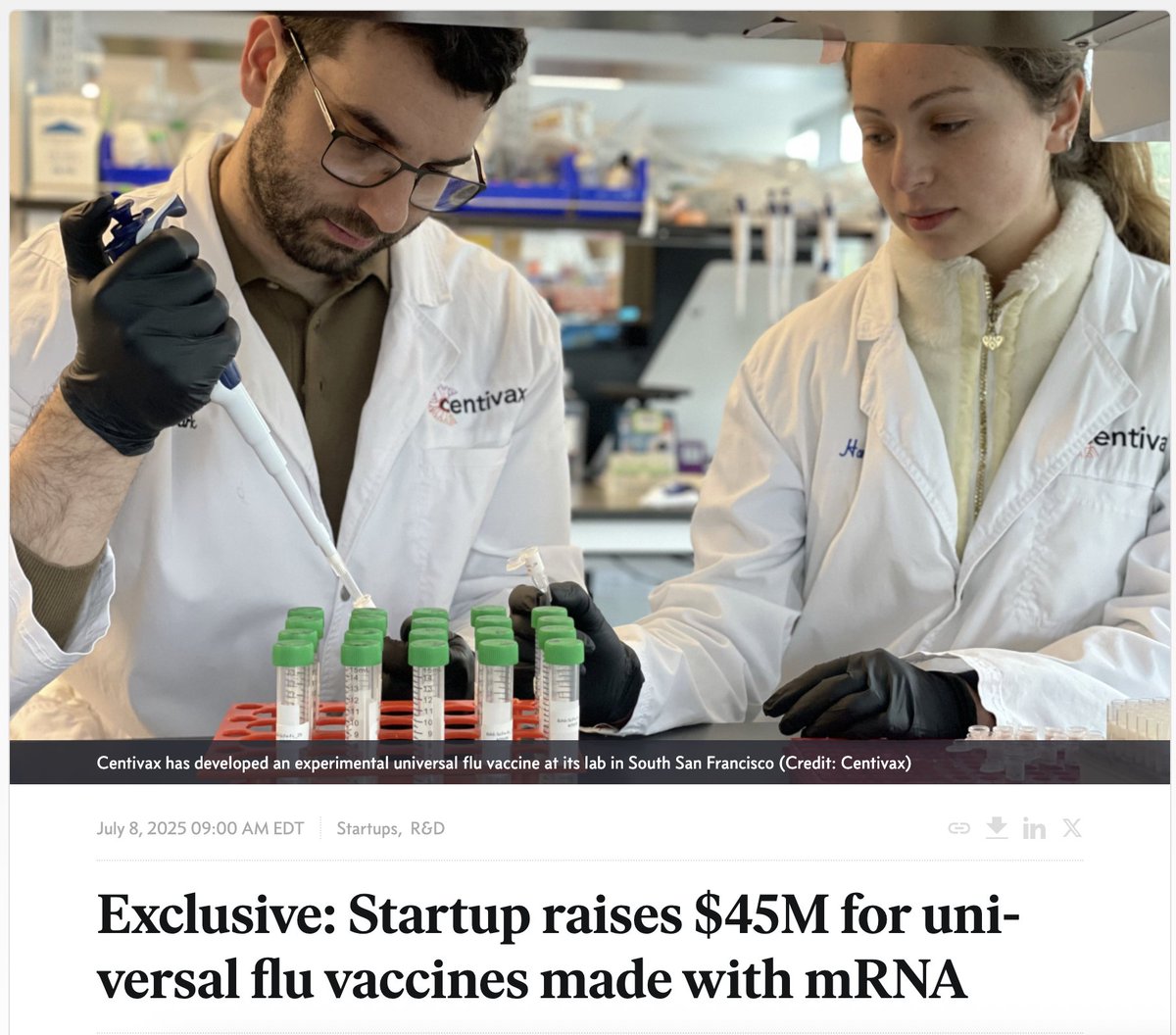
This has been a holy grail in vaccine development, one that I have philanthropically supported for many years (but those engineered nanoparticle approaches failed). Meanwhile, Centivax may have figured it out. Their approach has worked beautifully in many animal species, and human trials have just begun. We will know soon because there is a quick HAI assay that can evaluate the vaccine’s breadth of efficacy.
"For decades, flu vaccination has been reactive," said Sawsan Youssef, PhD, founder and Chief Science Officer of Centivax. "A universal influenza vaccine allows us to be proactive—moving from annual guesswork to predictable durable response."
“Beyond its flagship universal flu program, Centivax's epitope-focusing platform is advancing a growing pipeline spanning a pan-herpes Alzheimer's preventative, a broad oncology treatment, a malaria vaccine, and a universal antivenom recently published in Cell” — News today: https://t.co/XqdEjUZuZd
Yeah, one universal antivenom shot for all snake species. It should also work for a variety of parasites: viral, bacterial, protozoan, even fungal outbreaks for the Last of Us. One shot to end each of them.
And an Alzheimer’s preventative? If we can avoid infection by herpesvirus and flu, large natural experiments suggest that this would be neuroprotective for Alzheimer's and Parkinson's. It may prove to be the most effective treatment for dementia and neurodegeneration. See https://t.co/Sa2lCE4omj
Fingers crossed that this works in the current flu trials, and then, applying it more broadly, Centivax may end the pandemic era.
Some exciting news to share — we've made the world's first magnetically controlled antibody! What is a magnetically controlled antibody? It's an antibody drug that you can turn on and off, wherever you want in the body. (1/9) https://t.co/eoyawiQAqR
GPT-5.1 auto-routing seems worse to me than GPT-5 . Much more fabricating academic sources, where GPT-5 (even when forced to 'Instant', w/ the same prompt) provides real links to real sources. And 5.1 doubles down on the fabrication even when challenged.
@celinehalioua "Apparently there's a drug that they've developed for dogs, like a longevity drug. I don't know if they've released it yet, but I know that it shows promise and it extends dogs' lifetime."
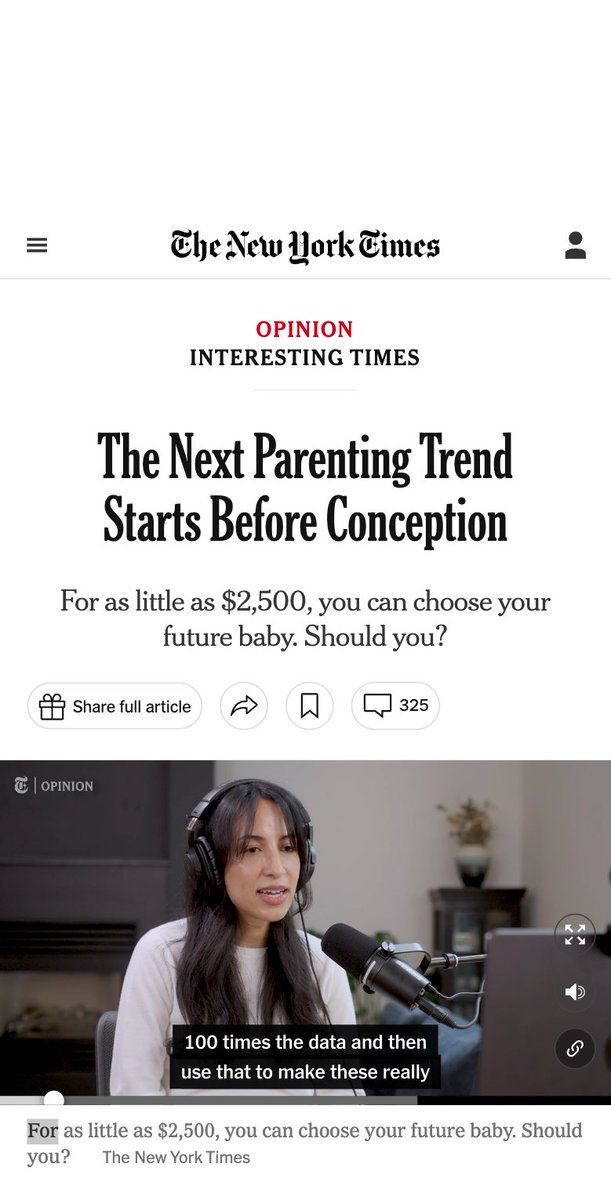
What if your baby never walks? What if they are never able to live independently?
What if you could have stopped it…
but chose not to?
That’s the question @OrchidInc’s embryo screening forces.
You optimize everything… career, diet, skincare… but you’re going to chance it on your child’s genome, one of the most significant determinants of their health?
This is one of the coolest ideas using EPIC-KITCHENS in a long while...
We've all been waiting to be replaced by robots! At least this is now done in the generative space...
Great work by @marionlepert@jiaying_fang0@leto__jean@StanfordIPRL .. congrats!
https://t.co/O3139Zk6xg
Introducing Masquerade 🎭: We edit in-the-wild videos to look like robot demos, and find that co-training policies with this data achieves much stronger performance in new environments.
❗Note: No real robots in these videos❗It’s all 💪🏼 ➡️ 🦾
🧵1/6
What if flu vaccines really worked?
And I mean *really* worked—to the point that humanity's endemic relationship with influenza became history, not an ongoing global health challenge.
What if we could mitigate *all* rapidly mutating pathogens?
This is why Jake Glanville founded Centivax. His life mission is to "finish what Edward Jenner started" by developing universal vaccines that accelerate humanity's transition to a post-pathogen future.
Jake is exactly the type of Technical Founder we look to partner with at Amplify. He was an early pioneer of computational antibody design at Pfizer, before becoming one of the first graduate students in Computional & Systems Biology at Stanford with Mark Davis.
He's synthesized a lifetime of work into a distinct—and somewhat contrarian—idea for developing universal vaccines.
And the team he's assembled is equally extraordinary. For example, Centivax's CMO, Jerry Sadoff, is one of the most prolific vaccine developers alive.
It's truly a privilege for us to participate in the Series A syndicate for Centivax. Over the last decade, Jake and the team have assembled a comprehensive pre-clinical data package for their lead flu program.
The only remaining experiment is to see if this translates to humans, which is what this round underwrites.
If this technology is successful, the impact will be enormous. And the story of this team's perseverance will require it's own book in the biotech canon.
@karpathy do you see any difference between setting the model picker to o3 versus 4o, when Deep Research is toggled on?
i go back and forth on whether this changes anything
An attempt to explain (current) ChatGPT versions.
I still run into many, many people who don't know that:
- o3 is the obvious best thing for important/hard things. It is a reasoning model that is much stronger than 4o and if you are using ChatGPT professionally and not using o3 you're ngmi.
- 4o is different from o4. Yes I know lol. 4o is a good "daily driver" for many easy-medium questions. o4 is only available as mini for now, and is not as good as o3, and I'm not super sure why it's out right now.
Example basic "router" in my own personal use:
- Any simple query (e.g. "what foods are high in fiber"?) => 4o (about ~40% of my use)
- Any hard/important enough query where I am willing to wait a bit (e.g. "help me understand this tax thing...") => o3 (about ~40% of my use)
- I am vibe coding (e.g. "change this code so that...") => 4.1 (about ~10% of my use)
- I want to deeply understand one topic - I want GPT to go off for 10 minutes, look at many, many links and summarize a topic for me. (e.g. "help me understand the rise and fall of Luminar"). => Deep Research (about ~10% of my use). Note that Deep Research is not a model version to be picked from the model picker (!!!), it is a toggle inside the Tools. Under the hood it is based on o3, but I believe is not fully equivalent of just asking o3 the same query, but I am not sure.
All of this is only within the ChatGPT universe of models. In practice my use is more complicated because I like to bounce between all of ChatGPT, Claude, Gemini, Grok and Perplexity depending on the task and out of research interest.
Could this vaccine approach help overcome our current real-life game of variant ‘whack-a-mole’?💡
CEPI is providing up to $5m to @Centivax to advance their tech aiming to create a single-shot vaccine to protect against multiple viruses and their variants: https://t.co/Y6KbrdxG8x
Introducing Phantom 👻: a method to train robot policies without collecting any robot data — using only human video demonstrations.
Phantom turns human videos into "robot" demonstrations, making it significantly easier to scale up and diversify robotics data.
🧵1/9
We did it! We tested 300 Bay Area foods for plastic chemicals. We found some interesting surprises.
Top 5 findings in our test results:
1. Our tests found plastic chemicals in 86% of all foods, with phthalates in 73% of the tested products and bisphenols in 22%. It's everywhere.
2. We detected phthalates in most baby foods and prenatal vitamins.
3. Hot foods which spend 45 minutes in takeout containers have 34% higher levels of plastic chemicals than the same dishes tested directly from the restaurant.
4. The 1950s Army rations we tested contained surprisingly high levels of plastic chemicals.
5. Almost every single one of the foods we tested are within both US FDA and EU EFSA regulations.
Check out our full results below.
Introducing Shadow: a cross-embodiment policy transfer method for robotics.
Shadow enables training a policy on one robot and successfully deploying it on a different, unseen robot, with no extra data required! 🦾🤖
To be presented at #Corl2024
(1/6)