Services are the future. Today we launched Ramp’s AI services motion.
It's easy to buy an AI subscription. It's hard to transform your company to actually run on agents.
Here’s our entire strategy.
1) Why now
Services are the new software (Sequoia)
Human labor TAM >> software license TAM. The market is bearish on seats and subscriptions.
Every enterprise AI company is doing this -- the labs have poured billions into services partnerships and their own deployment functions. Superintelligent models alone are not enough.
Palantir proved this is a strong business model: deeply embed engineers, build on top of a powerful platform, and customize extensively.
2) The real problem
Companies want AI. But the gap between "we have AI tools" and "agents run our workflows and we spend way less time" is enormous.
What we've found across over 50 companies we engaged with: agents start replacing real work when there is: complete data, read/write access across systems, agent-friendly policies. Most big companies struggle because:
- processes live in operators' heads
- dozens of disconnected systems (legacy ERPs, endless one-off excel sheets, etc.)
- archaic software with poor or no API access
Good data in the right place is a hard prereq to working agents.
Also, vibing in localhost ≠ a production system your enterprise can rely on. You still need hosting, ci/cd, observability, feedback loops, good interfaces. And taste to know what's even worth automating.
Everyone has a bulldozer, but most jobs just need a shovel pointed at the right spot.
What companies usually need is to be made agent-friendly. That's exactly what we do.
3) What we do
We focus on what Ramp does best -- finance.
And we embed FDEs that:
-> understand your problems
-> identify high-leverage, high-impact workflows that fit agents
-> scope the solution
-> connect your data
-> capture your context
-> deploy agents and often bespoke software for humans to collaborate with them
-> drive the business metrics that matter
Discovery and scoping are crucial. Building is easier than ever and thus judgement about what to build is more important than ever.
We're not a generic AI services arm, we're finance domain experts. Across the spectrum of financial operations, we help companies find and frame the problems worth automating -- similar to the taste a founder has in choosing which problems are worth solving (ex-founders make great FDEs).
Here’s the stack we deliver:
- Production infrastructure. Shipping an index.html from Claude isn't the same as creating a repo, hosting in a cloud service, ci/cd, testing, setting up evals, managing memories and skills, adding feedback loops, ensuring uptime, incident management, etc. Agents don't one-shot production systems yet. Production software is hard -- we build, host, and run it for you in a single-tenant, dedicated cloud environment. Most operators don’t have the time, knowledge, or experience to do this e2e. We help abstract the low-leverage plumbing so they can focus on the essential parts of their jobs.
- Data connectivity. Most enterprises have data lakes, but data is often incorrect, stale, or entirely missing. And write interfaces vary dramatically. Ideally we can use MCPs or CLIs, but usually it’s poorly documented APIs, SFTP, manual uploads, and email.
- A context layer. Things people have done for years aren't written down, so an agent can't do them until we capture that context -- ranging from simple policies to complex decisions. This usually involves creating policy documents, shared agent memories, and skills.
- Evals and feedback loops. How you know an agent is doing a good job, and how it improves over time.
4) Why Ramp AI Solutions
We focus on finance because it’s the vertical we know deeply, have structural advantages, and are most differentiated:
- Data. 70k+ customers use our core product, over $200B in annual payments, years of vendor data, millions of transactions and bills monthly.
- Money-movement primitives and partnerships. Global money movement rails, partnerships with banks, Visa, Stripe, etc. You don’t want to vibecode international wires for bill payments.
- An intelligence layer on top: fraud detection from hundreds of millions of expenses, PO-to-invoice matching, state-of-the-art OCR, and fine-tuned models for accounting coding, spend routing, policy review, etc.
Unlike the labs, we’re not incentivized to sell tokens.
Ramp is an AI fiduciary and an impartial broker to deliver AI that is:
- model-agnostic -- we benchmark all the leading models (labs, open source) and fit the right one to each task
- and token-efficient by design
Our main incentive is business outcomes -- which is Ramp’s mission, to save our customers time and money.
I’m extremely bullish about our motion, and the broad industry growth of AI-native services.
If you're a finance leader trying to be more agent-native,
If you’re interested in joining our FDE team,
I’d love to talk 🙂
Most companies slow down at scale.
Ramp is accelerating.
70,000+ businesses now run on Ramp. AI agents are becoming part of the finance team. And @RampLabs is shipping frontier experiments every week.
Today: $ 44B.
The next chapter of finance will be agentic and we’re building it.
Today, Ramp raised $750M at a $44B valuation.
Last time we grew this fast, we were 1/20th the size.
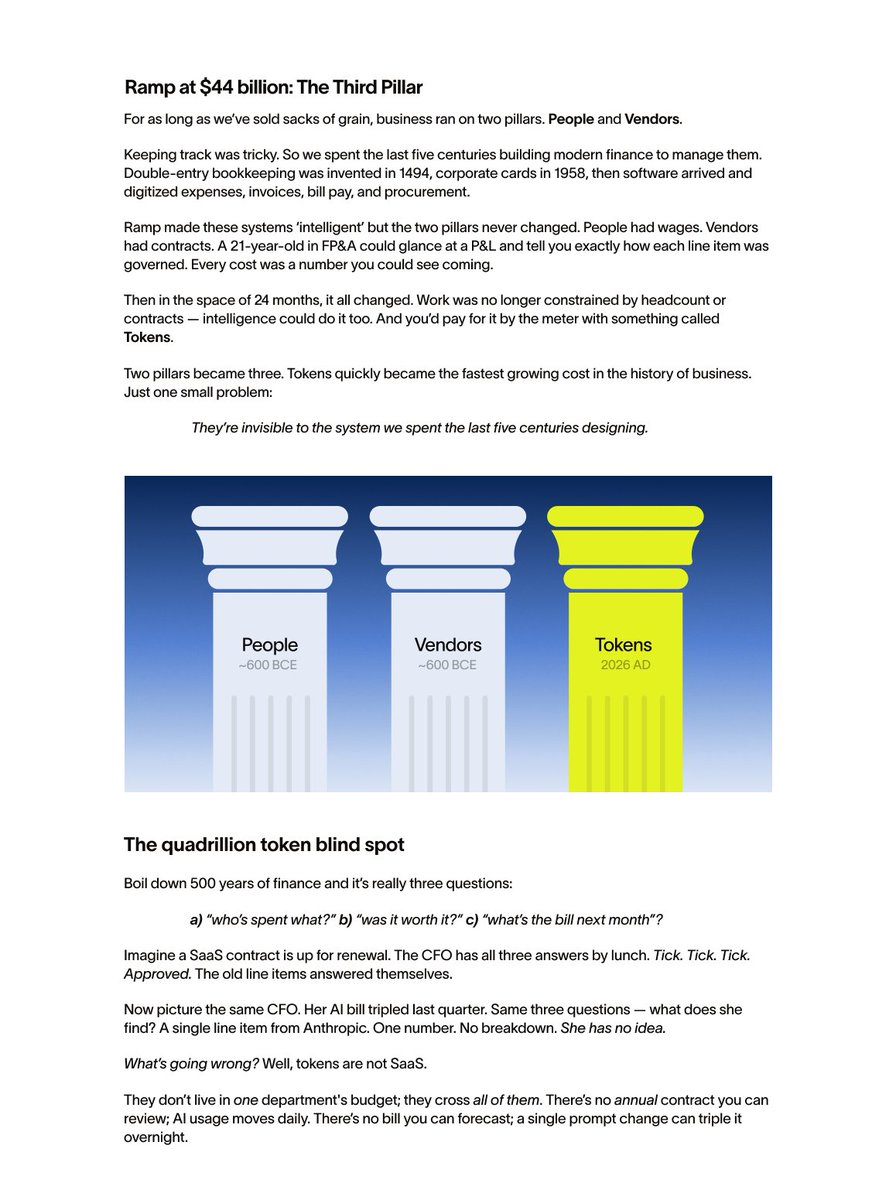
For 2000 years, business was built on two pillars. Today, a third: intelligence.
It’s your least governed cost. It’s also your single greatest opportunity.
Introducing Stack.
The AI operating system that lets accounting firms take on more clients without hiring. Learns your firm's process, runs the close, posts the journals. Fully auditable.
We’re living through the biggest shift in accounting since the spreadsheet.
Last night, Ramp investor Michael B. Jordan received a prestigious award known as an “Oscar” which is given out by the Academy of Motion Picture Arts and Sciences for achievement in the filmmaking industry.
Today, we're launching Ramp Agent Cards.
There's been no safe way for agents to spend money, until now. Ramp Agent Cards give agents the ability to spend, governed with real spend limits, merchant controls, and full visibility into every transaction.
Building onchain used to be a nightmare of Stack Overflow tabs, broken wallet integrations, and debugging till 3am.
AI fixes that.
Here's what's working: 🧵
Everyone thinks Claude Code is just for engineers.
The truth is it’s one of the most underrated tools for product managers. It’s basically a cheat code for anyone buried in ops grind and endless analysis.
Here’s how I use it day-to-day 🧵
Graduates of the Customer Product Engineering (CPE) program at @Alchemy have gone on to:
- produce YC-backed founders
- start two entirely new departments at Alchemy (TPM & SE)
- convert into world class PMs
Drop an application if you're early in your career and want to actually do something. CPEs operate with founder mentality: extremely ownership, customer obsession, and technical excellence. This is the highest leverage role to kickstart your career.
Link to the program below.
Robinhood started with stocks.
Coinbase started with crypto.
Now they’re racing toward the same destination, just from opposite ends of the spectrum.
🧵 Let’s break it down:
AI is automating thought.
Stablecoins are automating money.
AI moves information without humans.
Stablecoins move value without banks.
Both are backend revolutions.
Both are invisible when they work.
And both will redefine the systems we trust.
Stablecoins are the cleanest expression of demand for dollars.
Not printed. Not politicized. Just pulled in by users.
Every uptick in stablecoin supply = real economic signal.
No Fed narrative. No yield curve guesswork.
Just pure market demand onchain, in real time.
since everyone is talking about how @coinbase is a founder factory & has created so many founders
I also just want to highlight @a16z recently ranked @Alchemy among the top companies producing startup founders💙