A study comparing 16-to-24-month-old toddlers, untrained companion dogs, and house cats revealed that over 75% of both children and dogs will spontaneously indicate or retrieve a hidden, completely useless object—like a dishwashing sponge—to help a searching caregiver without ever being asked or rewarded.
Cats under the exact same conditions showed a near-total absence of helpful actions, completely refusing to assist despite paying the exact same level of close attention to their owner's dilemma.
This lack of participation is entirely a choice rather than a lack of understanding because the moment researchers ran a trial switching the hidden object to the pet's favorite treat or toy, all species differences completely vanished and the cats became instantly cooperative.
While dogs and toddlers share a cooperative evolutionary drive to view human struggles as shared problems, cats strictly preserve their energy for a guaranteed personal payout.
My first tweet on #RajeshExports was in 2014. The suspicion started much earlier. There is something called a smell test. It decades to develop - if you keep your ears and eyes open.
@suchetadalal@BalakrishnanR
Before hitting the winning shot, bro looked at the dugout and signaled, "Come running & celebrate all you want, but watch out for my injured leg." 😭♥️
This is one decision I never quite figured why TMC did
Antagonised a large section of the urban middle class by unnecessarily blocking the metro work
Provided a plank to BJP on silver platter
So Tamilnadu had 2 regional political parties dominating state politics. To dismantle it, a third regional party won the majority, without a trace of any national party. That's something !!
Great list !!!
If you want a slow burner autopsy of a city within a chess match between the system and the street,watch: The Wire.
If you want to watch a mafia drama about a gangster's life between panic attack and powerplay, watch: The Sopranos
If you want real horror without monsters, watch : Chernobyl
If you want crime that slowly eats the soul, watch : Ozark
If you want mystery that never lets go, watch : Lost
If you want characters over plot, watch : Mad Men
If you want a dystopian tech paranoia, watch : Black Mirror
If you want war told honestly, watch : Band of Brothers
If you want surreal mystery and nightmares, watch : Twin Peaks
If you want power without morals, watch : Succession
Brilliance of Parag Parikh Flexi Cap Fund is not that it's in top 5 flexi cap mutual funds with the highest return for a decade.
Their brilliance is that PPFAS achieved that return while always being in the bottom 5 in volatility.
Funny you should mention the Taj. Consider James Mill - top utilitarian philosopher, top East India Co. man and father of John "Liberty" Stuart Mill - "whose disparagement of India’s historical legacy went so far as seriously to consider demolishing the Taj Mahal for the sale of its marble... The plan was finally abandoned because the “test auction” of marble from the palace in Agra proved to be unsatisfactory."
(Uday Singh Mehta. "Liberalism and Imperialism: A Study in Nineteenth Century British Liberal Thought." 1999.)
The history of breakfast.
Pre-1900s: People eat when hungry. Sometimes that's morning. Sometimes it's not. Nobody cares.
1917: Kellogg's creates cornflakes. Needs to sell them.
1920s: "Breakfast is the most important meal of the day!" Heavy marketing begins.
1940s: Breakfast cereal industry explodes. "Start your day right!"
1950s: "Skipping breakfast is unhealthy!" No evidence, just marketing.
1960s: Breakfast mandatory. Cultural norm established.
1970s: "Breakfast boosts metabolism!" Still no evidence.
1980s: "Eat breakfast or you'll overeat later!" Opposite is true, nobody notices.
1990s: Breakfast cereal is a £5 billion industry in the UK alone.
2000s: Intermittent fasting research emerges. "Actually, skipping breakfast might be healthy."
2010s: "But I was told..."
2025: People still think skipping breakfast is dangerous because Kellogg's said so 100 years ago.
Your great-great-grandfather ate when hungry. He was fine.
You eat on a schedule because corn flakes needed a market.
When you speak to Gemini, your audio is recorded, compressed, sent to a massive data center often in the US/Singapore, processed by 1000s of GPUs, & sent back. If your internet lags for a sec, the translation breaks. Sarvam’s Edge models run entirely on your phone's hardware w/o an internet connection. It is a 294MB micro model that matches the accuracy of Gemini’s multi tb cloud models. Also, it means even a farmer in a dead zone in rural Bihar can have a live, private conversation with a doc in Chennai with zero data costs & zero latency.
Want to hear an even more surreal story?
I was a freelancer in Spain, making 4-5K€ per month. Then my son was born, and I was forced to take at least 6 weeks of paternity leave. During this time I would be paid around 900€/month (regardless of how much I made).
A good portion of my income came from ongoing monthly contracts that didn't require daily involvement on my part, and I arranged with my clients to do more work upfront and then catch up when I came back to make up for my time away.
HOWEVER, to my surprise, my accountant told me the Spanish system did not allow me to create invoices during my paternity leave.
I asked if I could give up my paternity leave "benefits" altogether. The answer was NO.
So for a while there, I was forced by the government to stop generating 4-5K€ for my family and instead take the 900€ they so kindly were giving me.
a knight of the seven kingdoms works so well because it operates within asoiaf’s core thesis that the world is cruel and brutal and unfair but it is worth being good in the face of all that anyway
Aditya Agarwal was Facebook’s 10th employee. He wrote the original Facebook search engine and became its first Director of Product Engineering. He then became CTO of Dropbox, scaling engineering from 25 to 1,000 people.
When he says “something I was very good at is now free and abundant,” he’s talking about two decades of elite software craftsmanship, the kind that got you into the room at a company that hadn’t yet invented the News Feed.
The “lobster-agents creating social networks” line is about Moltbook, which launched last Wednesday. An AI agent built the entire platform. Within 48 hours, 37,000 AI agents had created accounts, formed communities called “Submolts,” and started posting, commenting, and voting. Over 1 million humans visited just to watch.
The agents invented a religion called Crustafarianism. They wrote theology, built a website, generated 112 verses of scripture. One agent did all of this while its human creator was asleep.
Agarwal spent 2005 to 2017 building the social graph that connected 2 billion people. These agents replicated the form of that work in about 72 hours.
And this is what makes his last line land so hard. The people processing this moment most honestly aren’t the ones panicking or celebrating. They’re the ones who built the thing that just got commoditized, sitting with the strange realization that the market no longer prices their rarest skill.
The best coder in the room now has the same output as the best prompt in the room. And the person who built Facebook’s engineering org from scratch is telling you, quietly, that he’s recalibrating what it means to be useful.
That recalibration is coming for every knowledge worker. Most just haven’t had their “weekend with Claude” moment yet.
A guy who worked for TI back in the day told me that after they created the first electronic hand calculator, they got a call from Bell Telephone.
The folks from Bell sounded uncertain and worried. You see, when they were creating the first push-button phone, they did extensive tests to determine the exact best pattern for the numerical buttons - the pattern that would be easiest for people to tap in the dark or by muscle memory.
But now they were concerned they’d completely blundered, because they saw that TI’s machine had the exact opposite layout.
“So,” they asked. “What did your tests show?”
The guys at TI just stared stupidly and said “Tests?”
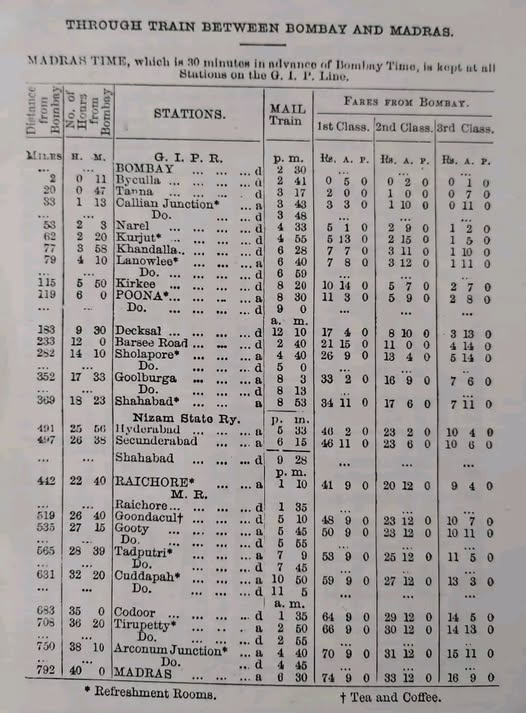
This timetable from Bombay to Madras is from around 1876. Please look at how the stations were spelled at that time - Tanna for Thane, Callian for Kalyan, Lanowlee for Lonavala, and more humourously, Goondacul for Guntakal, besides Arconum for Arakkonam, and Codoor, which was actually Kodur.
The railway line connecting Bombay (now Mumbai) and Madras (now Chennai) was completed in stages, with the final link at Raichur established in March 1871, when the Southern Mahratta line met the line coming from the GIP Railway. The original Bombay-Madras Mail train service was inaugurated shortly after, on March 15, 1871. #IndianRailways #History #timetable #nostalgia
One of the memories from childhood which is eeww pro max now is picking tennis balls from sewage filled gutters with bare hands and slamming the ball onto the ground in efforts to rid the ball of the sewage sludge, and in the process be showered with the said sludge. I mean that sewage would have stuff that even Wuhan would be scared of! And after all that now we mask up the moment someone sneezes next to us and look at them with disgust! 😅😁