Comfort is poison not just in real life, but the digital as well. Here’s to tech, money, data, and software being decentralized, open source and trustless. No single company, government or individual should have the power to own you.
Apple is going to poison the one victory Epic secured in their lawsuit so bad nobody would ever think to use it. They want a 27%(!!!!) commission on any link from an app to a website, reporting every few weeks, AND the right to audit your books?? Insane.
laserphile: AliExpress webpage keeping multipoint Bluetooth headphones active with WebAudio fingerprinting #security#privacy#tech https://t.co/f9afq2nPqD
this is a very sobering read. main thesis is in section 5:
> Our conjecture is that a modern society makes the third child expensive and childlessness cheap, even when GDP per capita is only a fraction of the frontier (i.e., the U.S. level). Children are expensive because a child must be equipped to function in a world of formal knowledge and credentials, which takes years of costly investment (Restuccia and Vandenbroucke, 2013, Doepke and Zilibotti, 2019). At the same time, children are no longer productive in the household, not even for smaller chores, having been replaced by “engines of liberation” such as the electric appliances now available even to poor households (this idea extends the intuition in Greenwood et al., 2005). Modernity also imposes tight career schedules, set by large-scale organizations, that collide with the biological clock and with the kin networks that used to share the work of raising children (Adda et al., 2017, Compton and Pollak, 2014). And modernity makes childlessness cheap, because an impersonal society imposes next to no penalty on those who have no children: pensions and health care do the work that sons and daughters once did (Boldrin et al., 2015), and lineage counts for little.
> Goldin (2026) pushes this line further with an argument about a growing mismatch between genders. Modernity also changes gender roles unevenly. Women’s opportunities expand rapidly through education, work, and greater independence, while expectations about housework and childcare often change more slowly (Goldin and Katz, 2002, Goldin, 2021). This is particularly true as economies shift toward services, where women’s comparative advantages are better rewarded (Ngai and Petrongolo, 2017). The mismatch operates at both the extensive and the 18 intensive margins: more women remain childless, and mothers have fewer children on average.
> This argument is attractive because it explains why East Asia and now Latin America have such low TFRs. These are the societies where the gender mismatch is largest.19 It also suggests an intriguing possibility: societies with highly unbalanced gender norms start with very high TFRs, as men impose their preferences (Ashraf et al., 2014), and end with very low ones, as women resist (Doepke and Kindermann, 2019, Doepke and Tertilt, 2018). A paradoxical reversal of demographic fortunes.
...
> In short, modernity in its current form seems largely incompatible with replacement-level fertility.
I'll never forget the morning of February 24, 2022.
After marrying my sweetheart in Ukraine and living happily in Lviv for years, I had abruptly canceled family Christmas and moved us to Dubai in December since becoming convinced that this was coming. (You can never time everything just perfectly, though.)
A couple of Ukrainian colleagues had similarly relocated their families to Portugal and the like well prior to the February invasion. But the majority of my Ukrainian family, friends, and colleagues were as yet enmeshed by their normalcy bias: it was just unthinkable and inconceivable, they'd say.
But that cold February morning shattered everyone's ordinary day and ordinary plans to smithereens. In the memorable early morning words in a group chat with an unprepped colleague in Kharkiv—with tanks massed and beginning to move in from just a few dozen klicks away: "Oh shit, I can see and hear bombs falling. Packing the bags!"
Over the days that followed, so many clung to yet more comforting illusions: that the enemy wasn't actually targeting civilians, that couldn't possibly be; that the atrocities were just isolated incidents, just unfortunate accidents. The reality check took several intense weeks to play out, and perhaps broke the minds of some.
For me, the six weeks following that early morning message turned into the most intense period in my life. While I had already moved my own immediate family out of harms way, there were so many others who needed help. Impossible situations, unlikely rescues, the need for boots on the ground. And it wasn't long until word of the first casualty, at too close of a social distance.
That particular story of the first six weeks, and the hundred plus souls it affected, has never yet been told, and will have to remain nonpublic stuff of legend for a while longer. Those who know, know. And for those who helped save lives, eternal gratitude.
As a Finn by birth and something like an adopted Ukrainian through marriage, the events of the last three years have proved all too familiar: the story of a recurring, ravenous, unfathomable great evil that returns over the span of generations, but is never quite believed nor remembered a couple of generations downstream, thus trapping us in Santayana's dictum.
As a kid growing up in Finland, I certainly didn't appreciate—I couldn't truly know nor comprehend—the calamity that had befallen my great-grandfather's generation nor the depth of sacrifice it had required to emerge from the other side of it; or to, half a century later, provide me with a happy childhood accented by peculiar moss-draped fortifications in nearby forests.
In bearing witness to these parallels in another time and another place, but facing the same evil, I learned so much more about those matters that my taciturn elders didn't wish to or couldn't find the words to discuss for lack of a sufficient transfer encoding.
I mourn for the Ukraine that was, the one my smart, sweet, and sensible wife grew up in—just sufficiently long emerged from prior horrors of history for children to not really believe in monsters. I mourn as well for the one that could have been, the one I would have liked my young children to grow up in. My children will never know either one of those countries, which I, too, but all too briefly glimpsed.
I pay homage to the Ukraine that now is, where children grow up knowing that monsters exist but also that the monsters can be slain. ⚔️
@ClassicII_MrMac I still shut down my Mac Studio to get rid of the light. Annoying.
Button on the bottom reads like joke. Something like the non-removable power cord on the Studio Display.
@wilderko “za realizáciu zisku nie je podľa platnej legislatívy považovaný len reálny presun financií z burzy na bankový účet, alebo aspoň presun kryptomeny do stablecoinu, ale aj predaj kryptomeny za kryptomenu”
@BasedPatriotX@ianmiles @WayneGb88 @realDonaldTrump@JamesBlairUSA It has already spread across Europe.
This German politician was arrested for quoting statistics.
These things are just un / underreported.
https://t.co/i5VjEmldR2
Will too much protein damage your kidneys?
Does protein shorten longevity due to its effects on mTOR?
Neither of these claims are supported by evidence.
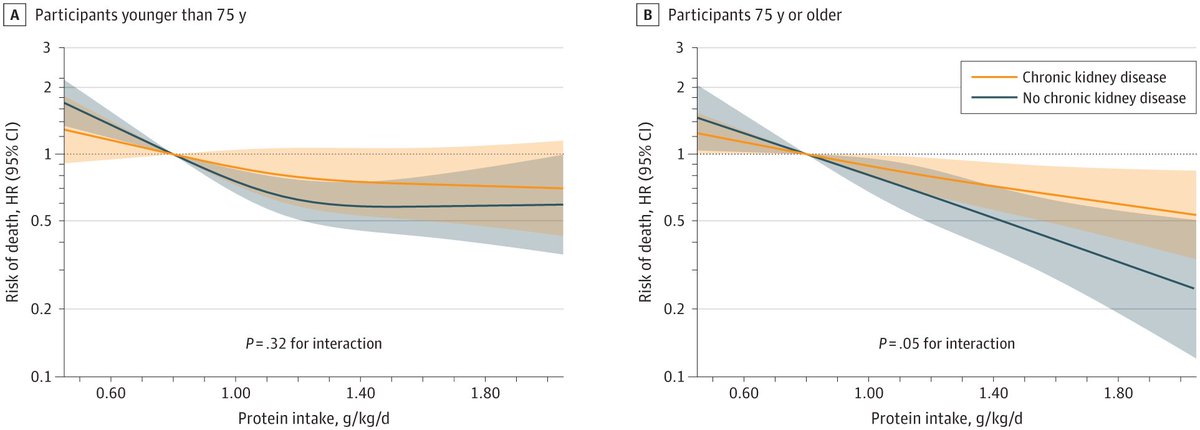
In fact, a new study suggests that the opposite might be true — more protein leads to greater longevity, even for people with chronic kidney disease (who are told to restrict their protein intake).
Eating more protein was associated with a lower mortality risk in a dose-response fashion for adults with and without chronic kidney disease.
The benefits of higher protein were stronger for adults older than 75.
Compared to the RDA for protein (0.8 grams per kilogram of body weight per day):
- A protein intake of 1.0 g/kg/day reduced mortality risk by 12%
- A protein intake of 1.2 g/kg/day reduced mortality risk by 21%
- A protein intake of 1.4 g/kg/day reduced mortality risk by 27%
- A protein intake of 1.6 g/kg/day reduced mortality risk by 33%
Both plant protein and animal protein were associated with a lower mortality risk, a finding that runs contrary to some of the evidence linking animal protein with a greater risk of disease and mortality.
The implications of this are clear: the benefits of protein outweigh any potential risks for adults with chronic kidney disease, especially if they’re older.
PMID: 39110456
I’ve written for @SpecCoffeeHouse on how various schools are leading the way on new smartphone policies, but there’s still too much variation and until parents get on board with the idea of dumbphones the most privileged will be the most shielded: https://t.co/3oaHxqI8cC