Counterpoint : oncogenic proteins exist. A grad student can synthesise a novel virus in a lab. Ergo the bio terrorism threat is real. The solution is a widespread platform that lets people analyse pathogens and omics at home. I have been building this but access to seed funding in Romania is weak.
CAR T-cell achieved a durable complete response in a chemotherapy-resistant solid tumor, with no systemic toxicity - (September 2026) N Engl J Med
https://t.co/fRjsp1iHlF
This is a 3D Ramachandran plot
["A fresh look at the Ramachandran plot and the occurrence of standard structures in proteins" Hollingsworth, et al 2010]
Today Anthropic introduced Fable 5.1 (generally available) and Mythos 5.1 ("available through trusted access programs").
Biology-relevant capabilities:
1. For agentic research: Fable 5.1 more than doubles its score (~52%) on Terminal-Bench-Science 0.1 vs Fable 5.0 (~24%)
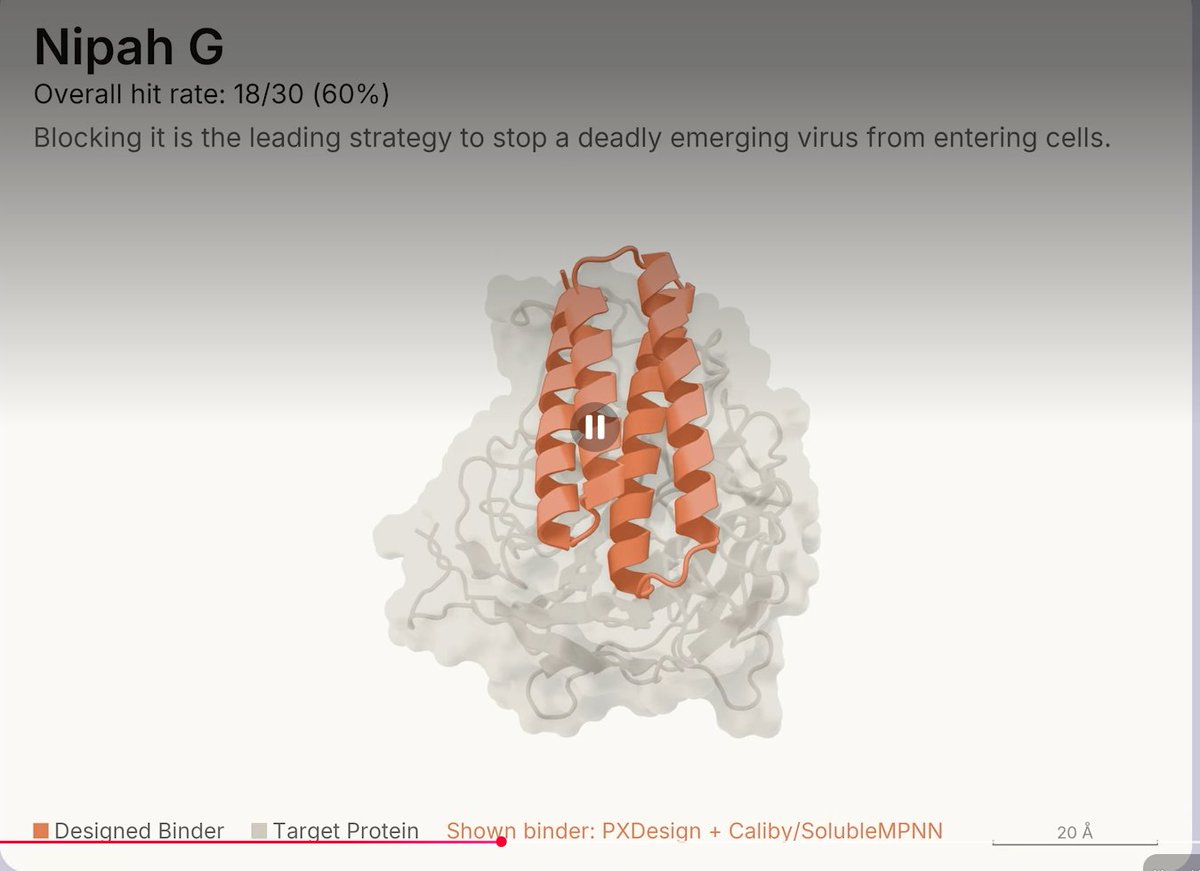
2. For binder design: Mythos 5.1 designed binders with wet-lab validated hit rate of e.g. ~50% of 12 samples
3. For biology model inference: Mythos 5.1 worked on the public repos and built custom GPU kernels getting a speedup of 1.4x to 2.5x for models like Evo2, Enformer etc. They will release the source later.
My father an my best friend will be buried tomorrow. Please be so kind to remember his legacy and help me get all his works published.
https://t.co/OuqY9UoO1b
Ok so total cost to design and validate a binder against a single target is ~14770 USD. Breakdown is: validation of the top 30 designs from a single-target run/campaign using the “full affinity characterisation” test from Adaptivity is ~$7770 USD. On top of the ~$6000 USD of GPU compute. Plus 24 hours of Opus 5 tokens for single-target execution, a guesstimate $1000 USD since the inference profile would be sparse a lot of polling for GPU jobs.
Ok so total cost to design and validate a binder against a single target is ~14770 USD. Breakdown is: validation of the top 30 designs from a single-target run/campaign using the “full affinity characterisation” test from Adaptivity is ~$7770 USD. On top of the ~$6000 USD of GPU compute. Plus 24 hours of Opus 5 tokens for single-target execution, a guesstimate $1000 USD since the inference profile would be sparse a lot of polling for GPU jobs.
@DeryaTR_ They ran Opus and Mythos independently. We can potentially just run Opus and increase the running time for each “campaign” (where a campaign is an autoresearch experiment) , which was capped at 24 hours by the prompt for single target runs.
GPU Compute budget to run Anthropic's de novo binding workflow yourself:
* For a single target: About 95 H100s per hour for 24 hours. Thats ~$6k USD on a neocloud, or ~$10k USD on Modal. This is compute used by the open source binding models (ESMFold etc).
* Full workflow: ~$210k USD. The prompts cap compute at $50k per 48 hr 14-target campaign, $10k per 24 hr single-target campaign x 16 targets.
- Plus CRO costs for validation (Adaptivity + Twist bioscience)
- Plus Claude inference tokens costs (48 hr session on the multi-target, 24 hrs each on the single-target campaigns).
Prompt are comprehensive and include a corpus of papers that inform binding and it specifically asks for H100s:
Many drugs work by binding to a specific target in the body and blocking or changing what it does. An important first step in the drug development process is designing a molecule that can bind tightly to its target. Traditionally, that's meant weeks or months of expert work per target, sifting through a large number of candidates to identify the few that work.
We wanted to test if Claude could successfully design novel protein binders from scratch (also called de novo design). With a protein design prompt written by a human expert, Claude autonomously designed protein binders against 14 out of 15 targets.
We then worked with Adaptyv Bio and Twist Bioscience, who independently built and tested the proteins Claude designed.
One of the most important molecules in your body is produced by only a few neurons in your brain.
The molecule is hypocretin (orexin).
Hypocretin acts like a stabilizer for the brain’s global state. Its neurons integrate signals about the circadian clock, metabolism, emotion, and behavioral demands, and then activate multiple arousal systems throughout the brain. This helps keep us stably awake when we need to be awake—and allows sleep to take over when wake-promoting signals subside.
The importance of this tiny system becomes strikingly clear in narcolepsy: loss of hypocretin signaling destabilizes the boundaries between wakefulness, NREM sleep, and REM sleep, causing sudden transitions and REM phenomena to intrude into wakefulness.
It is remarkable that a few tens of thousands of neurons and two small peptides can exert such profound control over the state of the entire brain.
The molecular structure shown is from RCSB Protein Data Bank: 1R02


![rlognormal's tweet photo. This is a 3D Ramachandran plot
["A fresh look at the Ramachandran plot and the occurrence of standard structures in proteins" Hollingsworth, et al 2010] https://t.co/CEWs48aINj](https://pbs.twimg.com/media/HSU-izrXYAA-6pB.png)