was testing out @epochal's api - one of the biggest events this week was the return of jensen on monday, so i was curious if there was any indication / leak of jensen's return on the internet before the official announcement at 5:55 am pacific time.
it didnt find anything high signal, but from a web search, this x post from a trump interview at 5:29 a.m shows up where jensen's return was implied.
this shows how important x is as a source of alpha, and also the difficulty of reproducing the state of the world at a given time through the public web alone.
another random thought - a simple way to verify the correctness of the environment then is to do a web search as of now, get the timestamp of the search results, and see whether these results appeared in the environment at the time.
https://t.co/fTh9wXMhHB
I spoke with @potus a few moments ago and asked him about the New York Times reporting that the woman involved with Jensen Huang had been in touch with an official of China’s top spy agency for more than a year:
Introducing Alto, our new voice model from Decagon Labs.
Alto powers our duplex architecture which lets agents listen, speak, and act at once. It delivers a 5+ percentage point lift in resolution with ~700ms responses on live calls.
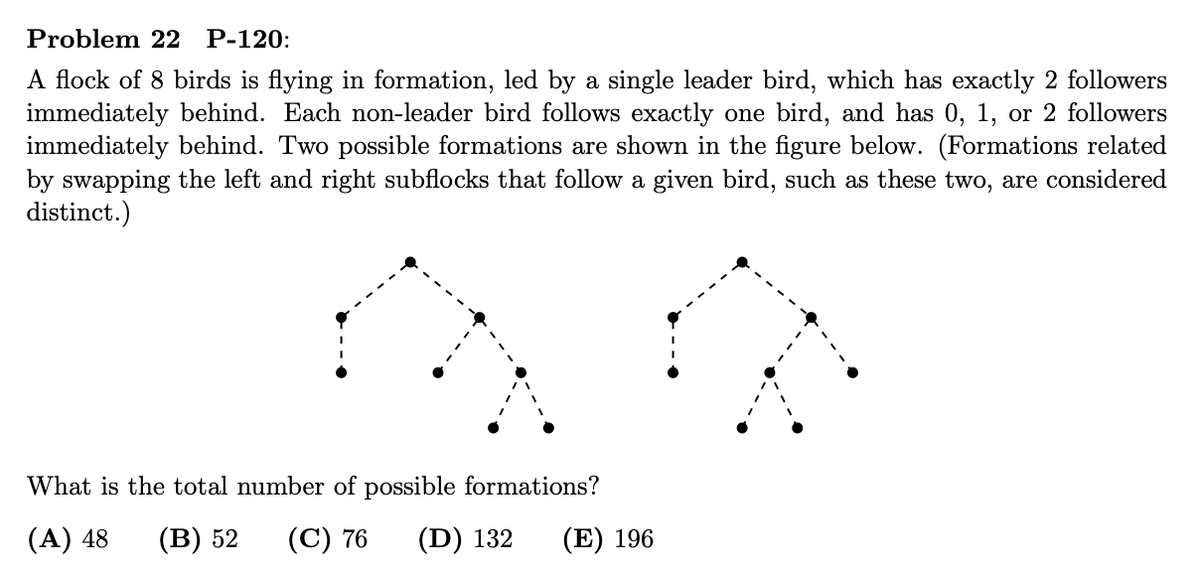
with DP:
f(8) = f(7) + sum(f_i + f_(7-i)) where i is between 1 and 6 inclusive.
=> 24 + 12 + 6 + 8 + 8 + 6 + 12 => 76
the birds have many options!!
Fun dynamic programming / recursion problem!
In a way this question beautifully shows how interconnected math and programming is, and that math ability in AI translates into coding and vice versa.
We asked GPT-6 Astra to edit Qwen3.5-0.8B weights to improve math.
It directly changed only 0.016% of weights, fixing 0.8B's reasoning loops & improving math up to 6x and even instruction following 3x, without gradients or training.
We call this Weight-Space Programming: frontier LLMs can now natively read/write neural network weights! 🧵
Blog: https://t.co/bOWCcFhCVq
The immediate next question is how do you trust the guardrails around the system are working. From my experience at Decagon, this means having an ensemble of weakly correlated guardrails that are both intelligence based and more mechanistic in nature (e.g different model family than the main model). Another question is how do you define their criteria - this is really where the real differentiation happens. More on this in an upcoming blog
Native customer service in Instinct
Nobody likes talking to customer service. Instinct should handle those tasks for you.
With Instinct Concierge, we enabled Instinct to make calls on your behalf. Now, we’re taking this a step further. When your Instinct connects with participating businesses on @SierraPlatform and @DecagonAI, the agents will be able to work together to solve your problem with speed, reliability, and safety without making a phone call.
I’m excited to announce that Instinct will be partnering with Sierra and Decagon to bring customer service experiences directly to your personal agent.
Customer service tasks like:
- Troubleshooting your home wifi issues
- Finding out when a delayed package will arrive
- Figuring out why your bill is higher than last month
- Getting clarity on a confusing return or cancellation policy
Prediction - in one year more customer support interactions will be initiated by ai agents rather than human - businesses need to face this reality and an agent specific protocol is a first step to making this communication efficient. More details: https://t.co/WkKNiCwUfH
Today, we're open-sourcing the Personal Agent Consent & Trust Protocol (PACT), co-developed by @Instinct. We're also joining the Personal Agent Protocol working group by @Muse.
Built on A2A and OAuth, PACT enables businesses to verify who a personal agent is acting for and what the customer has authorized it to do.
Excited to shape the industry standard for how personal agents will interact with businesses.
There is also a technical reason that will likely slow down big model release (these days most of the releases are distilled smaller models which doesn’t require RL). As model capability grows and can complete longer horizon tasks, the eval time also grows exponentially. Eventually this will be the bottleneck for model releases. E.g if inference compute can scale to weeks, you don’t want to release it after running for a few days
Pretty well-rounded analysis. I would say the only bull case for exponential growth for the frontier labs is if model capability continues growing on the non-verifiable, economically valuable tasks (relative to the open source models). But safety and alignment is forcing model development to take a pause (rightfully so as it’s a feature not an after thought). This forces the model market to be more or less “perfect competition” and compresses everyone’s margin. The biggest bear case is that the premium on the frontier models is over-valued relative to the credit risk in the data center buildout. Further whenever there is a mismatch in duration for cash flow, liquidity crisis happens (think svb, gfc; this is esp fragile given the high vol regime in long term interest rate)
Interesting finding - this feels like the exploration//exploitation tradeoff explained at a more atomic level: too much exploitation reduces “plasticity,” which makes continual learning harder.
The PhD thesis of my 15th PhD student, Shibhansh Dohare (@ShibhanshD), is now available.
Title: Learning Forever using Artificial Neural Networks
Url: https://t.co/Zp2GxZ03aw
Abstract:
In this dissertation, I study the ability of artificial neural networks to learn new things. I refer to this ability as plasticity. Plasticity is a desirable property of intelligent systems in the real world. Systems that interact with the real world can become outdated if they do not learn from the new information revealed to them by the extremely large and partially observable real world. All naturally intelligent systems continually learn new things to keep up with the changes in the world. Many applications like predicting markets or weather, learning human preferences, controlling factories or prosthetics, etc require AI systems that continually learn new things.
I provide direct and thorough demonstrations of loss of plasticity in deep learning systems. The demonstrations range from simple feed-forward networks to deep residual networks and cover a wide range of algorithmic choices. While seeking an understanding of the phenomenon, I found that loss of plasticity occurred simultaneously with hidden units becoming dormant and becoming similar to each other, hampering the ability of the networks to learn new things.
Next, I describe the continual backpropagation algorithm. I designed this algorithm, in collaboration with others, to maintain plasticity in artificial neural networks. Continual backpropagation is a simple extension of the conventional backpropagation algorithm. The conventional backpropagation has two main parts: initialization with small random weights and gradient descent at each step. In addition to gradient descent, continual backpropagation reinitializes a small fraction of units at each step. Continual backpropagation indefinitely maintained plasticity in many continual supervised learning problems.
Finally, I study plasticity of deep reinforcement learning systems. First, I show that plasticity loss has an effect even in stationary reinforcement learning problems. It is unsurprising that plasticity loss affects stationary reinforcement learning because it requires continual learning due to changing policies and bootstrapping. This effect is visible under long-term learning. I found that some commonly used RL algorithms do not scale with data. Their performance drops as they continue interacting with the environment. Plasticity loss hampers the ability of these algorithms to recover and relearn when the performance drops, resulting in agents that do not get better with experience. Continual backpropagation allows these algorithms to recover when performance drops, leading to agents whose performance keeps improving with experience. Second, I show that loss of plasticity is a significant problem in continual reinforcement learning problems, and continual backpropagation maintains plasticity in these problems.
Shibhansh is now a research scientist at Keen Technologies.
We'll be spending a lot more time trying to understand the outputs of language models. A few thoughts, tips & tricks:
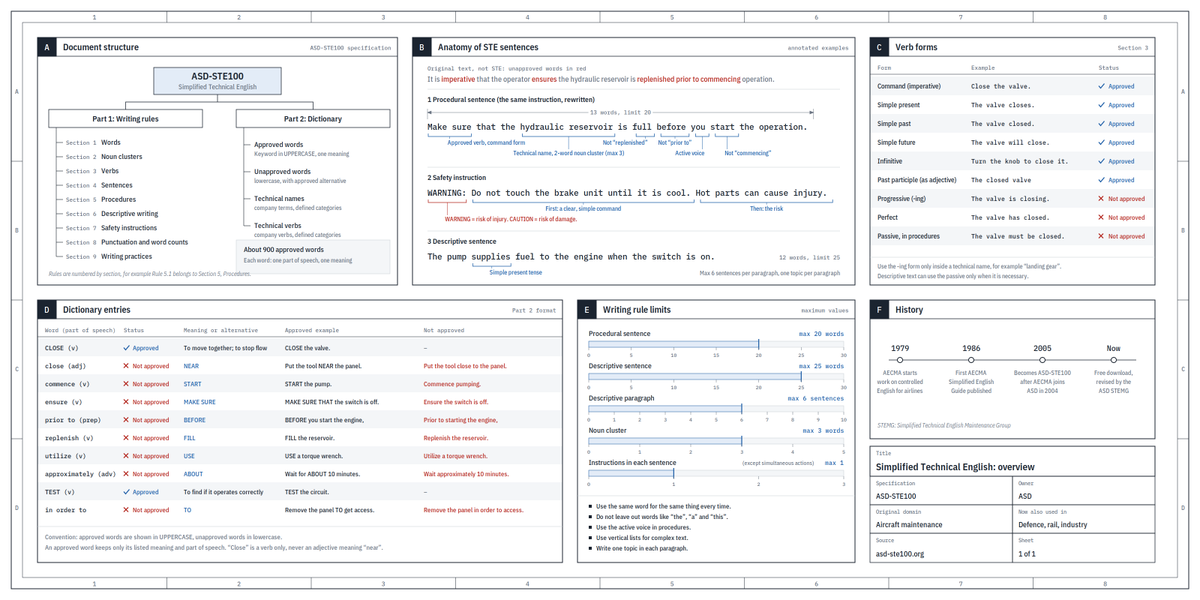
Writing. Something I've had success with: Ask your LLM to explain something in ASD-STE100, it's a controlled language specification originally developed for aerospace maintenance documentation. LLMs well-versed in this language and it comes with heavy constraints on clean writing style that I often find a lot more readable. Sometimes I've tried to soften it a bit e.g. ask for "80% of the way to ASD-STE100" because the spec is quite stringent. But even better:
Diagrams / images. Instead of writing, ask your LLM to create a diagram. These can be a lot easier to process, parse, and understand. But even better:
Web pages. Ask for output "in HTML" to get a beautiful, interactive webpage. LLMs are getting really good at frontend and can create beautiful experiences, animations, etc. But even better:
Explainer videos. The output format I am most bullish on is fully custom / bespoke explainer videos generated on any arbitrary topic. Experiment with things like "Create a 3b1b style video explainer on X. Use my ElevenLabs API key for audio narration". (you'd need an API key for the latter or you can ask your LLM to find you decent free alternatives that use your local compute). This is actually starting to work!
In summary:
- As LLMs get better, they will do more and more of the legwork autonomously, and a lot more of our work will rise up the abstractions into oversight and understanding.
- Luckily, LLMs can help here too because as intelligence and code are increasingly abundant, you can ask for large, custom, discardable software artifacts (e.g. web apps, video explainers) that would have never made sense to create before. Push the boundaries here and you'll be surprised.
Voice 3 is here.
Our most advanced voice experience yet combines Chord, our new voice model from Decagon Labs, with a duplex architecture that lets agents process incoming audio even while speaking.
Chord is post trained specifically for customer conversations, giving agents more natural pacing and intonation, while the duplex architecture enables smoother interruptions and less dead time as the agent keeps working.
Also launched today at Decagon Dialogues:
- Personal Agent Gateway: a dedicated communication layer for handling interactions with personal AI agents.
- Agent Modules: a foundation for expanding agents into new customer journeys.
- Duet Apprentice: a learning layer grounded in your company’s knowledge and the teammates who know the business best.
We turned Qwen3.8-27B into a multimodal decision model.
It beat Pokémon FireRed’s elite four and champion with sub-100 ms decisions from live game state.
With SGLang’s native /v1/decisions, you can now turn LLMs and VLMs into classification and scoring models.
We also added /v1/systemone so Jev-like open models can work with the TypeSafe SDK.
Consumer-driven agents will make markets incredibly more efficient - already I’m asking muse to rebook my flight / hotel if the price ever drops, leverage price protection of my credit card, cancel unused subscriptions etc. many b2c will likely face margin compression as a result and need to rethink their pricing strategy
Fascinating.
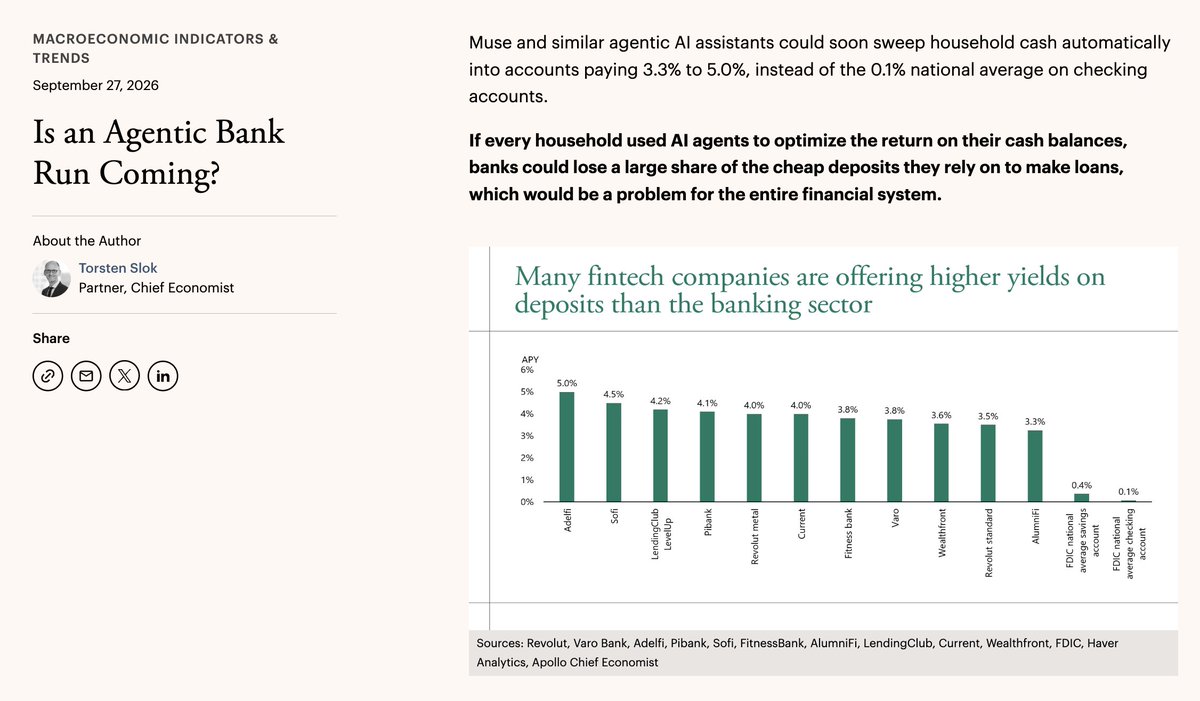
Chief Economist at Apollo: agents could cause a bank run by sweeping household cash into accounts paying 3-5% instead of the 0.1% national average, causing banks to lose a large share of their cheap deposits.