The engineers here got to board the ship like pirates and then seized the precious samples they've been seeking for like half a decade... bet it was a great day 🙂
@TheMarsSociety Love the ISRU focus! Using Martian CO2 and water ice for fuel and oxygen is as exciting as launching a satellite. The future is truly limitless!
You may have seen these headlines earlier this month:
'Space X Crashes into the Moon' and
'Elon's Out of Control Rocket Slams into the Moon.'
So, did this happen? Well, yes. Was this a big deal? No, at least I don't think so.
Last year, SpaceX launched a rocket with a mission of sending 2 robotic landers to the Moon. Normally, SpaceX plans trajectories such that these empty upper stages fall back into the grip of Earth’s atmosphere, where the frictional interaction between the two cause them to explode and burn up. But for a Moon mission, that stage uses almost all its fuel to get the landers going the right way. As a result, this one was left floating in a big, looping orbit around Earth. Eventually, the push from the Sun's highly active solar magnetic influence, coupled with additional various gravitational forces within the Earth-Moon system, changed its path. That path put the Moon in its crosshairs, and boom! "Houston..., we have an impact!"
It's important to remember that the Moon has no protective atmosphere (as the Earth does) and is hit with meteoroids and debris all day long (hence the many craters). This impact rate will undoubtably continue as we move toward a permanent Moon base. As more missions are envisioned to head to the Moon, better rocket stage disposal practices will become more critical. Until then, the occasional controlled or uncontrolled impact will keep happening. While something to watch —each one teaches us something useful about crater formation and the lunar surface-- the Moon has been collecting scars for billions of years. One more from a Falcon 9 upper stage barely registers.
📷 Artist rendering: Tony Dunn
Its been such an unbelievable week to be a SLS fan:
- A3 Center Center SRB segments stacked
- A3 Spacer forward ring welded
- A5 Engine Section progressing once more
- A6 Core Staged started
- A3 RS25 engines beginning install onto the core
In the lunar economy $RDW will:
1) power the base at the south pole (ELSA solar arrays)
2) Build local infrastructure (landing pads, roads)
3) 3d-print components
4) Turn regolith into concrete (for constructions)
@rivadaspace Satellite strategy: it's not just about launches! Love seeing the space sector bring real discipline to orbital networks. The future is limitless.
$RDW
At $11, Redwire offers a +271% upside within the next 5 months.
If you were late to the party, this is still a good entry.
Check my latest short on Redwire 👇
https://t.co/bBXy54d76a
$NVDA beat Wall Street’s expectations again, reassuring investors that the AI spending boom still has room to run.
The AI chip giant posted record quarterly revenue of $96.2 billion and net income of $59.7 billion, while forecasting $108 billion in current-quarter sales for now.
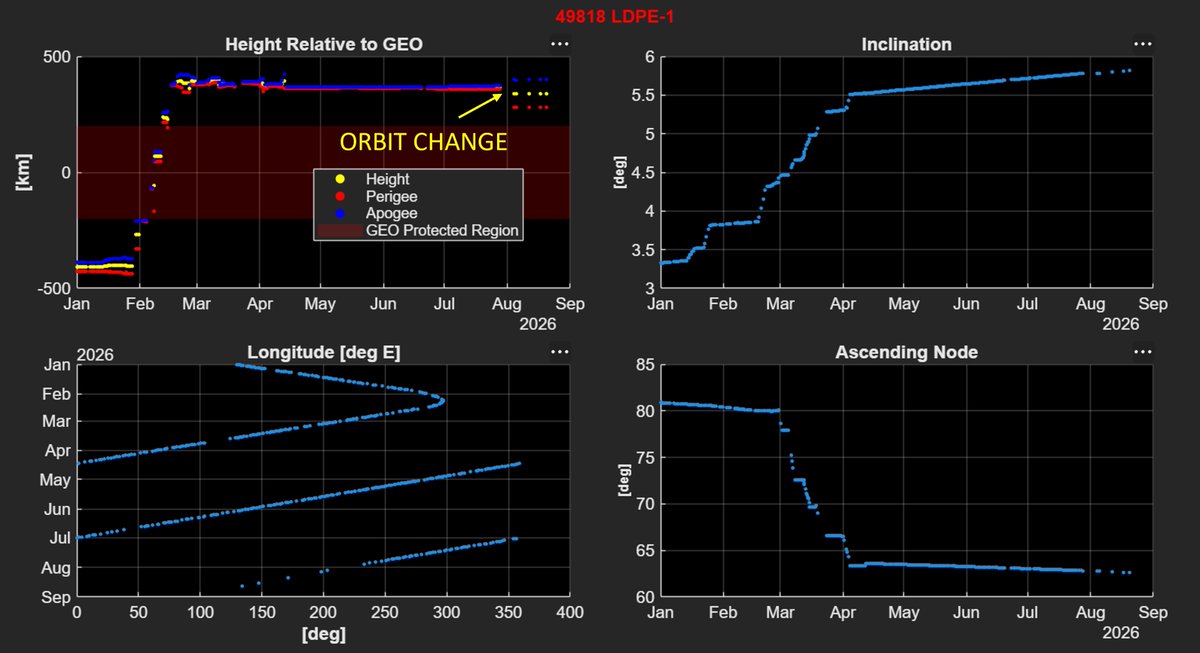
💥 🛰️ Debris event from USSF's "LDPE-1" GEO Satellite on 27 July 2026.
The Long Duration Propulsive ESPA-1 (LDPE-1) appears to have experienced a debris event on 27 July 2026 at 12:50 UTC (+/- 30 min). This is satellite 49818 in the @SpaceTrackOrg catalog (Int Des 2021-118B).
Two public sources of data corroborate the event:
1️⃣ orbital position information from @S4S_SDA via https://t.co/m3OEycBT6w (see graphic below) and
2️⃣ seven new objects appeared in the Vimpel catalog which associate back to LDPE-1 at a time concurrent with the orbit change--to within a ~ 1 hr window 2 sigma'ish
Thankfully LDPE-1 was operating in a supersynchronous orbit ~365 km above GEO altitude, or clear of the GEO Protected Region at the time of the event, and fully remains clear of the GEO Protected Region. The last noted meaningful maneuver was in April 2026, but predominant sources indicate the satellite was still active.
Unfortunately, some of the debris generated now encroaches into the GEO Protected Region.
LDPE-1 is a Northrop Grumman "ESPAStar" payload. There are several ESPAStar payloads active in GEO today with more missions planned. Hopefully the systemic root cause of the debris event is not something that could be repeated in the other platforms.
#SpaceDebris #LongTermSustainmentOfSpace #SpaceDomainAwareness #SpaceDomainNormsOfBehavior
Orbit data from @S4S_SDA via https://t.co/m3OEycBT6w, used with permission per ODR 24-002-4.