@neogoose_btw This is what I did to migrate my config: https://t.co/dnMDMEL99E
I'm not sure if the new built-in treesitter highlighting is different from the old. I didn't pay attention at that level, but the way to enable highlighting is different when using nvim-treesitter plugin
@neogoose_btw In your neovim setup, did you use the nvim-treesitter plugin to configure parsers? Things have changed a bit in neovim 0.12. This explains it a bit how to migrate your config:
https://t.co/gv5PVxzG91
@rodrigc6 this shows you how to migrate from the master branch to main branch (of nvim-treesitter), it doesn't show you how to install and configure parsers without the plugin
Oral care protocol:
Here's 9 habits for oral health:
1. Waterpik: High-pressure stream of water to remove food, plaque, and bacteria from hard-to-reach places. Morning & night.
2. Floss: After using the Waterpik to loosen particles, I use floss for plaque and debris removal.
I use Dr. Tongue's because it's showed a 25%+ increase in plaque removal compared to other brands. Morning & night.
We are excited to announce that we can successfully use Rust's std::thread on the GPU. This has never been done before.
https://t.co/Ya9LkO95dD
Supporting Rust's std::thread enables existing Rust code to work on the GPU and makes GPU programming more ergonomic.
@valyala You may find this interview with @mitchellh interesting, especially the part where he says that due to AI, open source is transforming from “default accept” to “default deny” https://t.co/vwZ6hbDq8E
9 interesting observations from my conversation with Mitchell Hashimoto (@mitchellh, creator of Ghostty, founder of HashiCorp):
1. Vagrant was created because dev environment setup was an unbillable time sink at a consultancy. At the Ruby on Rails shop where Mitchell worked, jumping onto another client’s project could waste half a day. This inspired building Vargant.
2. Terraform won, despite being 7th to market. Terraform won through relentless conference presence, community building, and a better developer experience — not timing.
3. HashiCorp had no real business for four years and their first commercial product was a full-on failure. The initial product, Atlas, required customers to adopt the entire HashiCorp stack. It was a hard sell. HashiCorp pivoted to selling individual services like Vault, and this approach proved to be a winner.
4. VMware almost bought HashiCorp for ~$100M, and Terraform would have not happened if it did. VMWare took took the offer to their board, where they rejected to buy with a single vote. Mitchell said that Terraform probably never would’ve existed if the VMWare purchase went through.
5. Mitchell’s new rule for building software: always have an agent running in the background doing something. He kicks off tasks before leaving the house — research, edge-case analysis, library comparisons — so work progresses while he drives or is away.
6. Open source is moving from “default trust” to “default deny” — and Mitchell thinks that’s how it should be. This is because AI makes it trivial to create plausible-looking but incorrect and low-quality contributions. As he put it: “open source has always been a system of trust. Before, we’ve had default trust. Now it’s just default deny.”
7. Git and GitHub may not survive the agentic era in their current form. Agents cause so much churn that merge queues become untenable, branches proliferate, and repos balloon. Mitchell compares the needed shift to Gmail’s revolution for email: “We’re at the Gmail moment for version control... never delete, archive everything.”
8. The best engineers Mitchell ever hired had boring, invisible backgrounds. No GitHub contributions, no public profiles, companies you’ve never heard of. “Every moment you spend on social media is taking away from something else... the best engineers are the ones that context-switch the least.”
9. Mitchell’s advice for AI-skeptical engineers: start by reproducing your research, not your code. As he puts it:
“There’s a lot of people like, ‘I don’t want it to write code for me.’ But just delegate some of the research part.”
He uses agents for library comparisons, edge-case analysis, and deep research — not just code generation. Mitchell: “You don’t need to pick up on the ‘it must replace you as a person’ kind of propaganda.”
Watch the full episode here: https://t.co/eETyr20fQA
Other platforms and transcript: https://t.co/yl0WdFRbA4
AI eliminated the natural barrier to entry that let OSS projects trust by default. People told me to do something rather than just complain. So I did. Introducing Vouch: explicit trust management for open source. Trusted people vouch for others. https://t.co/6mY8yIcvGx
The idea is simple: Unvouched users can't contribute to your projects. Very bad users can be explicitly "denounced", effectively blocked. Users are vouched or denounced by contributors via GitHub issue or discussion comments or via the CLI.
Integration into GitHub is as simple as adopting the published GitHub actions. Done. Additionally, the system itself is generic to forges and not tied to GitHub in any way.
Who and how someone is vouched or denounced is up to the project. I'm not the value police for the world. Decide for yourself what works for your project and your community.
All of the data is stored in a single flat text file in your own repository that can be easily parsed by standard POSIX tools or mainstream languages with zero dependencies.
My hope is that eventually projects can form a web of trust so that projects with shared values can share their vouch lists with each other (automatically) so vouching or denouncing a person in one project has ripple effects through to other projects.
The idea is based on the already successful system used by @badlogicgames in Pi. Thank you Mario.
Ghostty will be integrating this imminently.
Use local models on remote devices you control—as if they were local.
- Introducing LM Link from @LMStudio.
- Encrypted, identity-based access to your own LLM hardware.
- No public endpoints. No API key sprawl.
https://t.co/SGJC0JhlbU
@ThePrimeagen@justinmk@teej_dv I switched to @Neovim in 2021, after watching videos from you, @teej_dv , @chrisatmachine and others. I've never looked back, and have been extremely productive in Go, Rust, Typescript, Terraform, and other languages with rock solid LSP support and excellent Lua extensions!
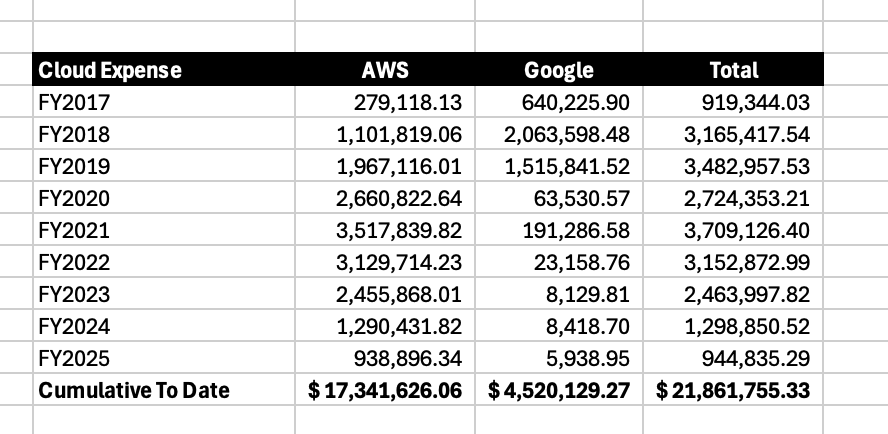
Since 2017, we ended up spending almost $22m on cloud. Peaking at $3.7m in 2021. Now that we're all out, we'll spend a little over a million on everything we own ourselves. Same team size. Better performance. Saving $2m+ per year! 🎉
We are excited to announce that we can successfully use Rust's standard library from the GPU. This has never been done before.
https://t.co/CUfzoJ4mja
Supporting Rust's standard library enables existing Rust code to work on the GPU and makes GPU programming feel normal.
@andrewlamb1111 Is there a conference where some of these teams could break out into a working group and collaborate in real-time? @rustconf 2025 has passed, but that is a good one.
There are various Iceberg meetups and conferences that might also be good venues.
@satnam6502 My personal feeling is that the current tech job market is largely in favor of employers, leading to more challenging interview processes, pickiness/flakiness, ghosting, etc. Based on your current experiences, do you agree?