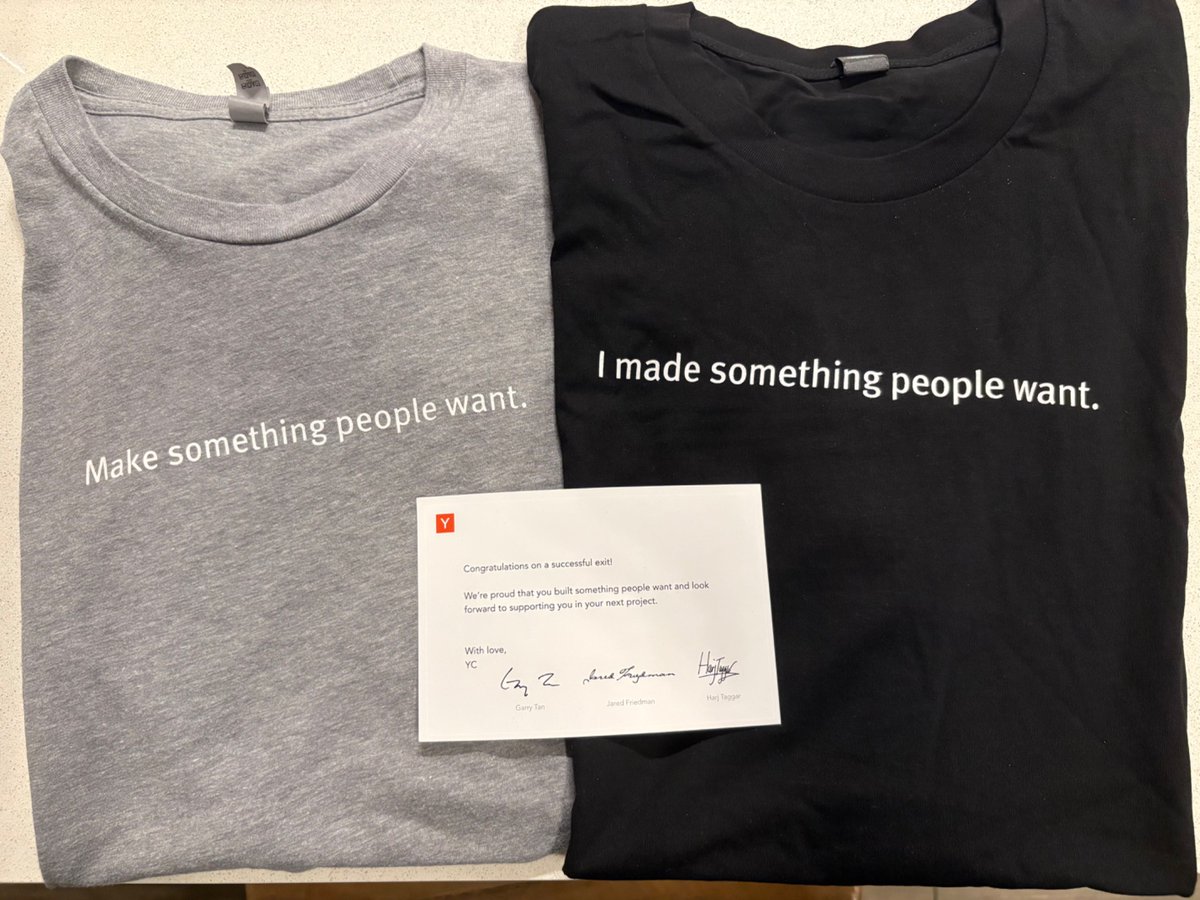
Ok, I will shit-talk VCs just a little bit.
It was curious to see, when @spindl_xyz was being acquired by Coinbase, how many of our VCs discouraged me to sell, and pushed me to either keep on building or launch a token and pump it as much as possible.
Spindl was a modest success, and early investors got a passable DPI, but nowhere near a fund maker. In their minds, this was failure.
Tech is like the cliché WWI movie: the VC generals lounge in their plush tents in the rearguard, ordering frontal assaults on unassailable redoubts, no matter the casualties, to claim the glory of a capturing this hill or that town. After all, it's 10x or nothing for them: Over the top, boys! Over the top!
The corpse-strewn field will be forgotten by them (and everyone else), but they'll be there to takes selfies with the one guy who somehow made it through the rat-tat-tat alive, and claim it a providential inevitability and testament to their strategic acumen.
And the only right answer when the VC orders another suicide charge is to laugh in their faces and say: "well *you* go grab a rifle and take that hill then, motherfucker" and do what's best for you and your squad to get out of the mess alive.
There'll be a different set of generals the next war anyhow.
I've added a new question to the list I consider during office hours with YC startups. As well as "Can we induce network effects?" and "Would it make sense to go full-stack?" I now ask "Can we make this AI-proof?" Can we ensure this company still exists if AIs do most work?
As a father of two young kids, I keep thinking about this from Dara:
"I think we're doing our kids a disservice by giving them too much, being around too much.
You want to love your kids, you want to know that they're absolutely loved and appreciated.
But it's the challenges in life that form you, and it's the overcoming of these challenges that give humans a profound satisfaction.
If you as a parent are overcoming these challenges for your kids, you're actually doing them a disservice long-term, whereas short-term you think you're doing them a favor.
They've got to learn how to make it in this world themselves.
A happy life is not necessarily an easy life."
The best part about this rotation from software into industrialization
Is that venture capital dollars and companies will finally be transforming the physical world
The 2010s deployed billions of dollars, but if you stepped out on the street, the world looked the exact same...
some thoughts on kirkland building its own harvey
1) kirkland is spending $500m over four years in order to build its own internal ai legal tools; kirkland intends to spend $100m this year
2) i suspect that kirkland is doing this because they have told themselves that they have valuable data and because they want to appear differentiated
3) i think the first issue is that kirkland probably does not have differentiated data from other elite law firms; at least, not at the level a harvey would absorb
4) all the elite firms probably have similar internal workflow data and so long as some of them defect, that is enough to commoditize the data kirkland wants to use for its platform
5) and, to the extent that they do have different internal workflows, harvey and legora will end up representing a better version of them and this will put kirkland at a disadvantage
6) moreover, companies like kirkland will have difficulty building their internal legal platforms because they do not have experience with software development
7) and, there are both cultural and structural issues with them managing software developers, like they cannot give non-lawyers equity in the firm due to regulation
8) so, i think firms like kirkland are better off using tools like harvey and legora and then looking to focus on where their value really is now: client relationships, local knowledge (litigation, regulation) and legal r&d (novel structures, etc...)
9) anyway, this seems to me like a phenomenon that ai creates across a lot of industries, where firms that were previously vertically integrated become unbundled due to ai because part of the intelligence gets moved to the labs or otherwise gets commoditized
10) and so, a new set of companies are created whose job it is in order to provide services complementary to the labs: forward deployed like harvey and legora and data providers like mercor, surge and handshake
You can work 5 days a week and succeed as a startup.
Mercury has done that from day 0 and we are valued @ $5.2bn 7 years after launch.
I have been an entrepreneur for 20 years and raised 3 kids while doing it.
The point of success is to have a great life not just a startup 😊
if you're under 50 and you stay healthy, i think you will live to 150 years old minimum
the medical singularity is happening.
just in the past 2 months alone:
> revmed's pancreatic cancer drug (daraxonrasib) doubled survival in the deadliest cancer there is, 13.2 months vs 6.7 on chemo. it got a standing ovation from 40k+ doctors at the world's biggest cancer conference
> a one-time gene editing infusion (verve-102) permanently switched off the gene that drives bad cholesterol and cut it up to 62% from a single dose. one and done, no daily pill for life
> a lung cancer pill (lorlatinib) kept 60% of patients with spread cancer progression-free at 5 years. the longest anyone has ever held back a metastatic solid tumor with a single drug
> mayo built an ai that catches pancreatic cancer on routine ct scans up to 3 years before doctors can. it spotted 73% of the earliest cases vs 39% for human radiologists
> lilly's new weight loss drug (retatrutide) hit up to 30% body weight loss in its big phase 3 trial, and along the way it cut knee arthritis pain by 76% and dropped bad cholesterol about 20%
and we are still just at the beginning of the exponential
call me crazy but i'm a believer when Demis hassabis says we will cure all disease in the next 10 years
The events of the last 6 months in technology are arguable amongst the most important in human history
The tools now increasingly exist for recursive self improvement of models & agents
We are likely in very early lift off & exponential
Largely unnoticed outside of tech
@DLoesch As @JTLonsdale said to me, the Marxists are going to hate this - we are making every child a capitalist from birth. For little more than our foreign aid to Jordan, we get a firewall in defense of capitalism. This is the opposite of welfare. This is private ownership writ large.
AI is embarrassing a lot of senior engineers. A junior who touched the frontier yesterday often has better instincts for what’s possible than someone experienced who last touched it six months ago.
Earlier this year I was getting frustrated with Claude's charts, fed this book to claude and had it generate a Tufte skill. Instantly got simpler/more beautiful visualizations.
https://t.co/lfXwyQfmQG
Another related fallacy is to think that you have to start a startup now because there's a boom happening now, and if you wait too long all the good ideas will have been done. I've been hearing this line for 20 years and it has never been true.
The vibes in Miami feel pretty fantastic right now. The outcomes is the best I’ve seen.
Founders are getting funded. Companies are getting built. Investors are showing up. People are taking real swings.
Most importantly, founders are helping each other.
That part matters the most.
Miami tech has always had a chip on its shoulder. For years, people asked “is there actually anything happening there?” and the answer was annoying because there was, it was just early, uneven, and hard to explain without sounding defensive.
Now you can feel the compounding.
A founder raises and immediately starts making intros for the next founder.
Someone gets a customer and shares the playbook.
Someone meets a great operator and passes them to three other companies.
Someone writes a small angel check into a person who probably would have been ignored by the traditional network.
That’s how ecosystems actually get built.
People helping people climb.
As a result:
1. The ladder here feels more open.
In a lot of places, tech feels like a prestige maze. Right school, right company, right fund, right dinner, right group chat.
Miami is still messy enough that the doors are not all locked yet.
A kid from FIU can meet a founder.
A first-time founder can get in front of angels.
An operator can become a founder.
A community builder can become the connective tissue for an entire scene.
That’s special.
2. The energy is ambitious without being miserable.
People are working hard, and it doesn’t feel like everyone is trying to win by making everyone else feel behind.
There’s less “I missed the last wave” energy.
More “what can I build, who can I help, and how do we make this city more legit” energy.
That is a much healthier default.
3. The wins create mobility.
When a Miami company raises, hires, exits, or even just survives long enough to become credible, the whole city gets a little stronger.
Employees learn.
Founders recycle capital.
Operators level up.
Angels get created.
Customers become references.
People outside elite tech networks get a shot.
This is the part I care about the most.
Tech should be one of the last great engines of social mobility.
Miami still feels like a place where that can be true.
4. The best people here are still accessible.
There is ego everywhere. It’s tech. Let’s be serious.
Most of the newly transplanted rich folks are meeting local founders (Larry Page had the founder of an AI co over recently) & investing heavily in Miami (ie Citadel, Palantir grants).
That is new.
And fragile.
The second an ecosystem becomes too status-obsessed, it starts eating itself.
Miami has a real chance to avoid that because the culture is naturally relationship-driven. People here remember who helped them. They remember who showed up. They remember who was around before it was obvious.
People will still roll their eyes at Miami tech.
That’s fine.
They rolled their eyes at crypto.
They rolled their eyes at remote work.
They rolled their eyes at Florida.
They rolled their eyes at half the people who ended up building real things.
Miami does not need to be SF.
Miami has its own edge: immigrant ambition, sales culture, hospitality, finance, crypto DNA, Latin America access, weird builders, local pride, and a community that still feels small enough for one generous person to make a meaningful difference.
That is a very good setup.
The outcomes are getting better.
The founders are getting sharper.
The capital is getting more serious.
The network is getting denser.
And the best part is that it still feels early enough that anyone serious can show up and matter.
Pretty fantastic vibes tbh.