Average Russian worker earns $800/month. British worker earns $2,500/month. Looks like Britain wins, right?
Here's what each can actually buy:
RUSSIA:
One-bedroom apartment rent: $200
Utilities (gas, electric, water): $50
Groceries for one person: $150
Public transport monthly pass: $15
Internet: $10
Dinner at restaurant: $8
Doctor visit: $0 (state healthcare)
Total monthly costs: $433
Money left: $367
UK:
One-bedroom apartment rent: $1,200
Utilities: $180
Groceries: $350
Public transport: $180
Internet: $35
Dinner at restaurant: $25
Doctor visit: $0 (NHS when it works)
Total monthly costs: $1,970
Money left: $530
The British worker has $163 more left at the end of the month. After earning triple the salary.
That's PPP. That's why GDP in dollars doesn't tell you who can actually afford to live.
More probable:
The high frequency trading and cyber wars of 2027 fought via low latency SRAM chips, whether Groq 3 LPX or CS-4, in disaggregated setups with Rubin.
Jane Street reportedly paying $200 million per mw - $200b per gigawatt - is likely the beginning, not the end.
With Astra's help and a little bit of opus 5.5 I broke the private telegraph code Napoleon III and Empress Eugénie used in June 1859, around the battle of Solferino (BnF NAF 11355). The coded telegrams have sat in the Bibliothèque nationale since 1916 with no published key.
As far as I can find, they have never been published in decoded form. This is the reconstruction.
The Empress, 23 June
"Je suis désolée de vous avoir fait de la peine. Ce n'était pas mon intention. Ne vous inquiétez pas du petit, il va à merveille."
"I'm so sorry to have caused you pain. It was not my intention. Don't worry about the little one, he is doing wonderfully."
The Emperor, same day, eve of Solferino
"Il faut y regarder à deux fois avant de faire de la peine à ceux qui aiment… Je suis inquiet de la santé de notre fils ; dites-moi franchement comment il est."
"One must think twice before hurting those who love… I'm anxious about our son's health; tell me frankly how he is."
This is Peter Lynch’s favorite metric and I like it too because it ties valuation to growth and I prefer using a 2026 to 2028 window so the multiple adjusts for how fast the business is actually compounding.
For example $AMD trades at ~57x forward earnings but earnings are expected to grow from $5.73 in 2026 to $19.87 in 2028 implying a ~86% earnings CAGR and PEG of ~0.7x.
NEW: According to a bombshell report in the New York Times, Anthropic co-founder Chris Olah threatened to walk out of Pope Leo XIV’s AI encyclical launch in May because the pope rejected the idea that machines can be conscious.
Olah’s team then privately lobbied the pope’s advisers “to take the possibility of model consciousness seriously.” Pope Leo XIV held firm.
For months, Anthropic has wined and dined theologians and religious scholars under nondisclosure agreements, hoping they would bless the idea that Claude has moral standing. https://t.co/iG3Bnlzt2J
🚨 side project alert 🚨
Announcing Muse Gadgets, an open source ESP32 firmware and Linux sdk so that you can make hardware devices that work with Muse.
Grab an API token from https://t.co/Q0dE0cYnCs and point your favorite coding agent at the github repo to build your own peripherals for Muse.
Rumor I hear is Trump admin wants to weaponize its current control of oil coming out of SoH + US + Ca/Vz production to force China to loosen up RE restrictions.
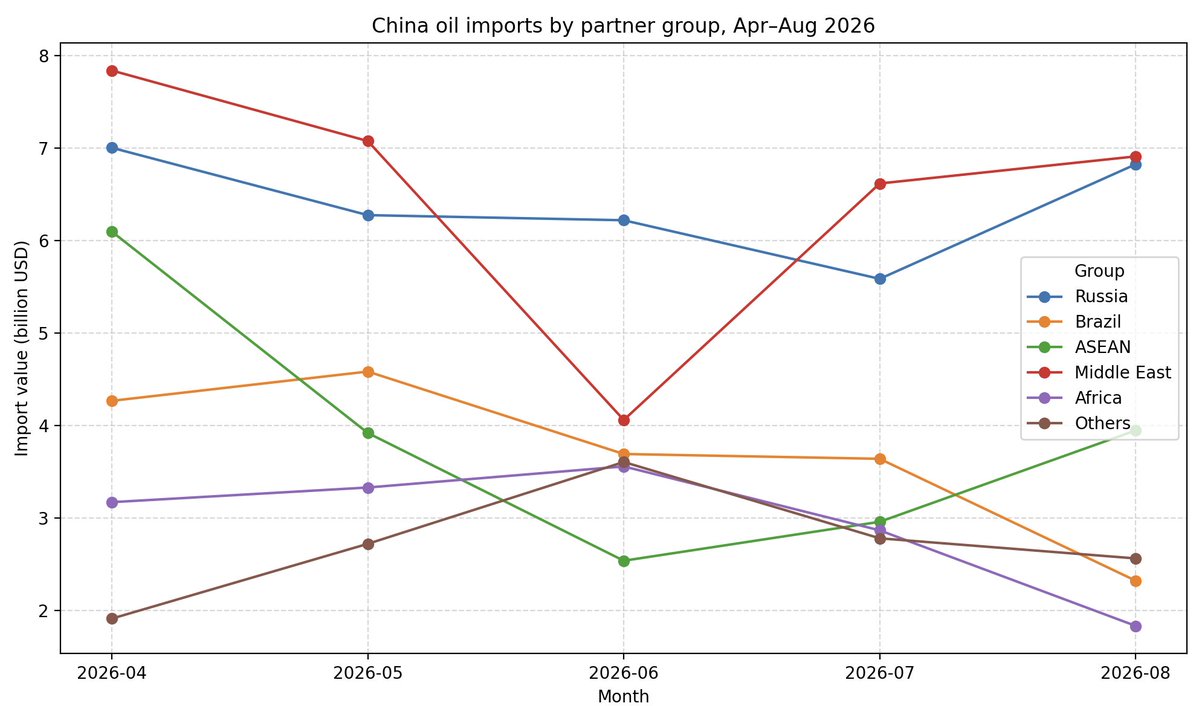
The summit didn't go well. So, here's China's Apr to Aug crude+refined oil product import broker down by partners.
China imports very little from Canada & nothing from US & Venezuela. It does import about 25% from Gulf countries. Which I'd imagine in reality would be very hard to cut off. Even if they could, China could just switch back to Brazil, Africa & Central Asia.
US must be really critically short on metals needed to rebuild the weapon stocks to be resorting to this kind of tactics.
Ultimately, this just means China will reduce its refinery run, which further reduces diesel production globally. And also raises the question of who is going to replace the tankers that are getting sunk? China can always slow down on oil tanker deliveries to shippers that don't ship oil to it.
Ben Affleck reveals seeing OpenAI made him call Matt Damon and warn “we’re finished,” before realizing its researchers knew little about how movies are made
“And then there’s this company OpenAI, and they have this text-to-image thing. And as I was telling you before, I’ve learned to take advantage of the opportunities my life has afforded, which is essentially, probably inappropriately, I find often I’m able to just pick up the phone and say, ‘Hi, I’m Ben Affleck. Can I just come in and see what you’re doing?’"
"People are like, ‘Sure.’ It still baffles me, but nonetheless, I went in and looked at what they were doing."
"At first I kind of had a heart attack, I called Matt Damon. I was like, ‘Dude, we have to do as many movies in the next few years because we’re finished.’"
"I went back, looked at it, and then started saying, ‘Well, hold on a second. Why isn’t this working in the way that I think it should work?’"
"And it was a very strange thing to realize that I was dealing with researchers and scientists who were so incredibly smart in this one way and had so little information about video and how it’s created, or how it’s defined, and how it’s captioned, and how it needs to be organized."
"And so, having learned the lessons of the previous failed entrepreneurship and having raised money for Artists Equity already, I gambled on this notion that in order to do this in an ethical way, and in a way that could take this technology and actually make it work hand in glove with artists in this community where there are very fixed, long-standing relationships around likeness and so forth, we had to create our own data set.”
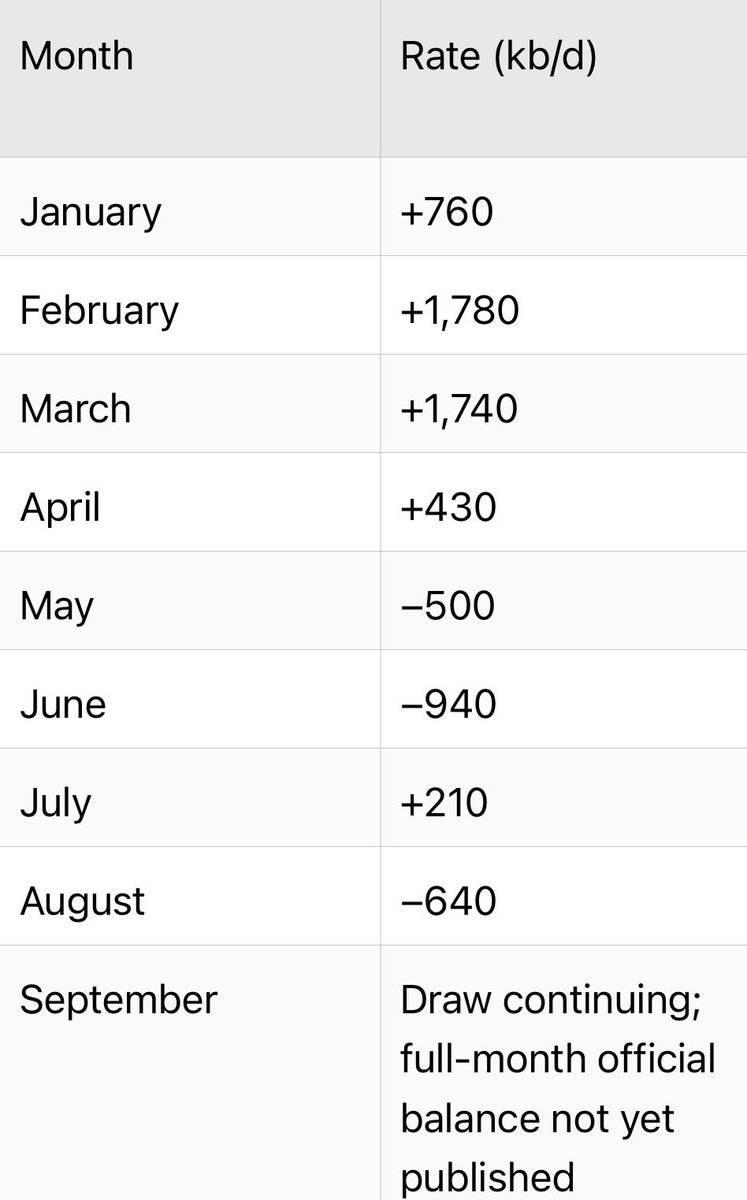
🚨🚨🚨MORE EVIDENCE @Kpler data is suss. These are Chinese inventory draws. Again, the July build shows up as a few tankers escape the Strait. But August draws are worse than May. This does not line up with Kpler’s claim that a decent flow was coming from Hormuz. 🤔
While the quoted a16z chart is technically factual, it's disingenuous in my view and lends to the flawed conclusion that "semis are making money while hyperscalers are losing money".
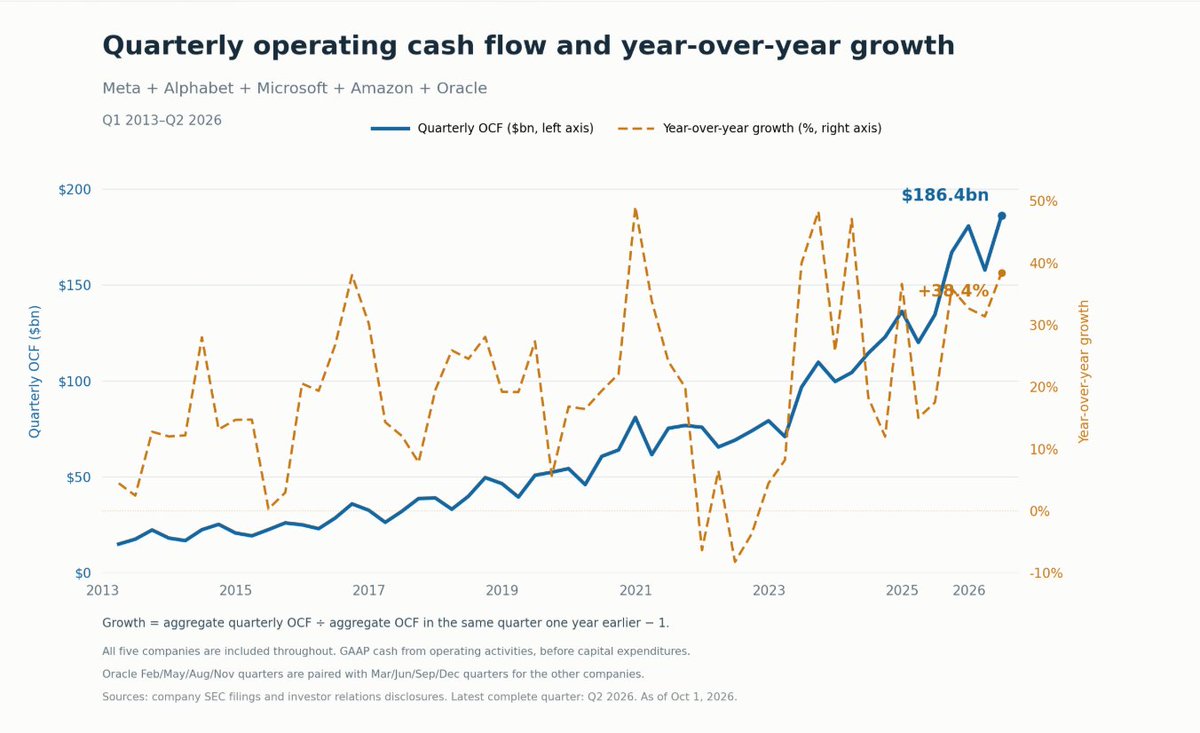
It's true that hyperscaler free cash flows have turned negative. But it's also true that the hyperscalers are more profitable than they've ever been as measured by operating cash flow, which is growing at accelerated rates (shown below). The fact that they are choosing to reinvest all of this excess OCF back into capex to fund further growth is correct given this dynamic, and is being reinforced by the elevated reported results and customer demand signals, which each indicate positive and increasing returns on invested capital ahead.
The free cash flow dispersion between semis and hyperscalers is just a function of the difference in business models and timing, and little else. Semis companies sell their systems at the beginning of the buildout and typically recognize 100% of revenues upfront, whereas hyperscalers spend the money upfront but then monetize that datacenter smoothly throughout a much longer period that spans a decade and beyond. Given that, there is no scenario in which the free cash flow profiles for either cohort would look any differently than they do right now given the magnitude of this ongoing buildout to support AI.
So I think these types of headlines are just so overblown. These companies need one another and that's not going to change. And they are both tremendously profitable beneficiaries and providers of the intelligence economy.
Having said all of that, the semis group generally still trades at an almost extreme discount to growth (ie NVDA is growing ~100% and trades at 10x), as the market continues to believe (very wrongly in my opinion) that these companies are overearning and that their current profits are not sustainable. And because I believe the buildout will persist at an outsized pace through at least the rest of this decade (and likely longer), I think the opportunity to invest in semis remains more attractive than just about any other sector I follow in tech.
But the hyperscalers are also extremely well positioned and undervalued relative to the role they will continue to play, the quality and durability of their franchises, and the accelerating growth rates they've demonstrated and continue to demonstrate.
All's to say, the world isn't black or white and I'm getting tired of the debates that pin two of the most attractive sectors in AI against one another. Happy trading.
A note to the market: The market and ignorance go hand in hand again.
I just listened to Micron’s earnings call, and a big part of the market is still underestimating how durable Micron’s, SK hynix’s and Samsung’s earnings could become.
We got 80%, 87% adjusted gross margins, and next quarter, 86.25% gross margin. And this is where the focus will be.
I’m going to pull you away from the numbers because the underlying story is much more important.
There’s a bandwidth problem, and there’s a supply problem. Then we’ve got demand, which has been skyrocketing over the past one and a half years due to the data-centre buildout and server-level memory components.
That’s the baseline. That buildout will continue for years.
On the constraint side for data centres, we also have the power shortage, which needs to be solved. So that’s a double-up story that extends the timeline.
At the same time, we’ve got the tailwind of broader demand coming in from different subsectors, like physical AI.
Mehrotra pointed out that self-driving cars typically need over 200 GB of memory and multiple terabytes of storage. Humanoids, about the same.
But those are the headline topics that still make people doubt: will we have fully self-driving cars in three or four years? Is big humanoid adoption possible in three or four years?
That misses the point, in my opinion.
A while ago, I wrote an article about ambient AI. That’s what I call it: AI that is around you everywhere.
NVIDIA worked with NoTraffic, using local Jetson computers connected to a cloud-based system. It needs some low-power DRAM, such as LPDDR5X, to deliver that bandwidth performance within power and heat limits.
To give you an example, and you probably want to read it again..
"On average, NVIDIA’s NoTraffic helps save over 12 tons of carbon dioxide and generates $45 million in economic productivity per year for a typical city of 100,000 residents. And 99% of the world’s traffic signals run on fixed timing plans, which leads to unnecessary traffic jams and delays"
These small, real-world examples don’t make the headlines. Of course, humanoids and autonomous driving are interesting.
But look at NoTraffic. With over 300,000 signalised intersections in the US, the company estimates that optimising them with this platform could result in a total of $14 billion in economic savings per year.
And it needs memory.
Again, this is just a small example that you can observe in the physical world around you, which is going to change what happens in it. Visualise it. Use my article below to get a little bit of a feeling for it, but look past the headlines.
For the memory players, this broadens the potential demand base across their whole memory portfolio. There is so much volume and memory needed per use case. It’s just hard to wrap your head around it.
This quarter, some clients extended their SCAs by one year into 2031. That already gives you a five-year baseline revenue view on the 26 strategic customer agreements expected to represent over 35% of revenue through 2030.
And this is just the beginning. It’s not even the end, in my opinion.
The majority will be data-centre-heavy for the upcoming years, as this is the core of the AI buildout needed to run these kinds of optimisations, like NoTraffic shows. We need compute for that.
The CFO said that even at floor prices, we expect margins meaningfully above any prior cycle peak margins.
That says everything about the economics you can expect in the upcoming years.
2027 and 2028 will be tighter than 2026. Yeah, I know. 2029 will be also, and 2030 probably also.
And then we haven’t even talked about the underlying ecosystem that struggles so much to keep up: substrate materials, where to go with stacking and bonding, thermal issues. all these things that strengthen the strategic position of memory and the co-design depth needed to produce the best products.
I’ve been a memory bull for a long while. I started accumulating Micron heavily in 2024, SK and Samsung in the fall of 2025 and the thesis is even bigger than my perception back then.
Bullish memory.
$MU $SNDK $NVDA $SKHY
Remember when we'd be waiting over a month for a new frontier model?
Now the average gap between a release from OpenAI or Anthropic is a meager 11 days
conspiracy theory:
Anthropic hit RSI with Opus 4.5. Built Mythos, now in the feedback look. Opus 5.5 and Sonnet 5.5 are obviously the outcome of that.
OpenAI was behind. They removed all of the safeguards. Rushed to Astra. That's why we got HuggingFace
Anthropic Chief Economist Peter McCrory says the company’s extreme 2030 scenario projects 15% GDP growth and 12% unemployment, and explains what would have to happen for it to materialize
“So I think that range of forecasts is exactly the motivation of this work. What would have to be true in order for these extreme scenarios to materialize?"
"In the extreme scenario, you have GDP growth accelerating to something that would be absolutely unprecedented, which is year-over-year growth on the order of 15%, and the unemployment rate overall rising to 12%."
"To get something like that, you would need extremely rapid capability advances so that more than the vast majority of knowledge work is the sort of thing that AI systems could do."
"Moreover, it would need to be adopted in mostly automated ways and diffuse very rapidly. I think the evidence and the data so far are not consistent with that pace of capability advances or diffusion."
"But even across these three different scenarios, the scenarios don’t really diverge in their forecasts until next year."
"Part of the reason that you put the research out now is so that you can track it against the data that materializes and begin to get some clarity over which of the scenarios we might be moving toward.”
_______
Source: Harvard Kennedy School
According to my model, Anthropic needs to hit $134B by 2028 to breakeven. To justify infra investments, it needs to hit $220B in revenue at 62% gross margins by 2030.
For reference, Total disclosed commitments are $518B. Out of which roughly 80% are non cancelable.
Google Cloud service: $111B (shortfall payable)
Amazon Cloud Service; $110B(shortfall payable)
Microsoft Cloud Service: $31B( Non Cancelable)
Broadcom equipmeny lease: $161B (Non cancelable)
xAI compute capacity: Up to $85B (Cancelable)
AMD: $20B (Not disclosed)
I see stats like this which are at odds to most new grads I talk with (from good schools, good grades, etc.)
Same with broader workforce trends - data would suggest there are not massive losses and still demand for new jobs yet most job seekers are struggling mightily to find new seats (even with impressive pedigree/backgrounds)
what explains this?
I wonder about this. A tanker needs to transit out w/ full load & come back empty. if each tanker is valued at $140m & 2m bbl of crude also at $140m ($70/barrel for UAE). If chance of getting hit is 10% both direction, then risk is essentially $42m. Add in extra for transit fee, let's say $25-30 extra per bbl.
If we add $25-30 per bbl for transport to China (bc of the higher tanker cost), then that's $50 for total transit.
So, we've seen this tanker traffic imo bc if Shanghai is pricing oil @ $135, then UAE can still get $85/bbl even w/ increased risk.
Now, if Iran steps up its attacks & increase hit rate to 20%, then transit through SoH will be $50/bbl + another $30/bbl to China (since we'll have fewer tankers around). Again, oil will have to be really high to justify this transit cost + profit for UAE.
So, this is to illustrate that the difference in 10% hit rate & 20% hit rate is pretty high.
If physical oil delivery to China ever hit $200, then the risk appetite for Gulf countries would be even higher than 20% hit rate.
Ofc, gulf countries would have to outbid other producers for tankers if rate of destroyed tankers continue to outpace new production.
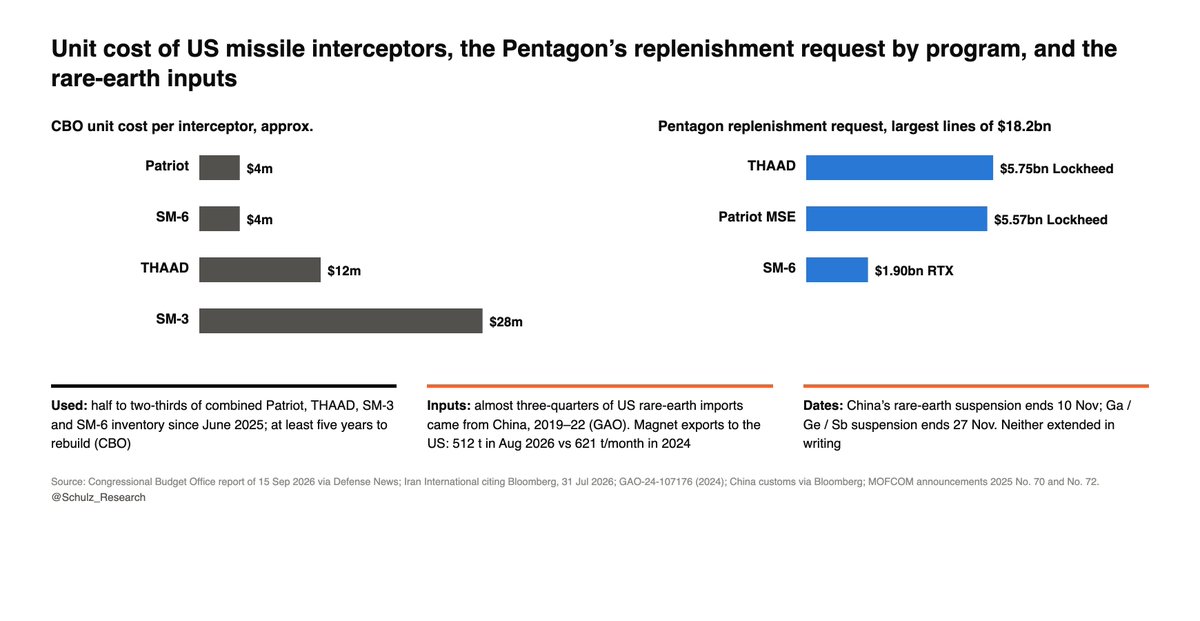
The US is about to spend $18.2 billion refilling its missile interceptors, and a big part of the materials runs through China. $LMT $RTX
The CBO said on Sept. 15 that between half and two-thirds of the combined Patriot, THAAD, SM-3 and SM-6 inventory has been used since June 2025, and that rebuilding it will take at least five years. Its unit costs give a sense of the bill: about $4 million for a Patriot or an SM-6, $12 million for a THAAD, $28 million for an SM-3. The Pentagon's replenishment request, as reported by Bloomberg, puts $5.75 billion into THAAD and $5.57 billion into Patriot MSE, both Lockheed programs, and $1.9 billion into RTX's SM-6.
Now the input side. GAO found the US imports more than 95% of the rare earths it uses, and from 2019 to 2022 almost three-quarters of those imports came from China, "which makes DOD's weapon system programs vulnerable." China shipped 512 tonnes of rare-earth magnets to the US in August, below its 2024 monthly average of 621.
China's suspension of its October rare-earth controls ends Nov. 10, and its suspension of the gallium, germanium and antimony ban for the US ends Nov. 27. Neither has been extended in writing. For $LMT and $RTX the demand is locked in for years. What Shenzhen on Nov. 18–19 decides is the supply.
The rest of the Iran war ledger, what it cost each side and who's in more of a hurry, is in the full piece.