Researcher & builder. Mapping how coordination breaks and building tools to fix it. Working on open infrastructure on Ethereum. Tweets on tech, cycling, poetry.
We have created unidimensional economic games. The values they are optimized for are without soul. Worse, winning the game necessitates accumulation and extraction. You speed run this for some generations, and few are left knowing anything better.
Inherent design flaws incentivize individual success at the expense of harm to the community. Worse, those who succeed at optimizing this attain God-like status, creating a vicious circle of those who want to emulate the same plays.
It ain't about dismantling everything all together. It is about creating a level playing field where regeneration stands a chance, where solidarity has space, and where stewards who protect public goods can make a living out of it.
If we don't do this, the system will keep tilting in favor of the few. Its negative externalities will consume all that we critically need but do not care enough about, from our ecology to those rendered weakest in our society. There ain't no other choice, anon.
We’re hosting Push to Prod Hackathon with @AnthropicAI, @ElevCap & @mesaschool_.
The prompt: Build the Next Audacious
Bring your boldest ideas to @basecampblr and spend 5 hours turning them into real products.
📍Bengaluru
🗓️8th August
💵$10,000 worth of credits
Apply below👇
At any other point of time in history, this alone would have led to impeachment proceedings - a US President appointing his former lawyers in official positions to negotiate with current lawyers to grab tax dollars and lifetime immunity from tax audits. What times we live in!
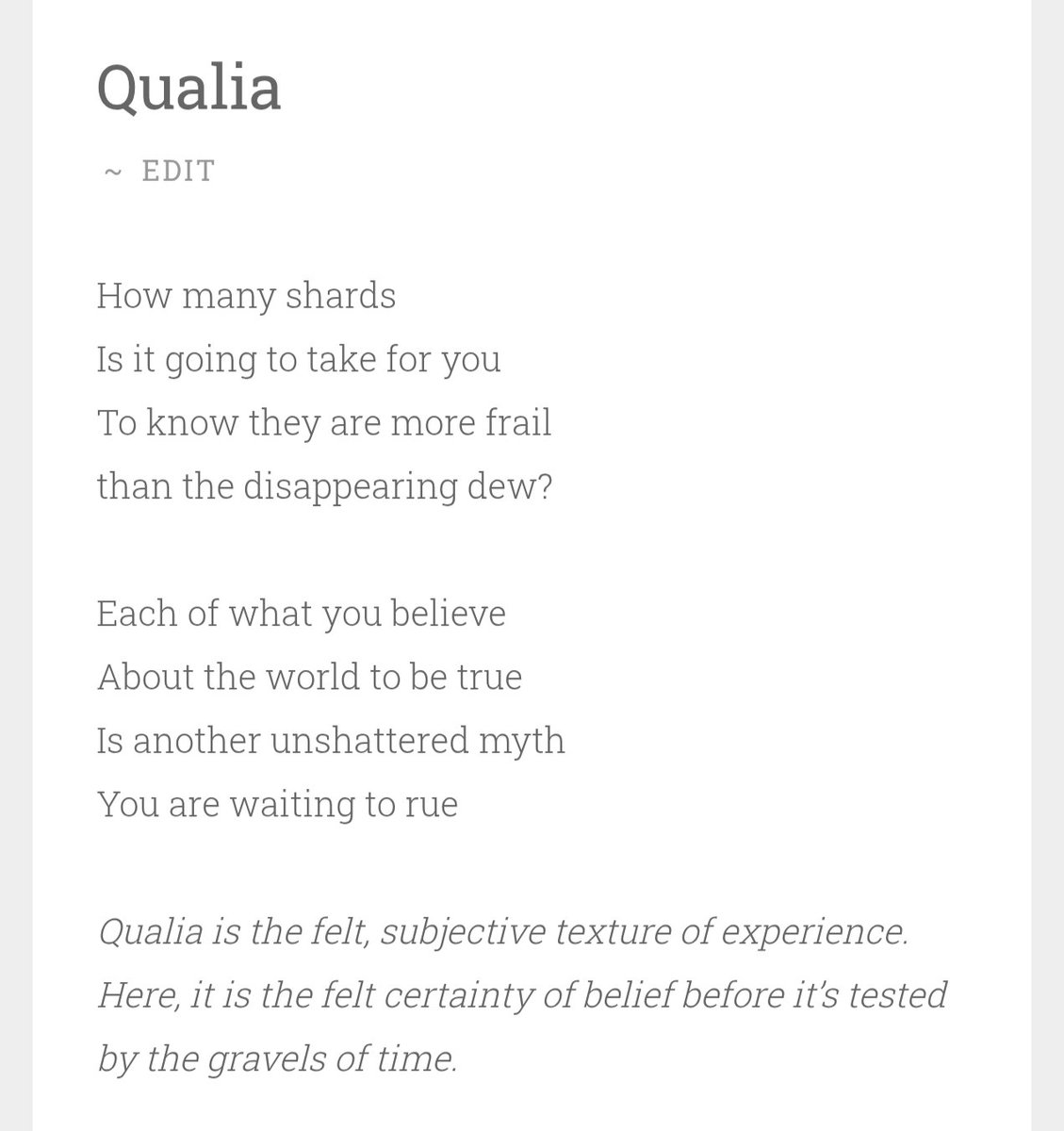
Write notes. Take pictures. Have conversations. Whatever it takes. The year always feels longer in Google Photos. FWIW, the habit of writing poetry has stuck around since school and has helped preserve a few "selfies" of the mind.
Crypto has a BD prob^W opportunity.
Do a simple experiment - ask five random normie friends what they know about crypto and DeFi. Most likely, the answer you’ll get will be some variation of “buy Bitcoin low, sell high”. If they’re a bit closer to finance, they may also say something about stablecoins for payments, the difference between “crypto” and “digital assets”, and how “it” is the future, but if asked further they won’t be able to give many examples. If you ask them whether they know Aave, Morpho, Spark or even Uniswap, usually the best you’ll get is that they’ve heard the name but have never used it themselves. I’ve done this many times, sometimes, surprisingly, in groups that technically “should” know better because they are directly involved in work related to digital asset strategies for institutions.
Not to mention that for many of them, the mainstream narrative of the last few years has been a steady stream of scams, frauds, collapses, controversies, and terminally online drama.
Some may see this as a problem. I see it as an opportunity.
Because it’s pretty easily addressable. Not by another high-level deck. Not by another panel where everyone already agrees with each other. You address it by going into the rooms where these people actually are and showing them what people in crypto take for granted.
Some years ago I did several workshops for people in traditional finance - lawyers, managers, analysts, compliance people, traders, but also some technical folks - going with them through @Speedethereum challenges, which back then was basically scaffold-eth plus playing with some burner wallets. They weren’t really writing any code. I was giving them snippets to copy-paste into Remix, but the code was short enough that they were able to grasp what was happening. You could literally see lightbulbs over people’s heads when they traded their custom-made ERC-20 tokens through a permissionless escrow.
Crypto projects need to do more of that. Much more.
You need to acknowledge that there is a word “development” in business development. It’s not just sales.
People need to know what you’re selling. The decision-maker is not the only audience. Their colleagues matter. Their lawyers matter. Their risk people matter. Their friends in other institutions matter. You want the person choosing your solution to look less like someone betting their career on weird unknown tech and more like someone experimenting with a new infrastructure category that serious people are already learning about.
That means meeting people where they are. I love Devcon and Token2049 as much as anyone. But if you want finance, fintech, payments, compliance, and institutional people to understand what you are building, maybe you also need to be at places like Singapore FinTech Festival.
People who have been in crypto for years forget how much they had to digest along the way. People arriving this year do not get that context by osmosis. The industry should not outsource all of the hard work to them. Crypto is already good enough from the tech side, now let's improve the BD.
I am putting together several hands-on workshops for non-crypto audiences this year. What should I show them?
@sidin The same "confidence" shows up at other avenues too. Without confidence intervals, projections look misleadingly precise.
https://t.co/tS2Bj7KCEI
I am disliking the growing "dumbification" of the audience by over-indexing on history and data in cricket. First, it were the metrics like projected score and win probability (should be a range versus an absolute value). Now a binary contextless qualifier for bowling options.
@QuantaMagazine "In philosophy, “qualia” refers to the subjective qualities of our experience: what it’s like for Alice to see blue or for Bob to feel delighted. Qualia are “the ways things seem to us,” as the late philosopher Daniel Dennett put it"
https://t.co/vCnKyu5BzM
**HELP needed** Anyone knows folks @UTMDAnderson cancer center? A friend's spouse is s4 pancreatic & a strong genetic fit for daraxonrasib trials (KRAS G12D mutation w/ VAF of 20.69%, along with a SMAD4 mutation) run by @DrShubhamPant. 47yo (m), indian army colonel, otherwise healthy. Pls RT / fwd to the right circles - might save a life! 🙏🙏
"If they push #SIR any further, you will be able to establish a small country within India populated by all those Indians who could not prove they were Indians"
#SIR is the weirdest sarkari exercise I've ever been subjected to. Helping staff in the neighbourhood search electoral rolls, this is what you discover:
🗳️ if your name doesn't show up, split it into subsections or run it together, ie NarendraModi or Naren Dra. The form encourages you to try out several permutations and combinations: fun for all the family!
(NB: Will hunt down the inventor of the Captcha, but that is after #SIR is over.)
🗳️ most people think they know the sarkar, so they bring bags of documents: ration card, voters' ID, Aadhar, Metro card, school leaving certificate, gas cylinder booking slip, kabbadi participation award, kuch bhi.
They are very impressed when it turns out that you have to search the 2002 rolls. Not 1993, which introduced EPIC; not 1995, the first major post-voter's ID card revision; not 2008, another major revision in Delhi.
Just 2002-2003. "Only the big babus could have thought of something like this. Full sixer," said a local guard. (I do not know if this is a compliment or not.)
🗳️ By now, I've searched the rolls for elderly friends and for workers who grapple with a system not built to handle migrants, illiteracy, misspellings, normal glitches.
It has its softer side, studying the rolls. You see large swathes of Delhi where mingling happened; the surnames are all mixed up by caste and religion, places where foreigners, including a family I was smitten by called Immaculate, Blessed and Superior, had made much of Delhi their home.
You also see segregation. And the mark of Partition, the mark of migrant clusters from other states, the mark of refugee camps that became permanent homes. And the city comes into view; old government Delhi, new, brash, entrepreneurial Delhi, rapidly expanding, straining at the limits; sometimes brutally slamming new migrants into unlovely pockets and corners.
🗳️ Until you find your name, or a parent's name, in the rolls, life takes on an existential anxiety. Did you really vote in the last four elections, or was that just a fever dream? Are you in truth Indian, or have you suppressed memories of being an outsider all along?
Once the long chain of documents that accompanies all Indians through life, from birth certificate to PAN Cards to Aadhar to School Certificates to Vaccine Certificates has lost its validity, everything becomes uncertain, ghostly. Who is to say you were even born in the first place? How many rolls will you painstakingly download and search to prove that you exist?
🗳️ Too many have become Schrödinger's citizens; neither Indian, nor not-Indian, because they've never belonged anywhere else.
If they push #SIR any further, you will be able to establish a small country within India populated by all those Indians who could not prove they were Indians... at least give them a homeland and a fresh electoral roll of their own...
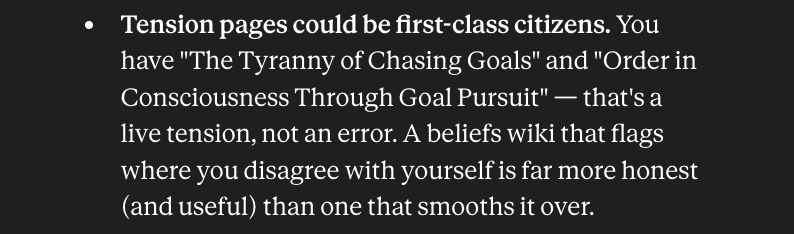
I have an Obsidian vault with ~300 articles and notes from the last decade, with reflections on work and beyond. Collectively, it is what I believe about the world to be true, at varying levels of conviction.
Thinking of building an LLM wiki on top of this, like a belief archaeology, that stays current as the underlying vault evolves. Fable is already doing a decent job of surfacing healthy conflicts in matters of conviction.
LLM Knowledge Bases
Something I'm finding very useful recently: using LLMs to build personal knowledge bases for various topics of research interest. In this way, a large fraction of my recent token throughput is going less into manipulating code, and more into manipulating knowledge (stored as markdown and images). The latest LLMs are quite good at it. So:
Data ingest:
I index source documents (articles, papers, repos, datasets, images, etc.) into a raw/ directory, then I use an LLM to incrementally "compile" a wiki, which is just a collection of .md files in a directory structure. The wiki includes summaries of all the data in raw/, backlinks, and then it categorizes data into concepts, writes articles for them, and links them all. To convert web articles into .md files I like to use the Obsidian Web Clipper extension, and then I also use a hotkey to download all the related images to local so that my LLM can easily reference them.
IDE:
I use Obsidian as the IDE "frontend" where I can view the raw data, the the compiled wiki, and the derived visualizations. Important to note that the LLM writes and maintains all of the data of the wiki, I rarely touch it directly. I've played with a few Obsidian plugins to render and view data in other ways (e.g. Marp for slides).
Q&A:
Where things get interesting is that once your wiki is big enough (e.g. mine on some recent research is ~100 articles and ~400K words), you can ask your LLM agent all kinds of complex questions against the wiki, and it will go off, research the answers, etc. I thought I had to reach for fancy RAG, but the LLM has been pretty good about auto-maintaining index files and brief summaries of all the documents and it reads all the important related data fairly easily at this ~small scale.
Output:
Instead of getting answers in text/terminal, I like to have it render markdown files for me, or slide shows (Marp format), or matplotlib images, all of which I then view again in Obsidian. You can imagine many other visual output formats depending on the query. Often, I end up "filing" the outputs back into the wiki to enhance it for further queries. So my own explorations and queries always "add up" in the knowledge base.
Linting:
I've run some LLM "health checks" over the wiki to e.g. find inconsistent data, impute missing data (with web searchers), find interesting connections for new article candidates, etc., to incrementally clean up the wiki and enhance its overall data integrity. The LLMs are quite good at suggesting further questions to ask and look into.
Extra tools:
I find myself developing additional tools to process the data, e.g. I vibe coded a small and naive search engine over the wiki, which I both use directly (in a web ui), but more often I want to hand it off to an LLM via CLI as a tool for larger queries.
Further explorations:
As the repo grows, the natural desire is to also think about synthetic data generation + finetuning to have your LLM "know" the data in its weights instead of just context windows.
TLDR: raw data from a given number of sources is collected, then compiled by an LLM into a .md wiki, then operated on by various CLIs by the LLM to do Q&A and to incrementally enhance the wiki, and all of it viewable in Obsidian. You rarely ever write or edit the wiki manually, it's the domain of the LLM. I think there is room here for an incredible new product instead of a hacky collection of scripts.