All of these were reported over the past month:
• A new pancreatic cancer drug, daraxonrasib, that roughly doubles survival in late-stage disease
• A precision lung cancer drug, lorlatinib, that kept 55 percent of patients progression-free after 7 years, versus 3 percent on the old drug
• A prostate cancer drug, talazoparib, that halves the risk of progression
• An endometrial cancer drug, dostarlimab, where 58 percent of patients hadn't progressed after 4 years, versus 16 percent on chemo alone
• An early-detection blood test, the NHS Galleri test, that quadrupled cancer detection but missed its main goal
• An mRNA cancer vaccine that halved the risk of melanoma recurrence when added to Keytruda
• The most effective weight loss drug so far, retatrutide, which cut body weight by about 28 percent
• The first in vivo gene editing therapy, which cut hereditary angioedema attacks by 87 percent from a single injection
• A one-time gene edit, VERVE-102, that lowered LDL cholesterol by 62 percent
• A feat of pharmaceutical synthesis that raised enlicitide's manufacturing yield 14-fold using engineered enzymes
• A functional cure for hepatitis B, bepirovirsen, that cleared the virus in about 20 percent of patients
• The discovery that human cells can swap chromosome-sized DNA through nanotubes
• An ancestor of CRISPR, VIPR, found in bacteriophages, that silences genes without cutting DNA
• A preventive Covid-19 pill, ensitrelvir, that cut symptom risk by 67 percent after exposure
• The first PROTAC drug, vepdegestrant, which destroys a disease-causing protein rather than blocking it
Every month, Niko and I write a round up digging into the latest news in biotech and medicine, and this month's was astonishing.
We share some thoughts on what's responsible for this progress and what it means for science in the future.
Huge news. A gene therapy for deafness, targeting a mutation in the OTOF gene, is approved.
Restored hearing in 9 of 12 children, well enough that they could stop using cochlear implants. The treatment will be free in the United States.
Crazy obesity guidelines for Mounjaro on the NHS, in which a patient can have
BMI> 40kg/m2
OSA
Dyslipidaemia
Hypertension and
Pre-diabetes
Started Tirzepatide privately & lost 15kg but unaffordable so got referred to Tier 3, failed eligibility for Mounjaro (no T2D) and got switched to Wegovy starting at 0.25mg!!! And regained all the weight lost
What are we doing here???
The night before the story about @Apple introducing ID checks broke, I upgraded my phone to find myself locked behind an age verification system. Despite the fact that I am 38, there was no obvious way to verify my age. The system didn’t explain the consequences of this, so I was genuinely worried that I wouldn’t be able to access my phone. I was not unique —- many people have reported being locked out of their phones: this is not strictly true, but it is what the messaging very strongly implies. Given how much we rely on our phones, the response is similar to those you might expect if you were locked out of your house: yes, you can hire a locksmith, but what if they can’t get there for hours - or turn out to be a con artist? It was only a day later that this was reported in the media, and it was two days later that Apple published an article clarifying what was blocked and the forms of ID required. I have still not been able to verify my age — of the forms of ID, the only real option available to me is a CirizenCard run by @getyoti but the application costs money and takes weeks to complete. I need to trust that @getyoti are legit and will not refuse — given that I have criticised the company in blog posts this is not a certainty. Not being able to prove that I am who I say makes me anxious. As a result my phone literally thinks I am a child: currently the restrictions are limited, but they are demeaning: if someone sends me a nude photo for example (not something that has happened to me in many years), a message would pop up asking me if I want emotional support or need to contact an ‘adult’. It looks likely that when the UK government implements restrictions on social media within the next year or so, I will be blocked from much of the Internet if @getyoti decide not to verify me, as they are under no legal obligation to do. What makes this all the worse for me is Apple’s response. At the outset, I wrote to @tim_cook setting out all of my concerns, including (briefly) the fact that I was visually impaired, which tends to make some of these ID checks problematic. I told Tim I would share any response if I didn’t receive a response within 7 days. Yesterday (5 days) I got what looked like automated response from Apple ‘accessibility’ team which gave me a case number, but ignored all the points in the email, and made no suggestion of how I might proceed. The deliberate gaslighting of disabled users does seem to undermine irrevocably the company’s case their products are accessible and I’d urge other disabled users to think twice before giving this company their business.
This isn't what the trial showed.
The control group was also recommended to increase fluid intake, and did; the intervention group had much more intense guidance (e.g. financial incentives and regular text messaging), and drank even more.
So we can't conclude that hydration is ineffective; the benefit may have already been saturated.
When you find a pair of running shoes that are super comfortable and also fit your style perfectly, order ten pair immediately and stick the extras in a closet because they absolutely will be discontinued soon.
The Tory promise to scrap the higher student loan interest rates for higher rate earners really shows a problem they have – they introduced these higher rates! They were part of a big swathe of punitive measures for higher earners:
- Higher student loan interest rates above £50k/year
- Child benefit withdrawal above £50k/year
- Childcare subsidies withdrawn at £100k/year
- IR35 on contractors
- Pension allowance cut above £200k
- Higher stamp duty on second homes
- The pension Lifetime Allowance cut to £1m (abolished by Truss, thankfully)
- Dividend allowance cut from £5k to £500
- CGT allowance cut from £12,300 to £3k
- Buy-to-let mortgage interest deductions capped at 20%
Plus fiscal drag, aka letting inflation push more people into higher tax bands. If the tax thresholds had been raised in line with inflation between 2010 and 2024, they would be:
- Higher rate (40p rate) threshold: £50k → £66k
- £100k threshold: £100k → £150k
- Additional rate (45p rate) threshold: £150k → £225k
These measures were probably viewed as a relatively easy way to raise revenues, plus a way to mitigate the allegation that the Tories were the party of the rich.
But apart from creating a *much* more progressive system than it looks like we have, making the country less hospitable for highly productive workers, they have probably helped to turn these voters against the party. Higher earners are now no more likely to vote Tory than anyone else.
And now they need those voters again, all they can do is promise to undo some of the things *they did*. The risk of taking part of your base for granted!
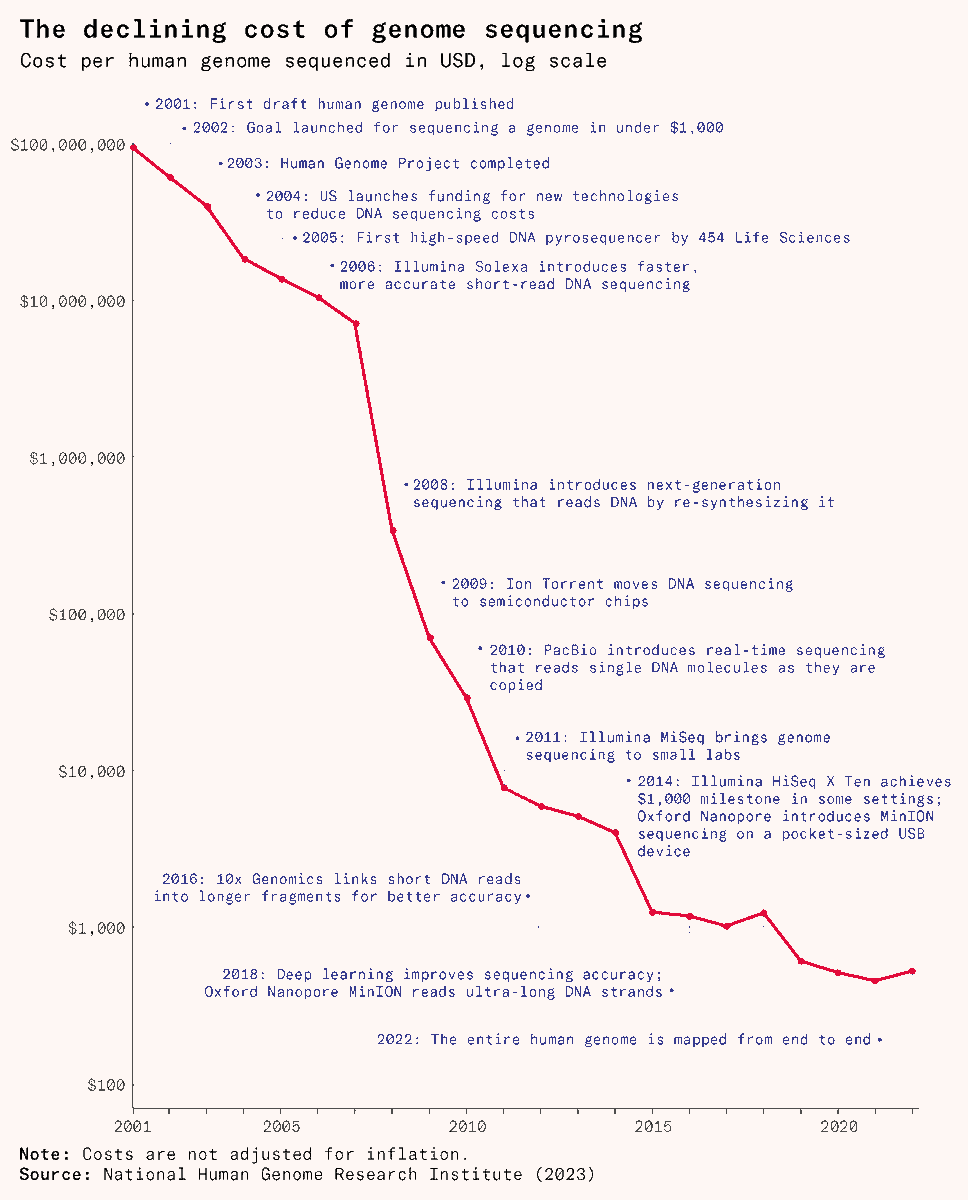
The cost of sequencing a human genome has fallen over 100,000 fold in nominal terms since 2001.
In a new visualization, I've added some of the key advances in sequencing during that timeline:
Thanks to @benbenbrubaker for the shout out for 'The Man from the Future' in @QuantaMagazine's newsletter! https://t.co/Z2FyVc6sMi
The excellent, wide-ranging review Ben mentions by Prof. Paul Davis. https://t.co/FWf9z98bJH
The book (get it before xmas!)
https://t.co/DAhzXcDrn6
Very interesting piece in which an author fine-tunes a model on her writing, asks her friends to guess which is her and which the AI, and nobody guesses correctly.
This doesn't make me feel particularly doomer-ish on art/writing, though. Rough thoughts on why:
- The generated texts are all pastiches of human authors. The study shows experts prefer AI-generated pastiches to human-written ones.
- The concern expressed in the piece is: what if an author just trained an AI on their own corpus, then used that fine-tuned AI to generate a ton more stories in their style, under their name?
- But I think this concern misses part of what we value in art, which is not just 'good execution' but also novelty. If you generated more finetuned early Kanye you'd get more "Graduation" but you wouldn't get "Yeezus". If you did more early Joyce you'd get more "Dubliners" but no "Ulysses". If you did more early Dylan you'd get more acoustic folk songs but none of the electric stuff. etc. Part of being an artist is to make progress in art.
- I also think we inherently value human involvement in the creation of art, just like we prefer watching human chess to AI chess (even if the humans are playing out ideas they got from AIs, which is almost always the case nowadays!). If nothing else, it's a filtering mechanism on your attention for when generating floods of competently-executed short stories becomes possible.
- So I expect that art, at least at the high end, will remain 'centaur-like' for a long time, with AI as collaborator/executor and humans continuing to be the main director/producers.
Novels' sentences are much shorter than they used to be.
Part of this is about punctuation: we use periods as people used to use semi-colons. And shorter sentences aren't necessarily simpler to read, since jargon can condense complicated ideas.
But plain language writing has also become more common. More people write as they speak.
That's why English prose has become easier to read, argues @HenryEOliver, in a great new piece for Works in Progress.
https://t.co/UUx5kSrSY6
This is a compelling argument but I have it on good authority (Nazi account based in India) that if you leave the house in London you will get chopped up with a machete
If you *only* used SAT to admit to elite colleges, share of admits from top 1% income falls 15.8% → 9.9% and representation from <$200k rises by +8.8%, with no reduction in post-college outcomes.
It's 'holistic review' and 'ban SAT' policy that allows the most wealthy and powerful to virtue signal while getting an edge.
First time in many years been refused entry from a venue in @CityWestminster because bouncers mistook my disability for inebriation —and that I suspect is just because I go out less! I know jasmine tea can be strong, but…. Won’t embarrass the venue — heard from my friend that there were only 5 others inside — but I’d be interested to hear from the regulator @SIAuk what are rules for training bouncers around disability awareness and what are the penalties for getting it wrong? #DisabledNotDrunk
The Online Safety Bill was conceived by the last government, and its failures were the result of decisions made by Tory ministers, but Labour MPs wholeheartedly endorsed it, and Kyle has staked his reputation by it. It is bad by design because it confuses three things — the admirable goal of preventing kids from accessing content which existing laws mean it is illegal for them to access, the goal of limiting their access to content which was not previously deemed illegal, but which the government now deems harmful; and the totally unjustified goal of making it harder for adults to find content which is not illegal but which the government now apparently deems immoral. And it is bad by design because it ignores the evidence that blocking categories of user from categories of content just leads to an uptick in use of parts of the web that are freer of regulation. But rather than take the blame for a #BadLaw that has rightly been criticized on both left and right s for curbing our free access to information, and contorting our democratic norms, @peterkyle seems intent on channeling the spirit of Lord Longford. He first accused his critics of supporting pedophiles, and now wants to shift the blame to others who are just trying to implement his laws