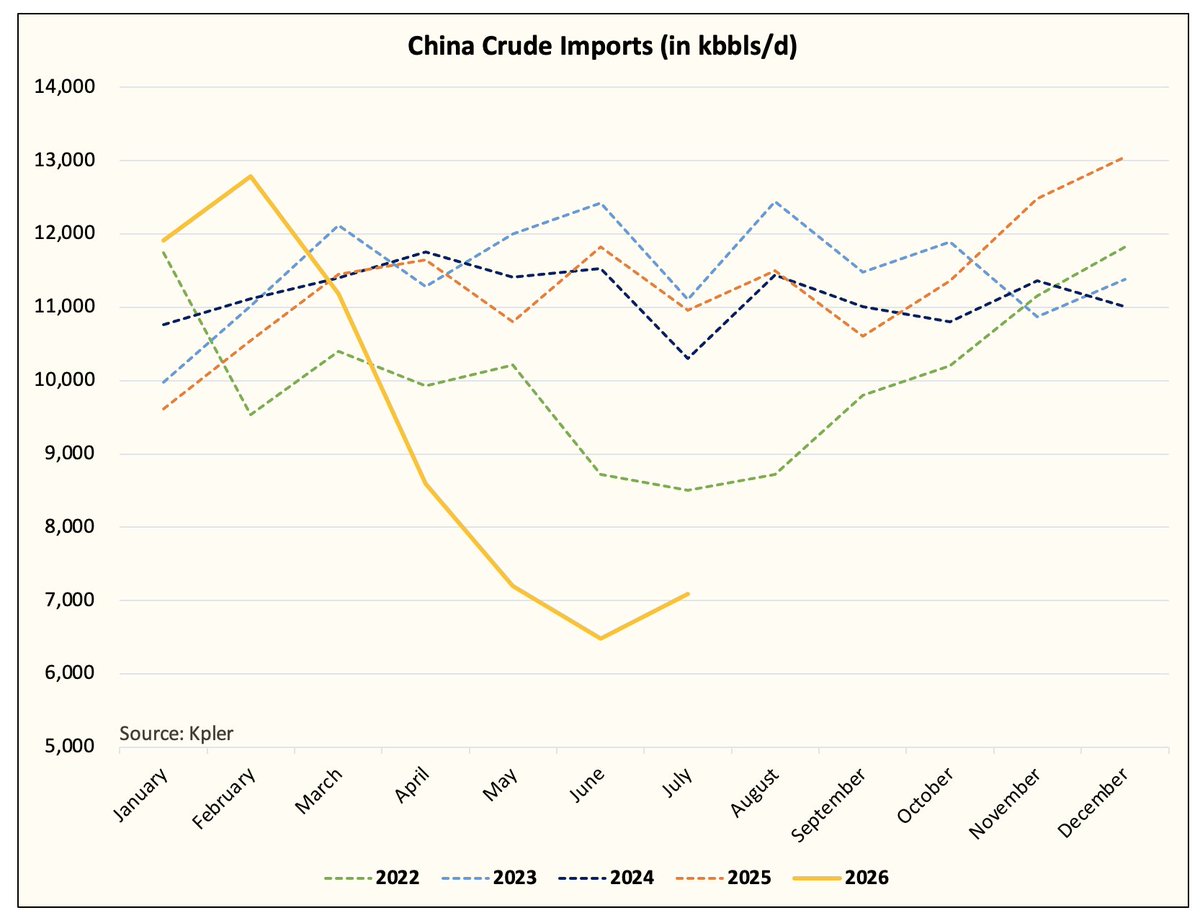
BIG jump in Chinese state-owned refinery run rates following a very slow Hormuz recovery.
State-owned refinery run rates are one of the two most important high frequency indicators of Chinese crude demand alongside tanker tracked crude imports.
This recovery in state-owned runs is currently bigger than the tentative recovery in crude imports, and represents real crude consumption. These run rates, if sustained, will start drawing Chinese crude stocks much faster absent a sharper and durable recovery in crude imports.
An Indian state refiner has just written two of the world's most important waterways out of a purchase contract.
Mangalore Refinery's tender for up to 1 million barrels tells suppliers that crude loading or transit "via Red Sea route or SoH to be avoided." SoH is the Strait of Hormuz. It is the first Indian refiner to write that clause.
That is not a risk premium. It is a route veto, and the difference matters more than the price does.
Insurance makes a dangerous journey expensive. Procurement can make it inadmissible. A market can pay more for scarcity. It cannot bid a deleted route back into existence.
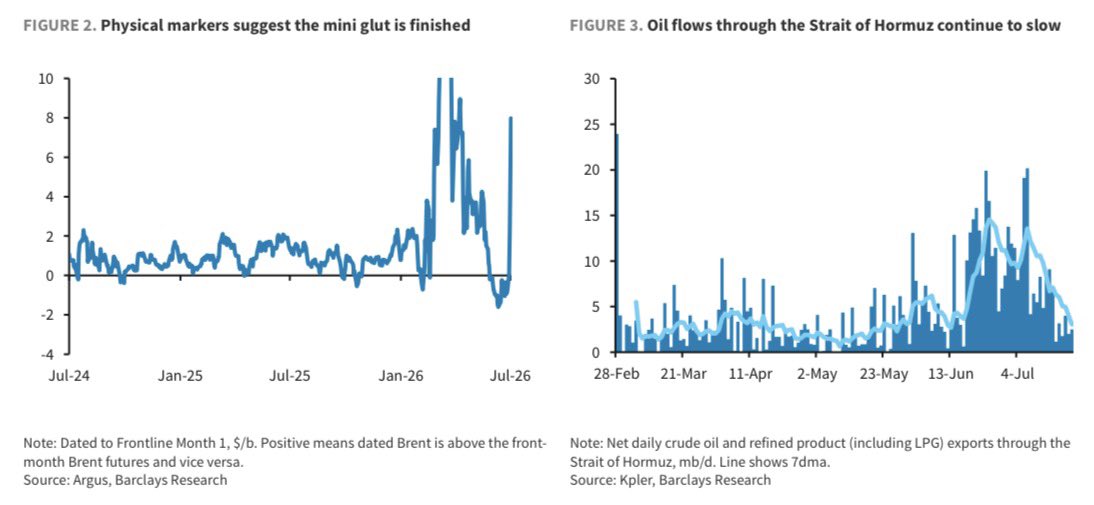
How both corridors became “unbuyable” is a matter of record. Iran/IRGC has been firing on ships & tankers in Hormuz for months, and fewer than 10 commodity vessels a day crossed it over the weekend against up to 150 before the war. The Yemeni Houthis declared a blockade of Saudi ports last Monday, then put ballistic missiles into the Jizan refinery on Saturday. Bab el-Mandeb fell to 11 vessels on Sunday, its lowest in months.
Now look at the trap underneath. Saudi Arabia pushed crude west through its pipeline to Yanbu precisely to escape Hormuz, and Yanbu handled about 92% of Saudi seaborne exports in June 2026. Diversion concentrated the flow. Concentration made the backup indispensable. Indispensability made it worth hitting. Redundancy is consuming itself.
Gas has no version of that escape at all. The IEA reports that 93% of Qatar's and 96% of the UAE's LNG exports crossed Hormuz in 2025, close to a fifth of world trade, and that no alternative route exists to bring those volumes to market.
Oil has always been priced on chemistry, location and freight. The route is now becoming a pass or fail condition sitting on top of all three. Spare capacity behind an excluded corridor is not supply.
The world is not running short of oil. It is running short of journeys on which oil still counts.
IRAN: U.S. WON’T DICTATE WAR OR PEACE
Iran says it is not holding peace talks with the U.S. and will "never allow" Washington to determine the timing of war or peace.
Tehran says it will defend its interests as long as necessary and insists the current pause in fighting is not a ceasefire.
Iran added its ongoing shipping talks with Oman are independent of the U.S. and focused on the Strait of Hormuz.
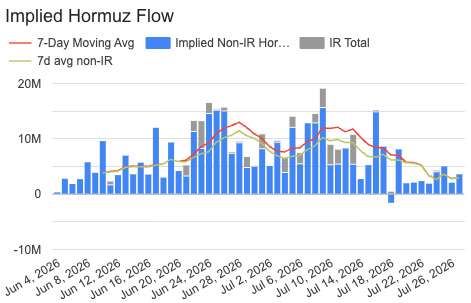
Implied Hormuz flow of 4.9, 1.9, and 3.5 million barrels over the last 3 days. The 7 day average sits at 2.9 mbpd (deleted the original post because I had missed a VLCC in Saturday's count as pointed out by @p912059g)
OIL RISKS AREN'T OVER
Oil prices fell over 5% after the Trump administration paused plans to intensify strikes on Iran.
But analysts warn the selloff may be premature.
Shipping through the Strait of Hormuz remains heavily disrupted, Houthi attacks threaten Red Sea routes, and Ukrainian strikes on Russian oil infrastructure add further supply risks.
If these disruptions worsen, oil prices could rebound quickly.
Strait of Hormuz shut for 5 months with only a brief reopening blip in June
Bab El Mendeb now shut to Saudi oil too
ARAMCO refineries and oil facilities burning
SPR at ATL around the globe
WTI at 84$
When they will read this post in the future they will think I was drunk
AI Firms Destroy Rare Books & US Interceptor Stocks Run Low - Will China/Russia Test the US?
Today's Digest covers Iran interceptor shortages and Russia/China risks, AI rare book scanning, GE Vernova gas turbines, Biden China blackmail claims, housing affordability crisis, and cancer gut microbiome.
#AI #IranWar
https://t.co/Sdp0MNPIDo
IRAN: U.S. WON’T SET THE TERMS
Iran said it will not allow the U.S. to dictate the timing or duration of the conflict, insisting it will respond whenever its interests require.
Tehran also said the Strait of Hormuz remains closed and stressed that its ongoing talks with Oman are bilateral and unrelated to Washington.
YIELDS, DOLLAR DROP AS TRUMP PAUSES IRAN STRIKES
Global bond yields, the U.S. dollar, and oil prices fell after President Trump paused planned strikes on Iran, easing fears of a wider Middle East conflict.
The 10-year U.S. Treasury yield dropped to 4.63%, while the U.S. Dollar Index (DXY) slipped 0.2%. Brent crude fell nearly 7% to around $90/barrel after briefly topping $100 last week.
Markets see the pause as a potential opening for diplomacy, though analysts caution geopolitical risks remain elevated and the situation is still uncertain.
The decline in oil and bond yields could ease inflation concerns ahead of this week's Federal Reserve and Bank of England policy meetings. Both central banks are widely expected to keep interest rates unchanged, although markets still assign some probability to a Fed rate hike.
U.S. FACES CRITICAL MINERALS SHORTAGE
President Trump aims to end U.S. reliance on Chinese critical minerals by January 2027, but industry leaders warn domestic supply is nowhere near ready.
Despite billions in government support, the U.S. still lacks enough mining and processing capacity, while China controls over 80% of rare earth refining.
Many Pentagon-backed projects won't reach meaningful production until 2027–2030, making the deadline difficult to achieve.
Usually around this time, manipulation ends (the window is always 1:30 am EST to 6:00 am EST) - let's see if they are done with this whole nonsense or they try one last push all the way down to 81.5$ on WTI