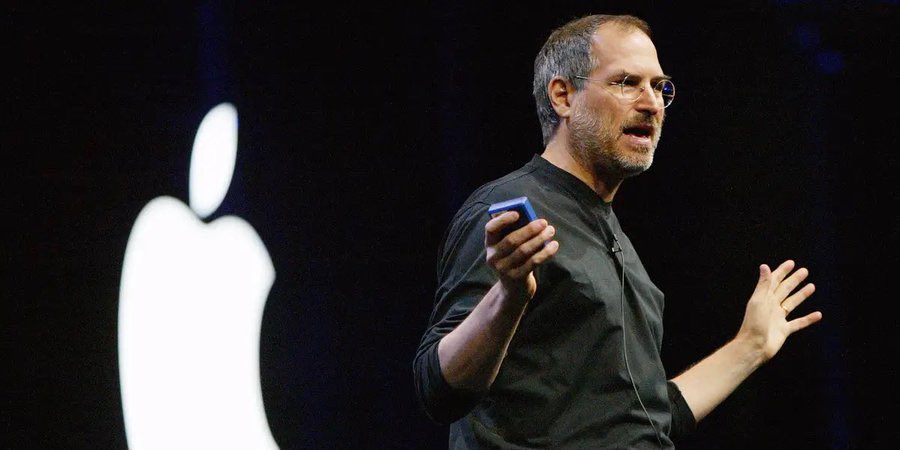
According to Steve Jobs, there is one single thing that "separates the people that do things from the people that just dream about them."
It isn't their intelligence, their work ethic, or their financial means.
It's something much more simple...
When Jobs was only 12 years old he opened the phone book and placed a call to Bill Hewlett (the co-founder of Hewlett-Packard).
On the call Jobs asked if Bill happened to have any spare computer parts he could have for a project he was working on––building a frequency counter.
Not only did Bill have the parts, he gave Steve a job that summer working on the assembly line at his company.
To quote Jobs, "I was in Heaven."
So what did Jobs do that was so special? (Besides calling the co-founder of a computer company when he was just 12 years old).
He asked.
Yep, that's all.
So many of us are held back by our own self-doubt or unwillingness to ask that opportunities we never even know are available pass us by.
A simple question I've used for years that has served me well:
Will I be any worse off than am I now by asking for this opportunity?
If the answer is no, which I'd argue it almost always is, ––then you've got nothing to lose.
If you're too afraid to ask, you're too afraid to fail.
And without failure, you'll never grow.
Just take action. Just ask.
If you enjoy content like this, follow me @blakeaburge for more.
Most of the universe is empty voids
Most of the space within the rare galaxy is empty interstellar space
Most of the solar system is emptiness
Most planets are hellish death zones
Even the Earth is mostly raging hot rock and metal
Earth's surface is a miracle paradise
How do you sell a new technology to people who are afraid of change? @heyfeifer says it's about building something he calls "the bridge of familiarity."
He uses the example of the introduction of cars—which were at one point called "devil wagons"—on the a16z Podcast.
@PopPunkOnChain As a founder, here is my daily hustle:
- 4 AM: wake up, grind
- 6 AM: finish grinding with some grind protein shake
- 7 AM: shower, while manifesting
- 7:30 AM grind starts
- 9 PM tell kids they won’t see me cuz grind
- 11 PM reflect and close deal
- 2 AM don’t sleep cuz grind
@yoserosie@EthereumDenver@TribeCredit This post reminds me of "The Intro" problem. My most recent experience with it was the following.
Izzy @browzeapp intro'd me to an investor that expressed interest in #TribeCredit via creating a WhatsApp group with all of us & left. Any better solutions for smoother intros?🤔
Two of my favorite quotes on competition. One personal and the second - business.
Personal
@naval - "Escape competition through authenticity" (because "no one can compete with you on being you") - The Almanac of Naval Ravikant
Business
@peterthiel - “All failed companies are the same: they failed to escape competition.” (innovate and provide 10x better service) - Zero To One
I love the lesson at the end @marcrandolph's narrative -
But I think the more important lesson—one that Blockbuster learned too late—is simply this:
If you are unwilling to disrupt your business, there will always be someone willing to do it for you.
In 2000, Blockbuster was the movie rental king with 60,000 stores and 9,000 employees. Reed Hastings and I, on the other hand, were just two Silicon Valley geeks with a DVD-rental-by-mail idea.
We’d been struggling since 1998 to find a way to make it work, and by the summer of 2000, we were finally seeing light at the end of the tunnel. Our no-due-dates, no-late-fees subscription model was a hit. Customers were pouring in and the company was growing like crazy.
Running a subscription business takes a lot of cash, since you pay acquisition costs up front while the revenue comes in over time. But it was the height of the internet boom. Cash was plentiful.
Until suddenly it wasn’t. Over a few short months, the internet bubble finally popped. The .com at the end of our name had been a badge of honor; now it was three scarlet letters. And with customers flooding in, cash was flying out. We’d spent more than $50 million getting to this point, and now it looked like our success was going to bankrupt us.
Luckily, there is a Silicon Valley play book for this. It’s called “pursue strategic alternatives”—code for “sell, and sell fast.”
The obvious strategic alternative for us was Blockbuster. Which is why, just a few weeks later, you’d have found me, Reed, and our CFO Barry McCarthy sitting at a giant conference table on the 37th floor of the Blockbuster headquarters in Dallas, getting ready to pitch Blockbuster.
The pitch was simple. We would join forces with Blockbuster. We would run the online business. They would run the stores. We would jointly develop a blended model. And everyone would live happily ever after.
And it was going great. They were leaning in. They asked good questions. Until they asked the most important question of all: “How much?”
Now, we had rehearsed this. We figured we were $50 million in the hole... so let’s go with that! Reed leaned forward confidently and told them: “Fifty Million Dollars.”
There was perfect silence. Their words were “we’ll consider it,” but we could tell they were fighting to suppress laughter. After that, the meeting went downhill fast.
Well, what doesn’t kill you makes you stronger. Or, as my father used to tell me, “sometimes, the only way out is through.” We knew there was no easy way out. We struggled for years. But we eventually did make it through. We had our IPO. We passed Blockbuster in revenue.
And today, the company that Blockbuster could have purchased in 2000 for $50 million, has a market cap exceeding $150 billion. And that company with 9000 stores? Now it’s got just one.
But what’s the lesson to take from this?
There’s certainly an inspiring one: It’s possible for a handful of people, with no prior experience in the video business, to take down a 6 billion dollar category-leading company.
But I think the more important lesson—one that Blockbuster learned too late—is simply this:
If you are unwilling to disrupt your business, there will always be someone willing to do it for you.
@yoserosie@TribeCredit Thanks @yoserosie! The Tribe game-plan is to enable people to use their credit cards and get all the perks while being able to drop the downsides like APRs 25%⬆️⬆️. 🙌
@yoserosie@TribeCredit@elonmusk Yes. 100 percent. The moment one recognizes that money is a tool and a powerful collaboration technology one can start thinking "can we do this better. Or is this it?" #TribeForLife