The team has been busy transporting all modules that were removed from the Vehicle Access Tower back to the pad to prepare for re-stacking. We designed and installed floors, pneumatics and electrical panels, and backbone piping on the modules. And we're moving the elevator to the side of the Vehicle Access Tower, freeing up significantly more floor access for our new CONOPS.
Ahead of Labor Day, I want to thank all of Team Blue for your hard work and give a shoutout to the team at the pad for their dedication to our return to flight.
The Moon is, on average, 238,855 miles away. Our MK1-101 Endurance team just made it feel closer.
Across two weeks of simulations, our team rehearsed key mission phases, including launch and separation, lunar orbit insertion, lunar orbit operations, and landing. The training also included checkout and software-emulated use of @NASA’s Stereo Camera for Lunar Plume-Surface Studies (SCALPSS) payload system, providing the team with hands-on experience operating a key science instrument on Endurance.
Each sim builds the coordination, confidence, and readiness needed for our mission to the lunar surface.
The Moon is, on average, 238,855 miles away. Our MK1-101 Endurance team just made it feel closer.
Across two weeks of simulations, our team rehearsed key mission phases, including launch and separation, lunar orbit insertion, lunar orbit operations, and landing. The training also included checkout and software-emulated use of @NASA’s Stereo Camera for Lunar Plume-Surface Studies (SCALPSS) payload system, providing the team with hands-on experience operating a key science instrument on Endurance.
Each sim builds the coordination, confidence, and readiness needed for our mission to the lunar surface.
Breaking ground today on our new Payload Processing Facility on the Eastern Range - the first ever built to support an 8.7‑meter fairing. Thank you to @USSF_SSC, @USSpaceForce, and @SLDelta45 for the partnership. At 120,000 square feet, the PPF will house four payload processing bays, two encapsulation bays, and a multi‑manifest area supporting National Security Space Launch, civil, and commercial missions. This facility expands our Space Coast footprint across Brevard and Orange Counties and supports continued job growth alongside our more than 4,500 employees in the region.
Team Blue and our partners at @NASAStennis have rapidly completed the structural design for the B‑2 test cell position, moving us toward second‑stage vehicle testing. Steel work is underway, tubing is being installed, cable harnesses are being built up, and the control room is getting its finishing touches. Next up: a GS2 makes its way to Mississippi.
This week, our second stage and payload teams successfully ran our first vertical CONOPS test at LC-11. Using a GS2 simulator, a forward dome we built in-house, and the full-sized payload fairing, the team conducted vertical stacking lifts and matings, gathered wind-damping data and effects, and tested new mechanisms that guide and slot these structures into place. The ingenuity it took to stand up this test quickly is exactly what gets us to flight soonest.
We’re building Launch Complex 36B at Cape Canaveral Space Force Station to support New Glenn’s high-cadence launch operations and infrastructure resiliency. 🚀 Read more: https://t.co/BzTHt5YGmQ
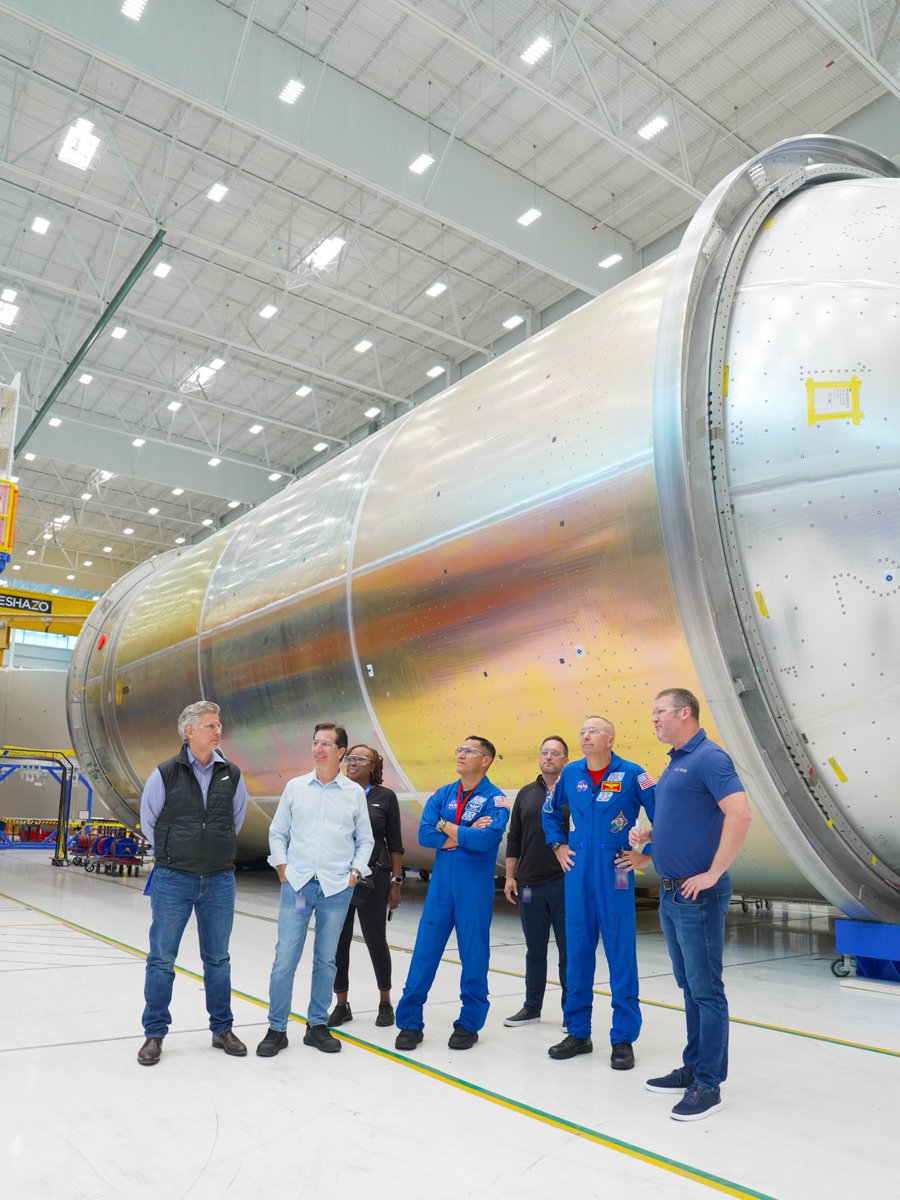
What's better than a day at Rocket Park? Astronauts stopping by. 🚀
We were thrilled to welcome @NASAArtemis III Astronauts Randy Bresnik (@AstroKomrade) and Frank Rubio to Rocket Park this week! These incredible astronauts represent the future of lunar exploration, and we're excited to support the Artemis III mission with our Blue Moon MK2 Earth Orbit Rendezvous demonstration vehicle.
Wanted to give an update on the hotfire anomaly investigation. Progress continues. The anomaly originated at the main oxygen valve on one of the BE-4 engines, which was later confirmed by hardware recovery and inspections. Extensive component-level and engine hotfire tests have been conducted to understand the failure mode better and inform mitigations. The path forward is clear. We're making small modifications to the valve that can be quickly retrofitted to existing engines. We’re manufacturing the updated hardware, which will be ready by the end of this month. In parallel, we're working through the remaining fault tree analysis.
New doors are going up at our Integration Facility at LC-36. Each of the six door panels on the North side stands 88 feet tall and weighs approximately 40,000 pounds for a total door opening width of approximately 196'. The South end comes next.
Launch table is out. The two-million-pound launch table is heading to the Integration Facility for inspection and adjustments to support our future ConOps. Once reinstalled at the pad, it'll be outfitted with the first stage aft umbilicals and tied into the water system, which delivers water injection just below the engine nozzles.
Last night, we celebrated New Shepard Propulsion Module, PM4-2, now on display at @airandspace in the RTX Living in the Space Age Hall.
As America celebrates its 250th anniversary this year, we're honored to see it stand alongside some of humanity's greatest achievements in exploration.
Some questions have come up on the launch bridge. It is in good shape and we will reuse. Three cranes are positioned to help lift the almost four-million-pound launch bridge and the two-million-pound launch table out of our flame trench and onto self-propelled modular transporters. Last night, the launch bridge was removed. The launch table is up next. Enjoy the crane ballet.
Quite a sight to see the progress this team has made since May 28. Wreckage recovery from start to finish was completed in 9 days, and all debris has been cleared from Launch Complex 36. Huge shoutout to the team who have been working 7x24. We have started reconstruction and still plan to fly again this year. Will have more details on the new conop soon.