🧠✨ New paper out! Can you tell how elastic something is just by watching it move? Turns out your brain has a remarkably efficient solution to this problem. 🧵 [1/4]
15 years. 1,100 adults. 3,400 juveniles. One question: do immigrants pay a fitness cost in the wild?🐟 Yes, but only sometimes. The cost of dispersal in Atlantic salmon depends on the origin, sex and age. Out now https://t.co/XIvH7SfaGW in ProcB @RSocPublishing 1/4
Absolutely overjoyed to share our new paper describing the oldest occurrence of soft-tissue preservation in crinoid echinoderms and their ecological significance
https://t.co/MXXOyPd6kF
Our partnership with @RSocPublishing has been renewed, bringing author seminars embedded directly into @silverchairnews article pages.
This paper (and many more!) comes with its author seminar video attached: https://t.co/czuC2zMcHu
Keep reading here: https://t.co/c6Cv0YJ6pb
The following issue from Royal Society Publishing Philosophical Transactions B is now one of their most highly cited and widely read and is FREE TO ACCESS ONLINE: Towards a toolkit for global insect biodiversity monitoring 🔽
https://t.co/fshVl2AzxA
@royalsociety
New from RGGS Postdoc Yilun Yu, AMNH PD alum Xing Xu and colleagues: Range of motion and myology support a digging function for the forelimbs of alvarezsauroid dinosaurs. Proceedings of the Royal Society B: Biological Sciences
https://t.co/edKeb6xuLN
New paper in @RSocPublishing Proc B 🐟 By doing longitudinal measurements from birth to early adulthood in guppies, we show that growth, sexual maturation and adult body size are linked to the ontogenetic development (scaling) of aerobic metabolic scope.
https://t.co/zSqxabsJQb
New pub alert! Introducing Pavo miejue - a new species of Pavo from the Pleistocene of Taiwan, and this is the first known extinct bird from Taiwan! Open-access at RSOR:
https://t.co/duevMN6b5A
miejue comes from the pronunciation of 滅絕 (extinction) in Taiwan - hoping to promote more awareness of paleo research in Taiwan.
Congratulations to Yong-Jie (his first paleo paper), and thanks to Gerald for all of his help!
Awesome new theme issue of Philosophical Transactions:
‘World models in natural and artificial intelligence’
Thank you @adamsafron!
https://t.co/Tzu1OH9Hib
Here is the specific link to our paper with Eunice Yiu, Shiry Ginosar and Kelsey Allen, how to construct causal models through intrinsically motivated action, something kids do and LLMs don't. The whole issue on world models is very much worth reading.
https://t.co/kk8xLFpsAU
It is the deepest honor to have been joined by Michael Levin (@drmichaellevin), Victoria Klimaj, Zahra Sheikhbahaee (@zah_bah), Dalton Sakthivadivel (@DaltonSakthi), Adeel Razi (@adeelrazi), David Ha (@hardmaru), Nick Hay, Kevin Schmidt, Irina Rish (@irinarish), David Krakauer (@sfiscience), Melanie Mitchell (@MelMitchell1), Samuel Gershman (@gershbrain), and Joshua Tenenbaum in organizing this special issue of the Royal Society’s (@RSocPublishing) Philosophical Transactions A:
“World models, A(G)I, and the Hard problems of life-mind continuity: Toward a unified understanding of natural and artificial intelligence”
https://t.co/XMYB2SAofX
This collection was motivated by a question with far reaching implications, ranging from the fundamental nature(s) of mind to choices that may determine the future of our civilization/species: what kinds of world modeling capabilities are likely to be realized by which kinds of minds and what world might we be in with respect to increasingly advanced artificial intelligences?
Will the scaling and refinement of present approaches result in AI with human-like (and beyond) cognitive abilities, or do we need radically different paradigms that more closely follow the principles of natural intelligence? Learning “world models” to predict/compress information may be how biological learners so efficiently learn (to learn) to achieve goals and generalize that knowledge across a broad range of task environments. World models may also be useful for reverse-engineering forms of “System 2” cognition, or the self-reflexive, deliberate, multi-step reasoning associated with cognitive capabilities that may be unique to humans. Predictive models that reflect how the world may be causally modified by actions allow agents to adaptively control their behavior with flexibility and context-sensitivity. Spatiotemporally and causally coherent models of the physical world may not only be the key for creating AIs that we can rely on for real-world deployment, but may even be the (dynamic) core of conscious cognition.
The contributions to this special issue consider the varieties of world models worth modeling from diverse points of view:
Douglas Hofstadter explores whether sufficiently coherent self-referential world modeling could ground meaning, consciousness, and a genuine “I” in future AI systems.
David Krakauer (@sfiscience), Melanie Mitchell (@MelMitchell1), and John Krakauer (@blamlab) examine the principles of emergent intelligence from a complex systems perspective.
Alexander Ku (@alex_y_ku), Declan Campbell, Xuechunzi Bai (@baixuechunzi), Jiayi Geng (@JiayiiGeng), Ryan Liu (@theryanliu), Raja Marjieh (@RajaMarjieh), R. Thomas McCoy (@RTomMcCoy), Andrew Nam, Ilia Sucholutsky (@sucholutsky), Liyi Zhang (@LiyiZhang_Leo), Jian-Qiao Zhu (@JQ_Zhu), and Thomas Griffiths (@cocosci_lab) argue for using the tools of cognitive science to understand and evaluate LLMs across multiple levels of analysis.
Evelina Leivada (@EvelinaLeivada), Gary Marcus (@GaryMarcus), Fritz Günther, and Elliot Murphy (@ElliotMurphy91) test whether LLMs deeply understand language and the “world behind words,” or primarily learn surface statistical regularities.
Pedro Tsividis (@ptsividis), João Loula, Jake Burga, Juan Pablo Rodriguez, Sergio Arnaud, Nate Foss (@_npfoss), Andres Campero, Ajay Subramanian (@ajaysub110), Thomas Pouncy, Samuel Gershman (@gershbrain), and Joshua Tenenbaum introduce a theory-based meta-learning architecture inspired by the remarkable flexibility and efficiency of human cognition.
Eunice Yiu (@eunice_yiu_), Kelsey Allen, Shiry Ginosar (@shiryginosar), and Alison Gopnik (@AlisonGopnik) explore empowerment, controllability, and causal reasoning as means of understanding the remarkable learning abilities of both child and adult minds.
Nadav Amir, Stas Tiomkin, and Angela Langdon investigate how goals shape the structure of experience and how the world modeling abilities of natural intelligences may be inseparable from values.
Vickram Premakumar, Michael Vaiana, Florin Pop (@FlorinPop17), Judd Rosenblatt (@juddrosenblatt), Diogo Schwerz de Lucena, Kirsten Ziman, and Michael Graziano show unexpected benefits of self-modeling as an inductive bias and regularizer for training artificial agents.
Hanlin Zhu, Baihe Huang, and Stuart Russell analyze why model-based reinforcement learning may fundamentally outperform model-free approaches in representational efficiency.
Bradly Alicea (@balicea1), Morgan Hough (@mhough), Amanda Nelson, and Jesse Parent (@JesParent) revisit fundamental cybernetic principles of regulation, adaptation, and world modeling across a wide assortment of complex adaptive systems.
Francesco Sacco (@FrancescoSacco1), Dalton Sakthivadivel (@DaltonSakthi), and Michael Levin explore topological constraints on self-organization and suggest that biological systems maintain long-range coherence in ways that are fundamentally different from current transformer architectures.
Georg Northoff (@NorthoffL), Yasir Catal, and Samira Abbasi examine how biological intelligence may depend on capabilities for flexible “inner time” to ensure adaptive alignment between the dynamics of system and world.
Nicolas Rouleau (@DrNRouleau) and Michael Levin explore whether theories of consciousness generalize beyond brains to unconventional embodiments and living systems more broadly.
Benjamin Lyons and Michael Levin investigate economies and collective intelligence as systems coordinated by “cognitive glues” in the form of shared models of scarcity and value.
Katherine Collins (@katie_m_collins), Umang Bhatt (@umangsbhatt), and Ilia Sucholutsky (@sucholutsky) consider “Rogers’ paradox” to demonstrate ways in which collective learning is impacted by different kinds of human-AI interactions.
Ruairidh Battleday (@RMBattleday) and Samuel Gershman (@gershbrain) distinguish between the “easy” and “hard” problems of science, and describe how while current AI systems demonstrate powerful narrow forms of optimization with respect to well-defined inference-spaces, further developments are needed for achieving capabilities for novel scientific discovery.
Fritz Breithaupt (@FritzBreithaupt) explores narrative world models and the roles of uncertainty and transformative experiences in natural intelligences, suggesting that coherent agency may depend on better understanding human-like meaning-making.
Taken together, these diverse perspectives suggest that while LLMs can clearly learn powerful generative models of language, they likely do so without having world models of sufficient spatiotemporal and causal coherence to achieve human-like reasoning abilities, capacities for generating subjective conscious experiences, or pathways to realizing artificial general superintelligence. However, by further developing world modeling architectures, we may eventually be able to create forms of intelligence that recapitulate the remarkable flexibility and generality of human intelligence. Finally, enhanced (e.g. more coherent/integrated) world models may not only afford expanded capabilities, but could potentially help ensure that increasingly powerful AI systems achieve both inner and outer alignment with human(e) values.
Our new article on awareness and flexibility in bees is out! A fantastic work by @CatherineMacri, Shirel Suissa and Tzur Haspel-Soares using trace and delay reversal learning and distractors! See here: https://t.co/8DoY0gtkyR
Congratulations to the team of Ullasa Kodandaramaiah for their recently published paper in the "Proceedings of Royal Society B" on how butterfly eyespots are regulated by humidity and host plant cues.
https://t.co/bKmfTBeqdB
Stoked that this is out now in Proceedings B. See thread 4 main results + humidity also influence wing shape! Thankful to my co-authors and so many more people. 🦋❤️
https://t.co/EoQPpyChKp
New paper out today on LLMs and world models
"A sentence is worth a thousand pictures: can large language models understand hum4n L4ngu4ge and the W0rld behind W0rds?"
https://t.co/sj9EemVQtt
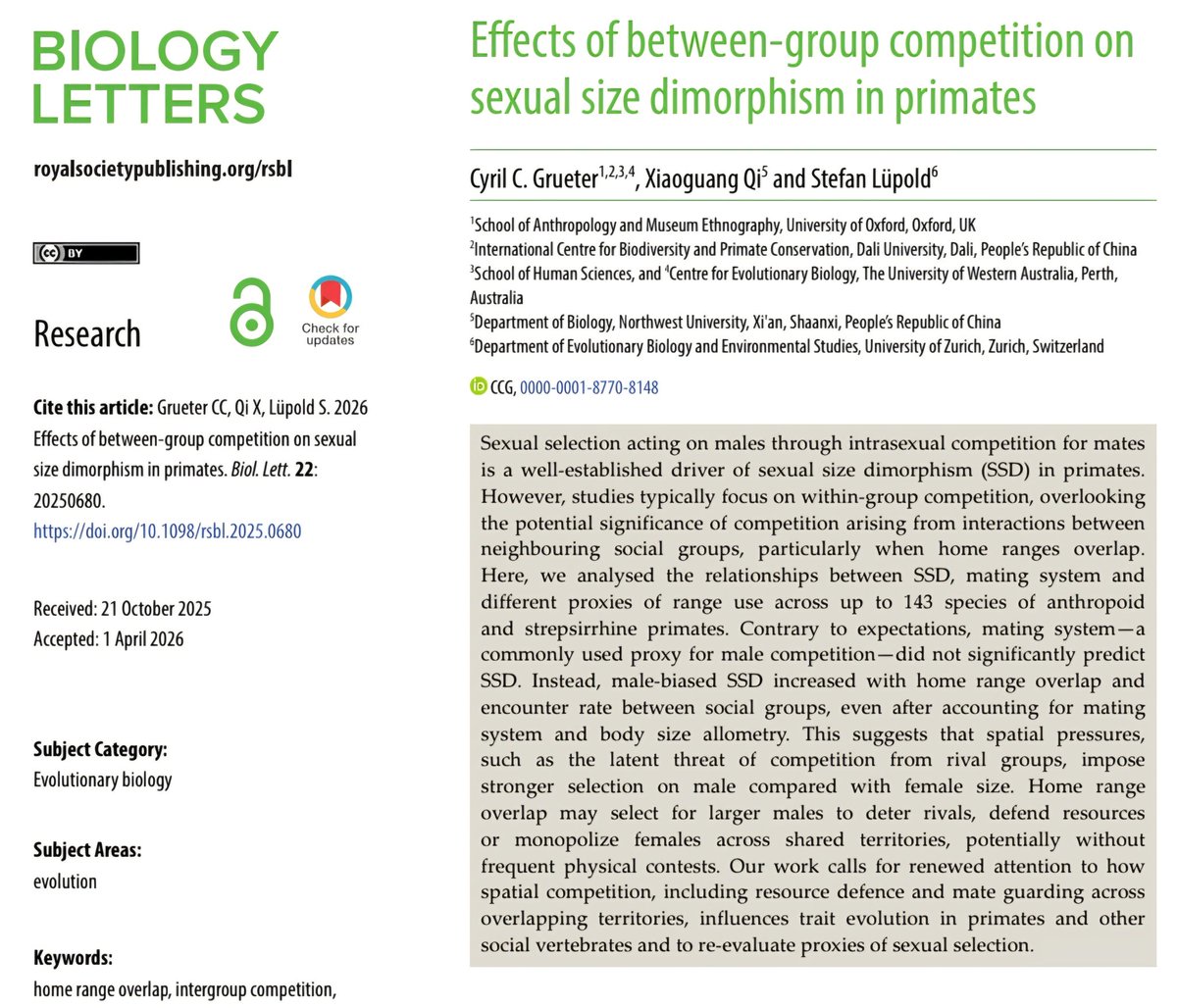
New paper out (@BiologyLetters, OA): in primates, male-biased size differences are better predicted by between-group competition than by mating system. Time to look beyond the group in studies of sexual selection. @UniofOxford
https://t.co/KQivF0ofXw