New post-doc opportunity looking at the atmospheric impacts of North Atlantic tipping points, working with me and @Len_Shaffrey at the University of Reading based in @AtmosScience at @UniRdg_Met
More info here
https://t.co/tuG0jPF9yu
Closing date 3rd of November 24
You can see on this forecast for near-surface smoke concentration, the several active wildfires that are the source for the smoke many in the western portions of the nation are dealing with today/tonight. Air quality alerts are in effect for many. See if your area is impacted at https://t.co/qk3BcVP5M8
Have you ever imagined jumping into the eye of a hurricane? 😯 Check out this stunning image of #HurricaneBeryl captured by #Sentinel2 🛰️ on July 1, 2024 🌀 This is the earliest Category 5 hurricane observed in the Atlantic basin on record ‼️
HD: https://t.co/lLmBf5rN5f 🧐
For #TimelapseTuesday, this #GeoColor imagery from @NOAA's #GOESEast satellite shows the first 4-days of #Beryl, when the storm grew from a tropical cyclone in the western Atlantic Ocean to a category 5 hurricane in the Caribbean Sea.
More on #HurricaneBeryl: https://t.co/g8o6QiThXB
The rare part is how the main development region (MDR) very rarely sees major hurricanes, let alone hurricanes, before August.
Beryl is expected to be only the 6th major hurricane in the MDR on record before August — doing so in *June*.
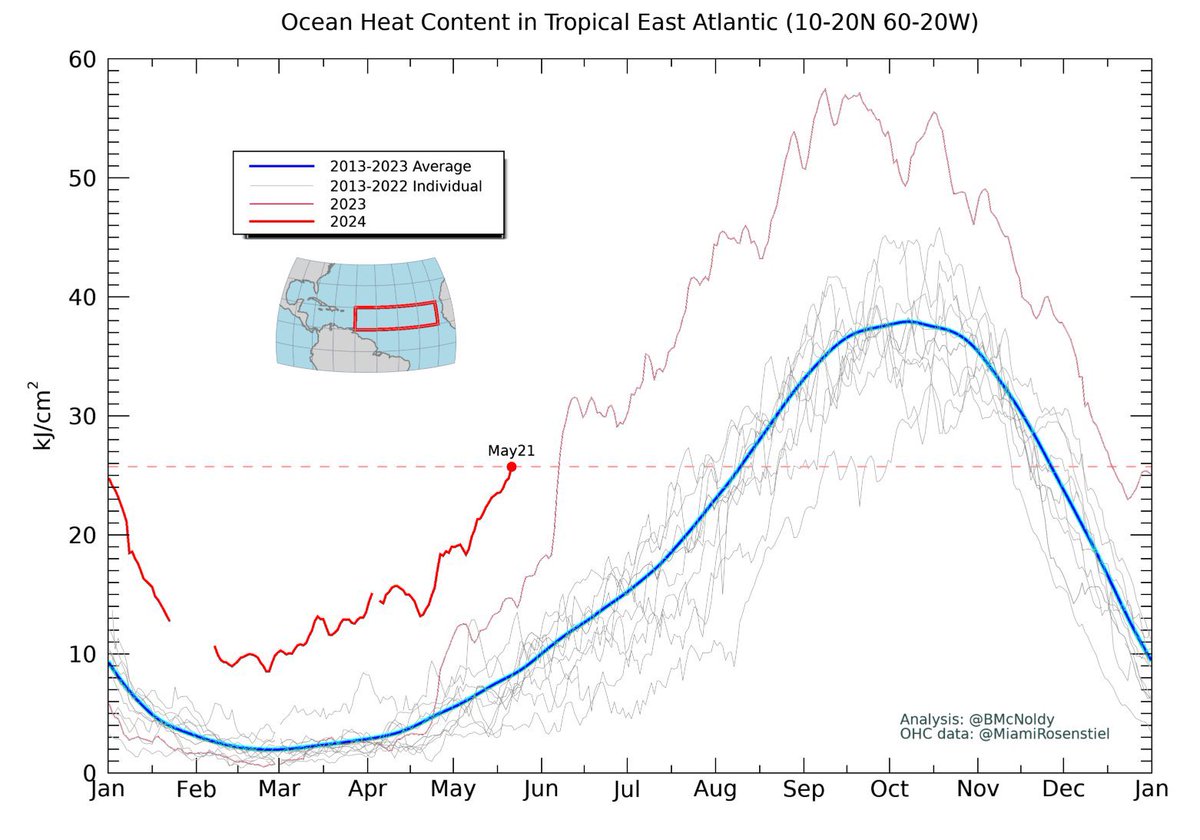
This is outlandish. The Tropical Atlantic Ocean heat content is so far above normal it’s now normal for Mid August.
The stored potential energy in the Atlantic is unreal this year, building on top of last year’s absurdity. 1/
In 1890, Henri Poincaré proved the non-existence of the uniform first integral of a three-body problem and the sensitive dependence to initial conditions of its trajectories.
Yet, stable solutions to it do exist.
https://t.co/haECKnWsfp
It’s been 50 years since the first attempt to forecast the El Niño/Southern Oscillation. The initial prediction was incorrect, but it marked the beginning of a journey toward understanding and predicting one of Earth’s most influential climate phenomena. https://t.co/ec73YaI9pc
From IPCC: "Overall, changes in the stratospheric polar vortex and Northern Annual Mode are not separable from natural variability, and so cannot be attributed to greenhouse gas forced sea ice loss."