The 2026 US Midterms Tracker is officially live! On it, you’ll find continuously updated forecasts from the Metaculus community on every race that matters: Senate, House, governors -- plus key drivers, electoral consequences, & other factors associated with the elections.
The Tracker is also connected to the Midterms Tournament, which carries a $10k prize pool (details in replies).
Here’s what the community is currently forecasting 👇
@Jabaluck You also might be interested in checking out forecasts from our Labor Automation Forecasting Hub if you haven't seen them. https://t.co/ut7kqKzvgl
1/ Our Labor Automation Tournament has $35k in prizes, including $5k for the best comments.
Before you dive in, we wanted to share what makes a strong comment in this case, as well as standout comments from Pro Forecasters. They're ineligible for the prize, so they're not who you're up against, but they're worth reading as case studies.
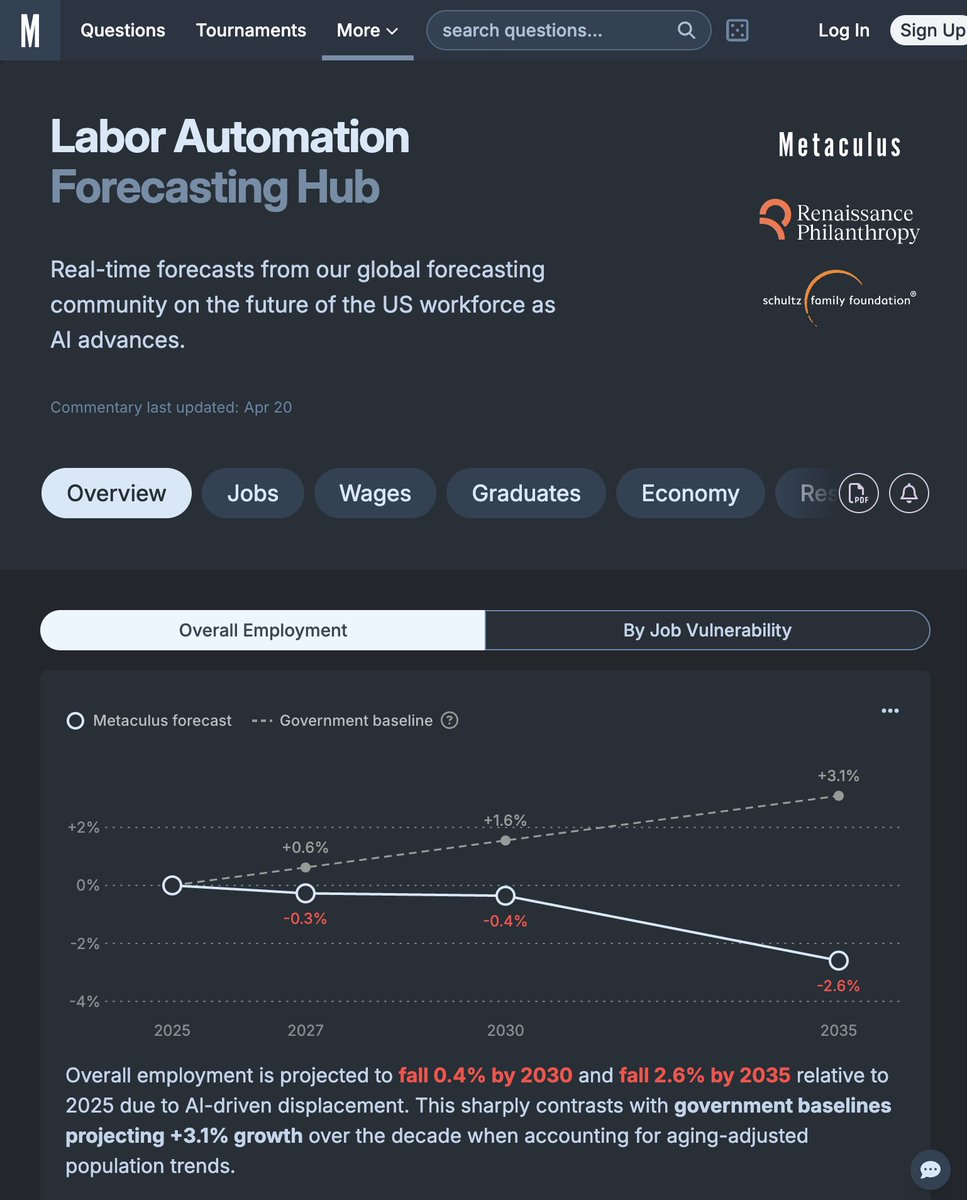
The Wage Paradox: Overall US employment is forecast to fall 1.4% by 2035, while real hourly median wages are forecast to rise 5.8% over the same period, per the Labor Automation Forecasting Hub.
1/
Homes have to be just a PR test case for this right? I could be wrong but am fairly sure like 95% of home construction already has a lumberyard within 75 miles that will deliver all necessary installer supplies just-in-time. Doesn't seem like the bottleneck at all.
After 1,000,000+ engineering hours, we're ready to give an update on what we've been making and how.
Construction is the largest, least productive industry on Earth, and it’s starting to affect housing. We're here to fix that.
Thesis:
We can build quality homes — any type — faster and cheaper than most of the industry through industrialization.
Here's how:
Construction's biggest problem is logistics: getting the right materials, people, and information in the right place at the right time.
So we invented a new type of manufacturing, Mobile Micro-Factories — small, modular, local factories that make and prepare every part of a home, then deliver it in stages, last-mile, to the site ready to assemble with non-specialized labor.
We’re built to scale fast — we can quickly copy our factories into hundreds of markets worldwide.
This is a really hard problem to solve; we're going to get there.
We'll walk through the nuances in more detail over the next few weeks. Full film dropping soon.
Leading figures in Silicon Valley believe that AI makes the prospect of a "permanent underclass" inevitable. @jasminewsun did a phenomenal job digging into what exactly they mean by this across dozens of interviews; we're excited and grateful that she approached this topic with such rigor.
Where this reporting captures vibes of a specific place, specifically the place driving the creation of increasingly powerful AI systems, the @metaculus Labor Automation Hub evaluates these questions at the national level, across a range of industries.
So what do forecasters see? Modest job loss overall, but a significant reshuffling of who works, who doesn’t, who gets what, & how jobs themselves might evolve. Read on for specifics + a link to the Hub.
Trying to get all my drafts out before baby comes, wish me luck. Starting with the oldest. I could have said a lot more but I gave myself a time limit. In a future post I'll talk about specific applications and lessons learned from modeling exercise we've been up to @metaculus
Alongside our report on how fast robot production could scale up, we've also released a series of @metaculus forecasting questions on the future of robotics.
If you have views on where these trends are headed, come weigh in!
Try out the @metaculus Labor Automation Forecasting Hub! Even conditional on AI investment stagnating (below $1T/year globally), forecasters still predict US employment declines through 2035. That's the optimistic scenario, and it's already negative.
Love this Labor Automation Forecasting Hub that @metaculus has put together. Aggregating forecasts on labor share, employment, displacement vulnerability across job type. Very useful resource.
https://t.co/pgivaV7f4V
Some bold forecasts by the folks at @metaculus. A reminder that the wisdom of the crowd has proven to be especially prescient on major questions.
If this is the case wrt education, then we're going to need to drastically improve pipelines to trade programs as well as ensure greater adoption of skills-based hiring.
OK since p(doom) is discourse here is my view on communicating risk with probabilities. We should do it because it makes it much clearer to people what you think and is empirically demonstrated good epistemic practice. Also we should hedge to show high-order uncertainty.
Some theses:
1. Probabilities give people more insight into what you think. If you use vague, qualitative language instead of numbers, people will just assume what you mean. There's @PTetlock's famous Bay of Pigs anecdote, where an advisor told Kennedy there was a “fair chance,” meaning a 25% chance of success. Kennedy later reported he had assumed the advisor meant a 75% chance, and said he wouldn't have pursued the invasion if he had known the advisor only meant 25%!
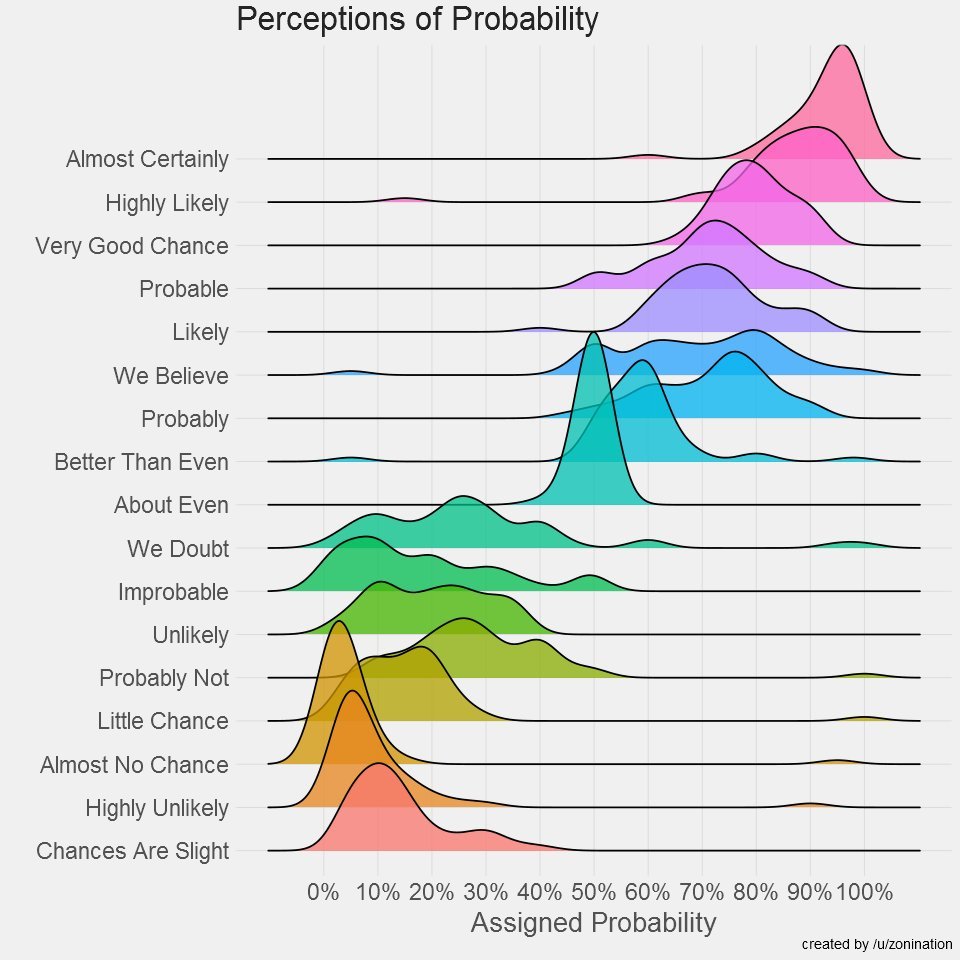
But this kind of miscommunication is ubiquitous. People assume different things about likelihood when speakers use qualitative language — it's an inherently less clear way to communicate what you are thinking. If you want your speaker to understand you, use numbers! Or at the very least, refer to the literature on perceptions of probability (see below) and pick your qualitative term very carefully so you communicate the right range! And don't use the extremely vague terms like "fair chance" or "improbable" that could mean literally anything to your listener. That is an extreme form of carelessness that we don't criticize often enough.
2. There haven't been many clear findings from the science of forecasting, but one of the clearest findings is that you make better predictions when you use precise numbers, even if these are completely made up. This is also true in group settings when aggregating the judgments of many people — which is essentially an idealized version of what we're doing pretty much any time we talk about probabilities. https://t.co/xvQE2v6e8I Here is an old thread I wrote on this topic some years ago: https://t.co/JWbl2YXHjG
3. Yes, people do perceive numbers as signaling more authority, and we shouldn't signal more authority than is appropriate. (How much is appropriate? Depends on the context. There isn't a universal answer in the context of existential risk from AI.) But you can do that without dropping numbers and losing the benefits of numbers I just set out. For example you can just use couching language, like "I would guess roughly 20%, but huge error bars, no one knows."
4. This can be studied!! It has already been studied a lot. I am finding it frustrating that no one in this debate is citing actual literature on perceptions of probabilities, especially in the age of LLMs where this information is readily available. We do know that percentages are viewed as more credible than qualitative language: https://t.co/62mMSMaVVJ. We do also know that hearing "61.87%" rather than "60%" triggers the inference that the speaker must have epistemic access that warrants the extra digits. https://t.co/FWwiYwpUhZ How much higher-order confidence is it appropriate to convey when communicating the P(doom) of, say, a world expert on AI or an aggregate survey of every AI researcher publishing in NeurIPS? I don't know! If you want to make an argument that saying "20%" signals too much confidence, please cite some of this literature and explain why you think that the groundedness signaled to the audience is inappropriate.
If you do want to advocate for a different communication style, it is not expensive to run a quick MTurk study to see what people's perceptions of it are and compare it to default rhetoric. Or even more cheaply you can run it on LLMs, which are a decent natural laboratory for testing hypotheses about human psychology in the absence of humans to test on. I hope to practice what I preach in the coming days and run some more LLM tests (I've ran one N = 7000 test yesterday) and set up a Mechanical Turk account so I can test my above claim about couching probabilities being just as good as using qualitative language, but with more clarity in communication and better epistemic practice.
We've been hard at work on this and are excited to be able to share it! We hope you find it useful, and if you do that you share it with others who could benefit from it.
Today, with @RenPhilanthropy and @SchultzFamilyFd, we launched the Labor Automation Forecasting Hub: a live tracker of expert and crowd-sourced predictions on AI's impact on the US labor market through 2035.
@CharlieBull0ck@NathanpmYoung Interesting, thank you! And yep point noted about the forecasting question terms, not interpreting you to be commenting on that directly!
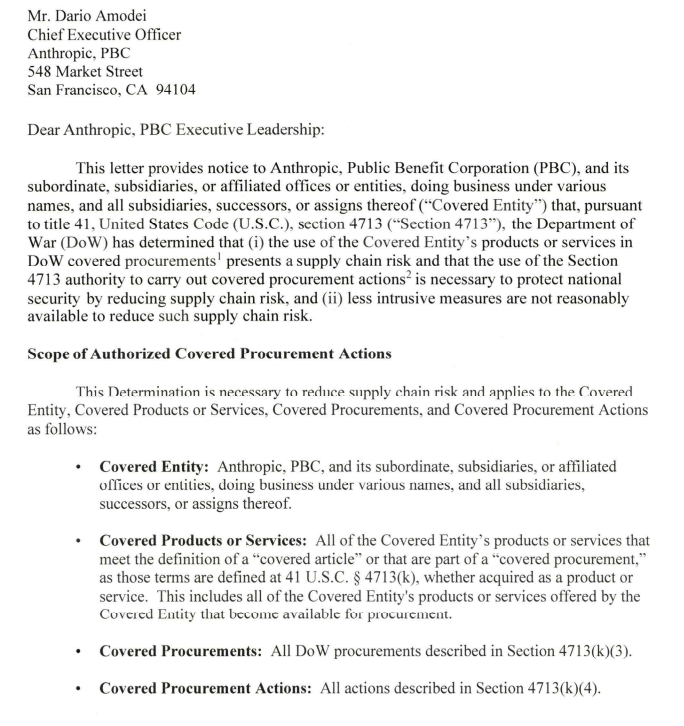
@CharlieBull0ck@NathanpmYoung Why do you say they're not prohibited from contracting with "~any" agencies? Hegseth's notice of supply chain risk designation explicitly says it prohibits all DoW procurements.