The fallacy of this is that more creates more. More hours, more hiring, more something.
And it is true in a sense. If you put in more work, more work will happen. But I think for most startups, the leverage is really in how differently you approach the problem, how well you cultivate your team, and the strategy.
Any large company can outspend you on hours. They have thousands or tens of thousands more people, spending more hours. If hours worked were the metric, every large company and government organization would always win and do the best work. More hours, better output.
This thinking is often representative of younger founders, where the startup becomes their identity and life. They have a hard time doing anything else, and cannot understand that your work is not the person that is you. But activities outside of work can grow you as a person too and make you do better work.
I’ve never worked this way. As a designer, I always saw the need to take a step back, to take a break. At times, I might work 12 hours or 16 hours, or whatever amount was needed, but it wasn’t the norm. You just can't grind design, you need inspiration. But taking that step away from the work, would give me more perspective, inspiration and I could approach the problem differently or I could just see the solution.
Grinding is never good for any creative problem, and startups or creating new products are often mostly about creative problem solving. Grinding works ok for email jobs, or where you just executing on very clear playbook.
With Linear, we’ve never worked this way. We work reasonable hours, 5 days a week. All of us founders have families. Many of our employees have families. I personally stop every evening, spend time with the family, cook dinner for the family, eat dinner together, and focus on things outside of work. Sometimes I work in the late evenings or weekends, but to me the pride is that I don’t need to. Company should be succesful without it.
My goal is to build a company that is sustainable in the long term, and doesn’t require heroics or personal sacrifices every single day.
There are times when our team is heroic. Launches, incidents, some other work that just needs to be done. They will work late into the night because they know it is the right thing. But we don’t require that every day or every week, and the more this happens, the more I think it is a failure of our company and leadership. The team and the leaders should always keep a reserve to use when something is needed.
Our thinking was also that quality, which we value, doesn’t emerge from working more or stressing people more. It emerges when you create the conditions for it to emerge. Often it is the appreciation, space, time, and how the person feels. A person who is rested will do better work.
I wouldn’t attribute much of our success to working a lot. The success came from having clear thinking, ideas, and focus to do the right things.
I sometimes wish we could move the culture more toward a Zen master.
Real mastery is not exerting the most effort. It is achieving the outcome with the least necessary effort.
No more frantic Googling right before a meeting.
Introducing Briefs. Granola searches your emails, the web, and previous meeting notes. Then writes 3 bullets with just what you need to know.
Join your next meeting feeling prepared.
We’ve noticed lots of teams are finding ways to use Granola’s context across their company.
So today we’re making that much easier by launching APIs, expanding our MCP, and introducing Spaces: a new way to share context with your team.
Read more: https://t.co/9f8LoPuul0
huge milestone for the team with the series c 🚀🚀🚀
lots of cool features launching as well: spaces, public api and more enterprise controls. this is a great time to join one of the fastest growing london startups
Today we're announcing our Series C alongside some big updates that make @meetgranola better for your team and your tools.
Excited to partner with Danny at Index and Mamoon at KP. Big things to come. Back to work!
Design Engineering Night #7 is happening! April 1st at Granola HQ.
This time we've got:
1️⃣ @_kejk, Design Engineer @DuckDuckGo
2️⃣ @jsscclr, Design Engineer
3️⃣ @lukerohanbailey, Design Engineer @meetgranola
🎟️RSVP: https://t.co/5bNZmNJBQh
Bring a friend, grab a spot and see you there!
There are some tweets out there saying that Granola is trying to lock down access to your data.
Tldr; we are actually trying to become more open, not closed. We’re launching a public API next week to complement our MCP. Read on for context.
A couple months ago, we noticed that some folks had reversed engineered our local cache so they could access their meeting data.
Our cache was not built for this (it can change at any point), so we launched our MCP to serve this need. The MCP gives full access to your notes and transcripts (all time for paid users, time restricted for free users). MCP usage has exploded since launch, so we felt good about it.
A week ago, we updated how we store data in our cache and broke the workarounds. This is on us. Stupidly, we thought we had solved these use cases well enough with our MCP.
We’ve now learned that while MCPs are great for connecting to tools like Claude or chatGPT, they don’t meet your needs for agents running locally or for data export / pipeline work.
So we’re going to fix this for you ASAP. First, we’ll launch a public API next week to make it easier for you to pull your data.
Second, we’ll figure out how to make Granola work better for agents running locally. Whether that’s expanding our MCP, launching a CLI, a local API, etc. The industry is moving quickly here, so we’d appreciate your suggestions.
We want Granola data to be accessible and useful wherever you need it. Stay tuned.
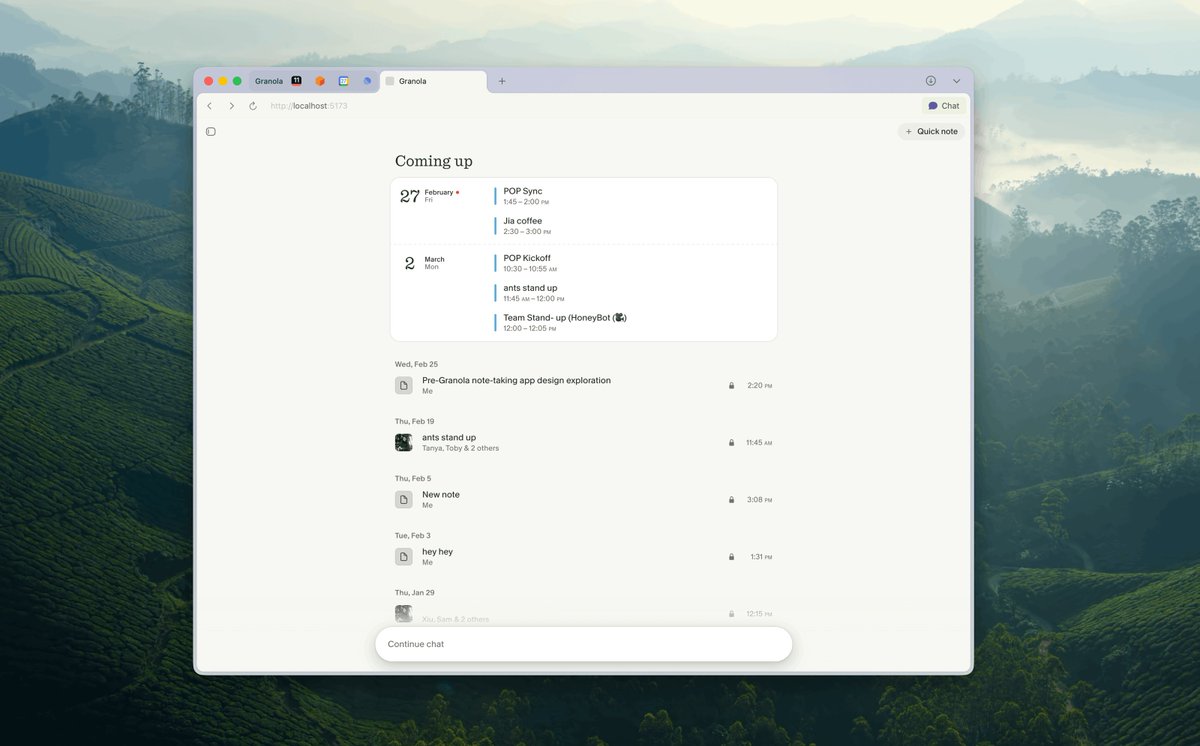
we made Granola work in a web browser so everyone, including non-engineers, can use Cursor/Claude on Slack to push fixes, make changes, and test instantly.
Granola is an Electron app so previously testing changes had a LOT of friction. here's how we improved it 🧵
(written as a note to myself, sharing here.)
for those entering 2026, feeling left behind/fomo/overwhelmed by the rate of change:
1. don't. it's so incredible early. social media lies to you.
2. establish a session of practice for every day. start with 15 mins, where you _force_ yourself to try a new tool/thing/ai on something you're already familiar with, purposely to not be biased by your old workflow(s), and see if you can articulate what's good/bad, what could be better about the new thing. do this honestly. repeat.
3. expand the sessions. ask other people if they can show you how they use these things (like, literally on a call with screen sharing)
4. be mindful. david gilmour isn't the best because he shreds, but because he makes every note count.
5. be healthy. it's a slog from here on out.
godspeed.