Now, this project has been one of my favorites during my postdoc with @Vectorimmunlab . Not only because it brought me stateside but also because I got to use groundbreaking techniques and dive into the world of mosquito immune cells.
Excited to share the latest preprint from the lab in which we made trangenic mosquitoes that express various immune cell markers and use cutting-edge flow cytometry techniques to examine mosquito immune cell populations! Awesome work from @samantsidis!
https://t.co/oFXEWIt5X5
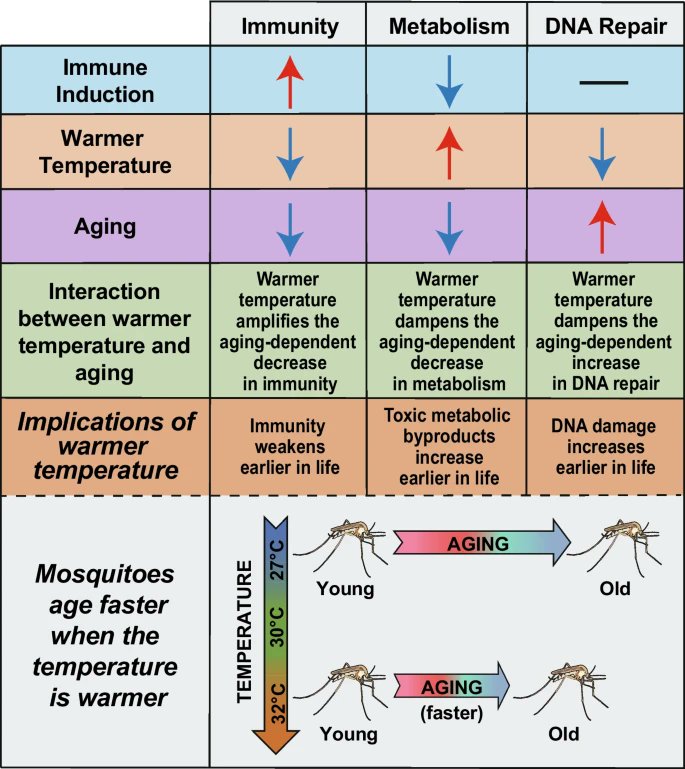
New article from the lab published in Immunity & Ageing: Warmer temperature accelerates senescence by modifying the aging-dependent changes in the mosquito transcriptome, altering immunity, metabolism, and DNA repair. https://t.co/E5HEBj0imK
I'm very honored and happy to share that that I’ve been appointed CRCN @Inserm in the PYP at the Center for Infection and Immunity of Lille 🎉
I’ll be developing a new research line on flea biology (gut, microbiota, immunity) and its role in human pathogen transmission🔬 🦠
👀There will be a Keystone Symposium with a focus on Vector-Pathogen Interactions to be held in Geneva, Switzerland in February 2027. It should be a great meeting and hope to see you there! https://t.co/YfXJCPVPJX
To the insect folks — does anyone have experience with the World Precision Instruments injectors? Our new Nanoject III stopped working after the third use, and we’re now exploring other options, such as this one https://t.co/NZgat8P0nu..
#mosquitoes
It is a tremendous honor to receive the Hoogstraal Medal! My achievements would not be possible without the hard work of so many outstanding trainees and colleagues. That is why I dedicated my acceptance speech to them!
Researchers in the Vosshall lab have discovered the first evidence of what happens when a female mosquito chooses to mate for the one and only time in her life.
We spoke to @leslievosshall and @LeahHouri about their unexpected findings. See the full Q&A:https://t.co/4NODZOfc9n
The world’s “most dangerous animal” just got easier to study 🦟
HHMI’s @leslievosshall & #VosshallLab at @RockefellerUniv have built the 1st cellular atlas of Aedes aegypti, mapping everything from legs to antennae. Available now to all researchers, & the public: https://t.co/MvaqanZZIs
Major week for mosquito research 🦟 New Science paper by @YukiHaba_ and @LindyMcBr on the origin of the London Underground mosquito: https://t.co/DVlK44j49T
Stay tuned - 2 more exciting studies coming this week!
New paper: Phagocytic hemocytes, independent of pericardial cells, modulate cellular immune responses on the dorsal vessel of mosquitoes, including the infection-induced reduction of the heart rate @VanderbiltU@EvolutionVU@vuartsci https://t.co/C30yDXEI7k
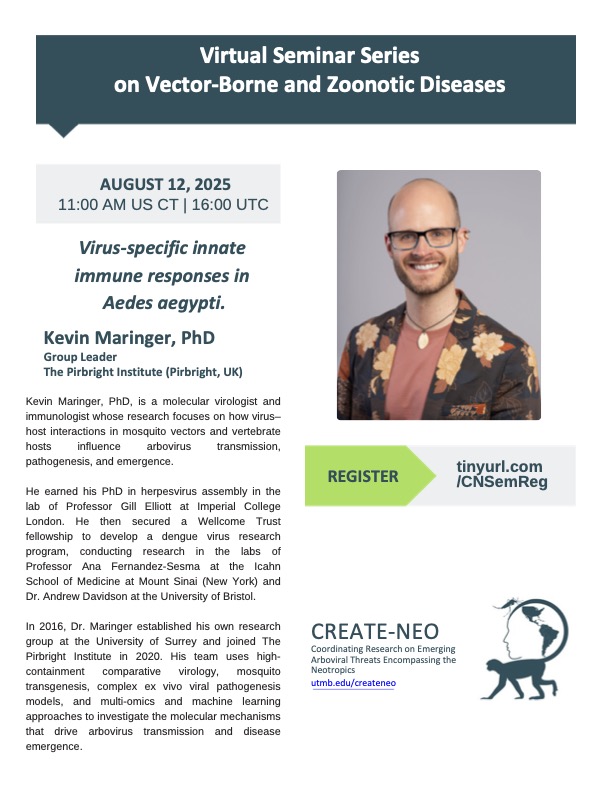
We look forward seeing you Aug 12 for our next webinar on Vector-Borne and Zoonotic Diseases. Dr Maringer will present "Virus-specific innate immune responses in Aedes aegypti". Register: https://t.co/slmPlJHE8z. @create_neo@ASTMH@sbviro@Virology_FAMERP@ACAV_ASTMH@utmbhealth
Celebrating the holiday weekend with another bang! Our work describing roles of TNF signaling on mosquito immune cell function and in limiting malaria parasite infection is now published. Big shout out to @samantsidis and others for their contributions! https://t.co/Ry0l1En9Ne
Excited to share our latest collaborative work with looking at the role of mosquito immune cells in virus infection. It turns out that these cells actually help disseminate an infection, increasing the potential for virus transmission https://t.co/8z7AWGZHLp
Proud to announce our latest research! Warmer temperature accelerates reproductive senescence in mosquitoes. @VanderbiltU@EvolutionVU@vuartsci https://t.co/ydsxMEffQe
We are happy to annouce that we have deposited at @VDRC (ViennaDrosophila Resource Center) a list of isogenized @Drosophila immunity mutants affecting all major immune modules and effectors. We hope these strains will be useful to the community.
https://t.co/oIEvATUN6E