@pvncher Use ergo or beads to have the agent write those tasks into a backlog in your repo. Then there’s a written record. A task backlog is resumable, interruptible, parallelizable, etc.
https://t.co/ZOhG9ewUNx
@BLUECOW009 His talent is hardware and, importantly, hardware organizations.
No special talent with software and software organizations (which are very different).
@AlexFinn Yes!
Next step: tell your agent to use use beads, bd, or (my own) https://t.co/ZOhG9ewUNx to write down & manage these task backlogs.
Now your plan is readable, storable, interruptible, resumable, shareable, portable, and rewindable
GPT3 writing code. A compiler from natural language to code.
People don't understand — this will change absolutely everything. We're decoupling human horsepower from code production. The intellectual equivalent of the discovery of the engine. https://t.co/QGJbQRBdQv
Unbearably excellent article. The world after work might be strange, warm, familiar, awful, and extremely acceptable to the human heart.
https://t.co/Ork4FsSvDw
The "water waste" from this bag of 900 almonds is the equivalent of about 34.2 million queries on ChatGPT (according to @sama).
You could personally do 1,000 AI queries per day on the current models for the next 80 years and you won't waste as much water as that bag of almonds.
100% Agree @GavinSBaker. Now, I'm going to debunk every single piece of mis-information about data centers that I've ever seen online:
> DISINFORMATION: Data centers use a lot of water.
FACT: Most AI data centers are closed loop dry cooler design that barely consume any water at all. A 20MW 10,000 GPU cluster needs 20,000 gallons to charge and doesn't use material water after that. That's less than 1/4 of the amount of water used to raise the amount of beef the average American consumes in a year. That means one of the largest data centers in the world, at 2GW, consumes less water than 20 people's annual beef consumption or three American's total water footprint (@ ~600k gallons per year for the average American).
> DISINFORMATION: Data centers increase electricity prices.
FACT: Data centers bring down a community's average electricity bill because they spur development of new power generation. Most data centers bring their own power generation, pay fees to the utility to build more power plants, or bring their own power storage to actually reduce the cost of energy in their community. Northern Virginia has some of the most data centers per capita and has low power costs. See research from the Electric Power Research Institute https://t.co/8fMZcIgMhx and https://t.co/KK04Pl8998.
>DISINFORMATION: Data centers don't create jobs
FACT: Data centers create hundreds of jobs at construction and a high number of exceptionally high paying jobs (many over $120k/year) for their ongoing operation and maintenance. No, they're not similar to an automotive plant in terms of the jobs / MW but they are phenomenal additions to an industrial park and community.
> DISINFORMATION: Data centers are constantly super noisy
FACT: Data centers are one of the quietest industrial buildings in the world. Drive by a data center in your city and roll down your window. They are very quiet. In fact, a metal mill is FAR louder than a data center---up to 10,000,000 more sound energy is produced by a mill and perceptually a mill can be 128x louder than a data center.
> DISINFORMATION: Data centers emit noise pollution from diesel engines running all the time.
FACT: Emergency generator sets are almost never turned on unless the grid connection goes out. This would be less than 0.5% of the time!
> DISINFORMATION: Data centers are surveillance systems
FACT: Data centers actually just host computers owned by private companies that are used to make phone calls, access the internet, run ChatGPT, Claude, X, Instagram, Facebook, Google, play multiplayer video games, and every thing you ever do online. That's it.
> DISINFORMATION: Data centers make water dirty
FACT: AOC held up a bottle of dirty water and said this is what data centers do. Completely false, well water disruption is a rare side effect of EVERY construction site in the history of humanity. This is not at all unique to data centers and is a complete red herring.
> DISINFORMATION: Data centers get massive tax breaks and drain tax dollars from towns
FACT: Data centers pay massive amounts of tax and often times huge % of an annual budget of a county or town! It's an absolute bonanza for the towns that are lucky enough to welcome a data center. New schools, new roads, new services are all paid for. Even if there is a sales tax rebate we're still talking tens of millions of new tax revenue. In 2022, Virginia’s data centers collectively generated $1 billion in local tax revenue and $640 million in state tax revenue! That was 2022. https://t.co/Oijl1TC7yb
Feel free to reply here if you have any other question you'd like answered about data centers happy to provide actual facts.
How does the United States of America — a relatively water-rich country — have a huge western water crisis?
In the most arid part of the country we’ve assigned the majority of the water to low-value agriculture rather than cities & suburbs.
https://t.co/m0N3m4qRE1
To give a rundown of the zombie facts haunting the data center debate:
-They pollute water: Every instance we've seen so far was caused by something relating to construction, mostly the same as other large buildings.
-They raise electricity prices as much as 267%: this was a stat about wholesale prices at specific nodes very close to data centers, not household prices in the area, which are often very different. There's no reliable pattern right now between DCs getting built and electric bills going up, but that could change in the future.
-Their normal operation harms people's access to water: No clear case I can find, outside a weird case in Georgia where a DC accelerated the need for a larger water treatment plant which got passed onto consumers as higher bills.
-They take all the land: even in Loudoun County with the most data center capacity anywhere DCs take up about 3% of the land. By 2030 all US data center buildings would cover about the surface area of Disney World
-They create harmful infrasounds: this was based on a single video that lied about almost every study it flashed on the screen. We don't have any reason to think data center infrasound is harmful unless it's so loud you can physically feel it.
-They don't pay taxes: this is the result of a game of telephone that started because data centers don't pay a specific type of tax (M&E sales) in most states, which got reported on a lot as "residents missing out on this much in tax revenue" which people mistook to mean DCs basically pay no taxes or get funded to get built. In reality that's just one of several taxes places can apply and in basically everywhere they're built DCs pay a lot of taxes. Loudoun collects $1.3 billion per year from them and doesn't charge M&E sales tax.
-They reliably make annoying sound: there are clear cases where they've created awful noise pollution, but these mostly seem like outliers, though there are enough to be concerned.
-They create harmful heat islands: The only study that's measured this finds that data centers can heat the air very close to them by a few degrees, and this drops to zero just a little farther out. A separate study that found that they heat the land for miles around seemed to have accidentally measured the results of normal land use change like new paved roads, and didn't control for that. It could be that the very largest ones create a harmful effect in areas where heat doesn't dissipate well, like desert valleys.
I'm finding that most educated adults I meet believe almost all of these.
@jjpcodes@JanahYsr You need to mentally and mechanically separate your feature spec from your backlog of implementation tasks
You can use a CLI tool like beads, bd, or sandover/ergo to do this.
Iterate on the spec 2x, separately iterate on the task backlog 2x, and you won’t go off track anymore
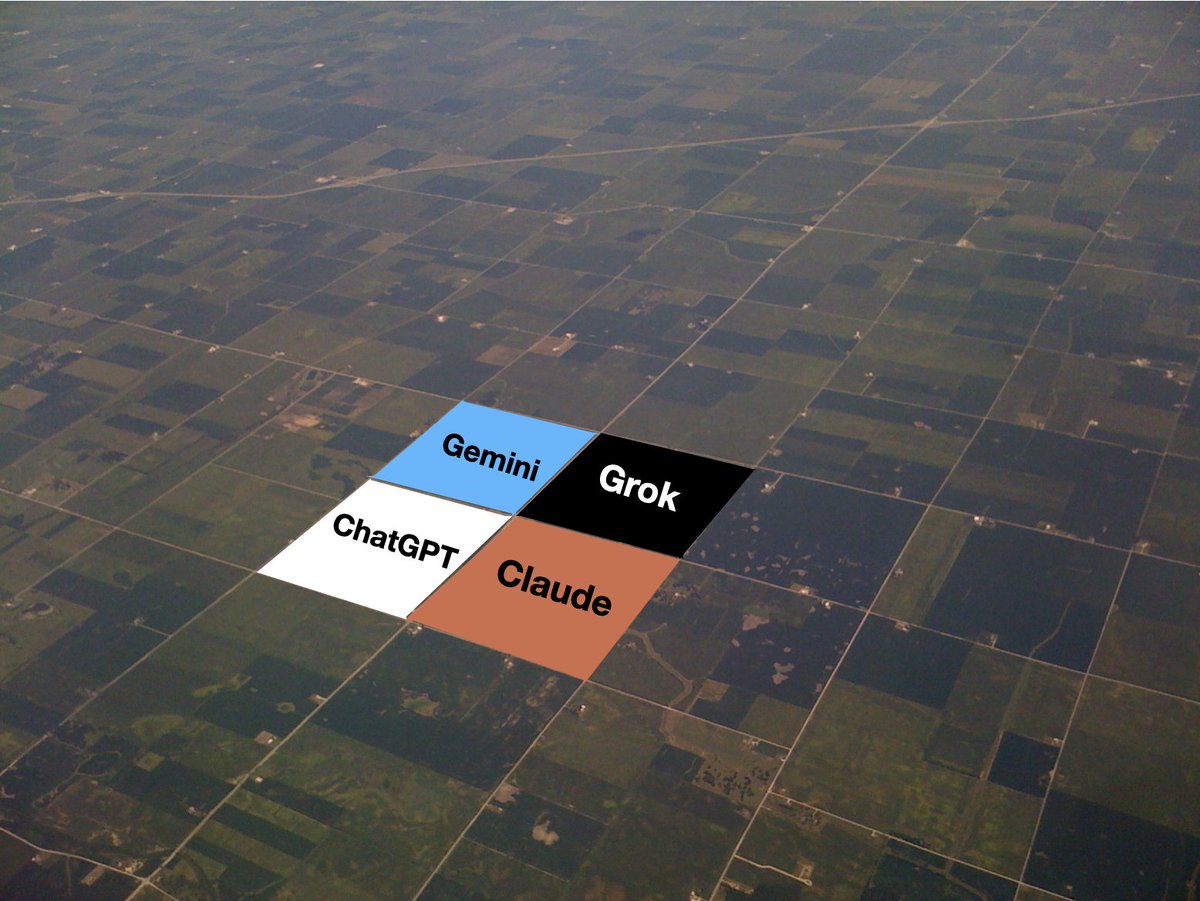
Each frontier AI model seems to use a little under a year's worth of a square mile of farmland's water to train. I think about this as the country having 4 square miles of farmland sectioned off to grow some of the most popular consumer products in history.