Yes, I do. New York went after the Mob. Back in those days, it was considered to be a death sentence. New York broke them up, and the Mob is now a pale shadow of what it used to be in the Goodfellas days.
Evil always exists, but many Americans have profound courage and integrity. We see this with our veterans who fought in wars they couldn't win but still showed up every day. We see it in medical personnel who travel to fractured states to provide basic healthcare. We see it in police fighting violent gangs.
We just need to give the order, and a legion of people will stand up and take charge.
@Prathkum That's a great plan!
Learning JavaScript is a great way to get started with coding, and the OpenAI API is a powerful tool for building AI-powered applications.
@traversymedia@codingphase I thought it’s just me who doesn’t open those emails! 😆 in fact, I never open any of them no matter how many times they follow up. 0% open rate.
Big milestone : Our system design YouTube channel has grown to half a million subscribers. Here are the top five most-liked topics:
- Why is Kafka fast?
- HTTP/1 to HTTP/2 to HTTP/3
- Top 6 Most Popular API Architecture Styles
- Kubernetes Explained in 6 Minutes
- What Is REST API? Examples And How To Use It
Thank you everyone ❤️!
Subscribe to our YouTube channel here: https://t.co/WDXcRRRvTu
Are you brave enough to build microservices?
If yes, I collected all the best practices for building microservices so you won’t have to.
Here they are in no particular order (don’t forget to bookmark):
1 - Design for failure
- A distributed system with microservices is going to fail.
- Your design must tolerate failure at every level - infrastructure, database and individual services
- Use circuit breakers, bulkheads or graceful degradation methods.
2 - Build small services
- A microservice shouldn’t be built like a Swiss knife.
- It should be designed to do one thing well.
- By the way, it’s right there in the name itself (micro-service)
3 - Use lightweight protocols for communication
- Communication is the core of a distributed system.
- Microservices should communicate with each other using lightweight protocols such as REST, gRPC or messaging queues.
- Your goal should be to reduce communication overhead and improve performance.
4 - Implement service discovery
- To communicate with each other, microservices must be able to first discover other services.
- Implement service discovery from the very beginning.
Facilitate this by using tools such as Consul or Eureka.
5 - Data management should be distributed
- In microservices, data should be owned by the individual services.
- A piece of data must be managed only by the owner service.
- The goal should be to reduce coupling between services so that they can evolve independently.
6 - Implement resiliency patterns
- Designing for failure is one half of the puzzle.
- You must also implement specific resiliency patterns to improve the availability of the services.
- Use retry policies, caching and rate limiting.
7 - Proactive monitoring for services
- In a distributed system, any component that can go down will go down.
- To identify the issues in a timely manner, it’s important to collect and analyze metrics.
- Tools such as Prometheus or Grafana help monitor the system as a whole and identify potential issues as early as possible.
8 - Security should be at all levels
- In a microservices system, the attack surface is quite large.
- Security must be implemented at every level from infrastructure to service to the communication layer.
- Use proper privileges with the latest security protocols and tools to build a secure and reliable system.
9 - Centralized logging
- Logs are extremely important for finding issues in a microservices architecture.
- However, to make sure they help you, logs from all services must be aggregated in a centralized location for easy analysis.
- Use tools like ELK to build a robust logging setup.
10 - Use containerization techniques
- To deploy microservices in an isolated manner, use tools such as Docker and Kubernetes.
- They are meant to simplify the deployment and scaling requirements of a microservice.
- But also remember to devote ample time to managing these resources.
11 - Use automated testing and deployment
- Last but not least, microservices should be thoroughly tested to ensure reliability.
- Use automatic test cases as part of CI/CD processes to create a seamless experience.
Phew! That was a long list.
To conclude, these are the basic practices you need to follow to build a successful microservices system.
So - are you still up for the challenge of using microservices in your next project?
Or would you rather stay in your cave, build a modular monolith and be happy?😉
If your LinkedIn is completely empty.
Your resume is barely done.
Your GitHub empty.
Your portfolio site nonexistent.
Your network doesn't exist.
What do you expect or hope for an employer to interact with or see? If you aren't giving YOURSELF a fighting chance, how will they?
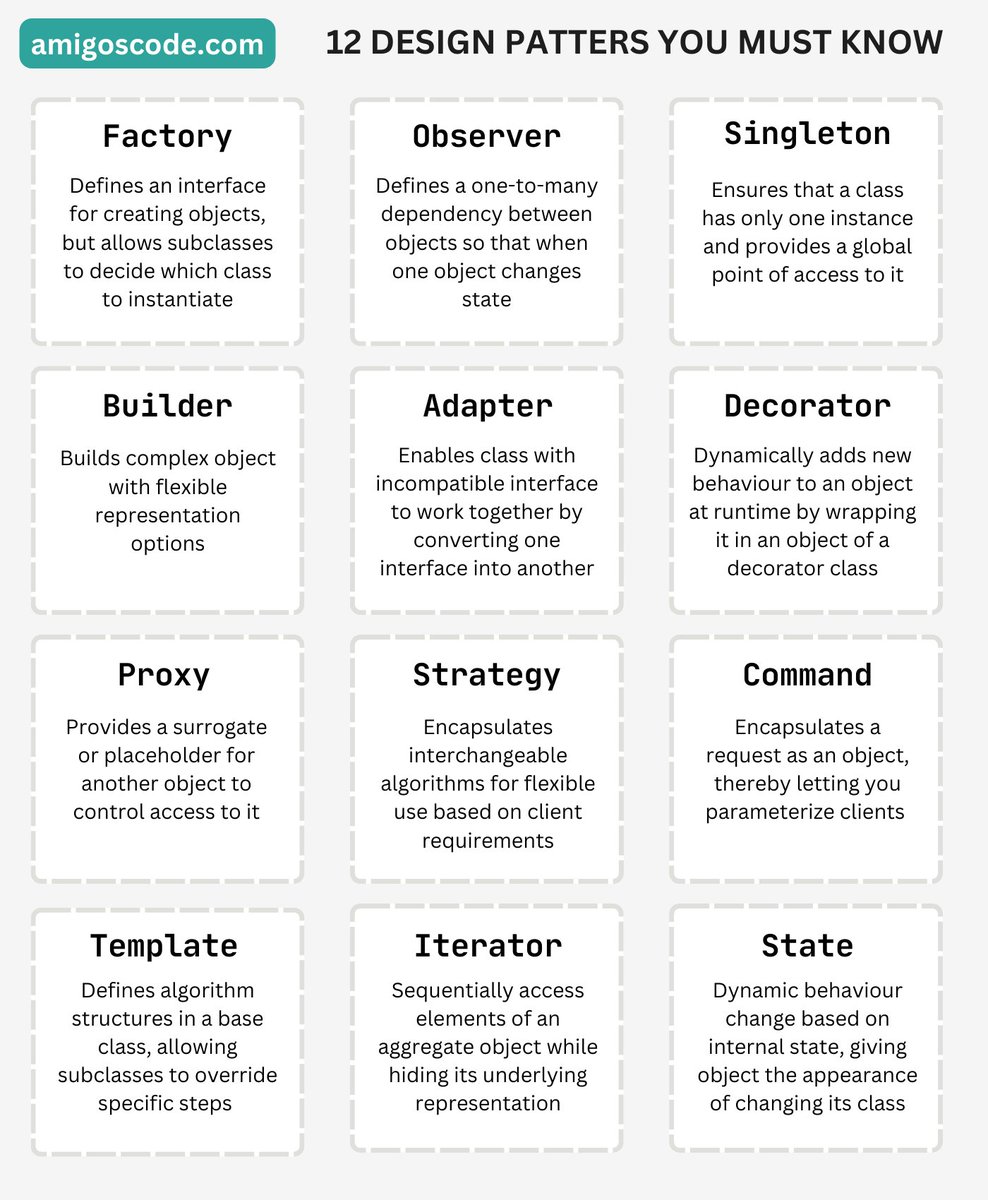
12 Design Patterns You Must Know
1. Factory Pattern 🏭
Imagine a factory that produces different products. Similarly, this pattern creates objects without specifying their exact class, making code flexible and easy to extend. 🧩
2. Observer Pattern 🔍
Like subscribing to updates! Objects (observers) register to watch changes in a subject. When the subject changes, observers are notified automatically. 📡🔔
3. Singleton Pattern 🕊️
The one and only! Ensures a class has only one instance globally accessible. Useful for managing shared resources like databases. 🌐🔒
4. Builder Pattern 🛠️
Building complex objects step by step. Think of it as assembling Lego bricks to create something intricate without the mess! 🧱🏗️
5. Adapter Pattern 🌉
Bridging the gap! Converts the interface of one class into another interface clients expect. Makes incompatible components work together. 🔌🔌
6. Decorator Pattern 🎈
Like adding toppings to your pizza! Dynamically adds responsibilities to objects without changing their code. A flexible alternative to subclassing. 🍕✨
7. Proxy Pattern 🕶️
Virtual representative! Controls access to an object, acting as a stand-in with additional functionality, like lazy loading. 🔒🔍
8. Strategy Pattern 🎯
Switching strategies seamlessly! Allows selecting algorithms during runtime. Useful when you want to provide multiple ways to accomplish a task. 🎮🔄
9. Command Pattern ⌨️
Encapsulates requests as objects, allowing parameterization of clients with different requests and queuing of requests. Think of it as a to-do list for your program. 📋📌
10. Template Pattern 📄
Standardized process steps! Defines the structure of an algorithm, letting subclasses override specific steps. Ideal for reusable workflows. 📊📈
11. Iterator Pattern 🔄
Tour guide for collections! Provides a way to access elements of a collection without exposing its underlying representation. 🚶♂️🗺️
12. State Pattern 🚦
Like a traffic light! Allows an object to change its behavior when its internal state changes. Keeps your code organized as states pile up. 🚥🔄
#Coding #SoftwareEngineering #SoftwareDeveloper
I just met a guy making $200,000+ per year.
And he didn't write a single line of code.
Here are 15 mind-blowing AI tools that he uses everyday to make money:
[ Bookmark to use later 🧵]
YouTube is one of the best ways to make money online.
ChatGPT makes it easy to start your YouTube channel.
Here's a simple 5 step process to make $10,000/mo on YouTube using AI:
MIT is offering free online courses.
Now you too can learn elite-level knowledge:
No textbooks, no tuition payments.
Here are 7 FREE courses you don't want to miss:
With respect to Binance, I'm reading through the SEC complaint. It's over 130 pages, but seems like the next in a series of steps to implement chokepoint 2.0 in the United States. The end goal is a agenda based CBDC partnered with a handful of massive banks and end-to-end control over every aspect of your financial life.
A regulatory event is where you have a debate about compliance with a law or guidance. This event seems to be a polticial philosophical disagreement with the very existence of cryptocurrencies and what they represent. An unelected group of people have decided that concepts like self-sovereign identity, owning your wallet, and the freedom to control your economic agency should be removed from the masses and given to the "enlightened" few.
Honestly, what is happening isn't anything new. It's always the same fight between freedom and authoritarianism just with different players, technology, and words. It does seem like this event is a perfect opportunity for the entire industry to set aside it's fragmented nature and unite for a common sense set of rules and guidelines that can prevent the United States from slipping into a distopia that would make 1984 look like a vacation.
I'll have more to say later, but will close with we are going to be fine. Everything's alright and the future is bright for the industry.
A population density map of beautiful France. I fondly remember the train stopping at the French border while travelling from Italy, taking a bus to Nice, renting a car/driving to Marseille, Montpellier, Perpignan, and finally Barcelona.
#rayshader adventures, an #rstats tale