There must be millions of Americans - like us Brits - who look at the political landscape and think:
I don’t belong anywhere.
Too liberal for the populist right.
Too sceptical for the progressive left.
Pro free speech.
Pro free markets.
Pro biological realities.
Suspicious of ideological certainty.
Politically homeless might be the fastest-growing political tribe.
Here’s something I wish somebody had told me years ago: you’re allowed to leave your political tribe without joining the other one.
You don’t have to become a raving right-winger. You can simply decide that some of the things your own side believes are nuts.
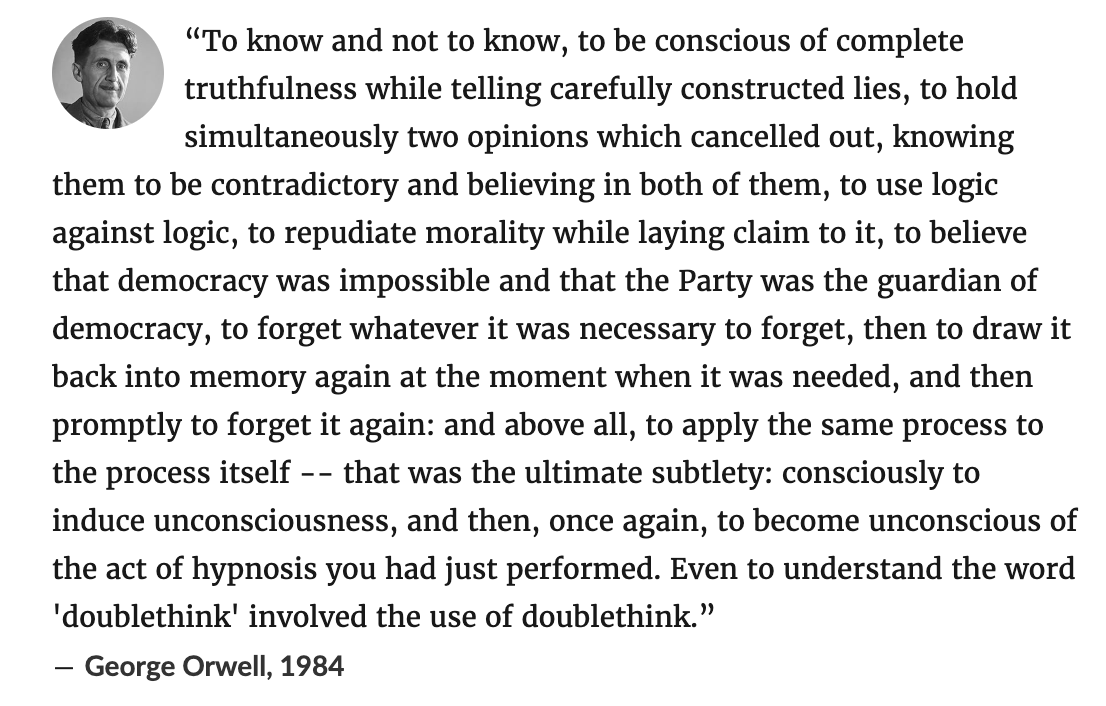
My most conservative position, apparently, is that being forced to pretend belief in things that deeply violate your conscience and sense of truth as a condition of participating in society is an extremely big deal -- for reasons George Orwell explained better than I can
Everyone should read @Tyler_A_Harper’s extraordinary Atlantic cover story, “Confessions of a Token Black Professor.”
It is one of the best accounts yet of how bad American campuses became between roughly 2015 and 2025, peaking from 2020 to 2023. It was a disaster for academic freedom, free speech, and higher education’s credibility. It also helped destroy trust in shared facts, because people stopped believing that our supposed referees would scrutinize claims that fit their own ideology as aggressively as claims from the other side.
Now there is a concerted effort to pretend either that none of this happened, or that it was merely a strange youthful indiscretion we can laugh off, much as people tried to do with the first great age of political correctness.
We must not let them wish it away.
If you experienced the quasi-religious groupthink that overtook institutions supposedly devoted to inquiry, write about it. Record what happened, what people were afraid to say, and why. Otherwise, this period will be rewritten by many of the same people who defended the status quo while casting themselves as brave underdogs. Looking at you, @rottenindenmark, among others. Doing PR work for a $1 trillion industry is not exactly fighting for social justice.
I also have always seen this through a class lens. Elite higher education is a gigantic industry that disproportionately benefits people who are already well-off. Yes, people like me can get through it and have our lives transformed. But we are a small part of the story.
There is an older intellectual history here. Thinkers such as Herbert Marcuse confronted a frustrating problem: the working class often failed to behave as intellectuals expected and an awful lot of working people hated intellectuals. Ordinary Americans liked their country, distrusted elites, and seemed perfectly capable of living without philosopher-kings directing them.
The solution was an newideology that allowed highly educated elites to regard working-class people with contempt while still seeing themselves as champions of the oppressed.
That became academia’s problem when universities built departments, bureaucracies, hiring systems, and professional cultures that treated deeply contestable political doctrines as moral dogma.
You can see the results throughout Tyler’s story: classism, utter contempt for locals, exaggerated self-importance, ordinary disputes transformed into battles of good and evil, and politicized administrators remarkably skilled at weaponizing elite ideology against their own institutions.
Tyler’s piece is both testimony and warning. There are excellent university presidents trying to right the ship, but too many faculty organizations and professional associations still seem to believe the ideology was never the problem—it simply wasn’t imposed consistently enough.
We need to document what happened and build institutions less vulnerable to another episode like it.
Because this was never some weird, isolated campus disaster. It spread into journalism, science, philanthropy, corporations, K–12 education, government, and politics. It damaged the credibility of the institutions we depend on to tell us what is true.
A society that loses faith in its knowledge-producing institutions eventually loses something more important than the reputation of its universities: its ability to see the world as it is.
@hecubian_devil I think the fundamental disconnect here is that you wants politics to solve man's search for meaning and I want politics to deliver a prosperous, safe, free society in which everyone can go find meaning in something other than politics.
The faster the center-right and the center-left realize that they have more in common with each other than with the extremists on their own "sides," the better off we'll be.
One of the things I mourn the most in the current political era is that we've lost an important idea - that people who run for office should, at the very least, be competent people and good people. Not crazy. No major scandals, no outright evil views.
Nobody cares any more.
Free speech is a legal right. It is also part of a larger inheritance, protected by people who paid costs most of us can barely imagine.
On Memorial Day, we remember those who gave their lives in service to that inheritance.
They did not die so Americans would fall into a dreary consensus on all things.
They died helping preserve a country where disagreement is possible without bloodshed, where dissent is not treason, and where citizens can argue, worship, protest, publish, persuade, offend, forgive, and begin again.
That is not a small thing. It’s the inheritance we are obliged to protect.
a side effect of reading and writing is becoming able to think clearly and as we move toward postliteracy i think we will likely regress to moronic brutedom for the most part
trained cognition will be a niche and suspect lifestyle
In order to be born, you needed:
2 parents
4 grandparents
8 great-grandparents
16 second great-grandparents
32 third great-grandparents
64 fourth great-grandparents
128 fifth great-grandparents
256 sixth great-grandparents
512 seventh great-grandparents
1,024 eighth great grandparents
2,048 ninth great-grandparents
For you to be born today from 12 previous generations, you needed a total of 4,094 ancestors over the last 400 years.
Think for a moment:
How many struggles?
How many battles?
How many difficulties?
How much sadness?
How much happiness?
How many love stories?
How many expressions of hope for the future? – did your ancestors have to undergo for you to exist in this present moment...
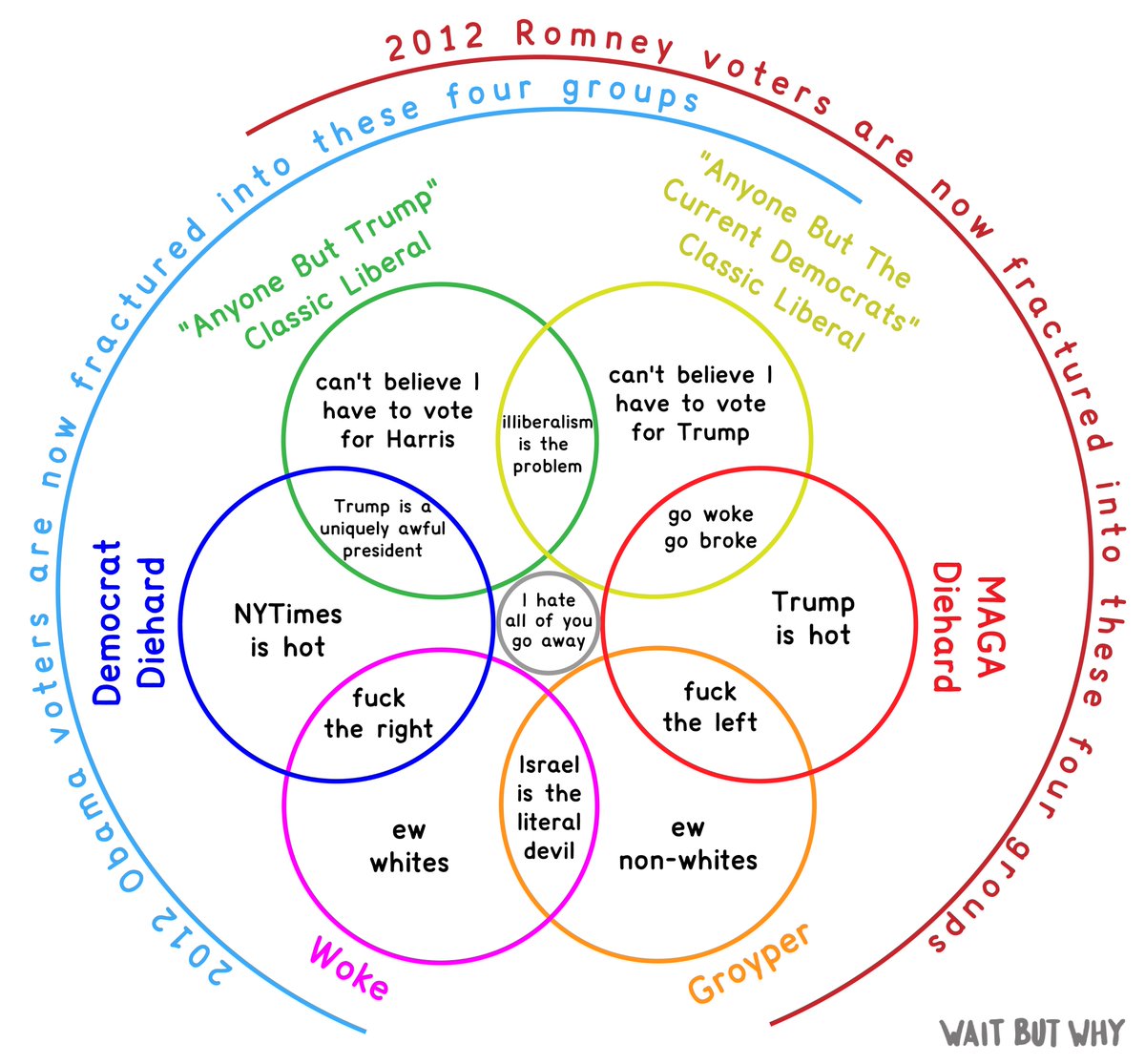
America’s political landscape is more complicated than it used to be. Here’s my attempt to depict what I see as the seven broad camps today. Most people I know fall pretty cleanly into one of these circles (each of which has some common ground with the two adjacent circles).
Some additional points:
- The top two circles (green/yellow) are concerned first and foremost with the rise of illiberalism—disregard for the constitution, cancel culture, mob behavior, political violence. They see liberal vs illiberal as more critical right now than left vs right. In 2020, they agreed that wokeness was bad but today they’re divided on whether Trump or Harris/Biden are the lesser of two evils.
- For the middle two circles (blue/red), left vs right is the main thing. They’re not illiberal themselves but tend to focus on illiberalism from the other side while ignoring or condoning illiberalism from their own team. Both skew older and are the main consumers of traditional media, whether it be cable news or newspapers.
- The two lower circles (pink/orange) share a strong sense of grievance, place utmost importance on identity, tend to view identity groups (race, religion, sex, etc.) as monoliths, and are prone to believing conspiracy theories that fit with their worldview. Both skew younger, with woke skewing feminine and upper class and groyper skewing masculine and lower class. Both use revolutionary rhetoric, seeing the establishment as rotten to the core, and readily employ illiberal tactics under the belief that desperate times call for desperate measures.
Thoughts?
It’s quite simple:
1. Family history is worth knowing, preserving, and passing on.
2. It does not grant moral authority, superiority, or a higher claim to being “American.”
The end.
Standing up for due process, free speech, civil liberties, intellectual pluralism, and scientific rigour doesn’t win you many friends these days, writes @jonkay.
https://t.co/HhLQUQyoD6