The somewhat cosmic looking Earnings & Valuation scatter plot below shows 150 years of stock market history. Along the horizontal axis is earnings growth and along the vertical axis is the annual change in the P/E-ratio. Together with dividends these two variables produce the total return. We can see right away that the relationship between earnings and valuation is inverse. That’s a simple byproduct of the fact that price anticipates earnings by several quarters. The size of the dots represents the 12-month return, and when the circles are empty it means that the return is negative.
There are four quadrants in this chart, with the upper right being the best and the lower left the worst, and the curved regression line depicts the intersect between positive and negative returns. Above the line along the middle is the sweet spot, when earnings are growing and the P/E-multiple is expanding. Below the line on the lower left is the worst-case scenario, where both earnings and multiples are falling (think GFC and https://t.co/AHwbGNds0b bust).
A rudimentary regression analysis of margins, earnings, rates, and credit spreads shows that these four variables explain quite a bit of the market’s valuation since the 1960’s. If we exclude rates from the equation, we see that the market is very close to fair value, but if we include rates the market is a tad rich. Should rates continue to rise to 5% or beyond, we could see the orange and blue lines diverge further.
🚨 THE ENTIRE AI BOOM MIGHT BE BUILT ON FAKE REVENUE.
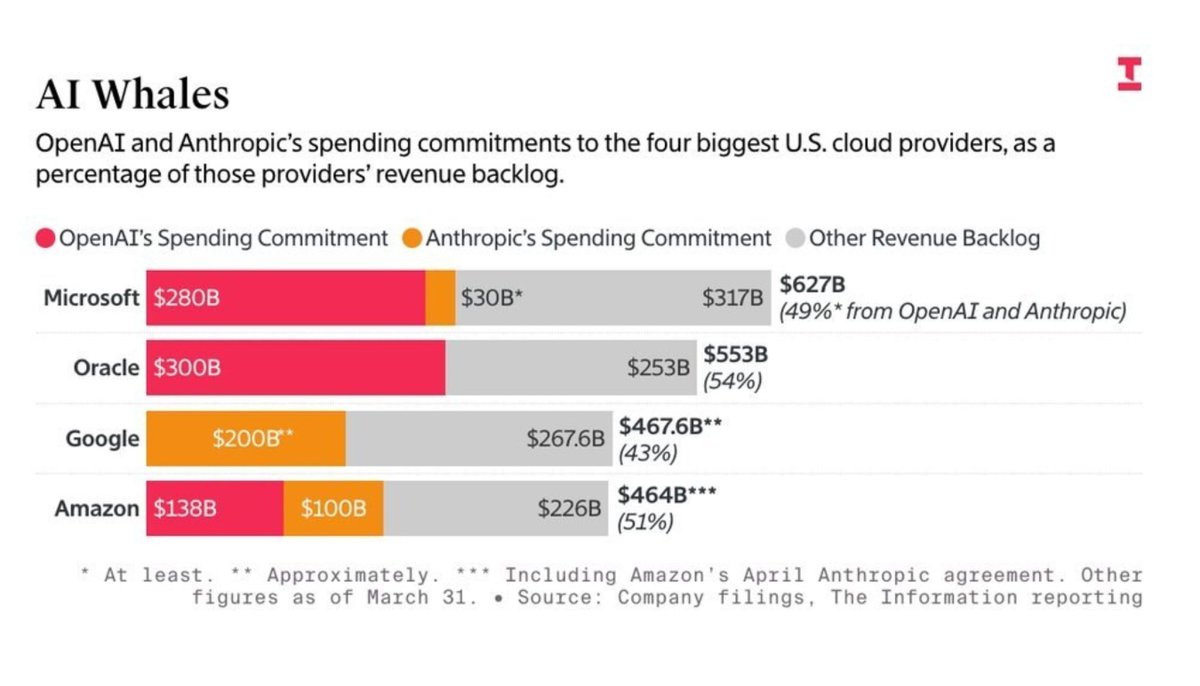
Latest corporate filings show that OpenAI and Anthropic alone make up over half of the entire $2 trillion future cloud backlog held by Microsoft, Oracle, Google, and Amazon.
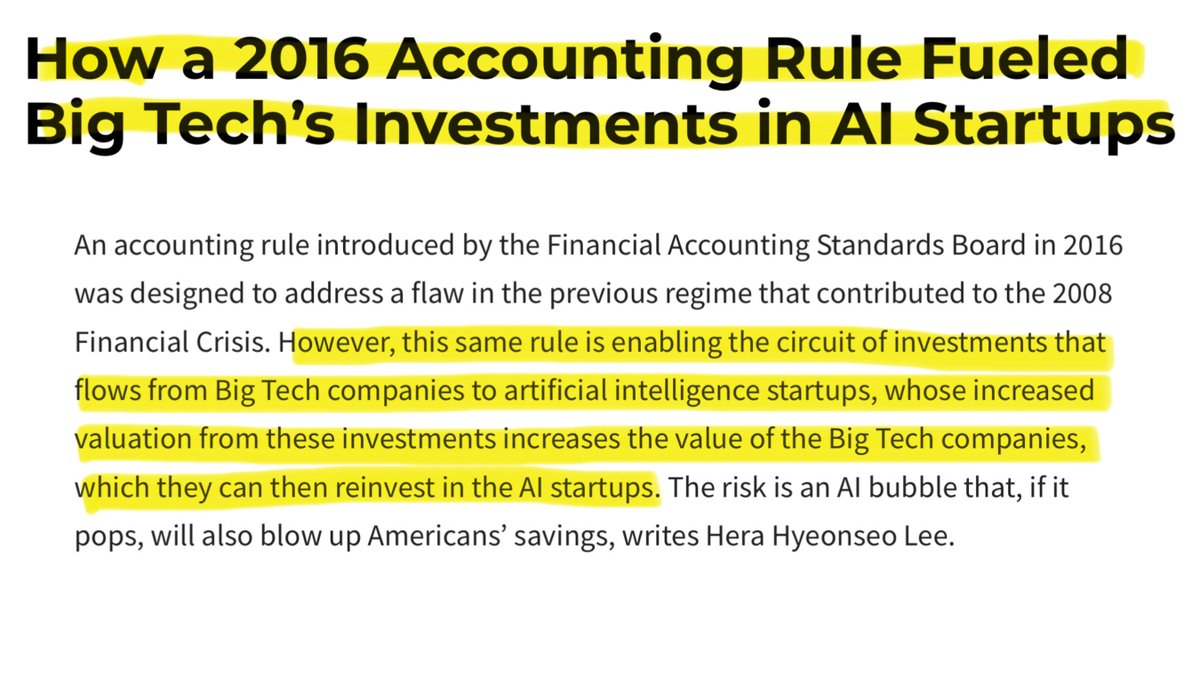
This massive pipeline is actually being created through a circular accounting trick called a round trip revenue loop.
But how it works ?
A tech giant gives billions of dollars to an AI startup as an "investment". But hidden in the contract is a strict rule forcing the startup to hand that exact same money straight back to the tech giant to rent their computer servers.
Look at the documented case of Microsoft and OpenAI.
When Microsoft invested $13 billion into OpenAI, it didn't just give them cash; it gave them "cloud credits" to use Microsoft servers. OpenAI used those exact credits to train its AI models, and Microsoft then turned around and recorded that server usage as brand new "cloud revenue" from a customer.
The tech giant is literally paying itself with its own money and calling it a sale.
This is why OpenAI’s annual cloud bill has ballooned to over $60 billion, double its actual revenue of $25 billion, kept alive solely by this recycled funding loop.
Anthropic runs the exact same play, spending $2.66 billion on Amazon Web Services in just nine months, which was basically 100% of all the money it earned at the time.
This manufactured demand triggers a second accounting trick where tech giants book massive paper profits. Every time a startup gets a higher value from a new funding round, the tech giant updates the value of its investment on its books and counts that unearned paper gain as direct profit.
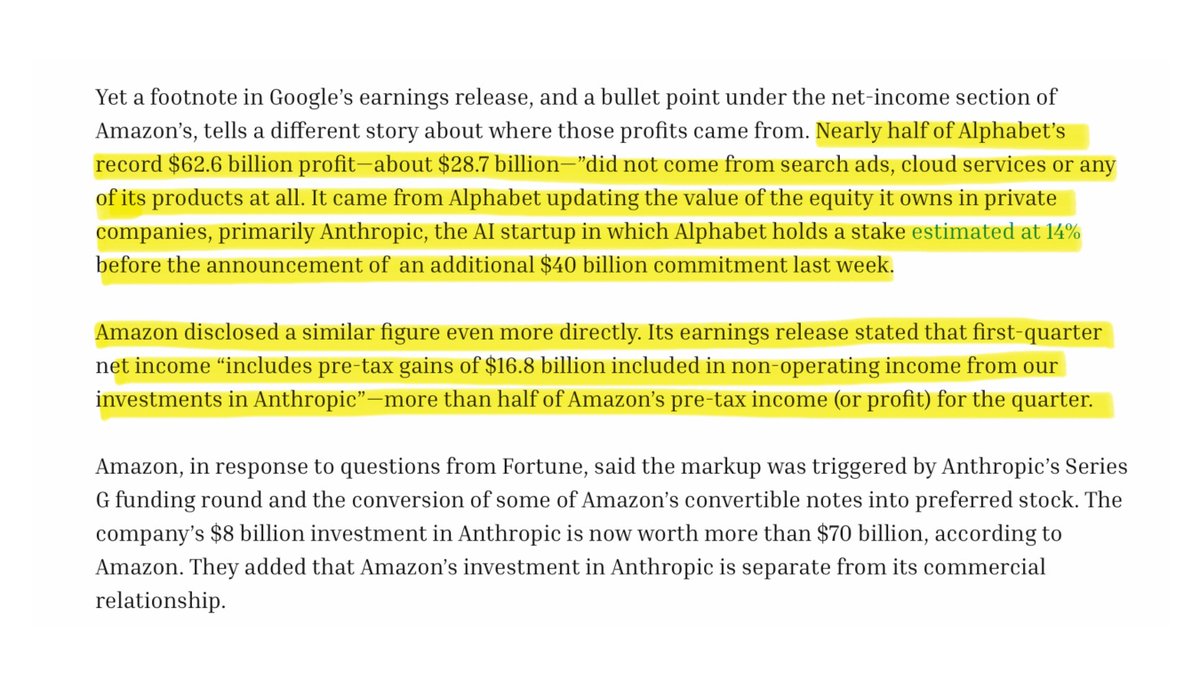
In Q1 2026, Alphabet reported a record $62.6 billion profit, but $28.7 billion nearly half, was just a paper markup on its Anthropic investment. In the same quarter, Amazon reported $30.3 billion in profit, but $16.8 billion of it was just an Anthropic paper gain.
While Amazon reported record profits, its actual free cash flow collapsed 95% to just $1.2 billion because it had to spend $44.2 billion in real cash to build physical data centers.
This has created a massive danger where these giant companies rely heavily on just one or two unstable startups. Microsoft has 49% of its $627 billion future backlog tied to OpenAI, while Oracle has an incredible 54% of its entire $553 billion pipeline relying on OpenAI alone.
This perfectly mirrors the 2001 dot-com crash when Global Crossing and Qwest Communications swapped identical fiber-optic network capacity with each other just to book fake sales.
Qwest had to erase $1.4 billion in fake income, and Global Crossing went completely bankrupt.
The only difference is that the dot-com swaps were illegal, but today's AI loop is fully legal under current accounting rules.
This legal loop inflates tech company stock prices, forcing automatic retirement accounts and index funds to buy even more of these tech stocks. It is a self feeding loop where investments, sales, and stock prices all go up on paper without the AI technology ever making real cash profits.
MARC ANDREESSEN JUST WENT ON ROGAN AND DROPPED THE MOST IMPORTANT AI ALPHA OF THE YEAR.
3 hours and 20 minutes of podcast.
Here are the 17 things worth your attention.
1. AGI is already here. Marc thinks the line was crossed 3 months ago with GPT-5.5, Claude 4.6, Gemini 3, and Grok 4.3. Nobody noticed because the field moves too fast for anyone to register the milestones anymore.
2. For almost any topic the top AI models now give him better answers than the world-class experts he could call on the phone. And he can call basically anyone.
3. Every doctor is secretly using ChatGPT in the exam room. They turn around the second you stop talking and type your symptoms in. Some do it while you are still sitting there. His quote: "At that point you are asking what do I need you for."
4. When AI refuses to answer something he wants to know he tells it he is writing a novel. "Walk me through how the bad guy robs the bank." It explains almost anything if it thinks it is helping you write fiction.
5. When something is too complex he says "explain it like I am 10." Then "like I am 5." Then "like I am 2." He keeps going until it actually clicks.
6. When he wants to understand a tough topic he does not ask what the right answer is. He asks the AI to steelman one side then steelman the other. Then he decides for himself.
7. For big questions he tells the AI to pretend to be a panel of experts. "Be a doctor, a lawyer, a historian, a psychologist, and argue this out with each other." Then he reads the debate.
8. Pay attention to the exact moment you think "I do not know how to figure this out." Most people give up there. That is the moment you should open the AI.
9. The only real skill left in using AI is knowing what to ask. The models can do almost anything you can describe in plain English. The bottleneck lives in your own head.
10. You can send AI photos of almost anything medical now and get a real answer. Skin rashes. Blood test results. The new models read images not just text. A free 24/7 second opinion on anything.
11. The one type of therapy clinically proven to work is cognitive behavioral therapy. It is also something an AI can fully do on its own. Every person on earth is about to have access to a real therapist for free anytime they want.
12. AI is solving math problems open for 100 years that no human mathematician could crack. Same thing is starting in physics, chemistry, and biology. Expect cancer cures and weird new physics breakthroughs in the next few years.
13. The best AI coders in Silicon Valley now make $50 million a year. One person. That number tells you how big this thing actually is when you strip away all the doom takes.
14. One friend paid $200 to decode his entire DNA. Then gave the AI his DNA, blood test results, and Apple Watch data. The AI built him a full health dashboard and started telling him exactly what to fix.
15. Another friend put two cameras in his home jiu jitsu gym. AI watches him spar and gives him technique notes after every round. A world-class coach at every practice for free.
16. The best programmers in Silicon Valley now run 20 AI coding bots simultaneously. Each bot writes code while they review the others. They call themselves AI vampires because going to bed means 20 workers stop and you lose money every hour you sleep.
17. The obvious next step: the bots will run their own bots. One human running 20 bots each running 20 more. One person. One laptop. 1,000 AI workers. This is months away not years.
Bookmark this before you watch the full podcast.
Follow @cyrilXBT for every AI insight worth your attention the moment it surfaces.
Anthropic CEO: "there are jobs that took generations to build that may disappear"
this is one of the best interviews I've seen in a long time
Dario Amodei talks about how to prepare for what's coming
here's what to expect:
> high GDP growth and high unemployment at the same time
> software becoming essentially free to build
> the gap between people who use AI and people who don't
the scariest part this is not a prediction, this is already happening
to stay competitive you need to adapt fast and you can't do that while ignoring AI
that's why I put together a guide on Claude features that 99% of users have no idea exist
it will completely change how you work with Claude
you can find it below
Anthropic just paid millions to hire Andrej Karpathy.
He gave you the same knowledge for $0 the same week.
Co-founder of OpenAI. Former head of AI at Tesla. The man who coined vibe coding.
No recruitment fee. No exclusive access. Just a link and 29 minutes.
LLMs are ghosts not animals.
Vibe coding is dead.
Software 3.0 is here.
Watch it.
Then read this.
Because Karpathy tells you what Software 3.0 is.
This shows you how to build one - a software factory with Claude Code that ships features while you sleep.
The full build guide is below.
🚨 BREAKING: AI can now analyze stocks like top hedge fund managers (100% free).
Here are 10 nuclear Claude prompts that completely replace $3,000/month Bloomberg terminals 💰📈
Bookmark this thread - you’ll thank yourself later 🔥
Google Cloud AI engineer just showed how they go from idea to deployed app at Google in 30-minutes using Claude.
26-minutes. free. by Google AI team.
one person + Claude + Google Cloud = a full engineering org running on a laptop.
worth more than any $500 vibe-coding course.
INSTEAD OF WATCHING NETFLIX TONIGHT.
Spend 1 hour with this.
Claude AI FULL COURSE that teaches you how to BUILD and AUTOMATE anything.
The people who watch this tonight will wake up tomorrow with a new skill.
Watch it and bookmark it now.
Are you ready to have your mind blown?
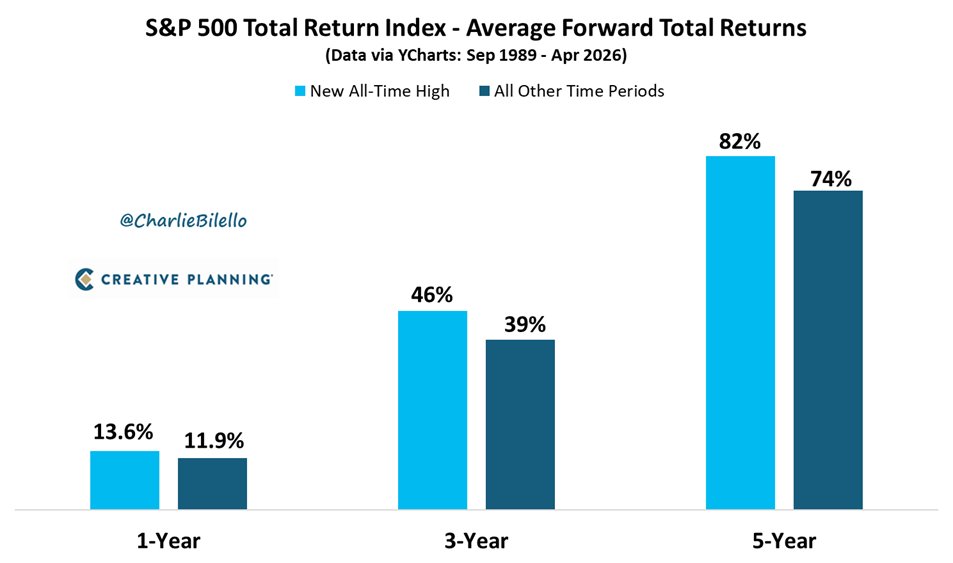
Since 1989, money invested when the market is at all-time highs has actually outperformed money invested on any given day. 🤯🤯🤯
STANLEY DRUCKENMILLER: "I SHORTED $200 MILLION OF INTERNET STOCKS IN MARCH 1999. IN THREE WEEKS I COVERED THEM AT A $600 MILLION LOSS."
"I was short 12 stocks. They all went bankrupt. Every one of them."
He was right on every single pick. Still lost $600M.
"If you're dead wrong on a long, you can lose 100%. If you're dead wrong on a short, you can lose 10 times your money."
"Frankly, I'm not sure I've ever made money in shorts. I've never had a down year, but I'm not sure I've made money in shorts. I like it. It's fun. But you can get your head handed to you."
"Don't try that at home."
For the record
Since 1928, this is the first time the S&P 500 has made a new all‑time high within 11 trading days of a 5–10% drawdown, and history around comparable V‑shaped rebounds suggests this kind of steep recovery is a continuation signal, not an exhaustion signal: in past steep V‑shapes, the “vertical” phase typically overshoots the old high and delivers roughly a 20–30% gain from the low over the first ~100 trading days, implying that if the March 22, 2026 low was near 6,300, the historical playbook points to a 100‑day S&P range of roughly 7,560–8,190 (mid‑case ~7,875), followed by positive but more trend‑like returns over the subsequent 6–12 months rather than an imminent bear market.
The upshot, you’re not bullish enough.
Have a nice day.
INSTEAD OF WATCHING NETFLIX TONIGHT.
Spend 1 hour with this.
Claude AI FULL COURSE that teaches you how to BUILD and AUTOMATE anything.
The people who watch this tonight will wake up tomorrow with a new skill.
Watch it and Bookmark it now.
Just six months ago the question of the day was whether the AI boom was turning into a bubble. Fortunately that did not happen, or the current drawdown would likely have been much bigger. Instead of the AI leaders heading into the bubble stratosphere (as CSCO did in 2000), today we see the opposite. Investors are asking the tough questions (which they don’t do in bubbles).
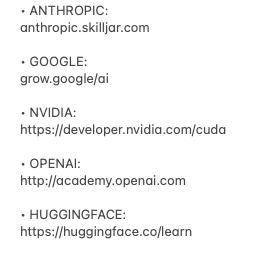
HERE'S A LIST OF AI COURSES OFFERED DIRECTLY BY AI COMPANIES
* ANTHROPIC:
https://t.co/7saVmCFtWW
* GOOGLE:
https://t.co/HMhbQBqiup
* NVIDIA:
https://t.co/OnH3PisUu3
* OPENAI:
https://t.co/rIFydWzAnc
* HUGGINGFACE:
https://t.co/sIwIc5Hbxz
BOOKMARK TO SAVE IT FOR LATER
don't worry. we are moving up and to the left. the days of 3-5% equity yields don't make sense sense if AGI is real. it isn't the safe harbor you think it is...
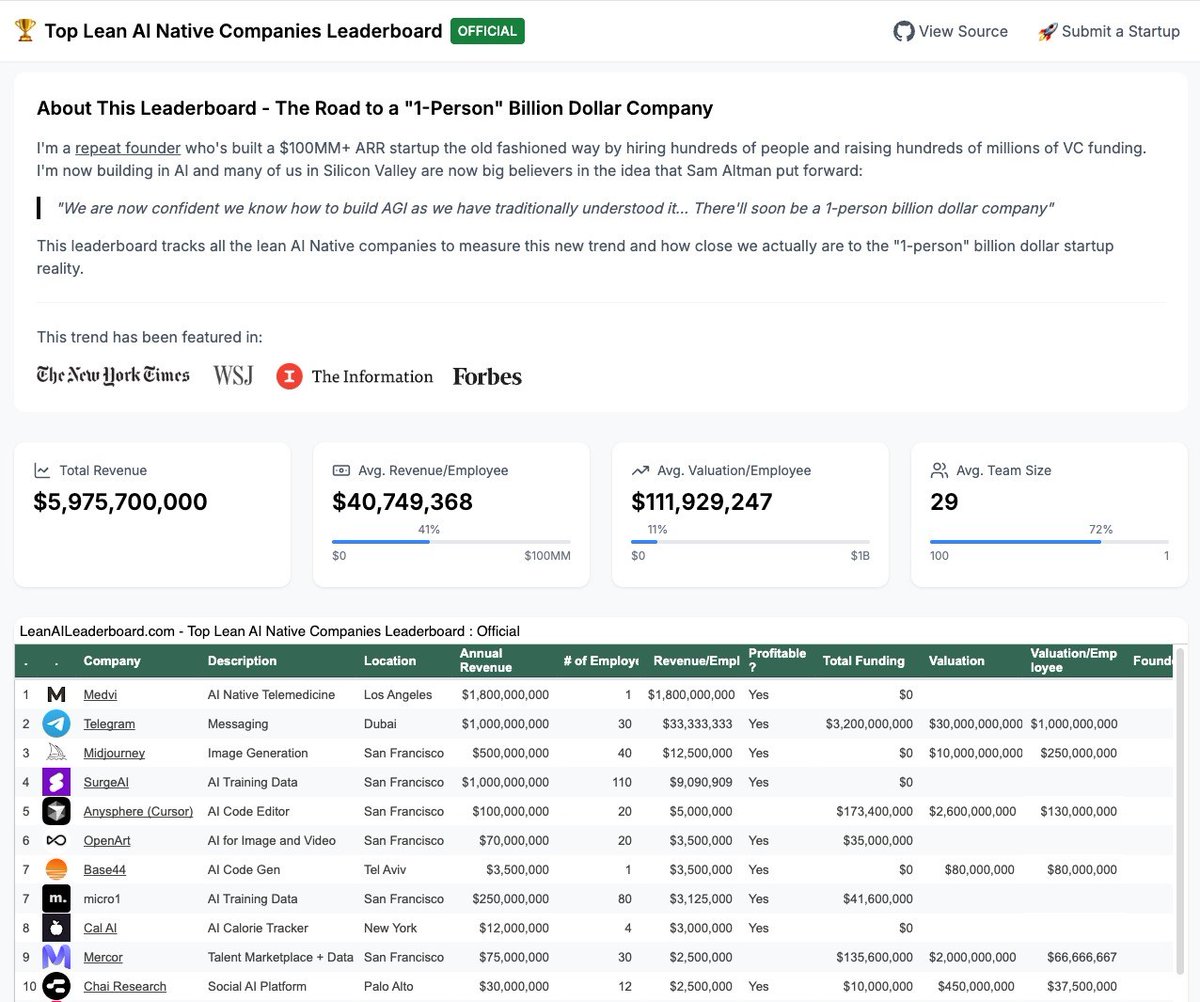
The wait is finally over. The first 1-person, 1-employee billion-dollar company is here.
It just took the #1 spot on the Lean AI Leaderboard, moving the average rev/employee from $2.5M to $40M per person (a 16x jump).
The product was built in 2 months by a 41-year-old and his brother from their house, with $20,000 and no funding.
Here's the story:
Matthew Gallagher launched Medvi, a telehealth storefront for GLP-1 weight-loss drugs in September 2024.
Within 15 months, Medvi had crossed $401M in revenue, built a customer base of 250k, and generated $65M in profit.
Each customer generates ~$200 a month. The total cost base in 2025 was $336 M ($160-200 M to the platforms and $130-170 M in marketing), putting the cost at $500-700 per customer.
With virtually zero overhead, the business made $65M in profits last year, and they are now running at a $1.8B annual run rate in 2026.
But this wasn't Matthew's first company.
Before this, he founded a company with 60 employees. It felt like progress, but the profits never came.
He realized that 60 employees only increased his costs and delayed his decision-making.
So when he started Medvi, he built it differently.
Medvi has two platforms - CareValidate and OpenLoop Health. They handle the doctors, prescriptions, pharmacies, shipping, and compliance.
Gallagher manages the customer relationship.
He built the website, ran the ads, and took customer calls on his personal cell (initially). His AI stack did the rest:
• ChatGPT, Claude, and Grok wrote the code
• Midjourney and Runway built the ads
• ElevenLabs handled voice
• Custom agents connected everything together
What's striking is that none of his tools are exclusive or hard to access. Anyone can sign up for them today.
But it wasn't completely smooth. The AI chatbot hallucinated fake prices in the early days, and he honored all of them.
But GLP-1 was just the beginning.
Men's health launched in February 2026 and pulled 50,000 customers in the first month alone.
GLP-1 aligned, chef-made meal delivery went live last month, and Women's health, hair, and skincare are next.
Sam Altman has been predicting the first 1-person billion-dollar company for years.
Nobody expected it to arrive this fast or look like this.
This is the new playbook: lean teams, rented infrastructure, AI doing the work of 50 people, and one sharp operator owning the outcome.
The only competitive advantage now is knowing your customer better and reaching them faster than anyone else.
We are right at the beginning of something extraordinary, and this is only going to accelerate from here.
Medvi and Matthew, welcome to the Lean AI Leaderboard.
The Lean AI era is officially here, and what excites me most is what it means for the next generation of founders.
The tools are accessible, and the playbook is now public.
There has never been a better time to build something extraordinary with almost nothing.